A Minardi takeover, a 2008 Monza win for Sebastian Vettel, Max Verstappen's record-breaking debut and a 2019 podium before the AlphaTauri rebrand.
Scuderia Toro Rosso was Red Bull's junior Formula One team, which raced from 2006 and was built on the former Minardi operation. Sebastian Vettel gave it its only pole and win at the 2008 Italian Grand Prix, and it was renamed Scuderia AlphaTauri in 2020.
Scuderia Toro Rosso was Red Bull's second Formula One team, a junior outfit to Red Bull Racing that raced from 2006 and was renamed Scuderia AlphaTauri in 2020. It grew out of the Minardi operation that Paul Stoddart sold in 2005, and it is best remembered for a shock win by Sebastian Vettel at the 2008 Italian Grand Prix.
How did Toro Rosso come out of Minardi?
Toro Rosso was established after Paul Stoddart sold his remaining interest in Minardi at the end of 2005 to Red Bull's owner, Dietrich Mateschitz, and the team was renamed. Red Bull took control on 1 November 2005, and the new name was chosen with care. Squadra, the Italian word for a squad like a football team, was dropped, and Scuderia, a stable for racing horses, was used instead, a term commonly applied to Italian motor racing outfits such as Ferrari.
Many Minardi fans were unhappy. More than 15,000 signed an online petition to keep the Minardi name, but it did not succeed. The deal also required the team to keep its headquarters in Faenza until at least the 2007 season, which kept the Italian heritage intact.
Minardi had been one of the least competitive teams of its era. It competed from 1985 to 2005 with a large fan base but never reached a podium, and its best finish was fourth in three races. Red Bull kept the Italian language in the name to hint at that heritage while abandoning the Minardi brand itself.
A Minardi takeover that became Red Bull's junior team, won at Monza in 2008 and reached a best of sixth overall in 2019.
What was the 2006 debut like?
Vitantonio Liuzzi and Scott Speed drove the STR1 in 2006, with Neel Jani filling the test and third driver role. Liuzzi scored the team's first point at the 2006 United States Grand Prix, and the car was a modified version of the 2005 Red Bull Racing RB1.
That design raised eyebrows. Some teams felt it infringed the Concorde Agreement, which expects each team to design its own car. Toro Rosso said the design had been produced in 2004 by Jaguar Racing, Red Bull's predecessor, and that the rights had passed to it when Jaguar Racing was sold.
Engines were a sore point too. The team used Minardi's contracted supply of 2005-spec Cosworth V10 engines rather than the new V8s, which were too expensive for smaller teams. Rivals including Super Aguri and Midland argued the concession gave too much advantage once the team was backed by Red Bull. Toro Rosso also asked for an extra 500 rpm in qualifying, but the FIA allowed only 300 rpm as the season progressed.
How did Toro Rosso win at Monza in 2008?
Toro Rosso used Ferrari V8 engines from 2007 to 2013, based on 2006-specification units. Speed was dropped after the 2007 European Grand Prix and replaced by Sebastian Vettel, a BMW Sauber development driver. The team's best results of that year came at the Chinese Grand Prix, where Vettel finished fourth and Liuzzi sixth for eight points between them.
In 2008 the team's drivers were Vettel and Sebastien Bourdais. Bourdais scored his first points with seventh place in Australia, and Vettel took fifth at Monaco. The team showed steady improvement, and at Belgium both cars ran in the top six for most of the race before wet-weather tyres pushed them back.
The big moment came at the wet Italian Grand Prix. Vettel claimed his first pole position and the first win for himself and the team. It was the first win by an Italy-based team other than Ferrari since the 1957 German Grand Prix, and Vettel beat second-placed Heikki Kovalainen by 12 seconds. Vettel then took fifth at Singapore, Formula One's first night race, while Bourdais managed 12th.
Bourdais was penalised in Japan after a collision with Felipe Massa, who had been running eighth. The 25-second penalty dropped Bourdais to 10th and promoted Massa, and Bourdais insisted he was not to blame. Vettel's final drive for the team then came in Brazil, where he overtook Lewis Hamilton, who still took the drivers' title. Vettel scored 35 of the team's 39 points that year, which helped Toro Rosso outperform its senior team on points for the first and only time in its history.
How did the team fare from 2009 to 2013?
With Vettel moving to Red Bull Racing, Sebastien Buemi and Bourdais led the 2009 challenge. Bourdais's contract was terminated on 16 July 2009 after disappointing results, and Jaime Alguersuari replaced him on 20 July. The team finished tenth and last in the championship, overtaken by Force India after its podium in Belgium. Buemi picked up points in the last two races.
Buemi and Alguersuari continued for 2010, and Alguersuari scored his first points with ninth at the Malaysian Grand Prix. In 2011 the STR6 gave Buemi four points with eighth in Australia, and Alguersuari finished seventh in Korea, the team's best race of that year. The team went through a points drought, and it failed to score for much of the season.
Daniel Ricciardo and Jean-Eric Vergne replaced them for 2012, and Franz Tost described the team as a rookie training school. Points came in the opening two rounds but then dried up until the Belgian Grand Prix, and the team finished ninth in the Constructors' Championship. James Key replaced Giorgio Ascanelli as technical director that September.
The 2013 season started slowly, but Vergne scored eight points for sixth in Canada, the team's best result since the 2008 Brazilian Grand Prix. Ricciardo's form earned him a move to Red Bull Racing for 2014, announced just before the Italian Grand Prix.
What changed with Renault engines in 2014 and 2015?
Toro Rosso signed a long-term deal with Renault for 2014, using the same specification engines as Red Bull Racing, Lotus and Caterham. Unlike its sister team, which received engines free of charge, Toro Rosso paid for its engines on a lease with limited factory support. Vergne stayed for a third season and was partnered by Daniil Kvyat, a GP3 and European Formula 3 race winner.
The team made a fine start at the Australian Grand Prix, where Vergne qualified sixth and both drivers scored. Kvyat broke Sebastian Vettel's record as the youngest points scorer in Formula One history. The season brought a run of retirements from exhaust and engine problems, and the team scored 30 points, with Vergne contributing 22 and Kvyat eight.
Then the team signed Max Verstappen, who was 16 years old, to replace Vergne for 2015. Verstappen became the youngest driver ever to compete in Formula One, at 17 years and 166 days, in a Toro Rosso at the 2015 Australian Grand Prix. Carlos Sainz Jr. partnered him, and Sainz scored two points with ninth place on his debut.
The 2015 season was the team's most successful by points. Verstappen scored two fourth places and finished with 49 points, while Sainz added 18. The breakout of Verstappen, combined with many points finishes, made it a standout year for a junior team.
How did the engine supply change in 2016 and 2017?
For 2016 Toro Rosso revived its customer partnership with Ferrari, using 2015 power units without direct factory support. The new STR11 had a longer wheelbase, because the Ferrari power unit and gearbox needed a spacer at the rear. After a controversial crash in Russia, Kvyat returned from Red Bull, and Verstappen moved up to the senior team.
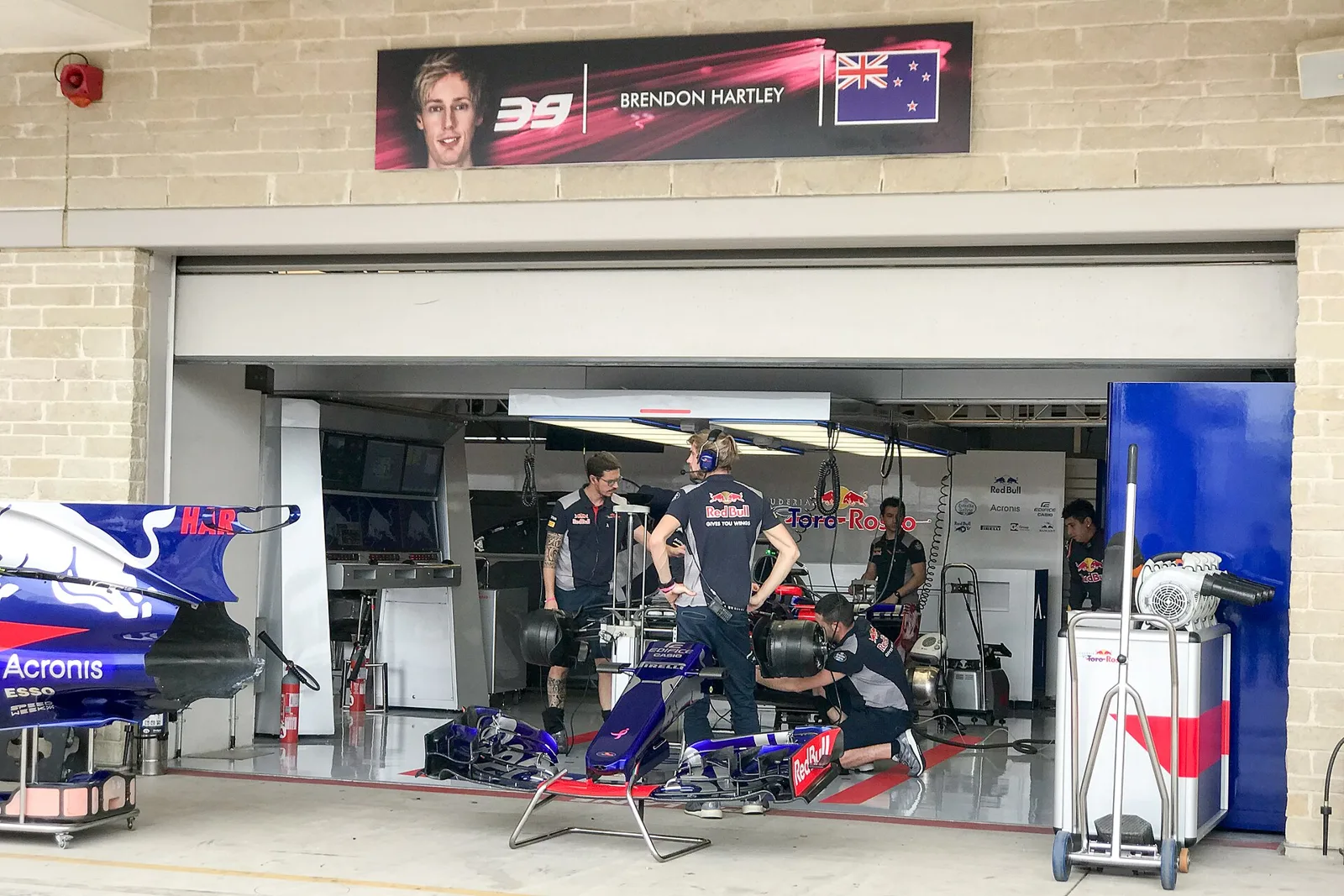
Renault supplied engines again for 2017, although the team ran Toro Rosso branding on them and received no factory support. Pierre Gasly replaced Kvyat from the Malaysian Grand Prix, and Brendon Hartley joined the team. Sainz moved to Renault for the rest of the season before his planned 2018 switch.
What did the Honda years bring in 2018 and 2019?
On 15 September 2017 the team announced it would end the Renault customer deal in favour of full-works Honda power for 2018. It was the first time the team had direct factory support and free engines. Honda staff worked at the Faenza base, and the team gained official vehicles and brand endorsements. The Honda unit had a poor reputation from its time with McLaren, but it surprised many in pre-season testing.
Gasly finished fourth at the 2018 Bahrain Grand Prix, the team's best result of the year. Hartley scored his first point at Azerbaijan and finished ninth at the United States Grand Prix, his best career result. Numerous reliability issues plagued the team, and it finished ninth in the Constructors' Championship with 33 points, 29 of them from Gasly.
For 2019 Gasly was promoted to Red Bull, and Kvyat returned to the team. Alexander Albon, the 2018 Formula 2 third-place finisher, replaced Hartley. Kvyat and Albon took third and sixth at the German Grand Prix, the team's first podium since the 2008 Italian Grand Prix. Gasly returned to the team after Albon's promotion to Red Bull and finished second at the Brazilian Grand Prix, the team's third podium.
The 2019 campaign ended with the team sixth in the Constructors' Championship on 85 points, its best points haul in its history. Only one reliability-related retirement occurred all year, compared with seven in 2018. Kvyat's ninth in the final race gave the team its 500th point.
| Season | Engines | Headline result |
|---|---|---|
| 2006 | Cosworth (Minardi supply) | Liuzzi's first point at the US Grand Prix |
| 2007 | Ferrari | Vettel fourth and Liuzzi sixth in China; eight points |
| 2008 | Ferrari | Vettel wins the Italian Grand Prix from pole; 39 points |
| 2009 | Ferrari | Tenth and last in the Constructors' Championship |
| 2012 | Ferrari | Ninth in the Constructors' Championship |
| 2014 | Renault | 30 points; Kvyat breaks Vettel's youngest-scorer record |
| 2015 | Renault | Verstappen 49 points; Sainz 18; most successful season by points |
| 2016 | Ferrari | Verstappen moves up; Kvyat returns |
| 2018 | Honda | Gasly fourth in Bahrain; ninth overall with 33 points |
| 2019 | Honda | Kvyat third and Albon sixth in Germany; sixth overall with 85 points |
Who sponsored the team?
Sport sponsorship is central to Red Bull's marketing, and Toro Rosso is one of several teams the company has rebranded. Cepsa invested in the team from 2011, a deal that ran until the end of 2015. Casio, through its Edifice brand, sponsored the team from 2016 to 2019. In 2019 the team also took on Thai-based sponsors, Moose Craft Cider and PTT Lubricants.
What is Toro Rosso's legacy?
Toro Rosso is remembered for turning a Minardi operation into a credible Formula One team. Its only pole position and only win came at Monza in 2008, and its 2019 German Grand Prix result was its best ever in terms of total points. The team also gave several drivers their chance, from Vettel and Verstappen to Sainz and Gasly.
In 2020 the team was renamed Scuderia AlphaTauri to promote Red Bull's fashion label of the same name. Its racing record from 2020 onward belongs to the AlphaTauri years and later Racing Bulls, so the Toro Rosso story closes with the end of its 2019 season.