Sebastian Vettel took his maiden Formula One win from pole at Monza, giving Toro Rosso its first Grand Prix victory in a race that began behind the safety car.
The 2008 Italian Grand Prix was a Formula One race at Monza held on 14 September 2008. Toro Rosso's Sebastian Vettel took a maiden win from pole, with Heikki Kovalainen second for McLaren and Robert Kubica third for BMW Sauber. It was the 14th race of the season.
Sebastian Vettel won the 2008 Italian Grand Prix at Monza on 14 September 2008, starting from pole position in a race that began behind the safety car. It was his first Formula One victory and gave Toro Rosso its first win in the sport. Heikki Kovalainen finished second for McLaren, and Robert Kubica took third for BMW Sauber.
Who won the 2008 Italian Grand Prix?
Sebastian Vettel won for Toro Rosso, finishing 12.5 seconds ahead of Heikki Kovalainen in a McLaren. Robert Kubica was third in a BMW Sauber, while Fernando Alonso took fourth. At 21 years and 73 days, Vettel became the sport's youngest Grand Prix winner.
The race was run in changeable weather. Heavy rain fell before the start and more was forecast through the day, and the air temperature was 14 degrees Celsius (57 Fahrenheit) at the track. The surface was very slippery when the cars lined up.
A maiden pole, a maiden win and Toro Rosso's first Grand Prix victory, all in changing Monza conditions.
Where did the title race stand before Monza?
Lewis Hamilton led the Drivers' Championship on 76 points before the race, two points ahead of Felipe Massa on 74. Ferrari led the Constructors' Championship on 131 points, with McLaren second on 119, 12 points behind. Robert Kubica was third on 58 points, and BMW Sauber stood third in the teams' table on 107 points.
At the previous race, Hamilton had been penalised for cutting a chicane to gain an advantage over Kimi Raikkonen in the closing laps. The stewards handed the win to Massa, and McLaren appealed, although the hearing was not due until 23 September. Mercedes-Benz Motorsport's vice president, Norbert Haug, admitted the disappointment was big, but he expected the setback to drive the team through the last five races.
Before Monza, Massa had said he wanted a dry track after the rain-soaked Belgian Grand Prix. Testing at the circuit in early September had suggested that the gap between McLaren and Ferrari had narrowed, and Ferrari hoped its straight-line speed would suit the long straights. On 12 September the team confirmed that Raikkonen would stay with it until at least 2010, ending speculation that he might retire.
How did practice unfold at Monza?
Three practice sessions were held, two on the Friday of 90 minutes each and one of an hour on Saturday morning, and rain affected all of them. Adrian Sutil was quickest in the first session at 1:32.842, while Kimi Raikkonen set the best time in the second at 1:23.861.
Only the second session gave teams a real chance to run on dry-weather tyres, because the track dried there. Raikkonen adapted best to the changing conditions, while Kubica placed second and his BMW teammate Nick Heidfeld third. Lewis Hamilton, Nico Rosberg and Felipe Massa rounded out the top six.
The opening session was so wet that six drivers, including both McLarens, set no time at all, and it was stopped four minutes early. Timo Glock was almost four seconds behind Sutil in that first session. The final session went to Glock at 1:35.464, with Vettel, Rosberg, Trulli, Nakajima and Heidfeld behind him. Hamilton completed only eight laps in that session and finished almost 11 seconds behind Glock.
How did qualifying shape the grid?
Sebastian Vettel took pole position in very wet conditions with a time of 1:37.555, becoming the youngest driver to start from pole in Formula One history. Heikki Kovalainen lined up alongside him on the front row, while Mark Webber qualified third and Felipe Massa sixth.
Qualifying ran in three parts. The first lasted 20 minutes and eliminated cars finishing 16th or lower, while the 15-minute second part removed positions 11 to 15. The final part set positions one to ten, and cars that took part in it could not refuel before the race, so they carried more fuel than in the earlier sessions.
Robert Kubica blamed late rain in the second session for qualifying 11th. Giancarlo Fisichella took 12th for Force India, the team's best grid position of the season. Raikkonen and Hamilton both put their 14th and 15th places down to a late entry into the second session.
Hamilton had first run standard wets, and the rain had intensified by the time he moved to extreme wets. It was the first time in his career that he had failed to reach the final qualifying session. The result was also McLaren's only qualifying placing outside the top ten all season.
What happened during the 2008 Italian Grand Prix race?
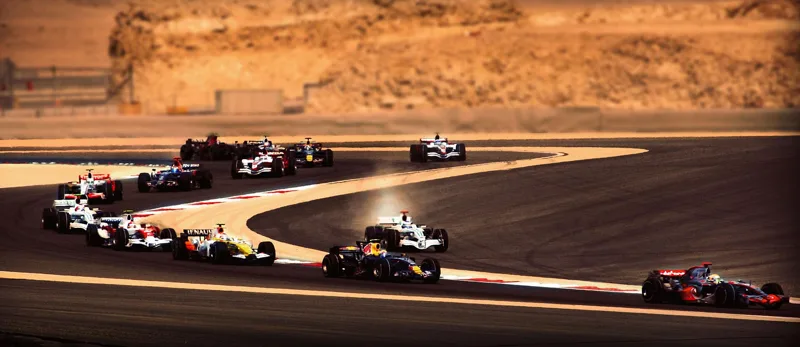
The race started at 14:00 local time behind the safety car, because heavy rain had made the track very slippery. The safety car came in at the end of lap two, and Vettel led into the first corner. He opened a lead that reached 6.3 seconds by lap eight.
Jenson Button and Kazuki Nakajima started from the pit lane after changing their set-ups from qualifying. Sebastien Bourdais stalled on the grid, and his team pushed the car back to the pits, where he rejoined last and a lap down. Vettel quickly opened a two-second lead over Kovalainen, who was hampered by spray thrown off the back of the Toro Rosso.
Fernando Alonso regained seventh from Glock on lap four, as the surface started to dry. Raikkonen and Hamilton passed David Coulthard on the same lap to move into 12th and 13th. On lap five Hamilton tried to pass Raikkonen at the third corner, overshot and cut the chicane. He gave the place back straight away, which kept him clear of a penalty.
Hamilton then took 11th from Raikkonen on lap 11 by outbraking him at turn four. Fisichella's race ended two laps later, when he collided with Coulthard. The front wing of his Force India broke loose and lodged under the car, and he spun into the gravel at turn nine. Massa had passed Nico Rosberg for fourth on the same lap and consolidated that position on lap 15.
Hamilton worked past Heidfeld, Glock, Kubica and Alonso one at a time to reach seventh by lap 19. Vettel pitted from the lead on lap 18, and Kovalainen, Webber and Massa followed four laps later. Light rain fell for five minutes on lap 26.
Coulthard was the first to fit intermediate tyres, pitting on lap 28, but the wet surface caught him out and he ran straight through the first chicane. Several cars followed soon afterwards. Alonso, Heidfeld, Kubica and Piquet made their only stops of the race, switching to intermediates, and most of the field had switched to them by lap 36.
Massa passed Webber at turn eight on lap 35, and Webber spun but kept seventh. A lap later Hamilton outbraked him at turn three and dropped the Red Bull driver to eighth. Hamilton then set the quickest lap at that stage, a 1:32.869 on lap 38 which was over a second quicker than Vettel.
On lap 45 three drivers set consecutive fastest laps. Kubica's time was beaten by Webber, and Raikkonen then went quicker still with 1:31.691. On lap 49 Hamilton and Webber touched wheels at the first chicane, and Webber was pushed onto the escape road before he handed the place back.
Late in the race Nakajima made a move on Coulthard at turn nine, and the contact sent the Red Bull into the gravel trap. Coulthard then pitted for a replacement front wing and fell to 17th. Raikkonen passed Coulthard and Piquet to take ninth.
Vettel crossed the line on lap 53, 12.5 seconds ahead of Kovalainen. Kubica and Alonso, both on one-stop strategies, finished third and fourth. Heidfeld, Massa, Hamilton and Webber completed the top eight, and Raikkonen finished ninth after setting the fastest lap of the race, 1:28.047, on the final lap.
Why did Toro Rosso's win matter?
It was Toro Rosso's first Grand Prix win, and the first victory for a non-Ferrari Italian-based team since 1957. The team had raced as Minardi, a side that rarely scored points, so the result carried strong emotion for staff who had been there in those years.
The result also set a record, because Vettel was the youngest winner the sport had seen. Max Verstappen later beat that mark in 2016, when he was 18 years and 228 days old at the Spanish race. Toro Rosso won despite running a 2007-specification engine, and Ferrari supplied the engines it used.
How did the drivers and team react?
Vettel acknowledged his team and said the set-up of the car suited the way the race developed. Hamilton said that with so much pressure it was easier to make mistakes, and that Vettel had not made any, so he congratulated him.
Stefano Domenicali, Ferrari's team principal, praised Toro Rosso, saying the team deserved the win and was close to Ferrari. Kovalainen was disappointed with second, because he had struggled early with the extreme wets and with brakes that took time to warm up. Hamilton described his afternoon as damage control, because he had taken points and kept his lead.
Massa had hoped to do better, but he said he had made up a point on his nearest rival. Kubica said his single stop let him make the most of changing track conditions, and that racing in Italy was special because he had lived there for five years. His helmet was split into Italian and Polish colours. Alonso called the result very good, as Monza had been the race the team looked forward to least.
What were the top finishers at Monza?
| Position | Driver | Team | Notes |
|---|---|---|---|
| 1 | Sebastian Vettel | Toro Rosso | Pole; maiden win at 21 years 73 days |
| 2 | Heikki Kovalainen | McLaren | 12.5 seconds behind the winner |
| 3 | Robert Kubica | BMW Sauber | Started 11th; one stop |
| 4 | Fernando Alonso | Renault | Started eighth; one stop |
| 5 | Nick Heidfeld | BMW Sauber | Kubica's teammate |
| 6 | Felipe Massa | Ferrari | Three points |
| 7 | Lewis Hamilton | McLaren | Started 15th; two points |
| 8 | Mark Webber | Red Bull | Started third |
| 9 | Kimi Raikkonen | Ferrari | Started 14th; fastest lap 1:28.047 |
Why does the 2008 Italian Grand Prix still matter?
The race is notable for Vettel's record as the youngest Grand Prix winner and for Toro Rosso's first victory. It also moved both title fights, as Massa and Kovalainen each cut into the leaders' advantage at Monza.
After the race Hamilton still led the Drivers' Championship, but only by one point, with four races remaining. The track conditions shaped almost every decision in the race, from the rolling start behind the safety car to the late switch to intermediate tyres.