How production cars raced on American ovals became purpose-built silhouette machines, with engine limits, aero battles and NASCAR's rise along the way.
Stock car racing grew from Prohibition-era moonshine running into a sport of purpose-built cars that look like road models. NASCAR, founded in 1948, governs the sport in America, and its Cup Series is the top national championship. Its cars now race on ovals across the country at speeds above 200 mph.
The sport is staged on ovals and on road circuits, and its name comes from the production cars it first used. Today the cars are built specifically for racing, and the largest governing body is NASCAR, whose Cup Series is the premier top-level championship. The sport has grown from Prohibition-era moonshine runners into a major spectator event in the United States.
What is a stock car?
In the original meaning, a stock car is a road car left in factory trim. Over time the term came to describe any production-based car used in racing. It is still used to separate those cars from a race car, which is a custom-built machine designed only for competition.
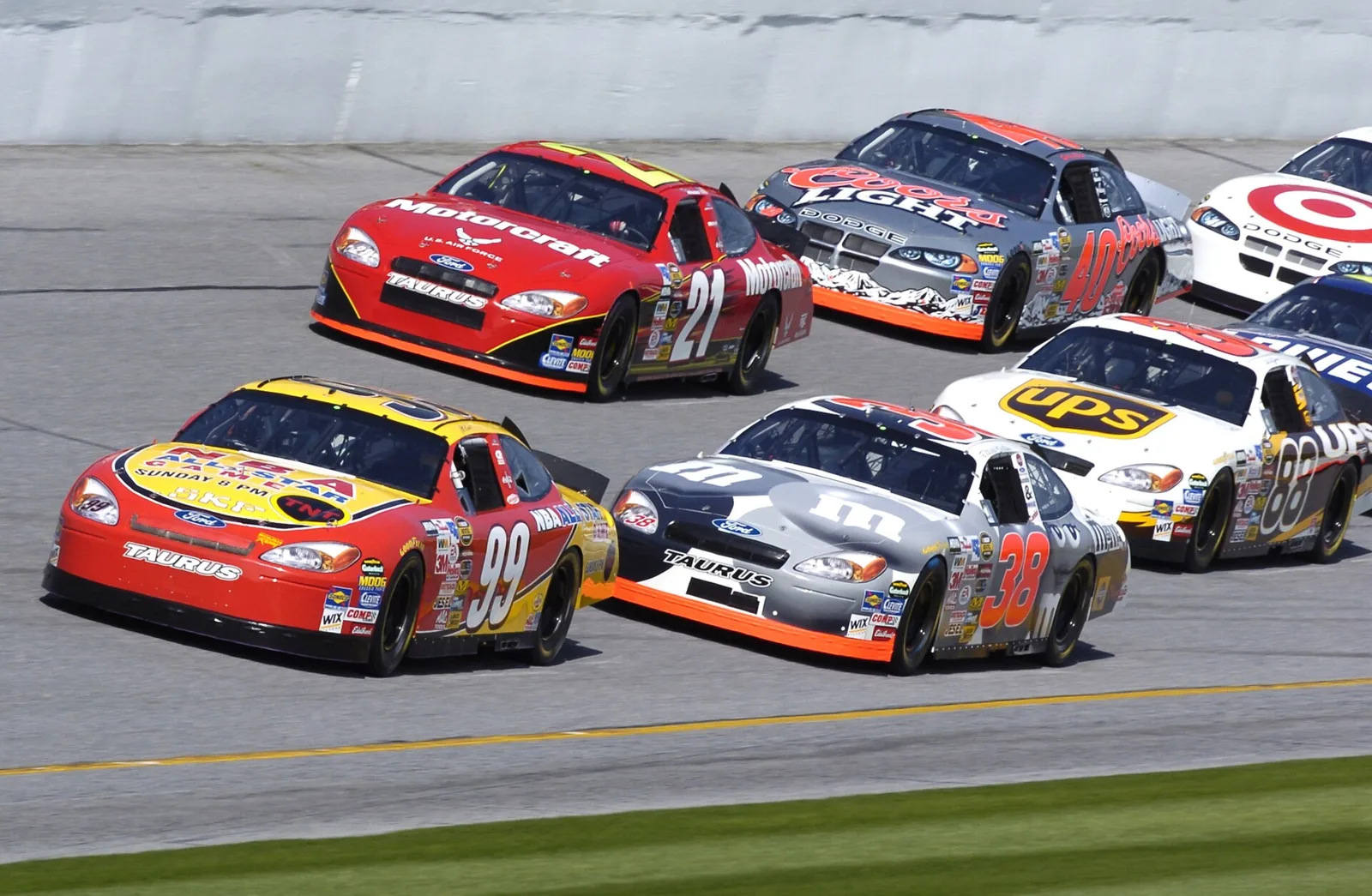
Most American stock cars now look like ordinary family sedans, but they are really silhouette cars. They are purpose-built racing machines that follow strict rules, so the chassis, suspension and engine are architecturally identical to those in production vehicles. NASCAR Cup Series cars, for example, now require fuel injection.
The idea has spread far beyond the United States. Canada, Mexico, Brazil, Argentina and Chile all have their own forms of stock car racing, and Australia, New Zealand and Britain run versions too. In Britain and New Zealand the term refers to a formula that looks very different from any road car.
Stock cars began as factory cars and became purpose-built machines, shaped more by rules than by any single driver.
Where did stock car racing begin?
The sport's roots lie in Prohibition-era moonshine runners of the 1920s, who had to outrun the authorities. They upgraded their cars while keeping them looking ordinary, then began running together and challenging one another. By the early 1930s this had become organised competition, although the lack of common rules across tracks was a constant problem.
Bill France Sr. saw that problem and called a meeting at the Streamline Hotel to set up an organisation that would unify the rules. NASCAR was founded in 1948 to govern the sport in the United States, and entrants had to use parts sold to ordinary buyers through dealers.
The homologation rule was stricter still. Each model needed more than 500 sales to the public, a requirement later copied by other series. In the early years drivers frequently drove their race cars to events themselves, so close were they to road cars.
How did the 1950s shape the cars?
Oldsmobile's Rocket V-8 of 1949, at 303 cu in (5.0 L), is generally credited as the first postwar overhead valve engine sold to the public. Oldsmobile sold well in 1949 and 1950, and rival manufacturers noticed the higher sales of its 88. The slogan of the era was, roughly, race on Sunday and sell on Monday.
Winning was not only a matter of power. The Hudson Hornet, a low-slung car with an aerodynamic body, won three title seasons running, from 1951 to 1953, using a 308 cu in inline six with an old-style flathead design. That showed there was more to winning than a larger engine.
Once the Korean War ended in 1953, an economic boom followed and buyers wanted stronger engines straight away. In the same year NASCAR recommended that drivers add roll bars, although it did not require them. In 1957 the Automobile Manufacturers Association barred carmakers from promoting race victories and from backing teams directly, arguing that racing encouraged reckless street driving.
| Year | Milestone | Figure |
|---|---|---|
| 1949 | Oldsmobile Rocket V-8 becomes a public engine | 303 cu in (5.0 L) |
| 1951 to 1953 | Hudson Hornet wins three seasons in a row | 308 cu in inline six |
| 1963 | Engine displacement limit set | 7.0 liters (427 cu in) |
| 1969 | David Pearson qualifies over 190 mph at Daytona | 190.029 mph (305.822 km/h) |
| 1971 | Aero-car displacement cut | 305 cu in (5.0 L) |
| 1987 | Bill Elliott's qualifying lap at Talladega | 212.809 mph (342.483 km/h) |
| 2007 | Russ Wicks sets a stock car speed record at Bonneville | 244.9 mph (394.1 km/h) |
| 2015 | Cup Series power output range | 750-800 hp (560-600 kW) |
What changed when the engine limit arrived in 1963?
The desire for faster cars within the homologation rules led carmakers to build limited-production special editions based on high-volume models. Manufacturers were also willing to produce larger engines, and the 1963 season capped engines at 7.0 liters (427 cu in), with only two valves per cylinder.
Ford took full advantage: it sold enough sport-roof Galaxies to meet the stock rule, and its FE block, opened out to the new ceiling, put the top five finishers in Fords. Chrysler's Max Wedge 426 could not keep pace, and General Motors finally abandoned compliance with the 1957 ban that year, letting Chevrolet produce its ZO6 427.
In 1965 Ford fitted a pair of single overhead cams to its FE 427 V8, producing the Cammer for higher revs. NASCAR then required a single cam-in-block for all its engines, but the FE 427 still won races without the Cammer.
How did the aero war of the late 1960s unfold?
Chrysler brought back the 426 Hemi in 1966 and fitted it to the Dodge Charger, a fastback with a sharply sloped rear window. David Pearson took the championship that year. Richard Petty then dominated 1967 with 27 wins from 48 starts, 10 of them consecutive, in the boxier Plymouth Belvedere.
The 1969 Torino Talladega had enough aerodynamic improvements to be faster than the 1968 Torino without other changes. Its extended nose and reshaped rockers were part of the package, and the Boss 429 replaced the 427 partway through the season. Ford had already won six straight Manufacturer Championships from 1963, and by the end of 1969 it made it seven in a row.
Petty had grown tired of winning races without the title, and after seeing Ford's new Talladega and Boss 429 he signed a lucrative deal with the company. At Daytona, Pearson's 427-powered Torino Cobra became the first car to exceed 190 mph in qualifying. Donnie Allison led most of the race, 84 laps in all, and LeeRoy Yarbrough chased down Charlie Glotzbach, who had built an 11-second cushion. Yarbrough's last-lap pass was the first time a Daytona 500 had been won that way.
Dodge answered with the Dodge Daytona, which added a pointed nose similar to the 1962 Ford Mustang I prototype. The shape needed a wing for stability above 180 mph (290 km/h). It never won a Daytona 500, but it was a significant improvement on the Charger 500.
Why were the aero cars restricted in 1970 and 1971?
NASCAR worried that the rising speeds were beyond what tyres of the day could handle, and that crashes would become more frequent. The 1970 homologation rules therefore required one car for every two US dealers to be built for sale, in an attempt to delay aero bodies until tyres improved.
Plymouth built over 1,920 Superbirds to qualify, and the 1969 Daytona was raced in 1970. Bobby Isaac won the 1970 championship in a Daytona. NASCAR then capped the aero cars, which included the Talladega, the Spoiler II and the Superbird, limited to 305 cu in (5.0 L) at the start of 1971.
Most teams abandoned the aero bodies for conventional shapes, and the big 7.0 liter units were replaced by 358 cu in (5.9 L) small blocks. Restrictor plates were also introduced to cap top speeds. The aim was to make the series a test of drivers rather than of car technology.
How did sponsorship change the sport?
In 1972 R.J. Reynolds, the tobacco company, became the major sponsor and renamed the top series the Winston Cup. Its financial contribution was far larger than that of earlier sponsors, and Richard Petty's STP deal set new standards for what teams could earn. The sudden flood of money transformed the way the sport worked.
The 1973 oil crisis then left large displacement homologation cars of every make unsold. Through the 1970s and until 1991, the factory sheetmetal over a racing frame meant that the cars looked much like their street versions.
How far have modern stock cars moved from production?
The change came in 1992, when grounded spoilers and a sleeker shape marked the start of non-stock sheetmetal. From that point stock cars were allowed to differ greatly from anything on sale. Today's racing cars keep the stock name but little else: their body is a loose template borrowed from current models, and their chassis have almost nothing in common with road cars.
NASCAR and the manufacturers recognised the problem. The Gen 4 car ran from 1992 to 2007 and the Car of Tomorrow from 2007 to 2012. From 2013 the four makers, Chevrolet, Dodge, Ford and Toyota, redrew their racing bodywork to look more like road models.
Which series sit beneath the Cup Series?
NASCAR runs three national touring series. The Cup Series is the most prominent and the most watched, with the O'Reilly Auto Parts Series as the second national series. It serves as the main feeder for the Cup, much as Formula Two feeds Formula One, and many current Cup drivers raced in it before moving up. The Craftsman Truck Series, which began in 1995, is the third.
The Truck Series was the idea of Ken Clapp, a NASCAR West Coast executive inspired by off-road truck racing. Its bodies are pickup trucks, but it is still treated as a stock car series. The Automobile Racing Club of America began in 1953 as a Midwest regional championship and came under NASCAR ownership in early 2018.
The reach of the top series is striking. The Cup Series drew over 6 million spectators in 1997, with an average live audience of more than 190,000 for each race. In 2002, 17 of the 20 top US sporting events by attendance were stock car races.
Which local classes sit below the national series?
Modified stock cars sit somewhere between open wheel cars and stock cars. Their rear wheels are covered, but the front wheels and engine are exposed. Modified racing grew in popularity after the Second World War, and in many regions on the east coast it is the highest class of local stock car racing.
Late models are usually the top local class in many other areas. Rules vary from region to region and even track to track, so a car legal in one series may need changes before it can race in another. Several sanctioning bodies run their own late model rule books, and the national late model series that began on the east coast later became the Busch Series.
How do the tracks shape the racing?
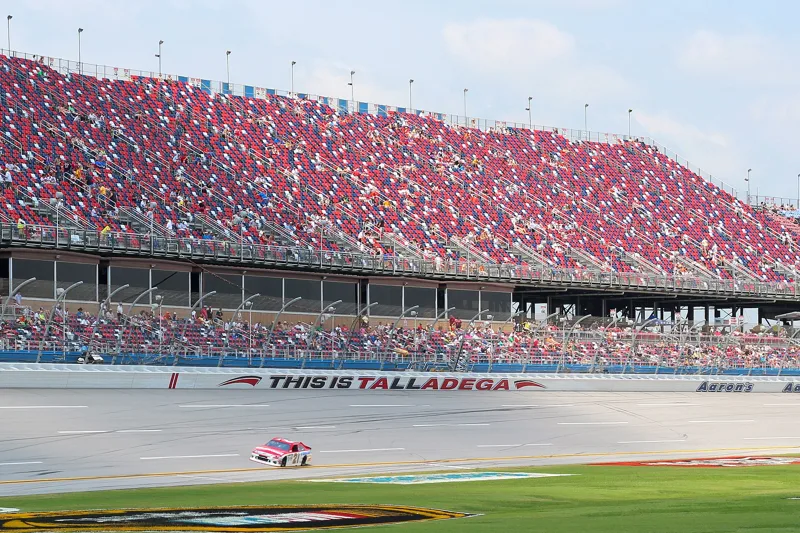
Stock car races take place mostly on ovals with three or four turns, all to the left. Short tracks are under 1 mile, intermediate tracks run from 1 to 2 miles, and superspeedways are over 2 miles. Speeds vary widely, from about 90 mph (140 km/h) at Martinsville to more than 200 mph (320 km/h) at Talladega.
In 1987, at Talladega, Bill Elliott qualified at 212.809 mph (342.483 km/h). Bobby Allison's car went airborne into the catch-fence and injured fans, and NASCAR responded with power-reducing measures, including mandatory restrictor plates. That response became known as restrictor plate racing.
Contact is also part of the sport. Bumping is part of the culture: unlike most racing series, stock car racing tolerates light contact, and the bodywork is built to shrug off superficial damage. Drafting, where a driver follows closely to benefit from the car ahead, is credited to Junior Johnson, who found it during his victory at the 1960 Daytona 500.
What do other countries race?
Canada's stock car racing dates back to amateur events in the 1950s, and official structured competition began when CASCAR was founded in 1981. NASCAR bought the league in 2006, and it became the NASCAR Canada Series. Brazil's BRB Stock Car Pro Series runs grids of 30 or more cars, although its races are not held on ovals, which makes them closer to touring car racing.
In Australia, AUSCAR had a following through the late 1980s and 1990s, but the Australian Superspeedway series closed after 2001 as the Supercars Championship took most of the competitors and the sponsorship. In New Zealand the cars are built to a rigid design with strong steel guards, and the top Superstock class runs V8s of as much as 4.1 litres (248 cu in).
What is the legacy of stock car racing?
Stock car racing has moved a long way from its moonshine beginnings. Its engineering stories, from the Oldsmobile V8 to the restrictor plates of the 1970s, show how rules and manufacturers shaped the cars more than any single driver did.
The sport still draws its character from production roots. The name survives even though the cars are purpose-built, and the rules are still designed to keep the racing close while the engines are kept under control.