A South Carolina driver who started in 1960, won three Cup championships and built a race record that ranks second only to Richard Petty.
David Pearson, nicknamed the Silver Fox, raced in NASCAR's top series from 1960 to 1986. He won three Cup championships and 105 races, and he is remembered for his Wood Brothers years and his rivalry with Richard Petty.
Between 1960 and 1986, David Pearson competed in NASCAR's premier division as a driver and team owner. He won three Cup championships, in 1966, 1968 and 1969, and he holds the second-highest career win total in the sport with 105 victories. Known as The Fox and later the Silver Fox, he could win on almost any type of track.
Where did David Pearson grow up?
Pearson was born on December 22, 1934, near Spartanburg, South Carolina. As a boy he climbed a tree beside the Spartanburg Fairgrounds to watch the stock car races, and he decided then that cars would be his life's work. He later worked with his brother in a car body repair shop and used the money to buy a Ford coach.
He stripped the fenders from that coach to make a street rod and jumped it over ditches until it rolled. His mother paid him to scrap it, and he put the money into another car. In 1952 he raced a 1940 Ford on dirt tracks and won $30 in an outlaw class race. His winning ways drew the attention of Spartanburg's racing community, including Joe Littlejohn.
Three titles, 105 wins and a Daytona 500 won across the infield grass: the Silver Fox raced on his own terms.
How did Pearson's NASCAR career begin?
Pearson began racing in NASCAR's Grand National series in 1960, after winning the 1959 track championship at Greenville-Pickens Speedway. He started 22 events that season, finished 23rd in points and was named the 1960 Rookie of the Year. He ran a second at Gamecock Speedway and a fourth at Hickory Motor Speedway during that first year.
Car builder Ray Fox gave him his big break in 1961. Darel Dieringer was unavailable for the inaugural World 600 at Charlotte because of a contract dispute, and Littlejohn recommended Pearson. Pearson qualified third fastest behind Richard Petty and Joe Weatherly, led after the first round of pit stops and held the lead for most of the race. A blown tyre with two laps to go nearly cost him the win, but he nursed the car home at about 20 miles per hour to take the victory.
That season he also won the Firecracker 250 at Daytona and the Dixie 400 at Atlanta, and he finished thirteenth in points after starting nineteen races.
When did Pearson win his first championship?
Pearson's first title came in 1966, his second full season of racing on the tour. He won fifteen of the 49 events that year, the second-highest win count in NASCAR history at the time. Four straight wins at the start of the season set the tone, and he added victories at Richmond, Bowman Gray Stadium and a second Richmond race before the year ended.
The years before that were more uneven. In 1962 he started only twelve of 53 events and still finished tenth in points. In 1963 he drove for Cotton Owens and finished sixth. In 1964 he won eight races, including at Richmond and Hickory, and finished third in a championship that Richard Petty won for the first time.
| Season | Team | Championship result |
|---|---|---|
| 1960 | Self-owned car | Rookie of the Year, 23rd in points |
| 1961 | Ray Fox | Three wins, 13th in points |
| 1964 | Cotton Owens | Eight wins, third in points |
| 1965 | Mixed programme | Fortieth in points after the Mopar ban |
| 1966 | Full schedule | Champion with fifteen wins from 49 events |
| 1967 | Holman Moody | Seventh in points |
| 1968 | Holman Moody | Champion with sixteen wins |
| 1969 | Full schedule | Champion, tied with Lee Petty for most titles |
| 1973 | Wood Brothers | Driver of the Year, eleven wins |
| 1976 | Wood Brothers | Ten wins, ninth in points |
| 1980 | Hoss Ellington | Final Cup win, 37th in points |
Why was 1965 a difficult year?
NASCAR banned the Mopar Hemi engine in 1965, and Pearson and Richard Petty skipped many races rather than run an uncompetitive engine against Ford and Mercury drivers. Both spent time in drag racing instead. For Owens he ran a Dodge Dart station wagon nicknamed the Cotton Picker, but the year still cost him points.
NASCAR owner Bill France Sr. later adjusted the engine rules and brought Mopar drivers back. Pearson competed in fourteen of 55 events and won two of the final 21 races at Columbia and Richmond, and he finished fortieth in the points.
How did the 1968 and 1969 titles unfold?
The 1968 season was a close fight. Pearson and Petty each won sixteen races, and Pearson took the title while Petty finished third in points. He ran most of the year for Holman-Moody, winning at Bristol, Richmond, North Wilkesboro and Darlington, among others, and he added twelve poles.
His third and final championship followed in 1969. The title drew him level with Lee Petty at three championships, and it was an early sign of the record that Richard Petty, Dale Earnhardt and Jimmie Johnson would later share at seven titles apiece. At the 1969 Daytona 500 Pearson became the first driver to qualify faster than 190 miles per hour, at 190.029 mph (305.822 km/h).
He finished the season with 51 starts, eleven wins, 42 top-five finishes and 44 top tens. He earned a record $229,760 in prize money and completed 14,270 laps, the most laps ever run in a single Cup season. He was also one of eleven drivers who boycotted the first race at Talladega over tyre concerns.
What made the Wood Brothers years so successful?
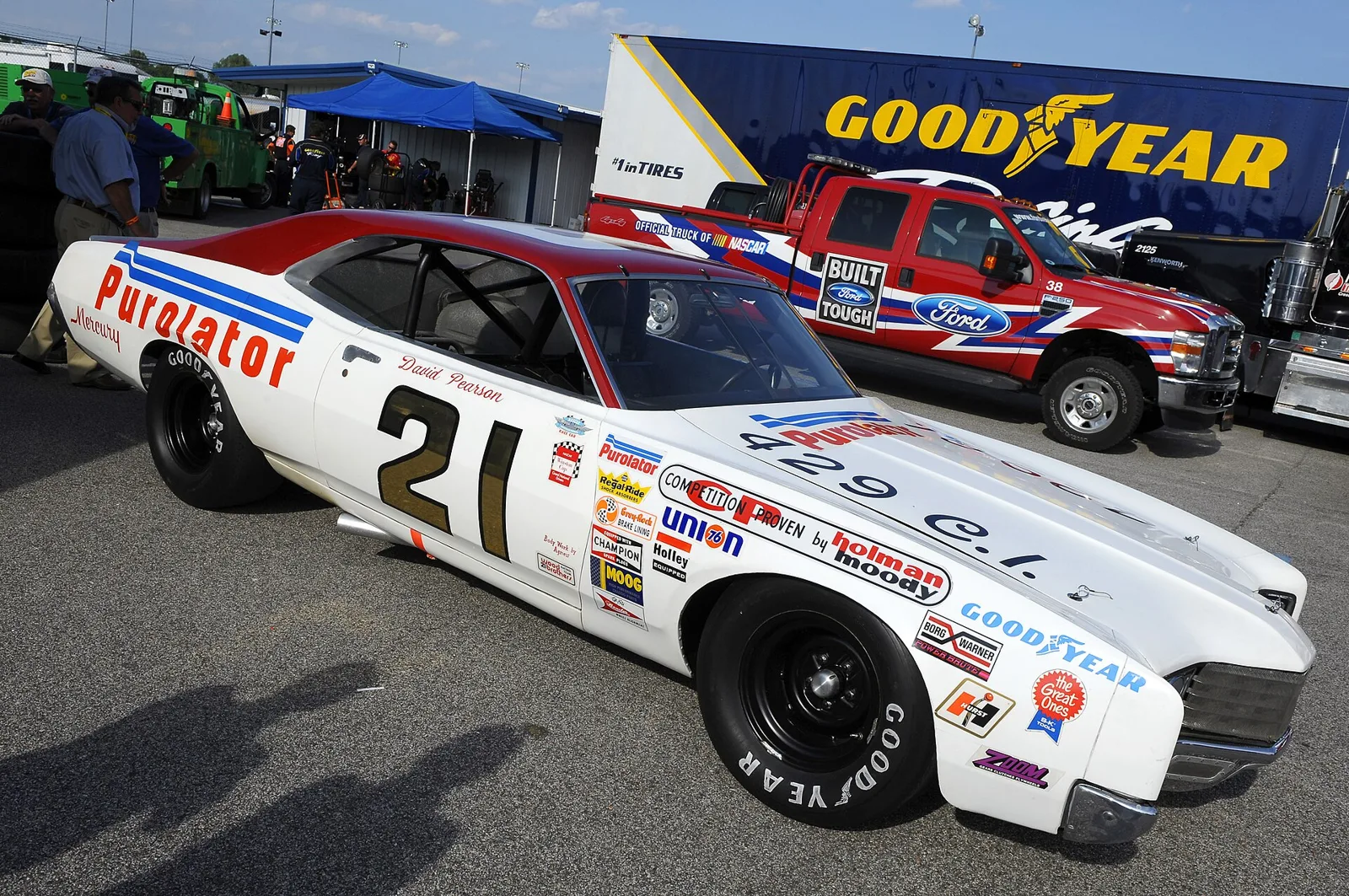
Pearson joined the Wood Brothers in 1972 after splitting with Holman Moody in 1971, when he refused a 10 percent pay cut. He won six races that first year and finished twentieth in points. At the Winston 500 at Talladega he was racing Bobby Isaac and Buddy Baker at the finish when Jimmy Crawford spun into Isaac, and Pearson took the win.
The 1973 season was his most dominant. He started only 18 of the 28 races but was named NASCAR's Driver of the Year after finishing eighth in points. Those eleven victories in 18 starts gave him a 61 percent win rate, which remains the highest in NASCAR history. At the first Rockingham event he led 499 of the 500 miles and gave up the lead only for a pit stop.
The 1974 season brought seven wins and a third-place points finish, and the Silver Fox nickname took hold. At the Firecracker 400 Pearson slowed on the final lap as if his engine had failed, then slingshot past Richard Petty at the line to win by a car length. He won the Winston 500 that year by 0.17 seconds over Benny Parsons.
What was the 1976 Daytona 500 finish?
The 1976 Daytona 500 is remembered for the final lap battle between Pearson and Richard Petty. Petty led by a couple of car lengths going into the last lap, and Pearson tried a slingshot pass on the back straight. His car pushed high into the final turn, Petty edged under him, and both cars spun into the infield grass about 100 feet (30 meters) short of the line.
Pearson steered his Wood Brothers Mercury across the infield and over the line, his lone Daytona 500 victory. He also won ten races that season, a series best, yet he finished ninth in points because he ran only 22 of 30 events.
How did the rivalry with Richard Petty shape Pearson's career?
Pearson's career ran alongside Richard Petty's, and the two men account for 63 first- or second-place finishes between them, with the edge going to Pearson. Petty had 200 wins in 1,184 starts, while Pearson had 105 wins in 574 starts. Petty said Pearson could beat him on any type of track, and that losing to Pearson hurt less than losing to others.
Pearson said he always felt that beating Petty meant beating the best, and Petty believed Pearson might have reached 200 wins himself with a full schedule. Pearson's own record includes 113 pole positions, and he had at least one top-ten finish in each of his 27 seasons.
What happened to Pearson in the late 1970s and 1980s?
In 1979 Pearson's time with the Wood Brothers ended after a pit stop mistake in his final race at Darlington. He left the pits before the crew had finished the lug nuts, and the tyres came off as he reached the end of pit lane, and he quit the team afterwards. He had won 43 races for them between 1972 and 1979.
He stepped in for Rod Osterlund's injured driver Dale Earnhardt that year and took the pole at Michigan and won the 1979 Southern 500. Fans voted him NASCAR's Most Popular Driver. In 1980 he raced for Hoss Ellington and won the rain-shortened CRC Chemicals Rebel 500 at Darlington, his final Cup victory.
From 1981 he drove part-time for several owners. He also ran a few Busch Grand National races in 1982, finishing second at Bristol and winning at North Carolina. His final season in NASCAR was 1986, when he drove his own car in two events. He ended his career with a tenth-place finish at Michigan in August.
Pearson planned a comeback in 1989 to fill in for the hurt Neil Bonnett in the Wood Brothers' No. 21 at Charlotte. Neck and back pain after testing ended the idea, and Tommy Ellis drove the car in the race.
How was Pearson honoured after his career?
Pearson was inducted into the National Motor Sports Press Association Hall of Fame in 1991 and into the Motorsports Hall of Fame of America and the International Motorsports Hall of Fame in 1993. He was added to the Charlotte Motor Speedway Court of Legends in 1998. In 1999 Sports Illustrated polled 40 NASCAR insiders and named him the Top Stock Car Driver of the Twentieth Century.
He was nominated for the first NASCAR Hall of Fame class in 2009 and missed the 2010 class by a single vote. In 2010 he was named to the 2011 class, receiving votes from 50 of 53 voters, and he was inducted on May 23, 2011.
What was Pearson's family life like?
His wife Helen Ruth died in 1991, and he had three sons: Larry, Ricky and Eddie. Larry raced in NASCAR and won the Busch Series championship in 1986 and 1987. Ricky worked as general manager and crew chief for Buckshot Racing, which claimed two Busch wins.
In December 2014 Pearson had a mild stroke that left the left half of his body partly paralysed, and he recovered. He died on November 12, 2018, in Spartanburg at the age of 83. No cause of death was given.