A New York road course that hosted the United States Grand Prix for twenty seasons, nearly closed in 1981 and was revived as a NASCAR-owned circuit.
Watkins Glen International, usually called The Glen, is a road course at Dix, New York. It staged the United States Grand Prix for twenty consecutive years from 1961 to 1980, and NASCAR owns it today. The current Boot layout measures 3.377 mi (5.435 km).
The Glen, as Watkins Glen International is known, sits in Dix, New York, at the southern end of Seneca Lake. From 1961 to 1980 it staged the Formula One United States Grand Prix for twenty straight seasons, and its road racing history spans nearly every category of the sport. NASCAR now owns the facility, and its present layout has changed little since 1971.
Where is Watkins Glen and how did racing start there?
The circuit lies just southwest of the village whose name it carries. Local motor races were first run on public roads around the village, and the first Watkins Glen Grand Prix in 1948 covered a 6.600 mi (10.622 km) route. Cameron Argetsinger, whose family owned a summer home in the area, organised the event with the support of the local chamber of commerce and the Sports Car Club of America.
Crowds lined the village sidewalks during those early races. The event changed location after a 1952 accident, in which a car left the road, killed a seven-year-old spectator and injured several others. The race then moved to a wooded hilltop southwest of town.
A road course that hosted the United States Grand Prix for twenty seasons and rebuilt its identity around the Boot.
How did the early road courses evolve?
The original 1948 to 1952 street route is now recorded on the New York State and National registers of historic places. A second 4.600 mi (7.403 km) layout followed in 1953, and a Grand Prix Corporation handled crowds, parking and food stalls for three seasons.
The first permanent course came next, laid out on 550 acres (2.2 km2) that partly overlapped the old street route. Bill Milliken and engineering professors from Cornell University drew up its 2.350 mi (3.782 km) layout, which was used from 1956 to 1970. The sports car race was lengthened to six hours in 1968.
What were the Watkins Glen layouts?
Five broad layouts have existed over the years, and two are in use today: the Boot, or long course, and the 1971 Six Hours layout, which is the short course. The table lists the main versions and the periods in which each was used.
| Layout | Length | Use |
|---|---|---|
| Public road course, 1948 | 6.600 mi (10.622 km) | Watkins Glen Grand Prix through the village |
| Second road course, from 1953 | 4.600 mi (7.403 km) | Run by the Grand Prix Corporation for three years |
| Grand Prix Course, 1956 to 1970 | 2.350 mi (3.782 km) | Purpose-built permanent track |
| Boot, from 1971 | 3.377 mi (5.435 km) | Long course used for the Formula One race and later the Six Hours |
| 1971 Six Hours, from 1971 | Short course | Used by NASCAR from 1986 and later by IMSA |
The 1992 Inner Loop slightly lengthened both the short and long courses, so each shares that later change.
How did the 1971 overhaul create the Boot?
A major rebuild took place for 1971. The Big Bend and the surrounding turns disappeared, and a fresh pit straight took over the pits and the start-finish line. The corner known as The 90 became Turn 1, where it had previously been Turn 8.
The most notable addition was the Boot, which was finished in time for the Formula One race. After the Loop-Chute, the cars turned left into a four-turn section that dropped downhill through woodland, climbed along the hillside and crossed a blind crest before rejoining the old course. The full loop measured 3.377 mi (5.435 km), and it soon became known informally as the Grand Prix Circuit.
The 1971 Six Hours ran on the short layout because the rebuild was unfinished. The long course was first used by that race in 1972, when most of the work was complete, and the pits and start-finish line were then fixed on the new straight.
Why did the Boot matter to Formula One?
The Boot raised the course from 2.350 mi (3.782 km) to 3.377 mi (5.435 km) by adding four corners. The surface was also widened and resurfaced, which made it the most significant change of the Grand Prix era.
Today the Boot remains a point of argument. NASCAR has never raced on it, and IMSA used it briefly before adopting the shorter 1971 configuration. IndyCar ran the long course from 2005, and in August 2015 NASCAR said it was weighing the full Grand Prix course. As of 2022 the stock car series still had not used the Boot.
What was the Watkins Glen United States Grand Prix?
Two early attempts at a United States Grand Prix, at Sebring in 1959 and Riverside in 1960, had not succeeded, so promoters sought a lasting home. In 1961, with about six weeks to spare, Argetsinger prepared the Glen for the championship's final round, building new pits with overhead cover to meet international standards.
Innes Ireland drove a Lotus-Climax to win the 1961 event, and Dan Gurney finished second in a Porsche 718. Ferrari stayed away after the death of Wolfgang von Trips at the Italian Grand Prix, so Phil Hill, the newly crowned champion, served only as grand marshal.
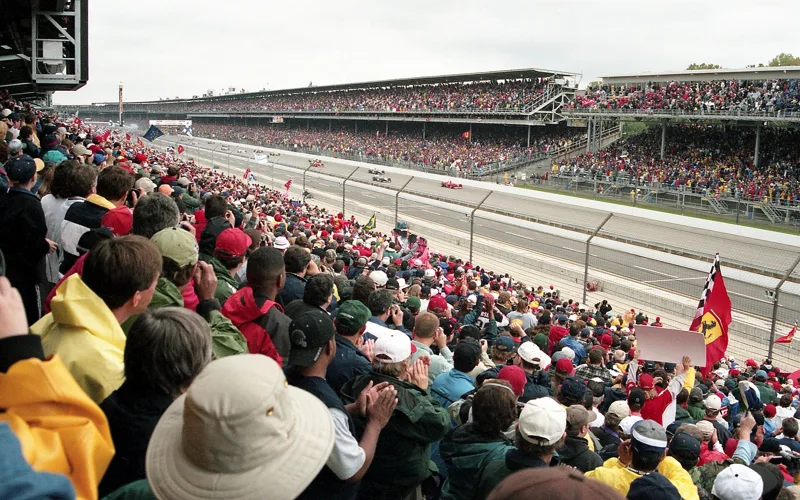
The race became an autumn fixture, drawing large crowds to the Finger Lakes region as the foliage turned. Teams and drivers liked it because its prize and starting money often exceeded that of all other races combined, and the Grand Prix Drivers' Association honoured it as the best organised and staged event of the season in 1965, 1970 and 1972.
How did the race starter become a Glen legend?
Richard Norman Tex Hopkins ran the start in a lavender suit with a cigar clamped in his mouth. He would walk across the front of the grid, turn his back on the field, leap into the air and wave the national flag. At the finish he waved the chequered flag as the winner crossed the line.
The later Grand Prix years brought trouble. The circuit was judged unsafe for the faster, stiffer ground-effect cars of the late 1970s, and serious accidents, including the fatal crashes of Helmut Koinigg and Francois Cevert, raised alarm. Crowd behaviour added to the problems. In May 1981 the International Auto Sports Federation dropped the race after the track failed to pay an 800,000 dollar debt owed to the teams, several months after Alan Jones had won the 1980 race for Williams.
What other races made the Glen famous?
Through the Grand Prix years the Glen also hosted Can-Am, Trans-Am, IROC, endurance sports car racing, Formula 5000 and CART events, which together made it the leading road racing venue in the United States. The Six Hours at the Glen, run from 1968 to 1981, drew stars such as Mario Andretti, Jacky Ickx, Pedro Rodriguez and Derek Bell.
Why did the circuit close in 1981?
Without a Formula One race the circuit struggled to survive. It went bankrupt and closed in 1981, and for two years afterwards it saw little maintenance and only a few SCCA meetings with no spectators.
How was the Glen revived after 1981?
In 1983 Corning Enterprises, a subsidiary of the nearby Corning company, teamed up with International Speedway Corporation to buy the track and rename it Watkins Glen International. The Esses chicane was removed, and the circuit reopened in 1984 with IMSA's Camel Continental I.
The top NASCAR series came back in 1986 on the 1971 short course. The Busch Series, now the O'Reilly Auto Parts Series, arrived in 1991 with a 150 mi (240 km) race that Terry Labonte won, and he claimed three more victories in a row from 1995 to 1997. The 1995 event was lengthened to 200 mi (320 km) and became the first Busch race on network television.
Why did the Glen change in 1992?
A series of crashes at the Loop, at the end of the back straight, prompted the change. In 1989 Geoff Bodine suffered a blown tyre, spun and hit the barrier head-on. In 1991 Tommy Kendall's prototype crashed in the Loop during an IMSA race, and seven weeks later NASCAR driver J. D. McDuffie died at the same spot.
Officials added a bus-stop chicane on the back straight before the Loop, dubbed the Inner Loop, which lengthened the lap slightly on both layouts. Together, the 1991 incidents led to a major safety overhaul of the circuit.
Which concerts and festivals have been held at the Glen?
The 1973 Summer Jam drew around 600,000 fans to see The Allman Brothers Band, the Grateful Dead and The Band. Phish returned for two festivals, Super Ball IX in 2011 and Magnaball in 2015.
How has the track been modernised?
IndyCar returned in 2005 after a 25-year gap, which prompted grandstands from Nazareth Speedway to be installed and gravel to be removed from The 90. In 2006 a new control tower and media centre were built, and the start-finish line moved 380 ft (120 m) farther toward The 90 to make room for timing equipment and the new starting lights.
A fire destroyed the Glen Club, an upscale venue on top of the Esses, on 6 March 2007. In 2015 the whole course was repaved, funded by International Speedway Corporation and a New York State grant. That year the NASCAR weekend closed the season so the work could be done, and IndyCar returned in 2016 over Labor Day weekend on the full layout.
What special events marked the 2000s and 2010s?
Sponsorship shaped many weekends. Camping World sponsored the Indy weekend through 2010, the Busch-Nationwide race became the Zippo 200 under a three-year extension, and the Pennsylvania lubricants firm Brad Penn backed the vintage sports car weekend for 2007 and 2008. Sponsors such as these kept the Glen's racing calendar varied while the track itself was being upgraded.
In June 2011 Tony Stewart and Lewis Hamilton took part in a Mobil 1 promotion in which they swapped cars. Stewart drove Hamilton's McLaren MP4-23 and Hamilton drove Stewart's No. 14 Chevrolet, and the event was open to the public. The white rumble strips on some corners were replaced beforehand with the red and white kerbs common at road courses elsewhere.
Weather also took its toll. Hurricane Sandy caused up to 50,000 dollars of damage in October 2012. In 2014 the original Dunlop Bridge, found in a storage barn, was put back up near the exit of The 90, where companies now use it for hospitality on race weekends.
What is the current event calendar?
NASCAR's Cup Series returns each May for its Go Bowling at The Glen race, and the O'Reilly and Craftsman Truck series run supporting events the same weekend. In June the IMSA SportsCar Championship holds the 6 Hours of Watkins Glen, the Trans-Am SpeedTour arrives in July, and the Sportscar Vintage Racing Association takes over in September.
The Zippo U.S. Vintage Grand Prix is staged there every year, and McLaren Trophy America is listed for 2027.