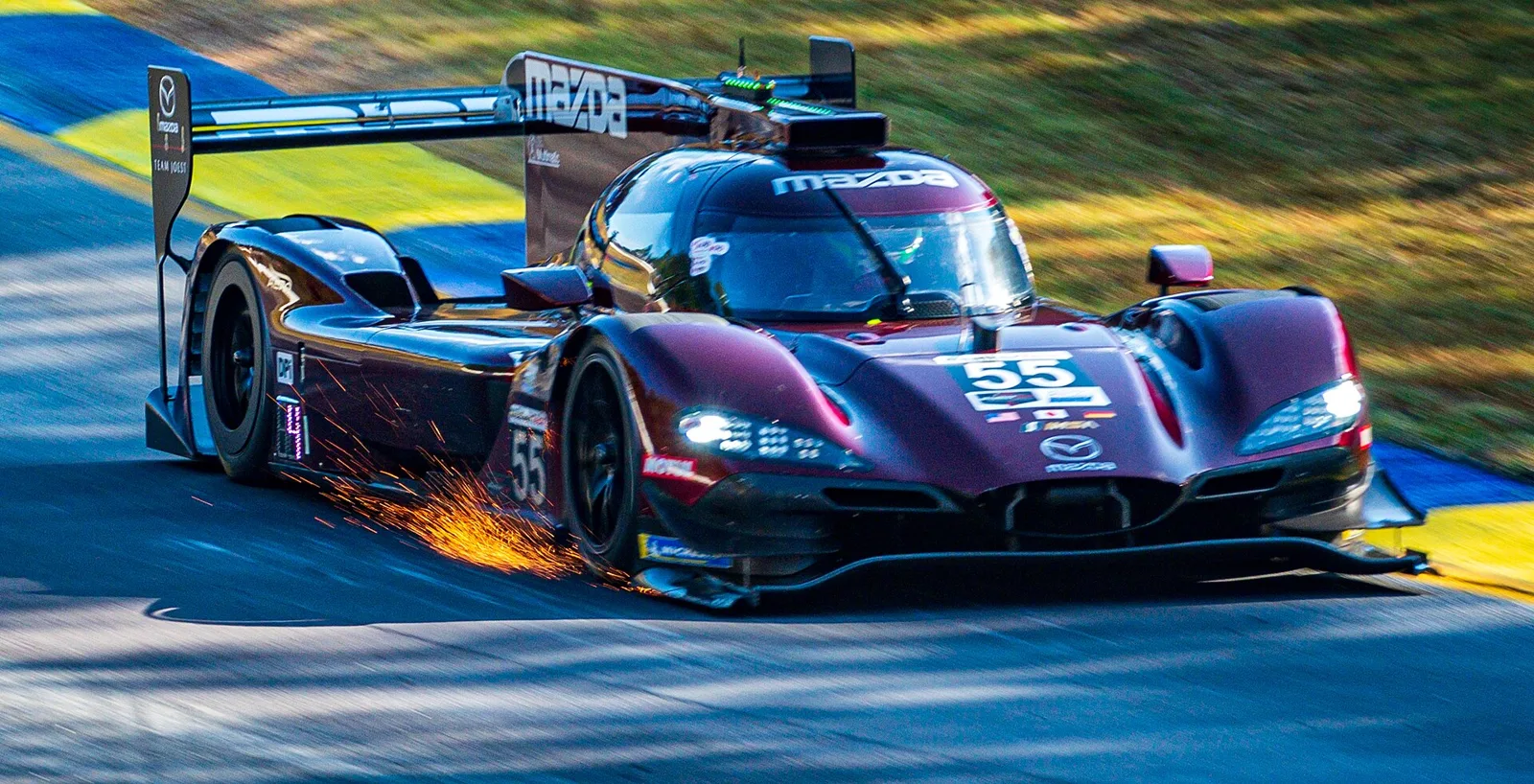
Built on a Riley-Multimatic LMP2 chassis, the RT24-P made its debut at the 2017 Rolex 24 and raced for SpeedSource and then Joest Racing.
The Mazda RT24-P is a DPi prototype built to 2017 IMSA rules by Mazda Motorsports and Multimatic on a Riley-Multimatic LMP2 chassis. It debuted at the 2017 Rolex 24 and earned podiums before moving to Joest Racing in 2018.
The Mazda RT24-P, which the company also styled the Road to 24 Prototype, is a DPi car built to the 2017 IMSA rules. Mazda Motorsports designed and built it with Multimatic Motorsports, using the Riley-Multimatic Mk. 30 LMP2 chassis as its starting point.
The car made its racing debut at the 2017 Rolex 24 at Daytona, running for SpeedSource Race Engineering under the Mazda Motorsports banner. Its first full campaign was disrupted by a change of team mid-year, and its second season passed to Joest Racing, which took the programme on under its own banner.
What was the RT24-P designed to do?
The RT24-P was built to the 2017 IMSA DPi regulations and was eligible for the DPi class of the WeatherTech Sportscar Championship. Mazda Motorsports led the programme, and Multimatic handled much of the engineering and aerodynamic work on the car.
Mazda unveiled the car at the 2016 Los Angeles Auto Show in November. Its body was based on the Riley-Multimatic MkXXX that it had been developed from, but the changes were so extensive that the RT24-P was effectively a new car.
Aerodynamic development was carried out using computational fluid dynamics by Multimatic. Nearly the entire front section was redesigned, with a new wheel pod design and revised positions for the brake ducts and mirrors, and the rear wheel pods were also reshaped to suit the new wing support.
The rear wheel pods tapered sharply at the end, which gave the car its distinctive rear wing support. That shape was one of the features that separated the RT24-P from its predecessor and from other DPi cars of its time.
A Riley-Multimatic chassis reworked by Mazda and Multimatic, the RT24-P earned podiums in its first season and then moved to Joest Racing.
How did the car change during development?
Early in testing, both cars ran with side exhausts. During the Roar Before the 24 tests one car was changed to periscope exhausts to see whether the layout helped, and after the Roar both cars were switched because the periscope layout was found to boost power.
Mid-season the car received a cooling update, which was fitted to the number 70 car at the 6 Hours of Watkins Glen. The update was one of several changes made during the first year, as the team tried to make the car more competitive.
The car's first major upgrade programme was set in motion in July 2017, when the SpeedSource programme was ended and Joest Racing was named to take over. Joest would test the car in two stages, one in North America and one in Europe.
The European phase began with a shakedown at the Hockenheimring Baden-Wurttemberg short course in Germany. The heavily revised car then had its shakedown at Donington Park in the United Kingdom, and US testing began at Daytona International Speedway on 1 November.
Multimatic said the upgrades would cost a million dollars and would focus on the aero and the mechanical side of the car. The heavily revised car was unveiled at the 2017 LA Motor Show in a new livery, and that version became the basis for the 2018 campaign.
Ahead of 2019 the car was upgraded again, with work focused on the engine. The aim was to improve reliability and raise the car's power limit, which had been a limiting factor in its earlier seasons.
How did the 2017 season unfold?
Mazda ended its partnership with SpeedSource in July 2017, only days after the Mobil 1 SportsCar Grand Prix in Canada. The change brought the year's campaign to an early close, and SpeedSource closed its doors at the end of the year.
At the Daytona season opener, cars 55 and 70 qualified ninth and tenth, trailing the pole-sitting Cadillac by a small margin. Car 55 retired from fifth place after an oil fire in the pitlane, while car 70 finished 197 laps down after a run of problems.
At Sebring car 55 finished fifth in the Prototype class, 29 laps down on the leader. Car 70 suffered a heavy incident on the final corner and lost a great deal of time to repairs, which left it well down the order.
The Long Beach round brought the first podium for the car. Tristan Nunez and Jonathan Bomarito drove car 55 to third place, 15 seconds behind the leader, while car 70 finished a lap down but still took seventh in class.
At the Circuit of the Americas, both cars suffered electrical issues. Car 55 retired, and car 70 finished 33rd overall after qualifying tenth, some way off the pace of the front runners.
The Detroit round was the team's best day of the first season. Car 70 took its second podium, finishing 34.502 seconds behind the leader, and car 55 finished fifth after a rival spun late in the race.
At the Six Hours of the Glen car 55 came home third, 7.363 seconds behind the winners, which was its second podium of the season. Car 70 was hit with a penalty for changing tyres on the grid and later retired after a turbocharger failure.
The season finished at Mosport, where cars 55 and 70 came home fourth and fifth, with car 55 leading its team-mate. Car 55 had been in the top three at one point, but a switch to slicks left it to fight back through the field.
What happened to the RT24-P in 2018?
Joest Racing ran the cars under the Mazda Team Joest banner in 2018. Car 55 qualified ninth at Daytona and retired after a major fire, while car 77 set no lap in qualifying after the team noticed an oddity in the telemetry.
At Sebring car 77 qualified seventh, and both cars ran strongly in the early hours. Car 55 led the race in the eleventh hour before a faulty headlamp forced an extra stop, and an ignition fault on the final stop dropped the car to sixth at the finish.
At Long Beach car 77 finished fourth and car 55 ninth. At Mid-Ohio car 77 took third place, while car 55 retired after contact with a GT car that caused suspension damage.
At Detroit both cars failed to reach the flag. Car 77 ran out of fuel with four corners to go, and car 55 retired after a drive-shaft failure within five laps of the start.
What did the RT24-P achieve overall?
The RT24-P's best results were podiums rather than wins. Car 55 finished third at Long Beach and at Watkins Glen, while car 70 took second at Detroit, which was the car's highest finish of the first year.
In 2018 the best finish was third at Mid-Ohio for car 77, and the team's reliability problems were the main reason for the car's inconsistent record. The 2019 upgrades were in part a response to those problems.
| Specification | Detail |
|---|---|
| Category | Daytona Prototype International (DPi) |
| Built to | 2017 IMSA DPi regulations |
| Designed and built by | Mazda Motorsports with Multimatic Motorsports |
| Chassis basis | Riley-Multimatic Mk. 30 LMP2 |
| Unveiled | November 2016, Los Angeles Auto Show |
| Racing debut | 2017 Rolex 24 at Daytona |
| 2017 team | SpeedSource Race Engineering, ended July 2017 |
| 2018 team | Joest Racing, Mazda Team Joest |
| Best 2017 result | Second for car 70 at the Detroit Grand Prix |
| Best 2018 result | Third for car 77 at Mid-Ohio |
| Upgrade cost reported | One million dollars |
Which rivals did the RT24-P face?
The RT24-P raced in a DPi field dominated by Cadillac DPi-V.R entries and Nissan DPi cars, and several of them were quicker in qualifying. That is why the car spent much of its first season starting from the middle of the grid.
At Daytona the Cadillac DPi-V.R set the pole, and at Sebring the Spirit of Daytona Cadillac led the qualifying order. In 2018 the ESM Nissan DPi took the lead at Sebring from the Mazda that had been running in front, showing how quickly the balance could change over a long race.
Wayne Taylor Racing's Cadillac was on pole at Long Beach, and the JDC-Miller Oreca spun late in the 2017 Detroit race. Against that level of competition the RT24-P's podiums were a real achievement for a new car.
Who drove the RT24-P?
Car 55 was driven in 2017 by Tristan Nunez and Jonathan Bomarito, who took the car's first podium at Long Beach. Car 70 was shared by Tom Long and Joel Miller, and that crew took the car's second podium at Detroit.
When Joest took over, the team's full-season drivers from 2017 were involved in testing the updated prototype. That continuity helped the new team understand the car, although the 2018 results show that reliability remained the main issue.