Sega AM2 used the arcade racer as the first game on its Model 2 board, and its stock car racing, camera views and soundtrack still shape the series.
Daytona USA is a 1994 Sega arcade racing game inspired by American NASCAR racing. Players drive the Hornet stock car against up to 39 rivals across three courses, and the game was a critical and commercial success before receiving a 1995 Saturn port.
Daytona USA is a 1994 arcade racer from Sega AM2 that puts players behind the wheel of a stock car across three courses. It was the debut title for Sega's Model 2 arcade board, and it became one of the most successful arcade games of its era.
What is Daytona USA?
Daytona USA is a 1994 arcade game. Sega AM2 built it and Sega published it. It draws on the popularity of NASCAR in the United States, asking players to outrun rival cars and reach checkpoints before the clock runs out. Checkpoints add time, so a steady pace matters as much as raw speed.
The game was built to showcase Sega's new arcade hardware and to outperform the Namco rival that had recently topped the charts. Its graphics, soundtrack and gameplay all attracted strong praise when it first appeared.
A stock car racer built on arcade hardware that taught a generation how texture mapping felt.
How does the race work?
Players begin at the back and must move up past as many as 39 computer-driven rivals. The first lap measures the player's skill, and the opponents adjust to match, so less experienced drivers find lanes opening up while stronger drivers face blockers.
Three courses are on offer: Beginner, Advanced and Expert. The beginner track is Three Seven Speedway, the advanced track is Dinosaur Canyon, and the expert track is Seaside Street Galaxy. The steering wheel uses force feedback, and gears are changed with an H-type shifter, so bumps and collisions reach the driver through the cabinet.
Drifting and power sliding are part of the physics. In multiplayer, the checkpoint clock is satisfied once the leader gets through, and rubber-banding keeps the whole field involved in the race. The player drives a stock car called the Hornet, and Nagoshi picked the number 41 for it after someone close to him called that number lucky.
What did the Model 2 hardware make possible?
The Model 2 was developed with GE Aerospace and rendered 3D graphics with texture mapping and texture filtering. The board could draw as many as 300,000 texture-mapped polygons each second, close to twice the Model 1 figure from the period when Virtua Racing arrived in 1992.
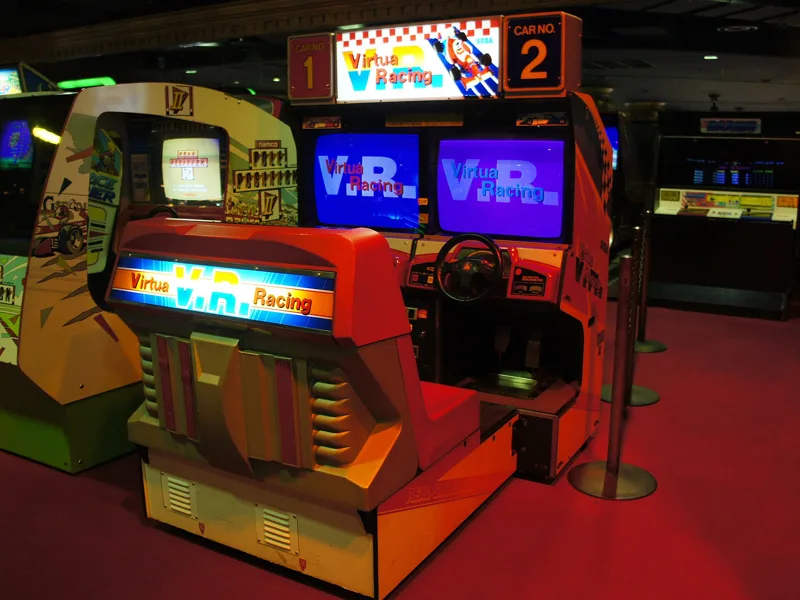
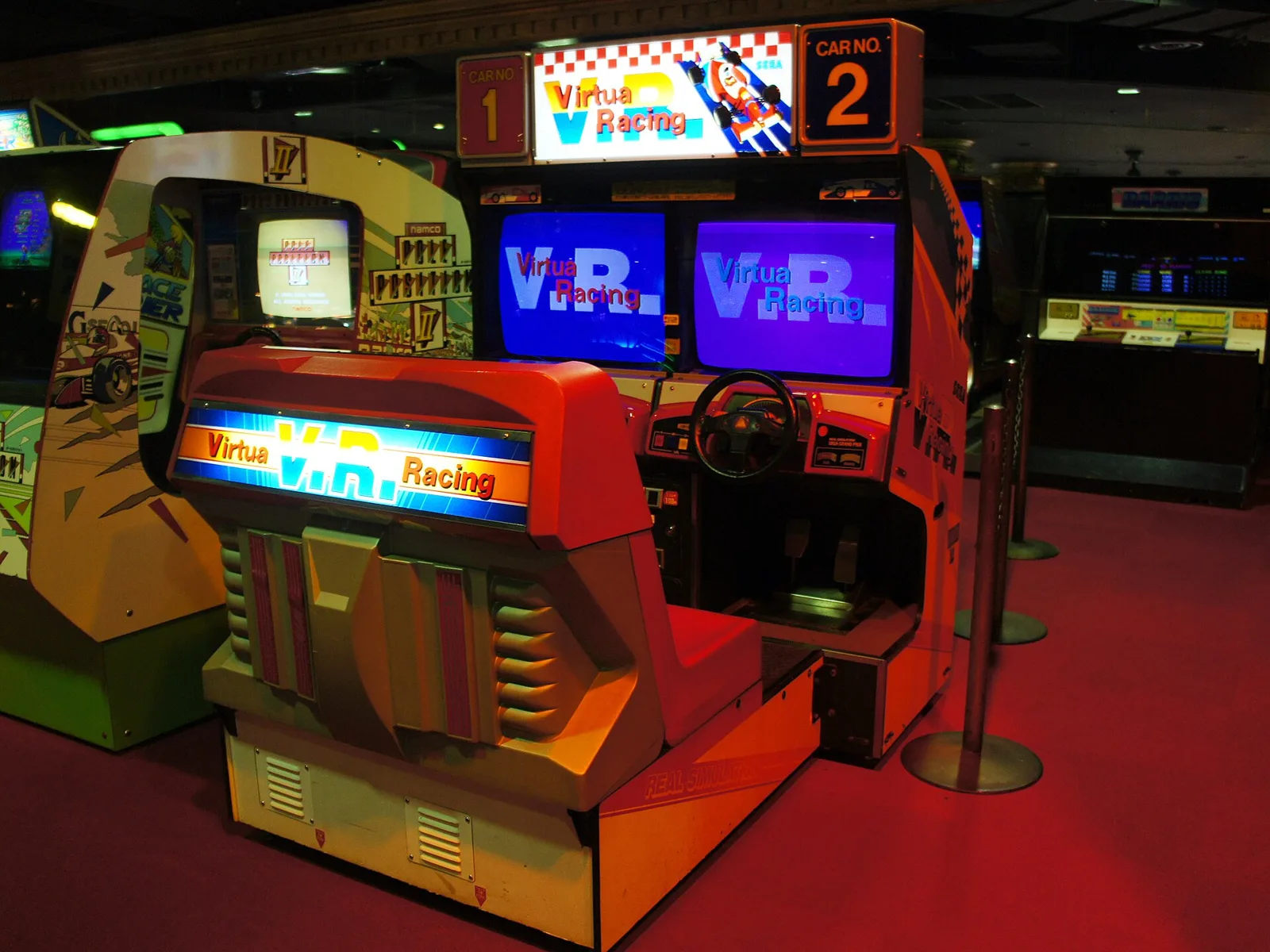
The camera offers four view perspectives plus a view behind the car, carried over from the team's earlier Virtua Racing work. Linked deluxe cabinets could add a camera pointed at the driver's seat, feeding a separate screen, and up to eight players could race across linked cabinets.
How did Sega settle on NASCAR?
Tom Petit, who headed Sega's arcade operation in America, suggested NASCAR as a brand for a Model 2 game aimed at the US market. Sega Europe had doubts because Formula One was more popular there, but Sega's executives approved the concept.
To keep costs down, Sega chose not to negotiate a NASCAR licence, so the game has no real sponsors, drivers or cars. Petit and the finance chief instead opened talks with the people behind the Daytona 500 about a licence to use the race.
The benchmark was Namco's Ridge Racer from 1993. Sega's mandate was to make a better game that sold more, and Ridge Racer had been the sales leader in arcades from late 1993 into 1994, and reviewers had praised its graphics highly.
Who led the development team?
Sega AM2 developed the game under Yu Suzuki, who had led earlier racing hits such as Hang-On, Out Run and Virtua Racing. Toshihiro Nagoshi became the director, and Daytona USA was his first project in that role, with Suzuki and Nagoshi serving as producers.
Nagoshi wanted a different direction from the simulation feel of Ridge Racer and aimed for funky entertainment instead. He had been given tickets to a NASCAR race while in the US for a Model 2 meeting, and the style of racing was not well known in Japan, so he designed the game around its spirit rather than its realism.
Research was intensive. The staff read books, watched NASCAR videos and photographed Daytona International Speedway from satellite imagery and on the ground. Game planner Makoto Osaki bought a sports car and watched the film Days of Thunder over 100 times, while Nagoshi walked a full lap to judge the banking in the corners.
AM2 split into two teams during this period. One worked on Daytona USA and the other on Virtua Fighter, and the staff who built the racer faced the first real challenge of texture mapping on the new hardware.
How were the courses chosen?
Two real tracks, Daytona International Speedway and Bristol Motor Speedway, were in the running as models for the starter course. Oval and tri-oval designs were first rejected as too repetitive, yet the final beginner course, Three Seven Speedway, is a tri-oval shape whose last corner is tighter and rewards firm braking.
Dinosaur Canyon and Seaside Street Galaxy give the other two courses their character. Designer Jeffery Buchanan proposed hiding curiosities around the circuit: a fossil, a clipper ship and similar sights. The team drew on its Virtua Racing experience for camera control and lighting.
What does the soundtrack sound like?
Takenobu Mitsuyoshi composed the score, and each course has its own song with vocals. Let's Go Away, the Daytona theme, mixes rock and funk, while Sky High draws on his background in jazz fusion. He chose vocals after hearing the techno music of Ridge Racer and wanted a different approach.
The arcade tracks were sampled and stored on a Yamaha sound chip, with drums and Mitsuyoshi's voice rebuilt by varying when the tracks played and looped. Vocals could only be included this way because of the Model 2's technical limits. On Saturn, the score was reworked.
The concealed song Pounding Pavement took its inspiration from the Eagles' Hotel California. Mitsuyoshi had no familiarity with stock car racing, but he composed a score that gave each course a clear personality.
How was the game released?
A prototype made its public appearance in Tokyo during August 1993, at the Amusement Machine Show, and was tested in select Japanese arcades. The complete version launched in Japan in March 1994, reached North America at the ACME show the same month, and went worldwide in April 1994.
The standard model was a twin-seat cabinet, while the deluxe version added detailed seats mounted above subwoofers. Sega had planned to use real car seats, but management decided they were too difficult to enter and leave. Daytona USA debuted at number two on RePlay's Player's Choice chart, and it stayed on the list for five years, 16 months of that at number one.
What versions and remakes followed?
Daytona USA has been ported and remade many times. The table below lists the main releases, with the platform and the change that made each one distinct.
| Year | Version | Platform | What changed |
|---|---|---|---|
| 1994 | Daytona USA | Arcade, Model 2 | Original release |
| 1995 | Saturn port | Sega Saturn | Western launch game, finished April 1995 |
| 1996 | Special Edition | Arcade | Smaller, more affordable cabinet |
| 1996 | Championship Circuit Edition | Sega Saturn | Expanded version on a modified Sega Rally engine |
| 1996 | Windows release | PC | Europe on 14 November 1996, North America in December |
| 1998 | Daytona USA 2: Battle on the Edge | Arcade, Model 3 | Sequel with no courses or music from the original |
| 2001 | Daytona USA 2001 | Dreamcast | Remake with online multiplayer and new courses |
| 2010 | Sega Racing Classic | Arcade, RingWide board | Remake without the Daytona name |
| 2011 | Daytona USA | PlayStation 3 and Xbox 360 | Eight-player online play and arranged soundtrack |
| 2016 | Daytona Championship USA | Arcade | Returned the franchise to arcades after 18 years |
The Saturn version added a Saturn mode that turns off the timer and includes more cars to choose from. The Endurance and Grand Prix modes also appear on that port, and both require pit stops, where damage affects performance. The Saturn release had no multiplayer.
How well did Daytona USA sell?
Daytona USA was a major arcade hit. Japanese figures placed it ninth among 1994's top-earning arcade games, and it led the dedicated cabinet ranking in 1995. In the United Kingdom it held the top spot on dedicated arcade charts for half a year in 1994.
In North America, Play Meter ranked it near the very top of 1994's arcade earners, and the twin cabinet won a Diamond Award from the AAMA that year. Retro Gamer's Nick Thorpe said exact figures were hard to find.
Japanese Saturn sales passed 500,000 units, and bundled copies in the USA reached a similar figure by December 1996, for a combined 1 million across both regions.
How did critics treat the Saturn version?
Reviewers were mostly positive about the Saturn port, though many pointed to graphical problems. Maximum praised the challenging course design and the realistic mechanics, such as the effect of wind resistance, while criticising low-resolution texture mapping and the lack of multiplayer.
Computer and Video Games argued that the Saturn version played better than the PlayStation's Ridge Racer, because players could ram other cars off the track. GamePro took the opposite view, saying the port pales in comparison with the PlayStation Ridge Racer in features, gameplay and graphics.
The Windows edition was adapted from the Saturn release, arriving a year later with the same graphical problems. Reviewers judged it less impressive than the arcade cabinet, which had drawn praise at its North American debut.
Has Daytona USA stayed in favour?
Yes. Daytona USA has appeared on many best-of lists, including Next Generation's list of the best games of all time in 1996 and Edge's list of the best games to play today in 2009, where it ranked 70th.
IGN ranked it the sixth-most influential racing game in 2015, arguing that it remained a shining example of arcade racing done well. The Xbox 360 and PlayStation 3 remakes drew mixed to favourable reviews on Metacritic, and the cabinets still turned up in arcades and bowling alleys.
Nick Thorpe of Retro Gamer argued that the game does not just stand alongside Out Run and Sega Rally in arcade racing history, but arguably defines that heritage.