Sega AM2's Formula One arcade game began as a test for the Model 1 board and went on to shape 3D racing for a generation.
Virtua Racing is a 1992 Formula One arcade game from Sega AM2, directed by Yu Suzuki. It began as a proof of concept for Sega's Model 1 3D board and became one of the top earners of 1992 in Japan and North America. It is widely credited with helping popularise polygon graphics and camera switching in racing games.
Virtua Racing started life as a technical demonstration. Sega AM2 used it to test the Model 1 platform, and the results were strong enough to turn the project into a full arcade game. It put players in a polygon world with selectable camera views and linkable cabinets, and it remains one of the most influential arcade games ever released.
How did Virtua Racing begin as a technology test?
Virtua Racing was developed alongside the Sega Model 1 system, which was originally called the CG Board. Sega's arcade team wanted 3D polygon graphics for arcades, which would keep a gap between arcade and home games. Yu Suzuki directed the project and Toshihiro Nagoshi designed it, and the platform was developed internally between 1990 and 1991.
Competitors Namco and Atari Games had already pushed polygon graphics to around 2,000 polygons per frame, so Sega aimed well beyond that with 6,500 polygons per frame. The company's ambitions were public too. In 1989, Sega of America's Tom Petit said the firm was recruiting 400 engineers to work on new technology.
The push also grew out of the Mega Drive console, which had shown how quickly home games were closing the gap. Sega wanted its arcade games to stay clearly ahead of home consoles, and a 3D polygon arcade board was the answer. Petit later argued the new technology would carry as much weight for the business as Hang-On had in an earlier growth period.
A proof-of-concept board became a hit arcade game, and its camera and polygon work shaped the racers that followed.
Which cabinet versions did players see?
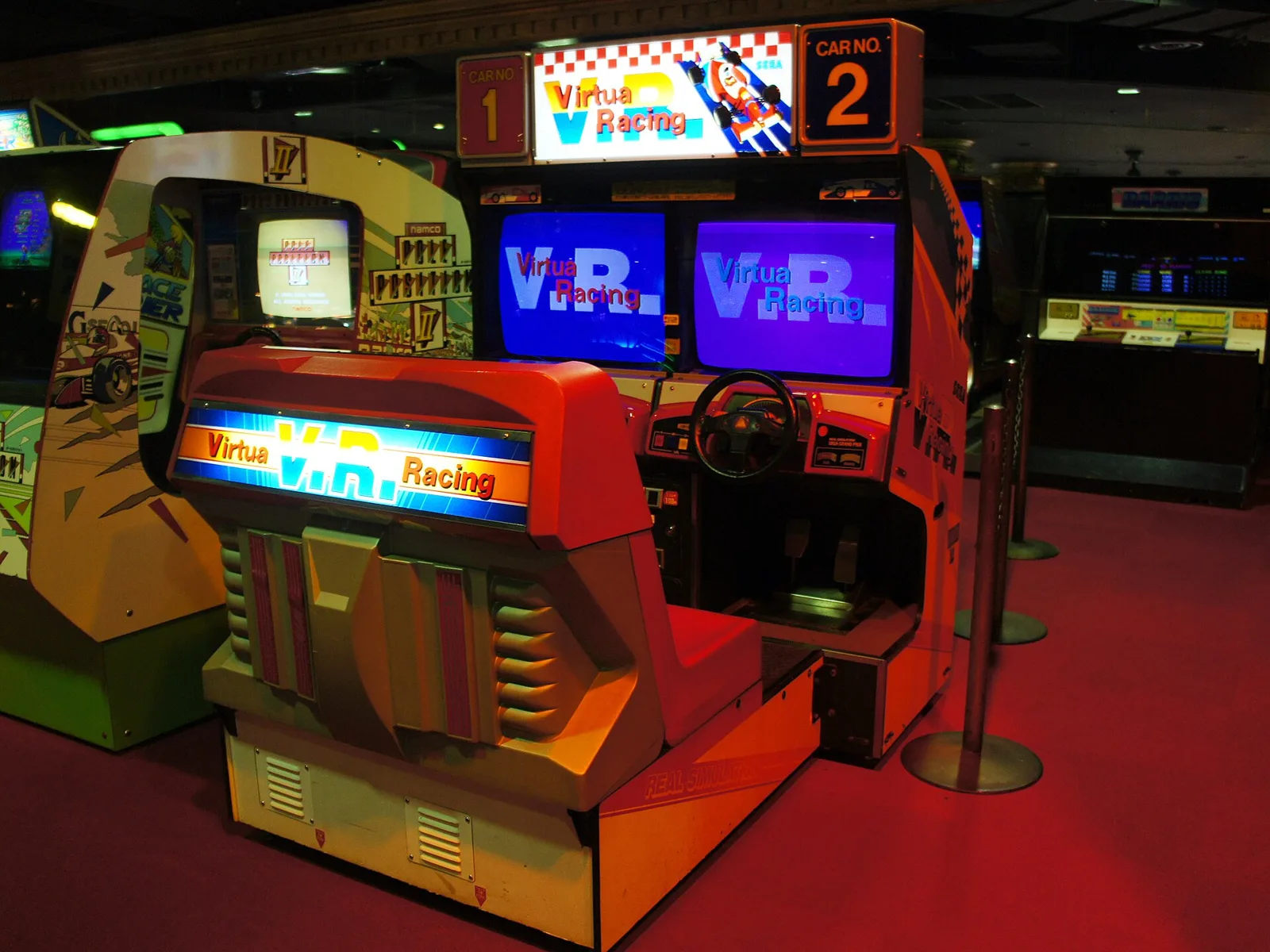
The main Twin cabinet placed two complete machines in one unit. The single-player upright used the same force-feedback steering, while the DX deluxe model used a 16:9 Hantarex monitor, airbags built into the seat and cost $2 a play against $0.75 for the Twin. Up to 8 players could be linked together by fibre-optic cable.
The US Twin cabinets were built by Grand Products in Illinois with 25-inch Wells-Gardner monitors, while Twin cabinets elsewhere used 29-inch Nanao monitors built by Sega in Japan. The DX seat's airbags nudged the player when cornering and inflated under braking, and the DX was the first mass-production arcade game to charge $2 per play.
Virtua Formula arrived in 1993, unveiled at Sega's Joypolis park in a room with 32 machines. Those units used a full-motion, hydraulically actuated Formula One car replica, and many were later converted into Sega's Indy 500 simulator. An optional Live Monitor sat on top of the Twin cabinets and replayed action shots with a virtual commentator called Virt McPolygon.
What was it like to play?
The original arcade game offered three circuits, graded by difficulty. Big Forest was the beginner course with its amusement park, Bay Bridge was the intermediate track and Acropolis was the expert course with a tight hairpin. Each had its own special feature, and the player could choose different transmission types for each car.
The V.R. View System gave players a choice of four camera views. That feature became standard in most other Sega arcade racing games, and it is still mentioned in the attract mode of titles such as Daytona USA. The camera system became one of the game's most lasting ideas.
How did the home versions compare?
The Mega Drive version arrived in 1994 after a cartridge design incorporating the Sega Virtua Processor chip was created, making the game possible on the console. The chip was expensive to manufacture, so Sega priced the cartridge at US$100 in the United States. The Mega Drive version rendered 9,000 polygons per second.
The 32X version, also known as Virtua Racing Deluxe, launched in 1994 and added two cars and two tracks. It had higher resolution, colour depth and draw distance than the Mega Drive version. The Saturn version of 1995 was developed by Time Warner Interactive without the original code, so the team worked from observation of the arcade game, and it added seven courses and four new cars.
Later remakes continued the line. Virtua Racing: FlatOut arrived on PlayStation 2 in 2004 in Japan, and a Nintendo Switch port developed by M2 was released on 24 April 2019 in Japan. The Switch version ran at sixty frames per second and 1080p, and it added online play for two players and offline play for up to eight.
How did critics and players respond?
The cabinet earned strongly in 1992, placing among the top grossers in Japan and the US. It topped the RePlay deluxe earnings chart in October 1992 and stayed there for most of the following year, and it was the highest-grossing dedicated arcade game of 1993 in Japan.
Critics agreed. Electronic Gaming Monthly praised the realism of the racing, and Computer and Video Games said the Virtua Formula cabinet offered a more exciting sense of speed than the more visually stunning Ridge Racer. At the 1993 AMOA Awards the game won Most Innovative New Technology.
On the home front, At the 1994 Consumer Electronics Show, GamePro picked the Mega Drive edition as the top Genesis title on display. The Saturn version was judged less important by some reviewers, who felt it was overshadowed by Sega Rally Championship, which arrived only weeks later.
Why does it matter for racing games?
Virtua Racing helped bring polygon graphics to a mass audience, and its selectable camera system influenced later racing games. IGN ranked it third in its 2015 list of the most influential racing games, behind Pole Position and Gran Turismo. Nintendo Life later described it as one of the most influential arcade games of all time.
Its technology also fed directly into Virtua Fighter. Having handled the movement of cars in three dimensions, Yu Suzuki turned his attention to people. The polygonal pit crew was used to experiment with animating human figures, and a football or rugby game was ruled out because the hardware could not animate that many characters, so Suzuki focused on two fighters.
The camera patent and the courts
In 1992 Sega applied for a Japanese patent on a button that switched the 3D viewpoint, a feature it also used in Daytona USA. The patent took five years to process and was granted in 1997, by which point camera change buttons were common in 3D games. Sega then collected royalties from companies including Atari and took legal action against Nintendo.
Nintendo and Sony Computer Entertainment later challenged the patent in Japanese courts, pointing to earlier games. Star Wars: Attack on the Death Star used the feature in 1991, and developer Mikito Ichikawa testified in court, which led to the patent being revoked. Ichikawa himself pointed to Magical Shot, a billiards game from the same studio, as the first game to use the feature, and that game also came out in 1991.
How did linking and the Live Monitor work?
A Live Monitor option replayed action shots from the Twin cabinets, narrated by a virtual commentator called Virt McPolygon. Linking allowed up to eight players across four Twin units, or across eight DX, UR or Virtua Formula cabinets. Fibre-optic cables connected the machines, which turned a session into a social event.
A four-player Virtua Formula setup was a serious investment, costing around 250,000 pounds in 1994, or about $383,000. That price made the four-player configuration a major commitment for any venue.
How did reception break down by version?
The arcade game dominated the reviews, and Electronic Gaming Monthly described its racing as among the most realistic ever made. Ports drew a mix of responses. The 32X version was called a near-perfect conversion, while the Saturn version was described as arcade-perfect by Next Generation, even though some reviewers felt it had been overshadowed.
The Mega Drive port lost some graphical clarity and audio quality, which Electronic Gaming Monthly's reviewers criticised, yet they still judged it the best racer yet seen on cartridge systems. GamePro praised its faithful gameplay and noted that its polygons moved faster than any other cartridge game.
Maximum made the sharpest criticism of the Saturn release, saying it was not a straight conversion of the arcade game. Rich Leadbetter of Sega Saturn Magazine felt most gamers wanted a straight conversion rather than a home remake.
How did the DX cabinet feel different?
The DX cabinet used two pneumatic cylinders to rotate the steering wheel, while the upright and Twin versions used an electric motor and clutch, so the steering feel was quite different. Sega had previously charged more for its R360 cabinet, and the DX pushed the price of a single play to $2.
Virtua Racing on television and in the charts
The game also reached television. The game also reached French television, where the programme Televisator 2 featured it on France 2 between 1993 and 1994. The host, Cyril Drevet, took on members of the studio audience at the machine, having chosen the game because he knew it well.
On the charts, the game ranked third among America's top earners in summer 1993, pulling in around 1,500 tokens per unit each week. Sega's own account was that the game had reshaped the driving simulator category, drawing in players who rarely visited arcades.
Awards and nominations
At Japan's 1992 Gamest Awards, Virtua Racing earned nominations in three categories: action, direction and graphics. Those lost out to Street Fighter II, Art of Fighting and Xexex respectively, but it went on to win Most Innovative New Technology at the 1993 AMOA Awards, a recognition of what the Model 1 hardware had made possible. Its nominations and awards were a reminder that the technology drew attention from critics as well as operators.