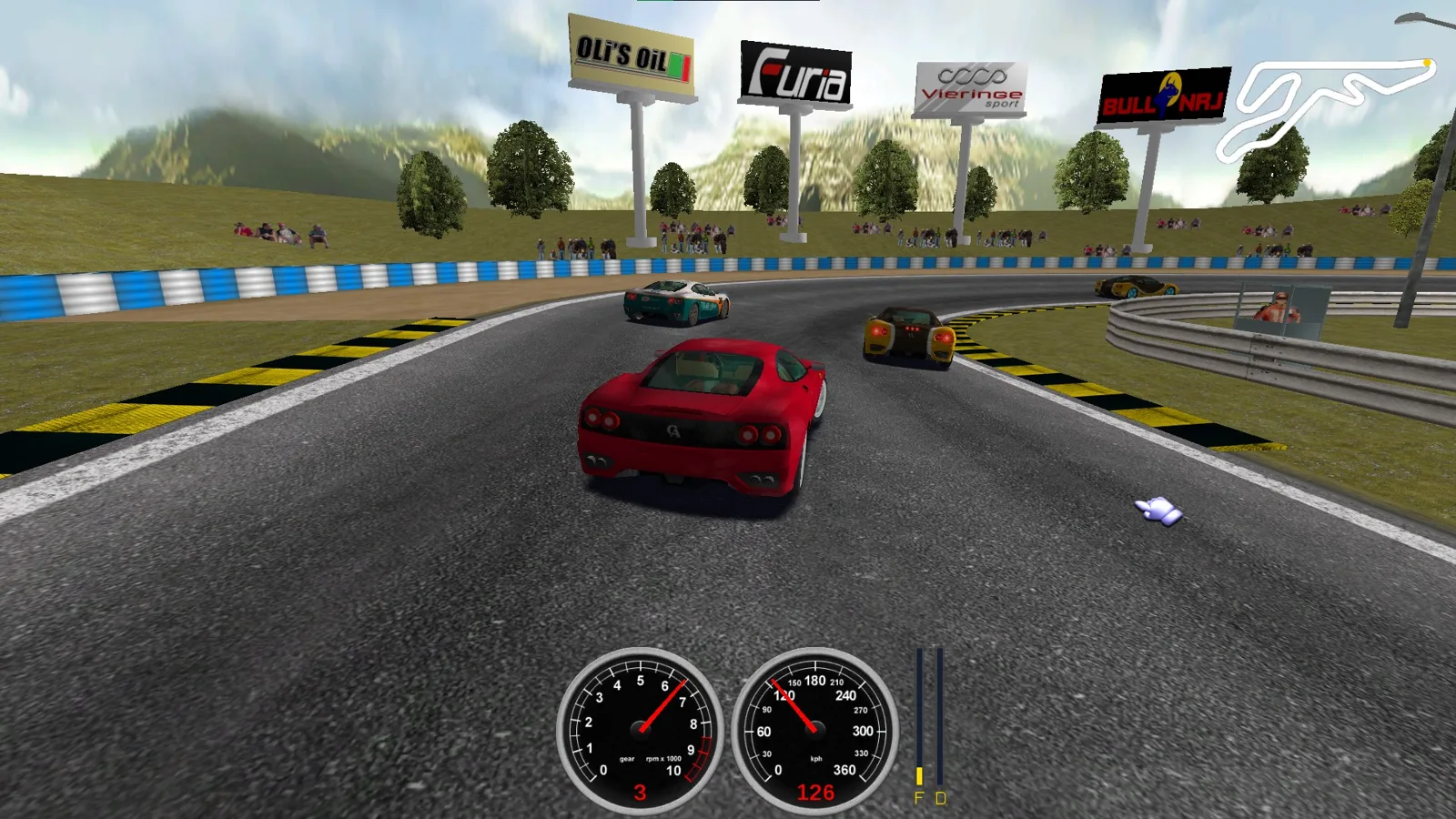
How a genre that began with mechanical driving machines grew into arcade thrills, hard-core simulators and a franchise that has sold over 100 million units.
Racing video games let players compete in races across real circuits, city streets or invented worlds. The genre spans loose, arcade-style racers and precise simulators, with kart and anti-gravity games as further branches. Its roots lie in mechanical driving machines that predate home consoles by decades.
Racing video games put the player in a race, whether on a real circuit, a city street or an invented world. They sit on a spectrum from precise simulators to arcade racers built around speed and spectacle, and kart racing is a popular branch of the arcade side. The genre's roots reach back to electro-mechanical machines such as Drive Mobile in 1941.
What is a racing video game?
A racing video game is one in which the player competes in a race, often with real or fictional vehicles. Titles fall into arcade-style racers, which prize fun and liberal physics, and simulation racers, which aim to copy real handling. Kart racers and anti-gravity racers form further branches of the genre.
Arcade-style racers put enjoyment and pace ahead of everything else. Cars slide through corners by powersliding rather than slowing for them, and collisions with other traffic are exaggerated. Many license real cars and leagues, but they are just as happy with exotic machines and invented settings.
Simulation racers work the other way round. They try to reproduce how a real car handles, including tyre condition and fuel load, and they reward proper cornering and trail braking. Many include assists such as traction control, anti-lock brakes and automatic gear changes for players who are less skilled.
The genre began with machines that had no rivals and grew into simulators that copy the feel of a real car.
How did arcade racing begin?
Arcade racing began with electro-mechanical machines, which used a steering wheel to follow a road on a metal drum or pre-recorded film. Kasco's Indy 500 in 1968 added rival cars, and its North American version, Speedway, became one of the biggest arcade hits of its era. Early machines had no rivals at all.
The earliest mechanical racing game was Yacht Racer, made by the London-based Automatic Sports Company in 1900. Mechanical car driving games later came out of British amusement arcades. International Mutoscope Reel Company brought the idea to the United States as Drive Mobile in 1941, and its upright cabinet resembled the arcade video machines that followed.
Capitol Projector's Auto Test, from 1954, ran film reels of driving footage and awarded points for correct decisions. Kasco introduced Mini Drive to Japan in 1958, and Japan then developed the form further. Kasco's Indy 500 in 1968 placed rival cars on rotating discs lit from behind, and mirrors produced a pseudo-3D first-person view. Kasco's Indy 500 moved over 2,000 cabinets in Japan, and Speedway passed 10,000 cabinets in North America.
Taito's Super Road 7 in 1970 followed with an endlessly scrolling road that the player had to dodge cars on, and it formed the basis for Speed Race in 1974. Namco's F-1 in 1976 was one of the last major electro-mechanical hits. It projected the driver's view on screen and was Japan's highest-grossing arcade game in 1976 and 1977.
What was Pole Position and why does it matter?
Namco built Pole Position in 1982, and Atari brought it to North America. Many consider it one of the most important racing games ever made, and it was the first to use a real racing circuit as its basis and the first to include a qualifying lap. It set conventions that later racing games followed for decades.
It grew out of Namco's earlier electro-mechanical racers, and the designer Sho Osugi had worked on F-1. Sega's Turbo had already used a third-person view, so Pole Position was not the first of its kind. Even so, it set the genre's conventions, and many imitators followed its success. IGN also credited it with introducing checkpoints.
Electronic Games praised the game for rewarding players who passed cars and finished near the front, not just those who kept all four wheels on the road. US sales passed 21,000 cabinets by 1983, and it was North America's top-grossing arcade title that year. It topped the US arcade earnings chart again in 1984.
When did 3D racing games arrive?
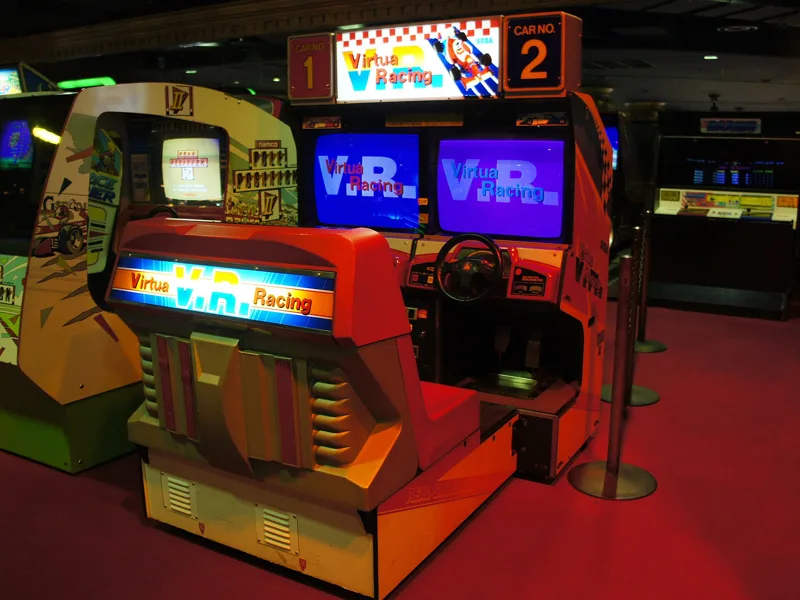
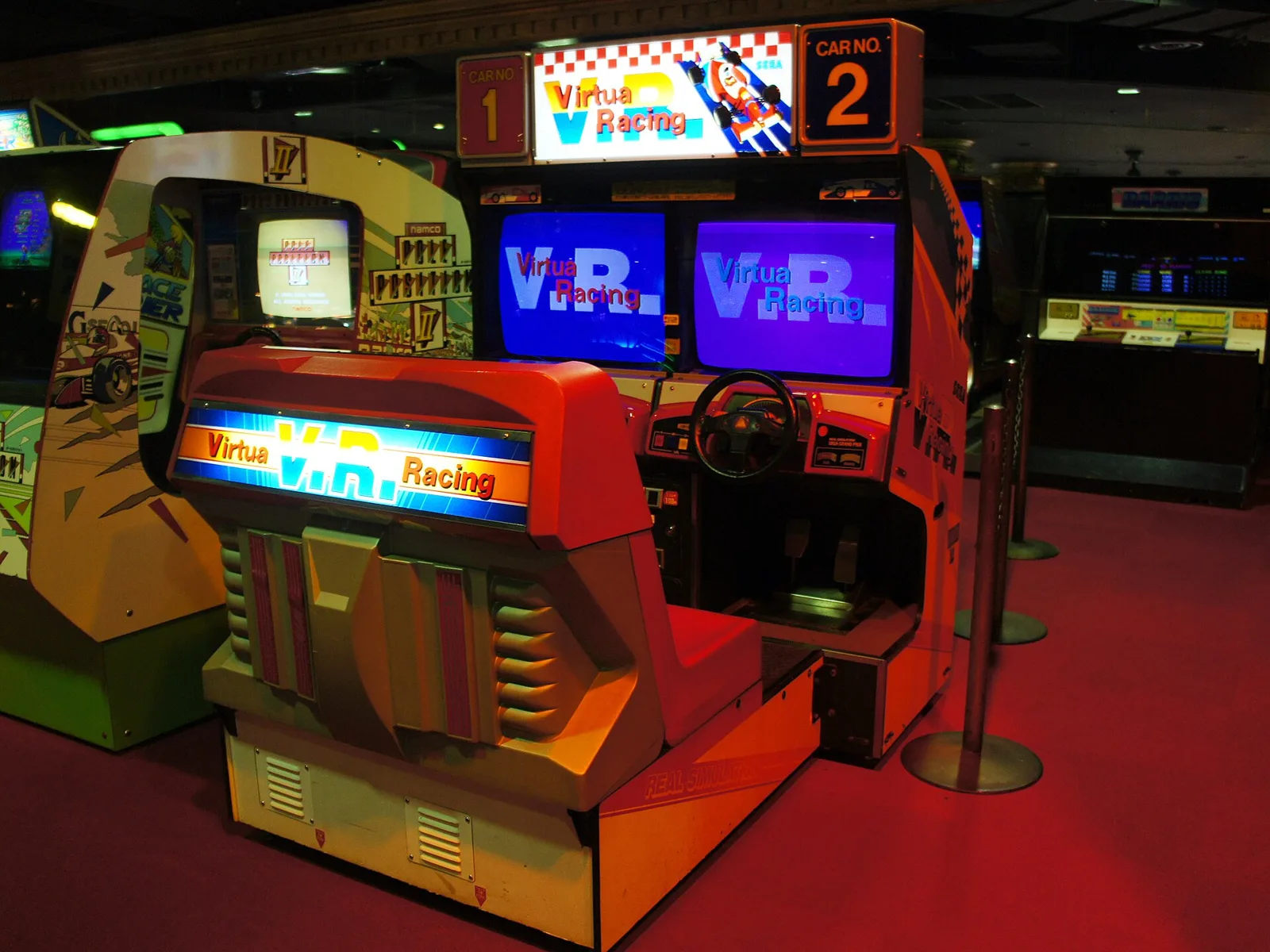
The shift to 3D polygon graphics began in arcades with Namco's Winning Run in 1988, which was followed by Atari's Hard Drivin' in 1989. Sega's Virtua Racing in 1992 combined multiplayer machine linking with clean 3D graphics, and it laid the foundations for later 3D racing games. Each step made the arcade machines more convincing.
In Japan, Winning Run ranked second among arcade earners of 1989. Hard Drivin' used force feedback, so the wheel fought the player through aggressive turns, and it added a crash replay camera view. Virtua Racing let players switch between camera angles, among them chase-cam and first-person views, and IGN places it third on its list of influential racing games.
Namco's Ridge Racer in 1993 stood out for its Gouraud shading and texture mapping, and it began what became known as the polygon war of driving games. Sega's Daytona USA followed with texture filtering. In 1994 Electronic Arts produced The Need for Speed, and Midway introduced Cruis'n USA the same year.
Sega Rally Championship arrived in 1995 and introduced rally racing with cooperative play alongside the usual competitive multiplayer. It was the first to put driving on asphalt, gravel and mud, each with different grip, and the car's handling changed to match the surface. That made it an important milestone for the genre.
How did racing simulators develop?
Simulation racing took shape on personal computers. Papyrus's Indianapolis 500: The Simulation in 1989 is often cited as the earliest proper racing sim for PCs. Formula One Grand Prix followed in 1992, and IndyCar Racing arrived from Papyrus the following year.
Indianapolis 500 accurately recreated the 1989 grid and modelled physics in more depth than most games of its time. It simulated the four tyre contact patches, the loss of grip in fast turns and throttle-to-brake interaction, and it included car setup, car failures and handling. A garage let players adjust tyres, shocks and wings. Its damage modelling was basic by today's standards but could still produce spectacular pile-ups.
Formula One Grand Prix, designed by Geoff Crammond, offered detail that was unmatched for a computer game at the time. It covered the 1991 season in full, with its drivers, cars and circuits. The US release, World Circuit, lacked an FIA licence, so the teams and drivers were renamed, and Ayrton Senna became Carlos Sanchez, although the names could be changed back.
What defines kart racing?
Kart racing simplifies driving and adds obstacles, unusual track designs and action elements such as projectiles and power-ups. Characters from platform games and cartoons often drive wacky vehicles, and the karts move more like go-karts than cars, with no gear stick or clutch pedal. More than 50 kart racing games have been released since the genre took off.
The subgenre took off with Super Mario Kart, released in 1992 for the Super Nintendo, which spawned the Mario Kart series. Car combat had appeared earlier, in Taito's Crashing Race in 1976, but Super Mario Kart made it mainstream. The game ran slower than other racers of its time because of hardware limitations, so the developers built a go-kart theme around it.
Later entries kept the formula alive. Mario Kart 64 in 1996 moved the series into 3D and focused more on items. Mario Kart Wii in 2008 used a Wii steering wheel, was the sixth installment in the series, and became one of the best-selling games of its era. Crash Team Racing arrived in 1999 with characters from Crash Bandicoot and was praised for its controls and courses.
What is anti-gravity racing?
Anti-gravity racing games use vehicles that hover or glide, racing against the clock or rivals in science fiction settings with futuristic tracks. Many of them also add combat. The arcade roots of the form go back to the laserdisc era, with Star Rider in 1983, and the console benchmark was F-Zero on the Super Nintendo in 1990.
Star Rider and Cosmos Circuit in 1984 both used animated laserdisc backgrounds. Alpha Denshi's Splendor Blast in 1985 mixed Pole Position style racing with futuristic craft, space settings and shoot 'em up elements. Atari Games' STUN Runner in 1989 used 3D polygon graphics and let players blast other vehicles.
On home consoles, F-Zero set the template and spawned its own series. Psygnosis's Wipeout in 1995 brought 3D polygon graphics to the PlayStation and started its own franchise. F-Zero X in 1998 carried the series into 3D on the Nintendo 64.
How did free-roaming and city racing change the genre?
Free-roaming racers moved away from enclosed tracks. Midtown Madness, released for PC in 1999, let players explore a simplified version of Chicago in any direction they liked. Midnight Club: Street Racing in 2000 offered recreations of London and New York on consoles, with checkpoints replacing fixed tracks.
The year 1999 also brought Crazy Taxi from Sega, a sandbox game in which the player drives a taxi and tries to reach each passenger's destination in the shortest time. Emergency Call Ambulance, also from Sega, shared almost the same gameplay, with patients to collect and hospitals to reach as quickly as possible.
Midnight Club II in 2003 became the first racer to offer both playable cars and playable motorcycles. The same period saw a wave of street racing inspired by the import scene, with tuned sports compacts. Series such as Juiced, Initial D and FlatOut 2 joined the trend.
Wangan Midnight from Namco arrived in arcades in 2001, and Wangan Midnight R followed as an upgrade. Genki later ported the game to PlayStation 2 under the name Wangan Midnight. Namco then released Wangan Midnight Maximum Tune as a sort of sequel.
Which milestone games shaped the genre?
| Year | Title | Why it mattered |
|---|---|---|
| 1941 | Drive Mobile | Electro-mechanical driving game with a steering wheel and an upright cabinet |
| 1968 | Indy 500 | Rival cars on rotating discs; over 2,000 cabinets sold in Japan |
| 1976 | F-1 | Namco title that was Japan's highest-grossing arcade game in 1976 and 1977 |
| 1982 | Pole Position | Real circuit setting, with a qualifying lap before Grand Prix races |
| 1986 | Out Run | Hydraulic cockpit cabinet with route choice and up to five endings |
| 1988 | Winning Run | Early arcade racer built on 3D polygon graphics |
| 1989 | Indianapolis 500: The Simulation | Often cited as the earliest proper racing sim for PCs |
| 1992 | Super Mario Kart | Popularised kart racing on the Super Nintendo |
| 1993 | Ridge Racer | Gouraud shading and texture mapping that began the polygon war |
| 1997 | Gran Turismo | PlayStation simulator with career driving tests; over 100 million units by June 2025 |
| 1998 | F-Zero X | Anti-gravity racing carried into 3D on the Nintendo 64 |
| 2000 | Midnight Club: Street Racing | First free-roaming racer on consoles, set in London and New York |
Several of these entries share a theme. Each one moved the genre a step forward in either realism, scale or the kind of freedom the player was given, and the table shows how those changes built on one another.
Why did motion simulator cabinets catch on?
Hydraulic motion cabinets became a trend in arcades after Hang-On appeared in 1985. Sega's taikan games, a name that means body sensation in Japanese, used cabinets that moved in sync with the on-screen action. Those machines appeared mainly in amusement arcades, because home systems could not reproduce the effect.
Hang-On, from Yu Suzuki's team at Sega, put the player on a motorbike replica and used force feedback. It topped the US arcade earnings of 1986 and ranked among the biggest earners in Japan and London.
Out Run followed in 1986 with a hydraulic cockpit cabinet and a sprite-based engine that became a classic. Players chose their route through the game and the radio station they listened to as they drove. It had up to five endings, and over 30,000 cabinets sold, making it Sega's best-selling arcade cabinet of that decade.
Super Monaco GP arrived in 1989 as a simulation of the Monaco Grand Prix, and in Japan that year it placed third among arcade earners. It kept the pseudo-3D approach at a time when polygon machines were taking over, which made it one of the last successful racers of its kind.
What do modern racing games look like?
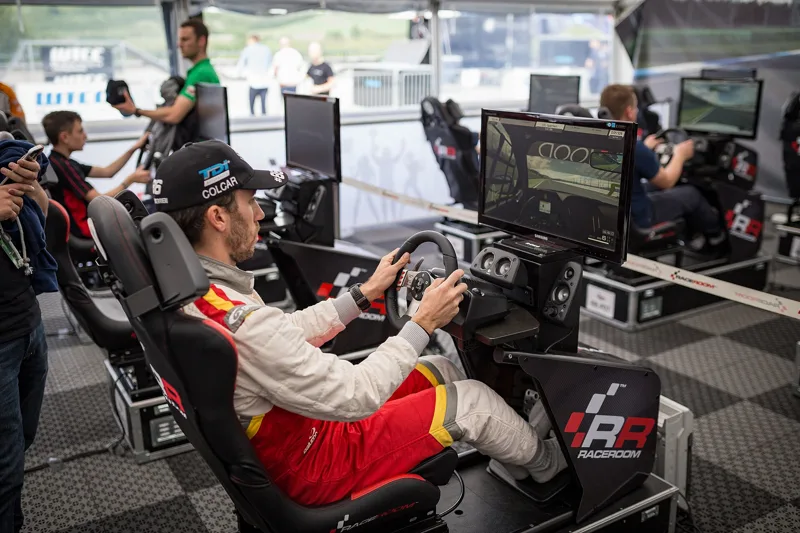
Modern racing games cover a wide range, from action racers such as Mario Kart World and Sonic Racing: CrossWorlds to simulators such as iRacing and Assetto Corsa. Many sims offer assists, detailed tuning and sound models, and their fans run online championships and create mods.
Sound is a key tool for feedback in simulators. Intake, exhaust and internal engine samples are built into the game through methods including granular synthesis and physical modelling. Tyre sounds change with slip angle and deformation to show the limit of grip, and the best sounding games combine the sound model with the vehicle and tyre models.
Gran Turismo shaped how many simulators handle career modes. It offered meticulous tuning options and an open-ended career in which players earned licences through driving tests and then chose their own path. As of June 2025 the franchise had sold more than 100 million units, placing it second among racing series.
How did racing influence other genres?
Racing has crossed into other kinds of game. Vehicular combat series including Twisted Metal, Destruction Derby and Carmageddon added racing as a mode, while weapon-based racers such as Full Auto, Rumble Racing, Grip, Re-Volt and Blur brought combat into the race itself. Weapons range from projectiles to traps and speed boosts.
Simulation fans also built their own world around these games. Because many players decoded the tracks, cars and executable files, customisation became part of the hobby. Internet communities grew around the most realistic simulators, and many websites host online championships.