From Pole Position in 1982 to official esports series and driver licence rules, the genre has moved from arcade cabinets into real racing pipelines.
Sim racing is a genre of racing video games that model real car physics and driving variables such as fuel, damage, tyre grip and suspension. It rewards technique over speed thrills, and it has become a training tool and an esports discipline used alongside professional motorsport.
Sim racing is the umbrella term for racing games that try to reproduce real driving, including fuel use, damage, tyre wear and suspension settings. Its roots lie in 1980s arcade cabinets, and its modern form includes subscription services, officially licensed championships and a formal FIA esports framework.
What is sim racing?
Sim racing covers games that try to copy real auto racing as closely as practical. Fuel use, damage, tyre wear and grip, and suspension setup all count. Players must learn threshold braking, how to keep a car under control when its tyres lose traction, and how to enter and exit a corner without losing speed.
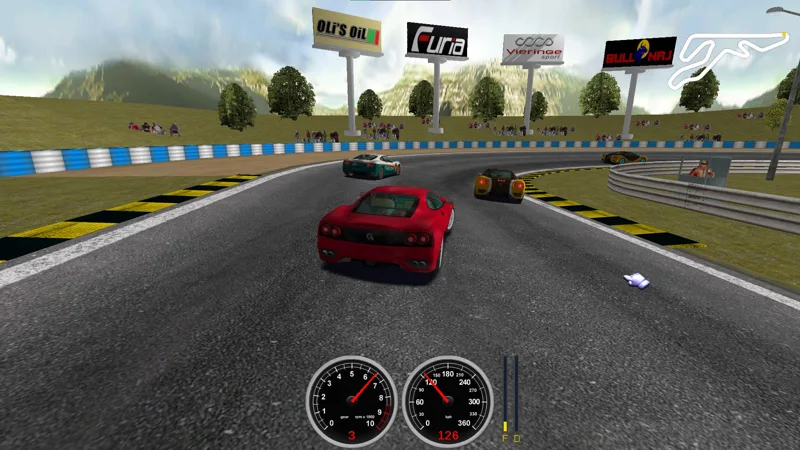
That difficulty is what separates the genre from arcade games, where real-world variables are dropped in favour of a feeling of speed rather than realism. The sim style has since spread to titles such as iRacing, Assetto Corsa, Gran Turismo and Forza Motorsport.
Many real-world competitors also use sims for practice or entertainment, and online ranked racing lets people race against human opponents rather than only the computer.
Sim racing began as a test of arcade nerve and now feeds real motorsport careers.
What equipment do sim racers need?
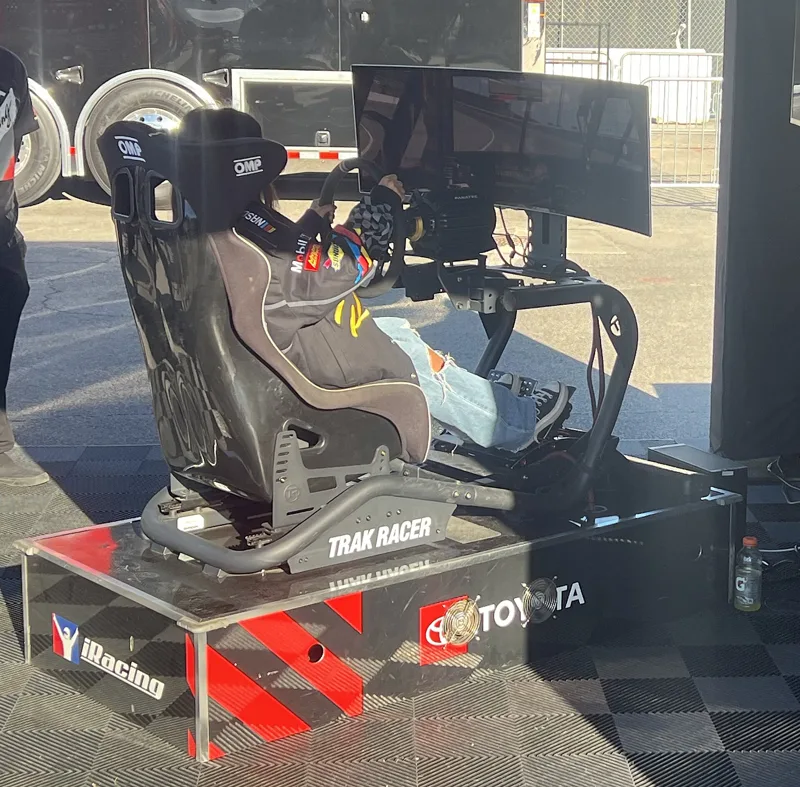
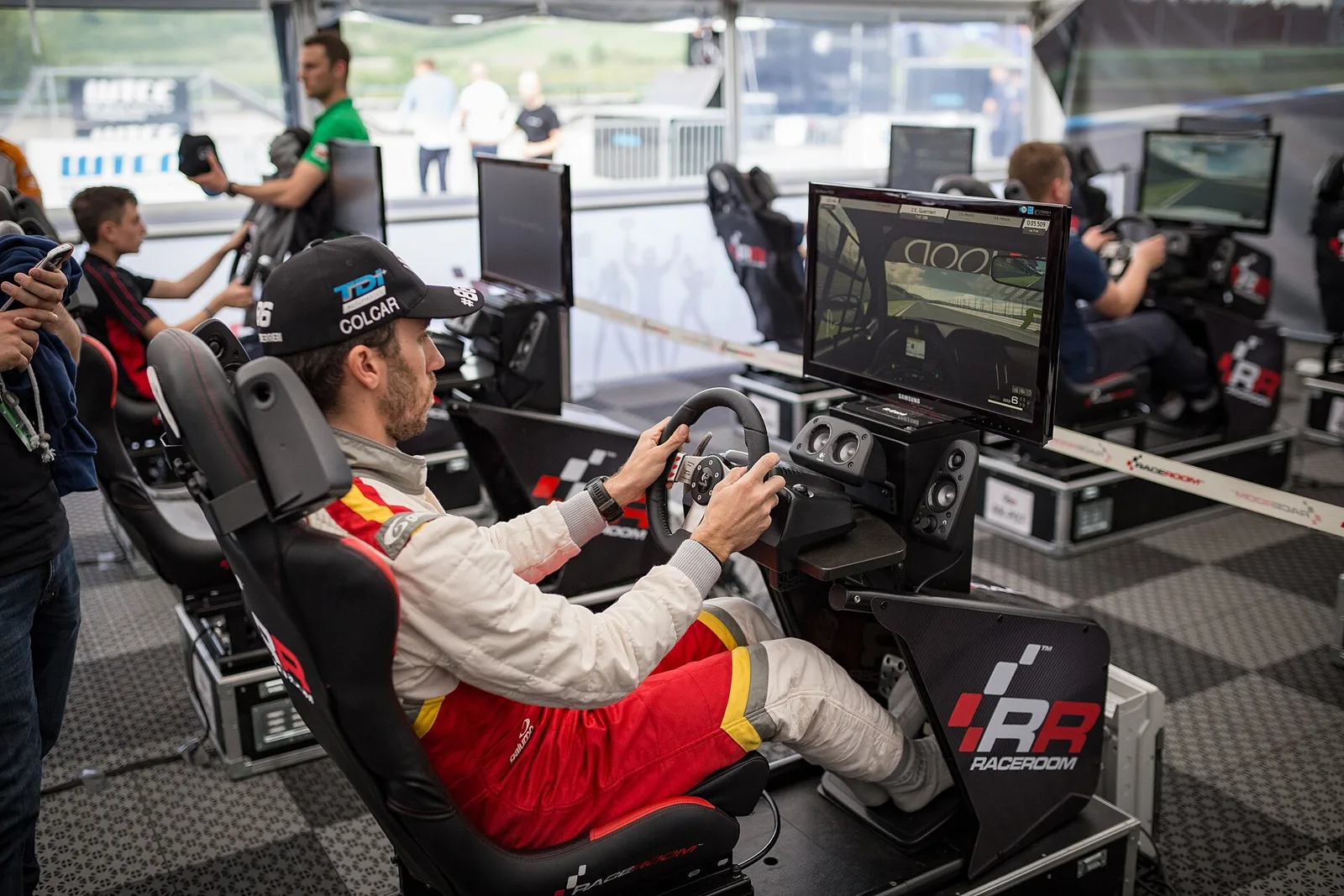
Sim racers usually need a steering wheel and pedals to match the physics, along with a faster computer than most casual games demand. A gamepad or keyboard can work for arcade racers, but they give far less feedback than a wheel. Many console sims are playable with a controller, though a wheel and pedals are recommended.
Improvements in physics engines and tactile feedback from wheels have made the experience more realistic. Online racing against human opponents is, for many people, the nearest they will come to driving on a real track.
Where did sim racing begin?
The first arcade racing games to aim at realism appeared in the early 1980s. Namco's Pole Position in 1982 offered rival cars, collisions with signs and other vehicles, and a qualifying lap before the grand prix. Its rear-view camera style became standard in later racing games.
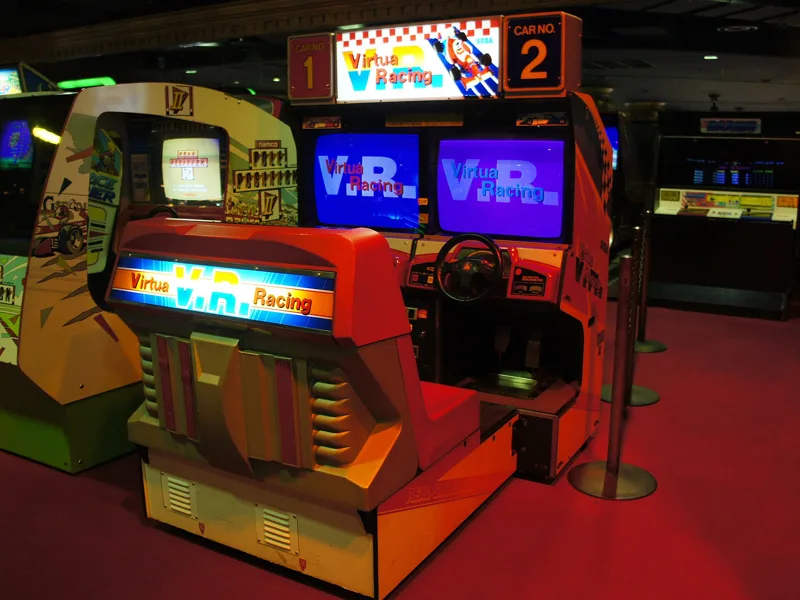
Pole Position II followed in 1983 with a choice of courses. TX-1 went further the same year, forcing players to brake or downshift before corners, and to ease off the accelerator when a skid began. Its force feedback made the steering wheel vibrate, and a three-screen display gave a wider view of the track.
Sega's Hang-On in 1985 is often cited as the first full-body arcade experience, because players sat on and leaned a motorbike replica. Out Run in 1986 used a similar hydraulic cabinet. Konami's WEC Le Mans, also in 1986, added a day-night cycle, circuits the Automobile Club de l'Ouest had signed off, and force feedback that reacted to acceleration and bumps.
Home computers had early attempts as well. Chequered Flag appeared on the ZX Spectrum in 1983, and Geoff Crammond's REVS followed in 1986 as a semi-realistic Formula 3 sim for the Commodore 64 and BBC machines.
Which sims marked the milestones?
A handful of releases shaped the genre's path from arcade simulation to dedicated sim. The table below shows the milestones most often referenced, with the reason each one mattered at the time.
| Year | Title | Why it mattered |
|---|---|---|
| 1982 | Pole Position | Qualifying laps and a rear-view camera |
| 1983 | TX-1 | Force feedback and a three-screen display |
| 1985 | Hang-On | Motorbike cabinet and Super Scaler graphics |
| 1989 | Indianapolis 500: The Simulation | Realistic physics and the full 500 miles |
| 1992 | Formula One Grand Prix | Turn-taking multiplayer and drafting |
| 1994 | NASCAR Racing | Over one million units sold and online play |
| 1997 | Gran Turismo | Console realism with driving tests for licences |
| 2004 | Richard Burns Rally | Multi-body physics and realistic rally courses |
| 2008 | iRacing | Subscription multiplayer simulation |
| 2014 | Assetto Corsa | A modding-friendly engine released in December 2014 |
| 2025 | Le Mans Ultimate | Officially licensed endurance racing simulation |
How did Indianapolis 500 change the genre?
Papyrus Design Group's Indianapolis 500: The Simulation, released in 1989, is widely regarded as the first true auto racing simulation for the personal computer. It modelled the contact between tyres and pavement, the loss of grip in fast corners and telemetry, and it sold over 200,000 copies.
Papyrus followed with IndyCar Racing in 1993, which sold around 300,000 copies. The NASCAR Racing series arrived in 1994 with SVGA graphics and detailed physics, and its cars finally stopped looking like boxes. It sold over one million units.
Formula One Grand Prix by MicroProse, released in 1992, let drivers take turns on one machine and linked two computers with a null modem cable. Leagues grew around it, and the LFRS league included 22 teams that downloaded setup files and checked frame rates before racing.
When did sim racing reach consoles?
Sim racing reached home consoles with Gran Turismo on PlayStation in 1997. It was considered the most realistic console racing simulation of its time, with tuning options and a career that required driving tests before players could earn their way into races.
Network Q's RAC Rally in 1993 gave rally fans an authentic sim, and Colin McRae Rally from 1998 made rally sims popular. The TEN multiplayer hosting service launched in November 1997, backed by NASCAR, which helped online racing grow.
What did graphics cards change?
Graphics accelerator cards arrived in the late 1990s and took load off the main processor. They brought texture mapping, anti-aliasing and particle effects such as fog and rain. Ubisoft's F1 Racing Simulation was one of the earliest titles to use them in 1997.
Grand Prix Legends from Papyrus, released in 1998, drew on the 1967 Formula One season. Critics hailed its physics and sound design, but its steep learning curve held back sales, and in some markets it sold only a thousand copies. Modders kept it alive for years by building expansions for later seasons.
Open-source TORCS arrived in 1997 and let modders add new features and even whole new games, such as Speed Dreams. Sega AM2's F355 Challenge arcade game in 1999 was considered an unusually accurate simulation of the Ferrari F355 for an arcade machine, and it was ported to Dreamcast in 2000.
Which sims pushed physics further after 2000?
From 2003 onward, sims focused on deeper tyre and vehicle physics. Live for Speed used a brush deflection tyre model and was among the earliest titles in its field to offer online multiplayer, while Richard Burns Rally, released in 2004, earned a reputation for multi-body physics and realistic courses.
rFactor arrived in 2005 as a download-only title with fictional cars and tracks, and its tyre model earned praise from critics. Its engine later powered rFpro, an industry tool for vehicle dynamics and driver assistance work. rFactor 2 followed in 2012 and became the official simulator of Formula E from 2022.
iRacing launched in 2008 on a subscription model. Papyrus co-founder David Kaemmer built it on the NR2003 engine code, and it runs regular competition seasons of 12 weeks. A revamped damage model arrived in 2021 and the Tempest dynamic weather system followed in 2024.
Assetto Corsa came from Kunos Simulazioni, which began work in 2010 and released the game in December 2014. Its engine was built for modding, and it became a hub for third-party content. Project CARS, a crowdfunded title from 2015, used a tyre model called Seta that simulated the carcass, tread, contact patch and heat transfer.
How did the pandemic change sim racing?
When live motorsport stopped during the COVID-19 pandemic in 2020, sim racing filled the gap. Live streams of virtual races drew as many as 400,000 viewers, and iRacing's subscriptions rose by 50% in the first months of 2020, reaching 160,000 in April.
Several racing series used sim events to keep fans engaged, including the eNASCAR iRacing Pro Invitational Series, the IndyCar iRacing Challenge, the W Series Esports League and the 24 Hours of Le Mans Virtual event. Formula One ran virtual Grands Prix too, on F1 2020, after part of its season was cancelled.
Do professional drivers come from sim racing?
Some drivers have built careers on sim racing, and others use it as a training tool. William Byron, Jann Mardenborough and Tim Heinemann are among those who came through sims, and several current racers say sim practice is a key part of their development.
GT Academy, a television programme run by Nissan and Sony Interactive Entertainment from 2008 to 2016, offered skilled Gran Turismo players a route into a professional racing seat. Over eight seasons it produced 24 graduates. Two of them, Wolfgang Reip and Florian Strauss, won the 2015 Bathurst 12 Hour overall for Nissan.
In 2025 the Nurburgring Nordschleife licence system changed to recognise sim racing. The German Motor Sport Federation accepted Digital NLS results toward a Permit B licence, the same year Max Verstappen made his debut in the Nurburgring Langstrecken-Serie. Verstappen is himself an avid sim racer.
How does sim racing esports work?
Sim racing esports runs through developer-hosted events, governing bodies and real motorsport series. The FIA added an esports appendix to its International Sporting Code in 2024, and the FIA MENA Esports Championship on Gran Turismo 7 in November 2025 was the first event to use it.
Gran Turismo World Series has been run by Polyphony Digital since 2018 and was sanctioned by the FIA from 2018 to 2021. Turn 10's Forza Racing Championship ran from 2016 to 2018 with ESL, and it used game controllers instead of wheels and pedals.
F1 Sim Racing has run each year since 2017, with teams selecting drivers to represent them. Its prize fund is $750,000, and Jarno Opmeer has won the most titles, three in all. iRacing also hosts official series such as the IMSA Esports Global Championship, and eNASCAR's premier championship carries a purse of $500,000.
How do sim racing ranking systems work?
Many online sims rank drivers in two ways. One rating measures speed and is usually built on an Elo rating system for matchmaking, while the safety rating tracks clean driving and can act as a licence for certain classes of race.
Project CARS 2 uses Racecraft Ranking and Skill Rating. iRacing uses iRating and a safety rating, while RaceRoom uses Reputation Rating and Rating, and Gran Turismo Sport relies on Driver Class and Sportsmanship Points. Other games, including Automobilista 2 and rFactor 2, have similar systems in development.