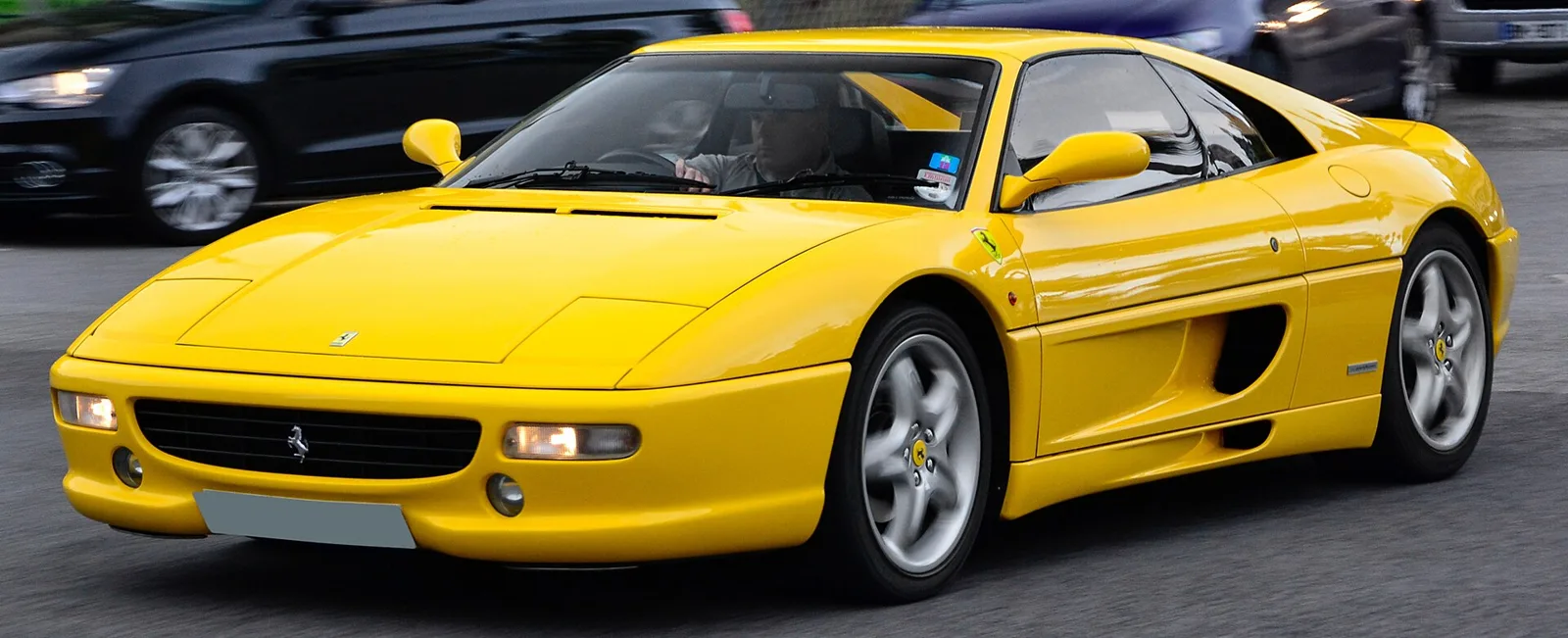
A revised 348 with a 3.5-litre five-valve V8, a Formula 1-derived paddle gearbox, and Berlinetta, Spider, GTS and Challenge versions.
The Ferrari F355 was built from 1994 to 1999 as a heavily revised Ferrari 348. Its 3.5-litre V8 used five valves per cylinder, the car came as a Berlinetta, Spider and GTS, and 11,273 units made it the most-produced Ferrari of its time.
The Ferrari F355 was a mid-engined sports car built from 1994 to 1999, based on a heavily revised 348. It introduced a five-valve V8 with a 3.5-litre capacity, and it gave Ferrari its first road car with a paddle-shift gearbox derived from Formula 1. An open Spider and a targa-roofed GTS followed the original Berlinetta.
When was the Ferrari F355 built?
Ferrari launched the Berlinetta in May 1994, and the Spider and GTS followed in 1995. The F355 ran until 1999, when the all-new 360 replaced it. Total production reached 11,273 units, a record for Ferrari at the time that the 360 and later the F430 surpassed.
The F355 was developed to improve performance while making the car easier to drive across a wider range of speeds, including slow city traffic.
Ferrari's mid-engined line ended its run of Flying Buttress rear windows with the F355, a design traced back to the 1965 Dino 206 GT shown in Paris.
Its name also broke from the older formula. Instead of engine capacity followed by cylinder count, Ferrari used capacity followed by valves per cylinder, so 355 means 3.5 litres and five valves per cylinder.
A five-valve V8, a Formula 1 paddle gearbox and 11,273 road cars made it the most-produced Ferrari of its time.
How did the F355 engine differ from the 348?
The F355 enlarged the 348's V8 from 3.4 litres (3,405 cc) to 3.5 litres (3,495 cc) and adopted a five-valve cylinder head. Those changes raised maximum power to 380 PS (375 hp; 279 kW) at 8,250 rpm and torque to 363 Nm (268 lb ft) at 6,000 rpm.
The stroke grew by 2 mm, from 75 mm to 77 mm, and the connecting rods were forged from a titanium alloy. Compression was 11:1, and each cylinder carried a single spark plug.
Engine management moved from the Bosch Motronic 2.7 in the 1995 model year to the M5.2 unit from 1996 until production ended. Lubrication was by dry sump, and the engine was designed by Paolo Martinelli.
Ferrari also fixed the transmission problems that had troubled the 348. A coolant heat exchanger warmed the gearbox oil quickly at start-up, and a rod-driven actuation system replaced the cable-operated shifting for more precise gear changes.
What was the F355 chassis and suspension like?
The F355 used a steel monocoque with a tubular steel rear subframe, independent unequal-length wishbones and coil springs over gas-filled shocks with electronic control servos. Owners could choose between Comfort and Sport damper settings, and anti-roll bars completed the layout.
Road cars ran Pirelli tyres measuring 225/40ZR 18 at the front and 265/40 ZR 18 at the rear. Power steering was fitted as standard, although a manual rack could be specified by special order.
Aerodynamics received more than 1,300 hours of wind-tunnel work. The car had a spoiler-style profile on the upper tail and an underbody fairing that generated downforce at speed.
The standard seats were trimmed in Connolly leather and fitted asymmetrically, which placed the driver slightly closer to the centreline than the passenger.
Why did the F355 get a paddle-shift gearbox?
The F355 Berlinetta became the first road car with an F1-style gearbox management system in 1997. The system was derived from Formula 1, where it made its debut in 1989 with a win at the Brazilian Grand Prix.
The electrohydraulic system worked the conventional six-speed manual through paddles behind the steering wheel, so both hands could stay on the wheel. Gear changes were faster, and the cars fitted with it were known as the 355 F1.
Fewer than 2 per cent of cars took the Fiorano Handling Pack, and only 0.3 per cent of production had a manual gearbox in that specification.
The Spider and GTS later followed with F1 options, so the paddle gearbox spread across the family rather than staying on the Berlinetta.
Which F355 body styles were built?
The F355 was launched as a Berlinetta, joined by the Spider and GTS in 1995. The Spider used an electrically powered automated soft-top, the first such system on a Ferrari, and the GTS had a removable targa roof that stored behind the seats.
Berlinetta production reached 4,871 road cars, of which 3,829 had the six-speed manual and 1,042 had the F1 transmission. The Spider was the second most popular F355, with 3,717 built, and the GTS totalled 2,577.
The Spider drew on 1,800 hours of wind-tunnel development, which gave it a blend of elegant style and aerodynamic performance. Of the Spiders built, 2,664 had the manual and 1,053 had the F1 gearbox.
Initially the Spider was offered only with the six-speed manual, and in 1997 it gained the F1 transmission as an option.
The GTS offered a removable targa-style hardtop, while other specifications matched the Berlinetta. Its production split was 2,048 manual cars and 529 with the F1 transmission.
How much did the F355 Challenge cost to build?
The F355 Challenge was a race-ready model for the Ferrari Challenge series from 1995. Dealers fitted a US$30,000 factory-supplied conversion kit to a Berlinetta, and 108 cars were built, all with the six-speed manual.
The kit included a roll cage, racing bucket seats, safety harnesses, an engine cut-off switch, a competition clutch, 18-inch Speedline magnesium wheels and 14-inch Brembo brakes carried over from the F40. Pirelli racing slicks completed the package.
Early 1995 cars came with cage mounts and no carpets. By 1998 the cars were supplied as nearly complete race cars, and the dealer still had to fit the rear wing.
What was the Serie Fiorano?
The Serie Fiorano was a limited run of Spider models launched in March 1999, with 100 units planned and 104 built. It added Competizione-derived suspension, drilled brake discs and carbon-fibre trim to the road car.
Because the run was built on the Spider, the Serie Fiorano brought track-focused hardware to the second most popular F355 model.
US deliveries accounted for 100 cars, of which 74 had the F1 paddle-shift transmission and 26 had the six-speed manual. Four more were produced beyond the planned figure, with three for Europe and one for South Africa.
The American units carried a numbered plaque on the dashboard, while the European cars did not. The Challenge-style rear grilles and enamelled Scuderia Ferrari shields were part of the package too.
Chassis numbers for the US cars ran from 115426 to 116799 for the F1 cars and 116291 to 116579 for the manual cars. The three European cars were 116194, 116201 and 116489, and the South African car was 115624.
How fast was the F355?
Ferrari claimed 0-100 km/h in 4.7 seconds and a top speed of 295 km/h (183 mph), while independent testing recorded 0-97 km/h (60 mph) in 4.5 seconds. The redline-limited top speed was 288 km/h (179 mph), and the engine delivered 107.2 hp per litre.
Ferrari's figures also covered 0-161 km/h (100 mph) in 10.8 seconds, 0-400 m in 12.9 seconds and 0-1,000 m in 23.7 seconds.
Independent testers recorded 0-161 km/h (100 mph) in 11.2 seconds, the standing quarter mile in 13.0 seconds at 177 km/h (110 mph) and 0-209 km/h (130 mph) in 19.1 seconds. Braking from 113 km/h (70 mph) to 0 took 156 ft (48 m).
Independent figures also show a rolling start from 8 to 97 km/h (5 to 60 mph) in 5.5 seconds and a top-gear run from 48 to 80 km/h (30 to 50 mph) in 7.9 seconds. Roadholding reached 0.98 g on a 300-ft skidpad.
What are the Ferrari F355 specifications?
The table lists the core figures for the Berlinetta, with the Spider and GTS sharing the same engine and chassis. Where a figure applies to a specific version, such as the Challenge or Serie Fiorano, the table says so.
| Specification | Detail |
|---|---|
| Type | F129, mid-engined V8 sports car |
| Production | May 1994 to 1999 |
| Engine | 3.5 L (3,495 cc) V8, five valves per cylinder |
| Power | 380 PS (375 hp; 279 kW) at 8,250 rpm |
| Torque | 363 Nm (268 lb ft) at 6,000 rpm |
| Specific output | 107.2 hp per litre |
| Gearbox | 6-speed manual; F1 paddle-shift from 1997 |
| Tyres | 225/40ZR 18 front, 265/40 ZR 18 rear |
| 0-100 km/h | 4.7 seconds (manufacturer claim) |
| Top speed | 295 km/h (183 mph) claimed |
| Challenge | 108 cars, US$30,000 kit, 6-speed manual |
| Serie Fiorano | 100 planned, 104 built, March 1999 |
| Total production | 11,273 units |
What made the F355 Challenge different from the road car?
The Challenge shared its engine and physical dimensions with the Berlinetta, so the changes lay in the chassis, bodywork and equipment. Engine, gearbox and shock absorbers were sealed with tags, and a lightened front bumper, a perforated rear grille and brake cooling ducts gave the race car its own look.
Suspension and steering were also changed. The kit included solid suspension bushings, competition springs and a competition steering wheel, plus manual radiator fan control with upgraded fans and a lightweight exhaust.
Each year the cars arrived with more factory-fitted race parts. Front and rear tow hooks and an emblem on the rear identify each car, and some claims of more than 300 converted cars remain unproven.
Was the F355 recalled?
Yes. In November 2009 Ferrari called back roughly 2,400 US-market cars from the 1995-99 run, covering both the manual and F1 versions. The clamps had been placed where they could damage fuel-supply pipes, and the problem came to light when Ferrari was sued over a fire that injured a driver.
The risk was fuel leaking into the engine compartment, and the recall was intended to address it. The action applied to the US market and to the 1995-99 cars, so later models were not part of it.
Frequently asked questions
Was a manual gearbox available on the F355?
Yes. The six-speed manual was the only transmission at launch and stayed on sale after the F1 gearbox arrived in 1997. Most Berlinettas were ordered with it, which shows that many buyers still preferred a clutch pedal. The F1 system was the alternative, and it worked the same conventional six-speed gearbox underneath.
What did the Fiorano Handling Pack include?
The pack was a factory option for European road cars built in the final year of production. It added a quick-steering rack and pump, lowered ride height, uprated springs, a wider track, thicker anti-roll bars and a Challenge EVO suspension control unit, plus red callipers and drilled discs.
Were right-hand drive F355s built?
Yes, but only in small numbers. Ferrari UK imported 18 right-hand drive Challenge cars and had them modified by MHT, while ten more went to other right-hand drive markets, making 28 in total. Some survivors are known in Indonesia, Australia and Japan, with one known example in South Africa.
How did the F355 compare with the 348?
The F355 kept the 348's basic mid-engined layout but gained a larger engine and a new head design. Power rose to 380 PS (375 hp; 279 kW), and the stroke grew from 75 mm to 77 mm. A coolant heat exchanger and rod-driven shifting addressed earlier gearbox problems.
_(cropped).jpg)