Yu Suzuki's convertible racer for Sega set a new standard for arcade driving, sold widely across home formats and gave its name to a synthwave subgenre.
Out Run is a 1986 Sega arcade racer known for its pioneering hardware, nonlinear route choice, selectable soundtrack and hydraulic cabinet. Yu Suzuki designed it around a Ferrari Testarossa convertible, and its success helped lift Sega's arcade business through the late 1980s.
Out Run is a 1986 arcade racing game from Sega, designed by Yu Suzuki. Players drive a Ferrari Testarossa convertible through traffic against a clock, aiming for one of five destinations, and the game later became the top-selling Sega arcade cabinet of the decade.
What is Out Run?
Released in 1986, this Sega racer is famous for its trailblazing hardware, branching routes, choice of soundtrack and hydraulic motion cabinet. Suzuki centred the design on a Ferrari Testarossa convertible, and the hit lifted Sega's arcade fortunes in the late 1980s.
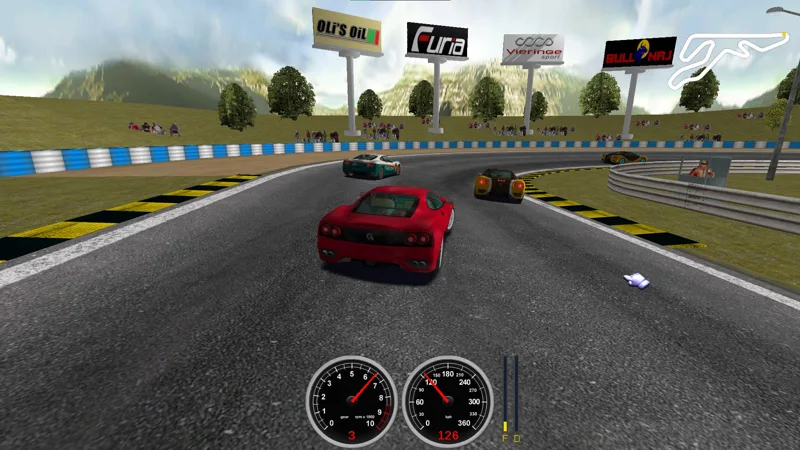
The player's view is a pseudo-3D rear perspective, with the camera set low to the ground. That low position mimics the seat of a car driver and limits how far ahead the player can see, so the road's curves, crests and dips hide the traffic that must be avoided.
A convertible Ferrari, a fork in the road and a motion cabinet that made arcade driving feel like the open road.
How does a stage work?
Each stage is a race against the timer. Reaching the checkpoint at the end of a stage adds time, and near the end of each stage the road splits into routes leading to five destinations. Those destinations sit at different difficulty levels, and each one ends with its own finish sequence.
The endings vary in tone. One sees the Ferrari break down, while another presents the driver with a trophy. The choice of route is what gives the game its nonlinear structure, since players can plan a path rather than follow one fixed road.
Why did Suzuki choose Europe?
His first pitch drew on The Cannonball Run, a 1981 American film he admired. Cars blowing up on impact was something Suzuki could not stand in racers, and he wanted players to enjoy the act of driving and feel superior behind the wheel.
Sega president Hayao Nakayama believed the United States was too unsafe for the project, and suggested Europe instead. Suzuki also felt the American landscape was too vast and bare for his design, so he spent two weeks touring Europe in a BMW 520. Stops included Frankfurt, Monaco, Rome, the Alps of Switzerland, the Riviera in France, Florence and Milan.
How was the Ferrari chosen?
Monaco inspired Suzuki to make the Ferrari Testarossa the playable car. When he returned to Japan he had his team find and photograph one, recording the car from every side and capturing the sound of its engine.
Sega never licensed the Ferrari name for this game. Once Ferrari objected, Sega settled the matter with a payment. Sega licensed the brand for later games in the series, so the car went on to appear in more of its releases.
How was the game built?
Four programmers, one sound creator and five graphic artists formed the team, and everyone had to come from staff not tied to other projects. Suzuki himself handled most of the coding and design work, staying late to finish within ten months.
He believed the hardest part was making the game as much fun as possible. He focused on wide roads, roadside buildings and a radio with a choice of soundtrack.
Suzuki had often found existing boards unsuitable, so the team needed fresh hardware. The result was the Sega OutRun board, built on the design of System 16.
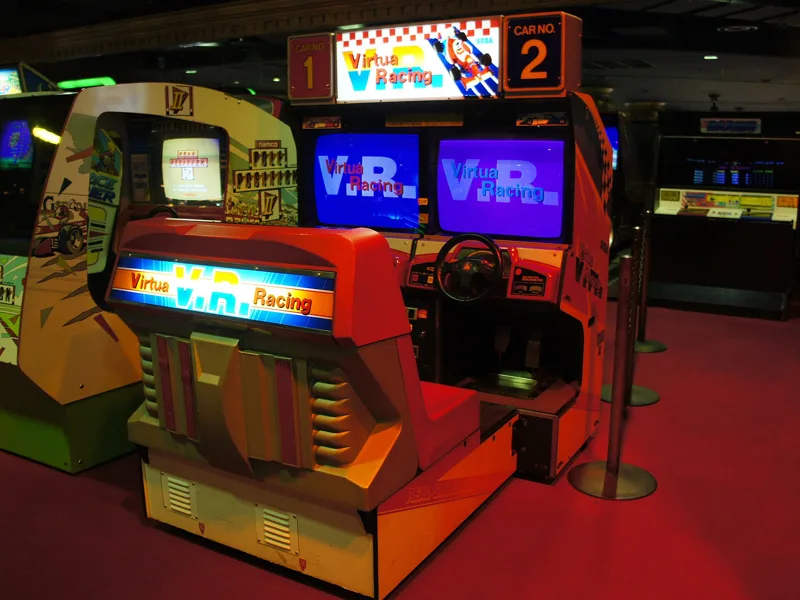
Four cabinet designs were released. Every one offered a wheel, a gear lever and pedals for throttle and brake. Two were upright, and the larger upright model had force feedback in its steering wheel. The other two were sit-down motion simulator cabinets resembling the in-game car, which turned and shook with the on-screen action. All four had stereo speakers behind the driver's head.
What made the driving feel real?
Suzuki wanted skill in real driving to carry over to the game, so the car model reflected horsepower, torque, gear ratios and tyre engineering close to real vehicles. Where drifting was hard to control, he added AI assistance to smooth it out.
Overgripping tyres made the car twitchy, which was a feature absent from earlier racers. Suzuki's approach to the 3D maths was also unusual: he said his designs were always three-dimensional, calculating position, scale and zoom in 3D before converting the results back to a 2D image.
What did the soundtrack contain?
Hiroshi Kawaguchi composed the original score, having previously written music for Suzuki's games, including Hang-On. The style leans towards Latin and Caribbean music, and Kawaguchi pointed to the Latin jazz player Naoya Matsuoka as a key inspiration.
Three tracks can be chosen on the car radio: Passing Breeze and Splash Wave, along with Magical Sound Shower. A further piece, Last Wave, plays on the final score screen. The arcade audio contained corrupted samples after a master ROM chip failed, and the glitch went unnoticed until a 20th anniversary box set was prepared. The team then pulled clean files off an 8-inch floppy disk, and subsequent versions used the repaired data.
Cassette tapes carrying the arcade score were handed out in the United Kingdom in December 1987, both with home computer conversions and with a magazine. The Mega Drive port kept the arcade music and added one exclusive track, Step On Beat, composed by Masayoshi Ishi.
Which versions were released?
The game reached many home systems, and not all of them arrived in the same form. The table below lists the main platforms and what made each one notable, based on contemporary reviews and the later re-releases.
| Platform | Notable detail |
|---|---|
| Master System | Released in 1987; praised by Computer and Video Games for capturing the arcade thrill |
| Genesis | Released in 1991; scored 90% from Joypad and Joystick in France |
| Amstrad CPC | Scored 8 out of 40 in Computer and Video Games, which called it a travesty |
| ZX Spectrum | Your Sinclair and Sinclair User both gave it favourable marks |
| Game Boy Advance | Included in the Sega Arcade Gallery collection |
| Nintendo 3DS | Released through the 3D Classics series |
| Saturn and Switch | Released as part of the Sega Ages series |
Not every planned version appeared. A conversion for the X68000 by Hertz was cancelled by management, and a 32X version was reportedly in development but never released.
How did Out Run sell?
Out Run sold well in the arcade and at home. It topped the Japanese upright cabinet charts in November 1986 and became the highest-grossing arcade game in Japan in 1987. In the United States it was the top-earning arcade game of the same year, and in the UK it held the top spot on London's Electrocoin charts for several months.
Sega had sold 18,000 machines by early 1987, and it reached 20,000 units worldwide by late 1987. Those cabinets earned Sega over $100 million in arcade machine sales. By 1994, around 30,000 cabinets had been sold, and Sega later passed those sales with Virtua Fighter.
The home conversions sold just as strongly. The 8-bit ports from U.S. Gold passed 200,000 copies within two weeks in the UK, and passed 250,000 by Christmas 1987. The Atari ST version became the first ST title to top a Gallup chart, in May 1988.
Its chart presence lasted for years. A cheap Kixx re-release reached the top of the all-formats chart in November 1990, while the Commodore 64 edition sat at number two in March 1991. In Japan the game placed third in 1988, fifth in 1989 and seventh in 1990, and in Europe it was the most popular arcade game of the late 1980s.
How did critics react?
The arcade original was a critical favourite, collecting the 1987 Golden Joystick honours for best game and best arcade game. Reviewers praised the hydraulic cabinet and the sense of speed. Top Score described it as the most enjoyable and most lifelike driving game it had seen, and Commodore User gave it 9 out of 10.
Clare Edgeley, writing in two magazines, liked the visuals, the sense of peril and the motion cabinet. The game also took a Best Visual Enhancement prize at the 1986 Players Choice awards.
Home reviews were more mixed. According to Games Machine, the Master System port came closest to the coin-op, and it earned 72%. The 8-bit computer versions were less consistent, with the Spectrum port receiving 61% in Games Machine and the Amstrad CPC version scoring a low 37% in Amstrad Action.
What sequels followed?
Out Run was followed by a long line of sequels, starting with the arcade Turbo OutRun in 1989 and OutRunners in 1992. OutRun 2 arrived as an arcade game in 2003, and home sequels included OutRun 3-D in 1988, Out Run Europa in 1991 and OutRun 2019 in 1993.
Sega also developed Rad Mobile in 1990, a game that resembles Out Run closely.
Several later racers adopted branching routes, and the car-radio idea, in which players pick their own music, appears in Grand Theft Auto and other titles.
Why does Out Run still matter?
Many critics count it among the finest games, and numerous later titles acknowledge its influence. It is closely tied to the taikan style of motion cabinets and played a role in the arcade industry's recovery.
Former Sega arcade director Akira Nagai credited Out Run and related games for the company's arcade success in the 1980s. He said the taikan games helped Sega's arcade business rise from its weakest point, and that Out Run helped lift the industry out of a slump and created new genres.
Its influence reaches outside games too. Synthwave music is often called outrun music, a name inspired by the soundtrack and the 1980s look of the game. Kavinsky, a French musician, titled his first album OutRun in 2013. Wired's Jacopo Prisco has said the game's influence is still felt across games, music and film.
In 2015 IGN placed Out Run fourth on its list of influential racing games, after Pole Position, Gran Turismo and Virtua Racing. Luke Reilly argued that its elements can be found in later games, including Forza Horizon and Driveclub.
Is there a film in development?
Yes. On 21 April 2025, Universal Pictures said it was developing a live-action picture based on the game. Michael Bay is the director, Jayson Rothwell is the writer and Sydney Sweeney is the producer.