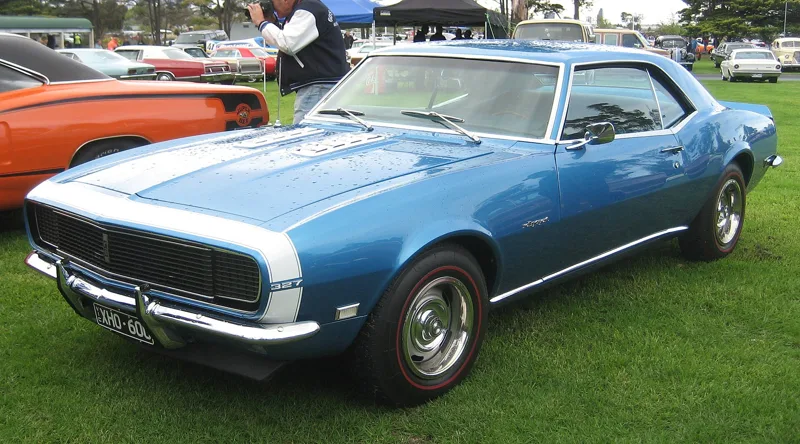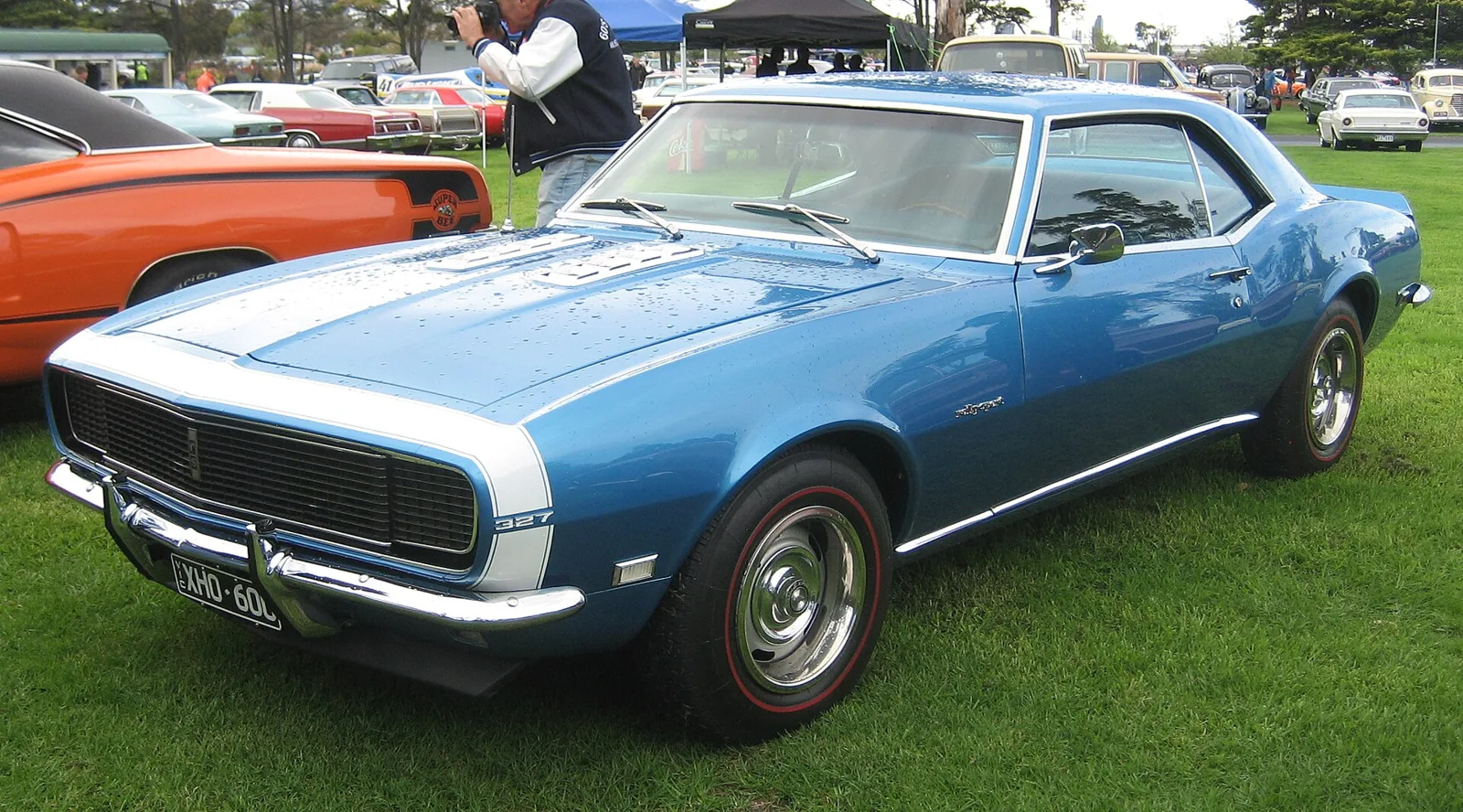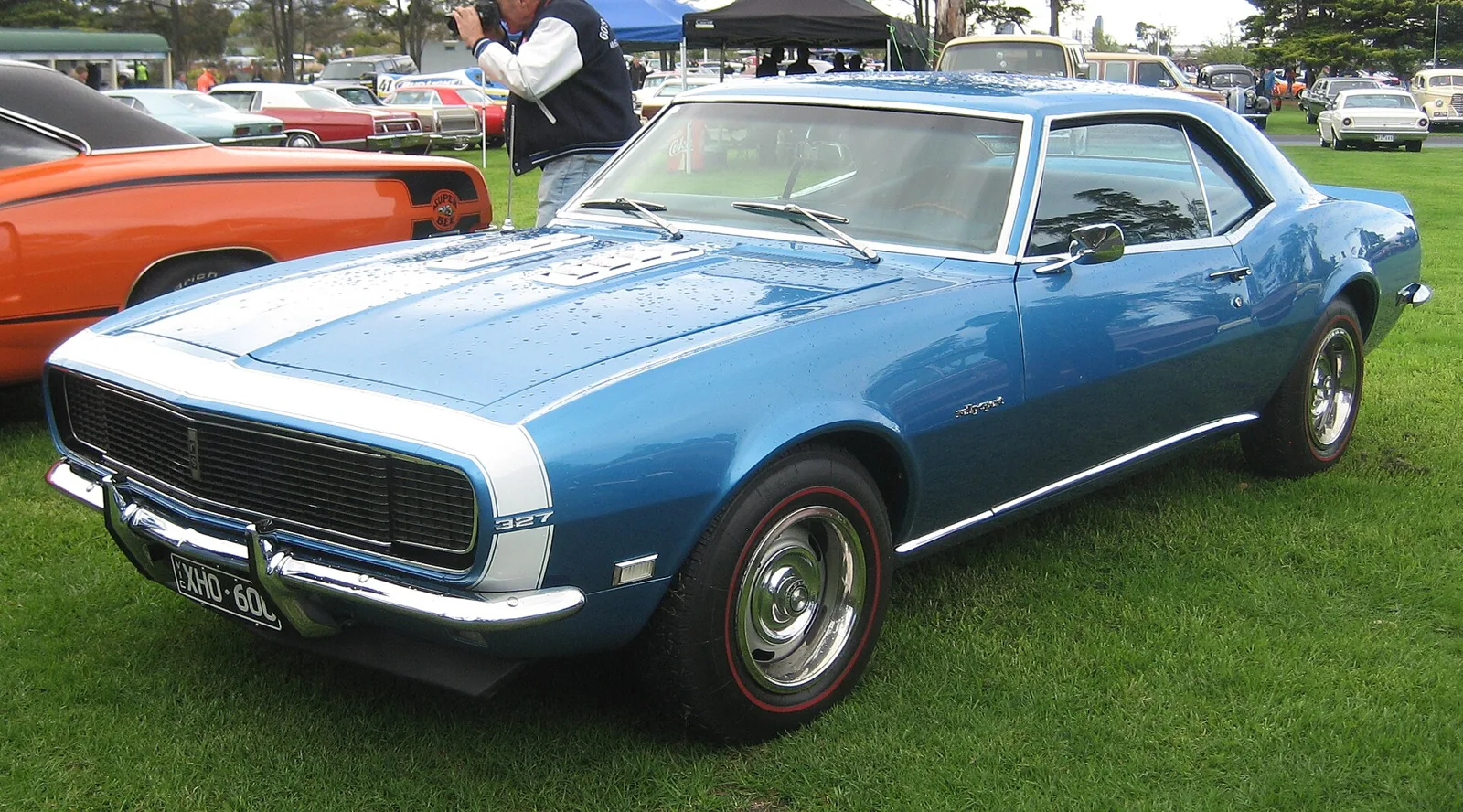
Launched for 1967 on a new GM F-body platform, the first Camaro offered six-cylinder and V8 engines, and its Z/28 was designed to compete in Trans-Am racing.
The first-generation Chevrolet Camaro was a pony car introduced in 1966 for the 1967 model year, built on GM's F-body platform. It came with a 230 cu in straight-six and a range of V8s, and its Z/28 option was built for Trans-Am racing.
The first-generation Camaro appeared in fall 1966 as a 1967 model, a two-door pony car on a rear-wheel-drive F-body chassis that GM had just introduced. A six-cylinder was standard and a range of V8s was optional, and the Z/28 package was built to be race-ready from any Chevrolet showroom.
What was the first-generation Camaro built on?
The car rode on a fresh GM F-body chassis, and that same platform was shared with the Pontiac Firebird in every generation. The Camaro came as a 2-door hardtop, a 2+2 and a convertible, with the 2+2 offering the rear seat that the coupe lacked.
Its styling came from the group that drew the 1965 second-generation Corvair. The subframe and semi-unibody construction matched the 1968 Chevy II Nova, and the car offered almost 80 factory options and around 40 dealer-installed options.
Almost all 1967 to 1969 cars were built in Norwood, Ohio and Van Nuys, California. Five plants outside the US also built Camaros, namely Peru, Venezuela, Switzerland, Belgium and the Philippines, where local assembly and local content were required.
A 302 V8 sold from a showroom and a 427 that dealers fitted themselves defined the first Camaro.
Which engines came in the first Camaro?
The base six was a 230 cu in unit from the Chevrolet Turbo-Thrift family, rated 140 hp (104 kW) at 4,400 rpm and paired with a three-speed manual. Eight engines were offered in 1967, ten in 1968 and twelve in 1969, so the choice widened every year.
Transmissions included the two-speed Powerglide, a four-speed manual that could be paired with any engine, and the three-speed Turbo Hydra-Matic 350 on most V8s from 1968. The SS 396 used a three-speed Turbo 400 automatic.
The SS 350 produced 295 bhp (299 PS; 220 kW) at 4,800 rpm. On the 396 big-block, buyers could choose 325 bhp (330 PS; 242 kW) in one tune or 375 bhp (380 PS; 280 kW) in the stronger one, with 563 Nm (415 lb ft) of torque at 3,600 rpm.
What was the Z/28?
The Z/28 option was first listed in December 1966, aimed at the 1967 model. Vince Piggins was its champion, and he believed dealers could sell Camaros that were virtually race-ready. The sales brochures never listed the package, so most buyers did not know it existed.
The engine was a 302 cu in V8 designed for the 5-litre class of the Trans-Am series. It had a 4 in (101.6 mm) bore and a 3 in (76.2 mm) stroke, an aluminium intake manifold and a 780 cfm Holley carburettor. Chevrolet advertised 290 hp (216 kW) at 5,300 rpm, deliberately understated to keep insurance and racing classification costs down.
The Z/28 came with power front disc brakes, a four-speed Muncie close-ratio manual and a 12-bolt rear axle. It also wore 15-inch rally wheels, while the rest of the 1967 to 1969 range used 14-inch wheels, and Chevrolet sold 602 Z/28 Camaros in 1967.
Ford did not mount a head-to-head rival until 1969, when the Boss 302 Mustang arrived.
How did the Camaro change in 1968 and 1969?
The 1968 car lost its side vent windows in favour of Astro Ventilation, and it gained side marker lights for the new safety rules. Square mirrors replaced the round ones, and the front running lights changed from circular to oval.
A 396 V8 rated 350 hp (261 kW) at 5,200 rpm joined the SS option in 1968, and Z/28 sales rose to nearly 7,200 that year. The Z/28 also appeared in Camaro brochures for the first time.
A 1968 Z/28 later raced in the 1971 British Saloon Car Championship, held at Crystal Palace, where it fought a three-way battle for the lead.
The 1969 Camaro kept the drivetrain but had new sheet metal, apart from the hood, trunk lid and roof. The grille was redesigned with a sharper V, and the Z/28 sold over 20,000 units. The Rally Sport option drew 37,773 orders at US$131.65.
Four-wheel disc brakes, RPO JL8, cost US$500.30, and only 206 units were produced. The 1969 model year ran on into November 1969 because manufacturing problems held up the second generation.
Which Camaro paced the Indianapolis 500?
The 1967 RS/SS convertible, fitted with a 396 V8, served as the Indianapolis 500 pace car. The factory later sold 100 replicas to the public, so ordinary buyers could own a car like the one that had led the race's parade.
The pace car's engine was the 396 offered in the SS option, which gave buyers a ready reference point for the engine they could order.
The SS package brought non-functional hood inlets and striping, and SS badges appeared on the grille, the front fenders, the gas cap and the horn button. Those details marked the car out from the base Camaro without changing its basic structure.
Why were COPO 427 cars built?
General Motors barred its divisions from fitting engines above 400 cu in to mid-size and smaller cars. Dealers such as Don Yenko were already installing 427 engines themselves, so Chevrolet offered them through a fleet-style order process, using Central Office Production Orders numbered 9560 and 9561 in the 1969 model year.
The orders were a formal route to a conversion that had been happening in dealer workshops. Installation work by dealers in Pennsylvania, New York, Illinois and California had already put big engines into Camaros before the factory stepped in.
What did the COPO 9561 and ZL1 engines make?
The COPO 9561 used a cast-iron block and heads with the solid-lifter L72 big-block, rated 425 hp (317 kW) at 5,600 rpm and 624 Nm (460 lb ft) of torque. Yenko ordered 201 of these cars and converted them into Yenko Camaros, and roughly a thousand Camaros received the L72 option in total.
The COPO 9560 used an all-aluminium ZL1 designed for drag racing. Drag racer Dick Harrell conceived it, and Fred Gibb Chevrolet in Illinois took the orders for NHRA Super Stock. Sixty-nine ZL1 Camaros were produced, and the engine by itself cost more than US$4,000.
The ZL1 was rated 430 hp (321 kW) at 5,200 rpm, and its torque reached 610 Nm (450 lb ft). It could make over 500 gross horsepower with exhaust changes and tuning, and each engine took 16 hours to hand-assemble in a room that Zora Arkus-Duntov called surgically clean.
What did the RS package add?
The RS appearance package could be fitted to any model, so buyers could add it to any car in the line-up. It included hidden headlights, which sat behind doors that retracted horizontally when the lamps were opened, along with revised taillights, with back-up lights set under the rear bumper.
RS badges and bright exterior trim completed the package. It gave the car a more dressed-up look without adding performance, and it was a styling choice rather than a mechanical one.
What were the Swiss-built Camaros?
Cars assembled at GM's Biel facility in Switzerland were all coupes. They used a 283 cu in Chevrolet V8 rated 198 PS (146 kW; 195 hp) at 4,800 rpm, its torque 386 Nm (285 lb ft) at 2,400 rpm, and that engine was not offered in the contemporary US-built Camaros.
Limited-slip differentials and front disc brakes were fitted as standard, along with additional safety equipment. The Swiss-built cars show how the car was adapted to local content rules. They are a small but distinctive part of the first-generation story.
Specifications at a glance
| Specification | Detail |
|---|---|
| Production | 1967 to 1969 model years; GM F-body platform |
| Standard engine | 230 cu in straight-six; 140 hp (104 kW) at 4,400 rpm |
| SS 350 | 295 bhp (299 PS; 220 kW) at 4,800 rpm |
| Z/28 (1967) | 302 cu in V8; 290 hp (216 kW) at 5,300 rpm advertised |
| Z/28 (1969) | 290 hp (294 PS; 216 kW) at 5,800 rpm; 393 Nm (290 lb ft) |
| COPO 9561 | L72 427 V8; 425 hp (317 kW) at 5,600 rpm |
| COPO 9560 | All-aluminium ZL1; 430 hp (321 kW) at 5,200 rpm |
| Build plants | Norwood, Ohio and Van Nuys, California |