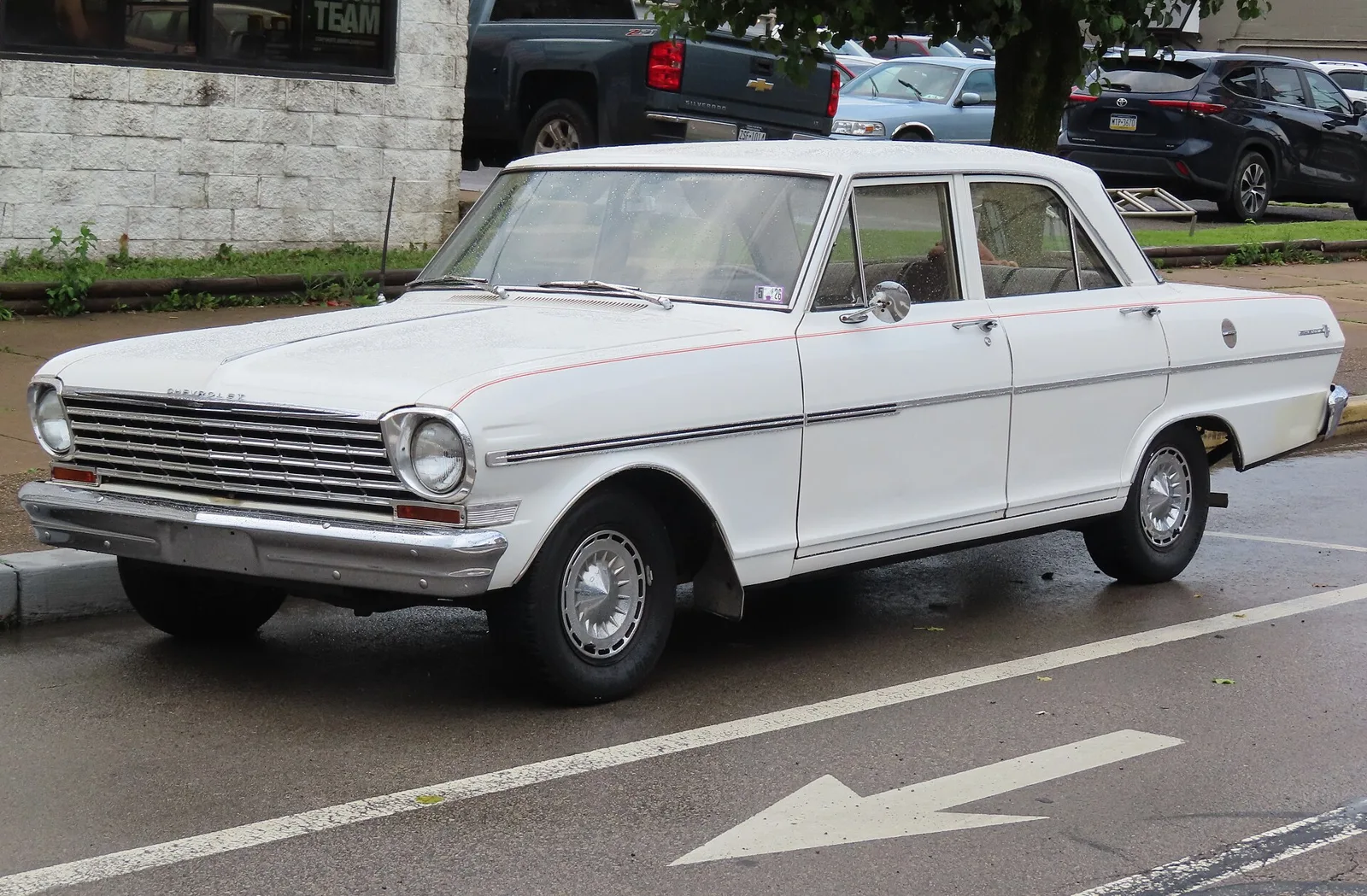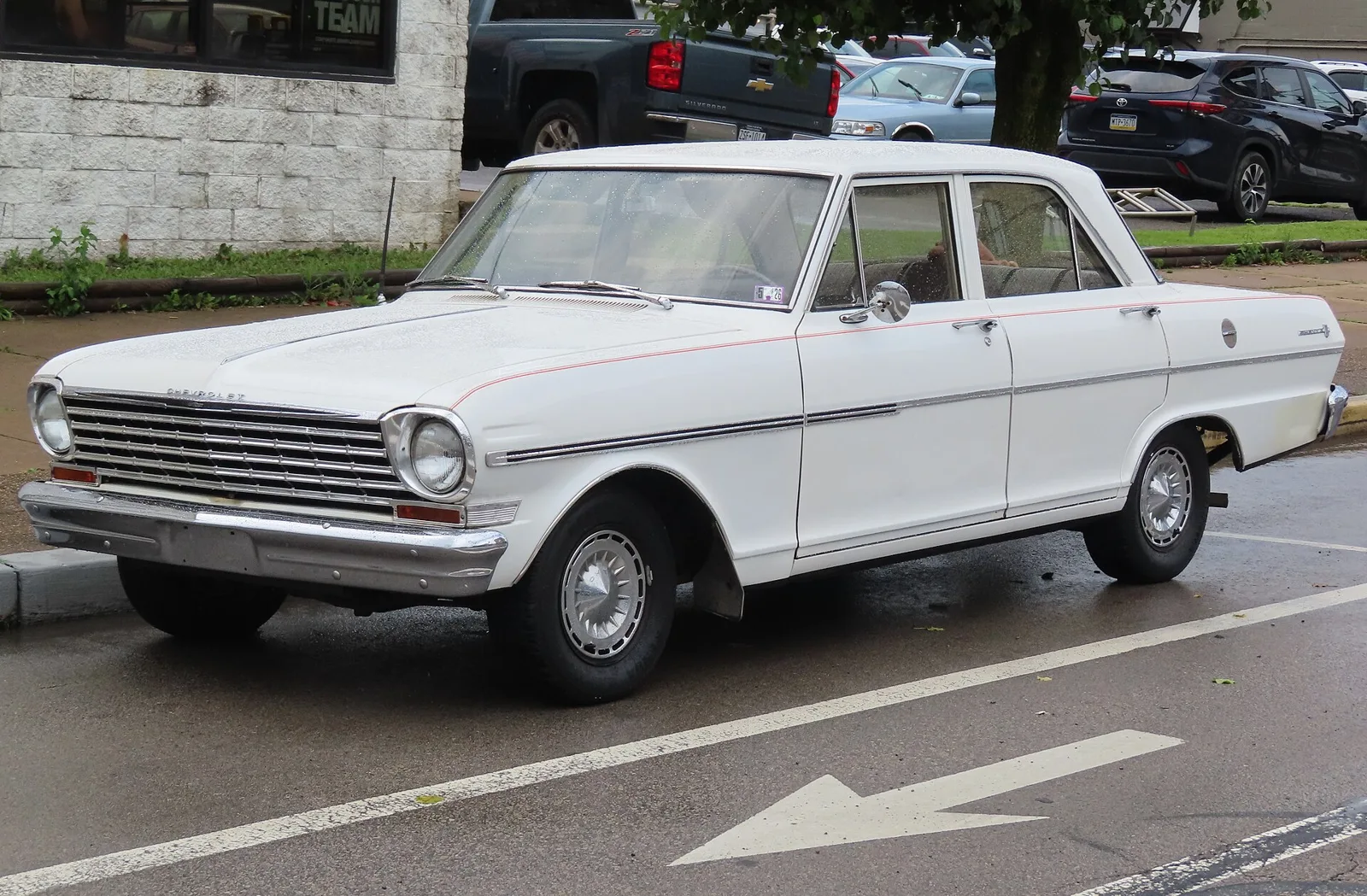
Chevrolet built its compact in eighteen months to answer the Falcon, while Dodge shrank a full-size car into a compact that ran until 1976.
The Chevy II was Chevrolet's 1962 compact, later sold as the Nova, and it became a muscle car in 1965. The Dodge Dart began as a downsized 1960 model and became a compact in 1963, with a long life that ended in 1976.
The Chevrolet Chevy II, later sold as the Nova, and the Dodge Dart were both American compacts that arrived to meet a challenge from the Ford Falcon. Chevrolet built its car in roughly eighteen months, and it did so with a deliberately simple brief. Dodge's Dart started life as a downsized full-size car in 1960 and became a true compact in 1963. Both lasted well into the 1970s, though each followed a different path.
Why did Chevrolet build the Chevy II?
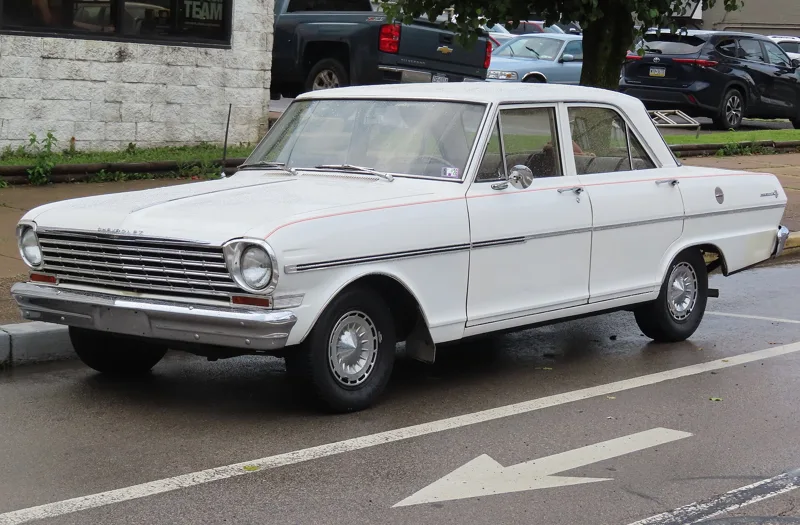
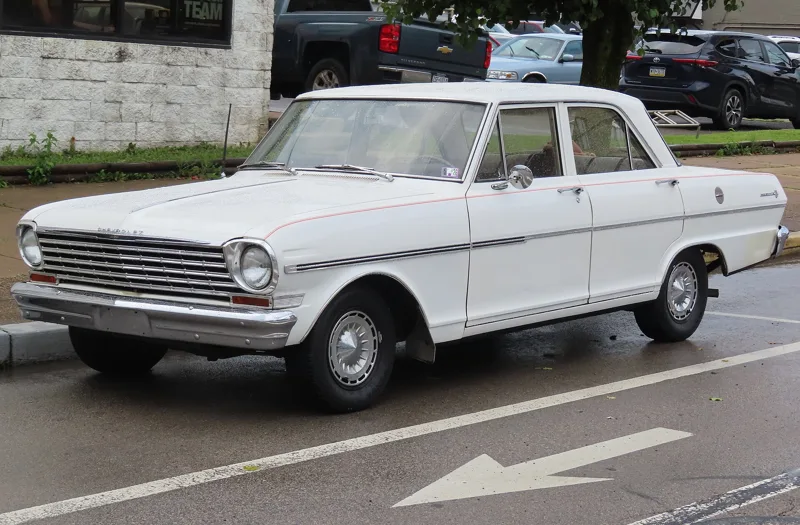
Chevrolet wanted a basic compact to compete with the Falcon, after the rear-engined Corvair had been outsold by the conventional Ford car. The Chevy II reached showrooms in September 1961. Its 110 in (2,794 mm) wheelbase was slightly longer than the Falcon's, and Chevrolet general manager Ed Cole pitched it on thrift and practical function.
The programme ran fast by GM standards. Engineers had the first production car rolling off the Willow Run line in August 1961, and the car was designed to avoid novelty altogether. It was the first Chevrolet with a four-cylinder engine since 1928, and the second post-war American Big Three car to use one. The Nova name had lost an early argument, but it went on to top the range before the Chevy II badge was dropped for 1969.
Chevrolet answered the Falcon with a car built in eighteen months, while Dodge turned a full-size Plymouth rival into a compact that lasted into the 1970s.
How did Dodge end up with the Dart?
Dodge launched the Dart for 1960 as a downsized full-size car, aimed at Dodge dealers who had been selling Plymouths since 1930. Its name was first used on Chrysler show cars in 1956 and 1957, one of them built by the Italian coachbuilder Ghia.
The production Dart was a Plymouth-derived unibody on a 118 in (2,997 mm) wheelbase, and it sold better than the larger Dodge Matador and Polara.
The Dart's arrival was not all smooth. Dodge's upper models were pushed upmarket, while Plymouth-derived products took over the lower end of the range. Chrysler executives let the two divisions fight it out, and the Dart's success meant the Matador left the range after 1960. Only in 1963 did the Dart become a compact, with a 111 in wheelbase and the same A-body suspension used by the Valiant.
Specifications side by side
| Specification | Chevrolet Chevy II / Nova | Dodge Dart |
|---|---|---|
| Production span | 1962 to 1979 model years | 1959 to 1976 in North America |
| Wheelbase | 110 in (2,794 mm) at launch; 111 in (2,819 mm) from 1968 | 118 in (2,997 mm) in 1960; 111 in (2,819 mm) as a compact from 1963 |
| Base engine | 2.5-litre (153 cu in) four, 1962 and 1963 | 3.7-litre (225 cu in) slant six in 1960; 2.8-litre (170 cu in) slant six from 1963 |
| Top engine | 5.4-litre (327 cu in) V8, up to 300 hp (220 kW) in 1965; Turbo-Fire 350 hp (260 kW) in 1967 | 6.8-litre (413 cu in) Ramcharger V8, 415 hp (309 kW) from mid-1962 |
| Body styles | Sedan, wagon, hardtop and convertible in 1962 | Sedan, hardtop, convertible and station wagon as a compact |
| Muscle versions | Super Sport and Nova SS from 1963 onwards | Dart GT, plus the yellow Dart Charger hardtops of 1965 |
| Sales | 122,800 built in 1965; 106,500 in 1967 | 142,708 Darts in 1961 |
| Starting price | US$2,475 for the 1962 Nova 400 convertible | None given |
How did the Chevy II become a muscle car?
The Chevy II became a muscle car in 1965, when a 327 V8 with up to 300 hp (220 kW) arrived. Before that the Super Sport package had been a trim and appearance option, and the standard SS engine was a six.
Enthusiasts swapped in small-block V8s regardless of the factory rules, which tells you how keen the market was for a faster compact.
The 1966 restyle gave the car squared proportions and a semi-fastback roof, with the Super Sport badged as a Chevy II SS. In 1967 the Nova SS option replaced those badges. The top engine that year was a Turbo-Fire 327 rated at 350 hp (260 kW), first seen in the Chevelle, and paired with a close-ratio four-speed manual it made the mild Nova a proper muscle car.
The 1965 Chevy II received a cleaner front end, with a full-width grille, new integrated headlight bezels and restyled taillights. The Super Sport now offered a brushed-chrome console with a floor-mounted four-speed or Powerglide automatic, and its instrument panel added an ammeter alongside oil pressure and temperature gauges.
The 1963 Super Sport package had cost US$161.40, about $1,718 in 2025 dollars, and it brought special emblems, wheel covers, bucket seats and a floor shifter. It was limited to the 400-series sport coupe and convertible, and the standard SS engine remained a six.
What were the Dart's early years like?
The 1960 Dart came with three trims, Seneca, Pioneer and Phoenix, and its standard engine was a 3.7-litre (225 cu in) slant six. Darts also offered 318 and 361 cu in V8s, with two- or four-barrel carburettors, and the 383 arrived in 1961. Brakes were 11-inch drums.
Dodge production rose to 367,804 cars for 1960, the division's best total to date, and it placed sixth in the American market, with Chevrolet at the head of the table. Chrysler's leaders worried that most of Dodge's volume now came from the low-margin Dart line.
Did the 1961 Dart styling hurt sales?
The 1961 Dart's styling was widely disliked, and the figures do not isolate its effect on sales. Dodge still sold 142,708 Darts that year, in an off-year for the wider car market, while drivers behind complained that the low, small tail lights were hard to see.
By mid-year Dodge offered auxiliary taillights through dealers, though those large round lamps sat awkwardly against the fins. Sales of the Dodge Lancer reached 74,773 units, while Plymouth's Valiant sold 143,078 cars in the same year.
How did the compact Dart take shape?
The 1962 Dart was downsized onto a new B-body unibody with Chrysler's Torsion-Aire front suspension. The Lancer name was dropped in favour of the Dart for 1963, and the car became a senior compact on a 111 in (2,819 mm) wheelbase.
The Dart was available as a sedan, hardtop, wagon and convertible, with the GT as the premium model.
Chrysler's engines moved forward through the mid-1960s. The 273 cu in LA V8 arrived in 1964 at 180 bhp (130 kW), and a four-barrel version gave 235 bhp (175 kW) in 1965. That year the Dart Charger, a yellow GT hardtop with a black interior, became the first Dodge to carry the Charger name. The 1963 sales jump was sharp, and the Dart stayed popular for the rest of its run.
Which car sold better?
Dart sales and Chevy II sales do not line up cleanly because the two makers reported in different ways. The Chevy II built 122,800 units in 1965, against 213,601 Falcons, and it was the only GM model to see a sales decline that year.
The Dart sold 142,708 units in 1961 as part of a Dodge total of 269,367.
Output fell again after 1965, and in 1967 Chevy II sales fell by over a third, to 106,500. The Dart's popularity held through the 1960s, and it remained a strong seller against the Falcon and the Nova right up to 1976.
What did the Dart's B-body platform add?
The 1962 Dart rode on Chrysler's B-body, a lightweight unibody with Torsion-Aire torsion bars at the front and asymmetric rear leaf springs. Its low unsprung weight and near-ideal geometry gave the car sound handling, braking and acceleration.
The platform stayed in use with only slight changes for nearly two decades, through to the 1981 R-body cars.
The mid-year 1962 Ramcharger, a 413 cu in (6.8 L) V8 rated at 415 hp (309 kW), was built with the strip in mind. It was aimed at sanctioned drag racing, and it set performance records almost as soon as it was raced. Dodge also ran a turbine experiment on the platform, when a CR2A turbine engine was fitted to a 1962 Dart and made the trip from New York to Los Angeles in spite of snow, rain and strong winds.
The 1963 compact had a turning circle of 38.9 ft (11.9 m). Buyers could still choose the pushbutton Torqueflite automatic, which was offered for 1963 and 1964 only, and 1964 added sturdier door locks plus a better automatic choke.
How did the Dart compact change after 1965?
The fourth generation arrived for 1967 with the 170 cu in slant six still standard, but its output rose to 115 hp (86 kW) through a carburettor and camshaft change inherited from the 225. For 1970 the base six became a 3.2-litre (198 cu in) unit that shared the 225's block and cost less to make.
Wagons followed their own path. The 1963 to 1966 wagons kept the Valiant's shorter 106 in (2,692 mm) wheelbase, while the 1971 to 1976 Demon and Sport models switched to a 108 in (2,743 mm) platform borrowed from the Duster.
How did the Chevy II's later life unfold?
The third generation, from 1968, was fully redesigned on a 111 in wheelbase that left the chassis one inch shorter than the Chevelle coupe. The station wagon and the hardtop sport coupe were dropped, which left American Motors as the only US maker of compact wagons until Chrysler returned to the market in 1976.
Those cars were also sold under Buick, Pontiac and Oldsmobile badges, as the Apollo, Ventura and Omega.
The fourth generation appeared in 1975 and shared its chassis, though not its bodywork, with the Cadillac Seville. Chevrolet dropped the Nova name in 1980 when GM moved the X platform to front-wheel drive, using the Citation badge instead. The name came back in 1985 on a subcompact built with Toyota at the NUMMI joint venture, using the body of the Toyota Sprinter. In 1989 the Nova gave way to the Geo Prizm.
Which compact suits which buyer?
A buyer who wanted an early V8 compact with the Nova SS badge had the Chevy II, and from 1967 the 350 hp option gave a serious performance car. A buyer who wanted a Dodge with a longer line of trims, a 1962 Ramcharger for drag work or the 1965 Charger hardtop had the Dart.
The records do not name a single winner, because each car pursued a different kind of compact buyer.