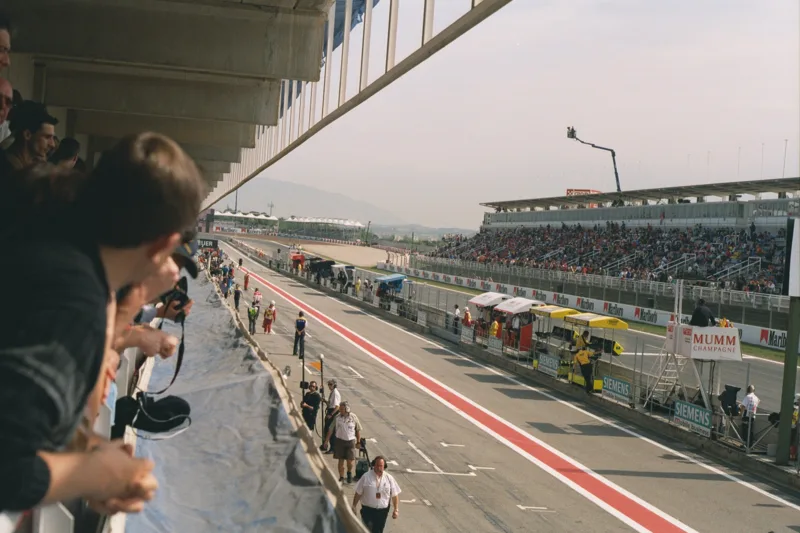
A first career pole for Ralf on his 26th birthday, a race led by him for 23 laps and a Ferrari win from second on the grid.
The 2001 French Grand Prix at Magny-Cours on 1 July was decided in favour of Ferrari's Michael Schumacher, who started second and won. Brother Ralf had taken pole for Williams and finished second, with Barrichello third. The result extended Michael's lead over Coulthard in the drivers' table to 31 points.
Michael Schumacher won the 2001 French Grand Prix from second on the grid, the 50th victory of his career. His brother Ralf had taken his first pole position on his 26th birthday, and the younger Schumacher led the opening 23 laps before the first round of stops changed the order.
Who won the 2001 French Grand Prix?
Michael Schumacher won the 72-lap race for Ferrari from second on the grid. Ralf Schumacher finished second for Williams, and Rubens Barrichello was third in the other Ferrari. It was the tenth round of seventeen in the 2001 World Championship, and the 51st running of the French Grand Prix in the series.
The win was Michael's sixth of the season and his 50th in Formula One. He moved further ahead of David Coulthard in the drivers' table, and the result left Coulthard chasing him for the rest of the season.
Ralf Schumacher took the pole on his 26th birthday, but Michael's sixth win of 2001 came from second on the grid.
What kind of circuit is Magny-Cours?
Magny-Cours is a 15-turn circuit of 4.251 km (2.641 mi), with a mixture of low- and high-speed corners and four long and short straights. Its surface is flat and smooth, with no deformation to disrupt the cars, so Bridgestone and Michelin brought soft compounds to maximise mechanical grip.
Those tyre choices made the weekend a question of set-up as much as of straight-line speed. Each team had to balance mechanical grip against the track's variety of corners, and the best lap was a matter of getting the car to work through every section.
Why did Ralf Schumacher's pole matter?
Ralf took the first pole position of his career with a lap of 1:12.989, on his 26th birthday and in his 76th entry. It was also the first pole for the Williams team since the 1997 European Grand Prix, and he twice beat the qualifying track record held by Nigel Mansell, the 1992 champion.
Michael was ten-thousandths of a second slower in second, and was the early pace setter until Ralf's time. He was distracted by Ferrari technical director Ross Brawn over the radio and was later baulked by Jarno Trulli on his third timed lap.
What was the championship picture before Magny-Cours?
Michael Schumacher led the drivers' table with 68 points, ahead of Coulthard on 44 and Barrichello on 26. Ralf was one point behind Barrichello in fourth, and Juan Pablo Montoya was on 12 points in fifth. Ferrari led the constructors' table with 94 points, 41 ahead of McLaren.
Williams were third on 37 points, with Sauber on 15 and Jordan on 13 contending for fourth. Coulthard had won the 2000 French Grand Prix and said he expected McLaren to be within four-tenths of Ferrari, depending on tyre wear, while Michael took a race-by-race view. He called Coulthard his main rival, with eight races still to go.
What did the teams change for Magny-Cours?
Renault debuted a revised specification of its V10 in the Benetton B201s of Fisichella and Button. The new engine did not increase top speed, and the cars remained slow throughout the weekend. Prost revised the suspension geometry and the bodywork of its AP04 chassis.
Sauber mounted a new front wing on its C20 with a V-shaped design, and BAR introduced a new rear suspension developed by Honda on Olivier Panis's 003 chassis. Ferrari went furthest in testing, carrying out a shakedown of the F2001 at Fiorano on 28 June, the only constructor to do so before the race.
How did the spare-car rule change before the race?
Ferrari's shakedown session was six hours and 45 minutes long, with Luca Badoer driving 45 km (28 mi) to test the electrical systems and practise launch control starts. The move came as the FIA's World Motor Sport Council, meeting in Paris on 27 June, agreed a rule change for the grid.
Under the revised wording, a driver who stalled on the grid before the formation lap lost the right to the spare car. A swap into the spare had to happen 15 seconds before the formation lap began, and it spared the driver a pit-lane start.
How did Friday practice go?
The Friday sessions took place in hot and clear weather. In the first session, held on a slippery track on Friday morning, Hakkinen was fastest at 1:15.889, with Michael Schumacher 0.155 seconds behind in second. Coulthard and Barrichello were third and fourth, and Ralf and Montoya fifth and sixth.
Ralf's running ended early when a water leak appeared, possibly caused by a damaged pipe in the sidepod from debris off Raikkonen's Sauber. Irvine got his Jaguar stuck in the gravel on his first attempt at a fast lap, and Raikkonen's front wing detached as he left the pit lane, causing him to oversteer through the gravel at high speed.
Coulthard was quickest in the second session at 1:14.935, late in the session. Irvine was second, Villeneuve third and Hakkinen fourth. Verstappen's Arrows engine failed on the pit lane straight, and he took over Bernoldi's car for the final 20 minutes of the session.
Who was fastest on Saturday?
Michael Schumacher was fastest in the third session on Saturday, at 1:13.729, set late in the session. Coulthard was 0.406 seconds behind in second and Ralf third, with Barrichello fourth and Montoya and Trulli fifth and sixth. Frentzen, Panis, Villeneuve and Raikkonen were seventh to tenth.
In the fourth session Michael Schumacher remained quickest without improving his lap. Ralf was second, the two McLarens were third and fourth with Coulthard ahead of Hakkinen, and Trulli fifth. Barrichello was sixth, Montoya seventh and Heidfeld eighth, with Irvine ninth and Raikkonen tenth.
What was the qualifying top ten?
| Position | Driver | Qualifying note |
|---|---|---|
| Pole | Ralf Schumacher | 1:12.989, first pole of his career on his 26th birthday |
| Second | Michael Schumacher | Ten-thousandths of a second slower, distracted by Brawn on the radio |
| Third | David Coulthard | Gravel from Burti's Prost at Lycee corner affected his lap |
| Fourth | Mika Hakkinen | Minor engine vibrations and an error on his final timed lap |
| Fifth | Jarno Trulli | Set his best lap late and apologised for slowing Michael |
| Sixth | Juan Pablo Montoya | Slower Williams, annoyed by Alesi on his last lap |
| Seventh | Heinz-Harald Frentzen | Baulked by Panis on his fast lap |
| Eighth | Rubens Barrichello | Handling problem on the limit, with a late best lap |
| Ninth | Nick Heidfeld | Made minor adjustments that improved the balance |
| Tenth | Jacques Villeneuve | Adjusted his flaps during the first half-hour |
How did qualifying play out?
Saturday's one-hour session was run in hot and sunny weather, with each driver limited to twelve laps and the 107 per cent rule in force. Ralf Schumacher twice surpassed the qualifying track record set by Mansell, and his second timed run set the pole. Montoya drove on the harder, slower compound, and his lap was slowed by Alesi's blocking at the end of the session.
Michael Schumacher led the early running until Ralf's time, and Trulli later baulked him on his third timed lap, which Trulli apologised for after the session. Coulthard ran over gravel from Burti's Prost, which caused a minor mistake, and he set his time on the fourth run with three minutes left in the session.
Burti's Prost spun on his third timed lap and qualified 15th. Button was prevented from setting a faster time because he forgot to change his differential setting as he exited Estoril corner, and he remembered only at the Adelaide hairpin. Verstappen, 18th, could not adapt the Arrows to the track.
The two Minardi drivers were at the rear of the field. Fernando Alonso was slowed on his final timed lap by Bernoldi, while teammate Tarso Marques had understeer that could not be corrected. Irvine, 12th, spun twice in the session and switched to the spare Jaguar. Panis had been 11th after heavy traffic slowed his final timed lap, and Raikkonen, 13th, was disappointed with the balance of his car. De la Rosa, 14th, was kept from the circuit by an electrical fault in his part of the garage, and Bernoldi was unable to extract any more speed from his car.
What was discussed before the race?
At the pre-race drivers' meeting on Saturday evening, the drivers debated how to avoid crashes at the exit of the pit lane. Drivers had asked for the pit-lane exit to move, and for 2001 the change placed it at the entry to the Estoril turn.
Warm-up took place on race morning in warm and dry weather. The warm-up gave teams a last look at their set-ups before the race. Hakkinen was fastest in the 30-minute session at 1:15.428, one-thousandth of a second ahead of Michael Schumacher, and Barrichello changed his rear wing setting. Barrichello's car was corrected to have a balanced set-up after a technical meeting.
How did the race begin?
The race began at 14:00 local time in hot and clear weather, with the air at 25 to 29 C (77 to 84 F) and the track at 40 to 51 C (104 to 124 F). About 120,717 people attended, and the hot weather raised the chance of mechanical problems.
Hakkinen was unable to start the formation lap because a gearbox part had been fitted wrongly, and his car was wheeled back into the pit lane. De la Rosa's throttle failed on the formation lap, so he drove back and started one lap down. Ralf made a brisk start to keep the pole advantage into the first corner, while Michael Schumacher was slower off the line due to a glitch between the launch control and the clutch. Barrichello climbed from eighth to fifth by the end of the first lap, and Raikkonen moved up four places. Montoya passed Trulli, which cost Trulli momentum and let Barrichello past him too. At the end of the lap Ralf led by 0.3 seconds from Michael, followed by Coulthard, Montoya, Barrichello and Trulli.
How did the race unfold?
Ralf led the first 23 laps before his first stop, and Michael Schumacher assumed the lead after the first round of stops. Coulthard served a ten-second stop-and-go penalty on lap 32 for speeding at the pit lane exit, and Michael pulled away from the slower Ralf, who baulked Montoya, until his second stop on lap 44.
Montoya led laps 46 to 50, but Michael Schumacher then took the lead for the rest of the race. He won from second on the grid, a result that brought him his 50th career victory. Ralf finished second, with Barrichello third in the other Ferrari.
How did the result change the standings?
The win extended Michael Schumacher's drivers' lead over Coulthard in second to 31 points. Ralf's second place moved him past Barrichello into third, and Montoya, who had retired from the race, kept fifth until then.
Ferrari extended its constructors' lead over McLaren to 52 points, and Williams remained third on 43. Sauber broke its tie with Jordan to take a clear fourth with seven rounds remaining in the season.