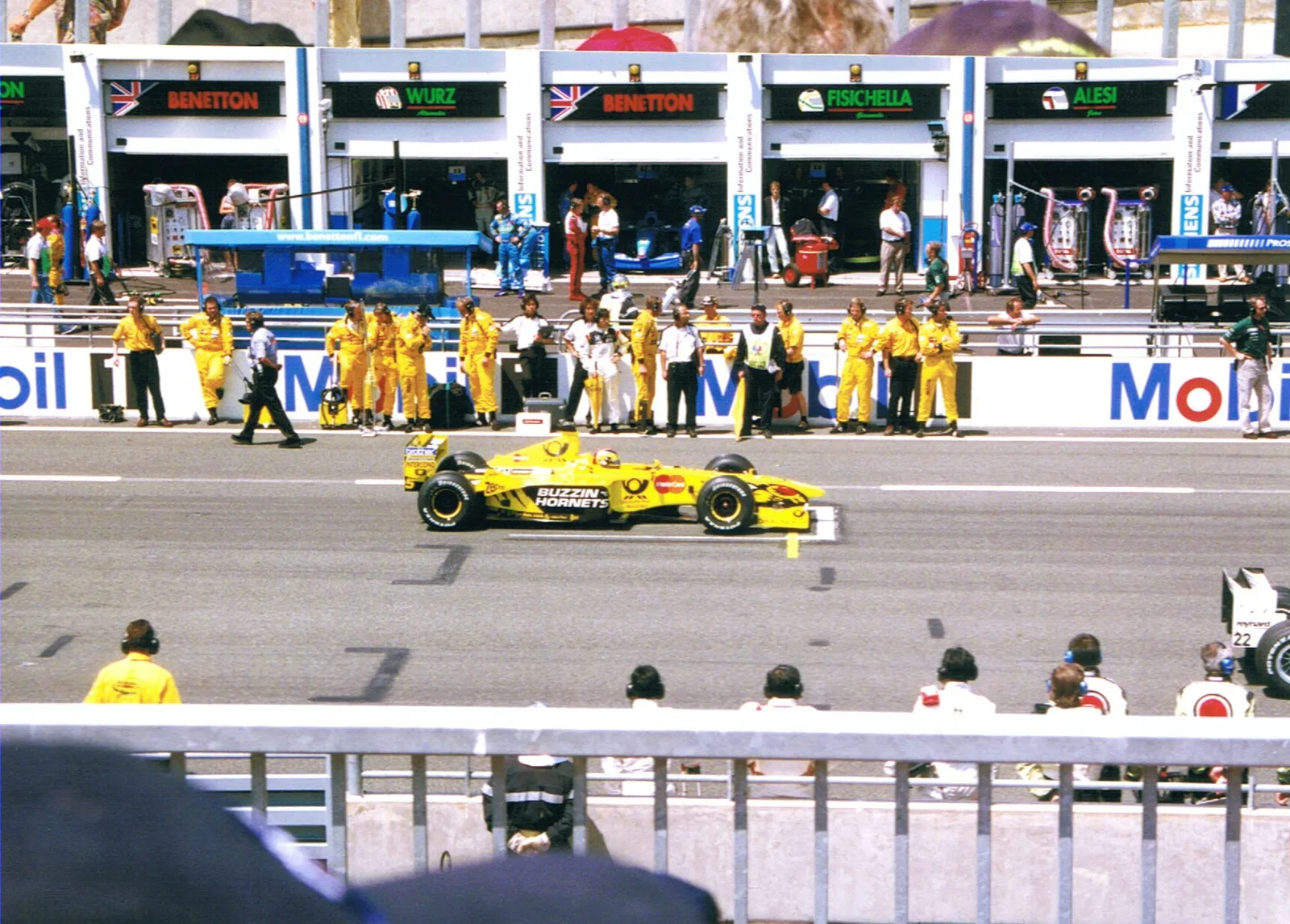
McLaren's David Coulthard started second, got past Michael Schumacher on lap 40 as Ferrari's tyres faded, and won at Magny-Cours.
David Coulthard won the 2000 French Grand Prix at Magny-Cours on 2 July 2000, starting second on the grid. Mika Hakkinen finished second for McLaren and Rubens Barrichello third for Ferrari, after Coulthard passed Michael Schumacher on lap 40. Schumacher retired on lap 59 with an engine failure.
David Coulthard won the 2000 French Grand Prix for McLaren after starting second on the grid. It was his third win of the season and his eighth in Formula One, and Mika Hakkinen finished second with Rubens Barrichello third at Magny-Cours on 2 July.
How did Schumacher lose the lead at Magny-Cours?
Michael Schumacher had taken pole and led after the first round of pit stops. In the second stint his tyres began to wear, and Coulthard reduced the deficit and passed him on lap 40, as the wear had cut into Schumacher's pace.
Barrichello, starting third, had passed Coulthard on the way into the first corner, and Schumacher kept his early lead.
Coulthard held his lead through the second round of pit stops and won the race. Schumacher retired on lap 59 with an engine failure, which advanced Hakkinen to second place.
Coulthard got past Schumacher on lap 40, and an engine failure on lap 59 finished the job for McLaren.
The championship before the race
Schumacher led the drivers' championship with 56 points before the race, followed by Coulthard on 34 and Hakkinen on 32. Barrichello was fourth on 28 points, with Benetton's Giancarlo Fisichella fifth on 18.
Ferrari led the constructors' championship with 84 points, ahead of McLaren on 66. Benetton were third on 18, Williams fourth on 15 and Jordan fifth on 10.
The race was the ninth of seventeen rounds and the 86th French Grand Prix, and 112,112 spectators came to watch it at Magny-Cours in Burgundy.
Schumacher had won five of the first eight races, and he was the favourite. He was optimistic that his car would perform well on the Magny-Cours track. Benetton's Flavio Briatore played down his team's chances and said a podium would take something close to a miracle, while the BRDC president, Jackie Stewart, backed Coulthard to win the title.
Coulthard had stalled on the Canadian grid, and he picked up a ten-second stop-and-go penalty because his mechanics had worked on the car before the start. He said that Ferrari could still be caught with nine races left to run, and that the team had to look ahead to Magny-Cours and close the gap.
Tyres and the circuit at Magny-Cours
Bridgestone was the sole tyre supplier and brought the Soft and the faster Extra Soft dry compounds to the event. Its technical director, Yoshihiko Ichikawa, urged teams to use the Extra Soft, which gave more grip and less understeer at Magny-Cours than on rougher circuits.
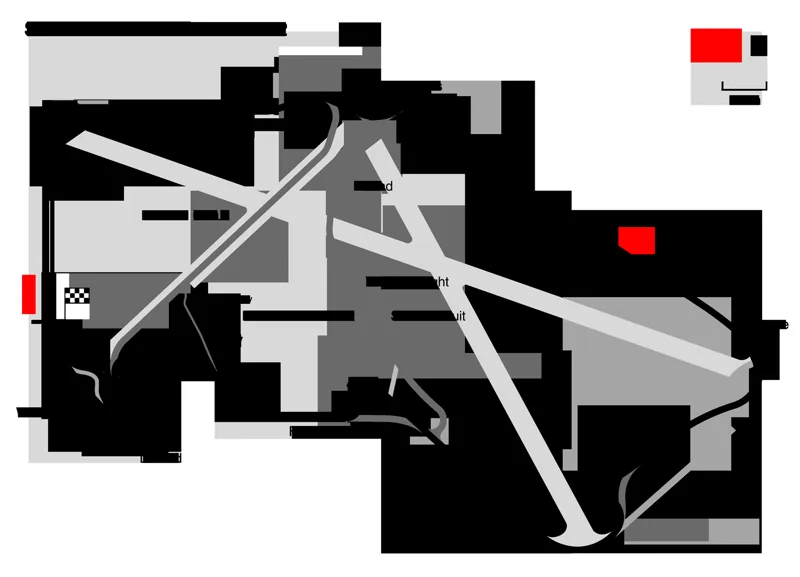
The event featured eleven teams with two drivers each, and the entries were unchanged from the start of the season. The track measures 4.251 km (2.641 mi) and runs clockwise through Burgundy.
Teams weighed the two dry compounds carefully, and driver tyre usage and set-up changes all affected how the compound wore during the race. Every driver ultimately started on the Extra Soft.
What changed on the cars for France?
Almost every team changed its car for the event. Ferrari added chimney stacks to the F1-2000 during free practice, but it reverted to the earlier specification for qualifying and the race. The team had also rebuilt the axle at the bottom of the car with composite materials to reduce friction on the asphalt.
McLaren installed a new extractor profile for practice and qualifying, then removed it for the warm-up and race. The team also positioned its rear-view mirrors asymmetrically, with the right-hand one further forward and lower to help visibility in the final corner.
Peugeot gave Prost an upgraded V10 for Alesi, who had complained about its driveability. Jordan debuted a revised braking system, BAR fitted a new body and ailerons, and Sauber modified the sides' openings.
What did testing before the race show?
The teams tested between 21 and 23 June, with the exception of Minardi, which missed the sessions because of a transport strike in Italy. Coulthard led the first day from McLaren test driver Olivier Panis, and Hakkinen was fastest on the final day.
Coulthard was fastest again on the second day, although Fisichella damaged the underside of his chassis and lost testing time while Benetton repaired the car.
Arrows' Jos Verstappen crashed into the barriers at turn two after a mechanical failure and suffered neck strain, but he was later cleared to compete. Michael Schumacher stopped on track when his Ferrari engine failed, and a replacement engine was installed in the chassis.
On 27 June Ferrari took its three F1-2000 cars to the Fiorano circuit, where test driver Luca Badoer shook them down and practised pit stops.
How did Friday practice set the order?
Two one-hour sessions ran on Friday in hot, dry weather, and the first session was the start of the weekend's running. Michael Schumacher set the pace in the first session at 1:16.474, two-tenths quicker than Hakkinen. Heidfeld was third and Ralf Schumacher fourth in that session, with Irvine fifth.
Coulthard led the second session with 1:16.253 after losing 25 minutes to an oil tank leak, which his crew repaired by removing the engine. Hakkinen was second fastest in that session.
Only four drivers set no laps during the Friday sessions. Coulthard had a fuel pump fault, Barrichello drove one installation lap to save tyres, and both Jordan drivers sat out.
In the third session on Saturday Coulthard set 1:15.965, the first time anyone had lapped faster than 1:16. Hakkinen was second, and Barrichello was third.
On the Saturday morning Irvine was fifth and Herbert eighth, with Michael Schumacher and Button between them. Barrichello and De la Rosa were ninth and tenth.
In the last session an engine problem halfway down the track forced Coulthard into the pit lane, and his mechanics replaced the engine for qualifying. Trulli and Frentzen finished fifth and sixth for Jordan.
Irvine was seventh quickest in that session, ahead of Michael Schumacher, who concentrated on his qualifying set-up. Button and Herbert were ninth and tenth.
Who took pole for the French Grand Prix?
Michael Schumacher took pole at 1:15.632, his fourth pole of the 2000 season and the 27th of his career. Qualifying was held in dry, hot weather, with temperatures rising periodically during the session. Coulthard was 0.102 seconds slower after the team fixed a defective fuel pump under his fuel tank. Schumacher set the time about 25 minutes into the session.
Coulthard drove the spare McLaren for two laps during that repair, and he could not lap quicker after spinning through 180 degrees. The FIA then sent him for a car weight check in the pit lane.
Barrichello took third after changing his set-up in qualifying, which had made ride height uncertain. Hakkinen was pushed down to fourth by Barrichello on the final lap, because of difficulty in the slow corners.
Ralf Schumacher was fifth and Irvine sixth, and Villeneuve took seventh. Trulli and Frentzen were eighth and ninth, and Button qualified tenth.
Trulli and Frentzen were disappointed with their laps. Trulli went wide off the course and returned via the off surface, which stopped him from lapping faster.
Herbert was 11th, nearly three-tenths of a second short of the top ten. Salo took 12th when cloud reduced the air and track temperatures, with De la Rosa 13th and Fisichella 14th.
Alesi was 18th, Zonta 19th and Verstappen 20th. The two Minardis of Gene and Mazzacane started 21st and 22nd, 2.4 and 2.6 seconds slower than the pole sitter.
After qualifying, the FIA safety delegate Charlie Whiting banned practice starts at the pit lane exit, having seen how drivers behaved in that area during Saturday's free practice.
How did the warm-up and conditions look?
Overnight rain left the asphalt slippery, but the sun dried it as the 30-minute warm-up went on. Hakkinen set the fastest time of 1:19.329 with two minutes remaining, ahead of Coulthard in the other McLaren and Michael Schumacher in third.
Some drivers lost control on the slippery surface, and Michael Schumacher drove both the spare and race Ferraris while adjusting the settings to the changing track. Frentzen damaged a semi-axle by running off the circuit during the session.
The 72 laps made up 306.072 km (190.184 mi), and the race got under way at 14:00 local time in front of 112,112 people. The air was 27 to 28 C (81 to 82 F) and the track 38 to 39 C (100 to 102 F), with a 40% chance of rain forecast.
Every driver started on Extra Soft tyres. Coulthard removed the rear aerofoil tailplane to reduce understeer and gain top speed.
Autosport argued that the start would decide the race. The pit lane straight is short and runs into a quick left-hander rather than a braking zone, so drivers on the inside of the even-numbered grid spots had a harder time, while cars on the outside could sweep across ahead of them.
How did the start unfold?
Coulthard made the better getaway of the leading pair, but Michael Schumacher moved left and kept the lead. Coulthard moved right, was blocked, and slowed to avoid a collision, which let Barrichello past for second, while Michael Schumacher kept the lead into the first corner.
Salo had the strongest start in the field, climbing from 12th to ninth on the first lap. Irvine fell four places, and Ralf Schumacher dropped from fifth to seventh.
At the end of the first lap the top six were Michael Schumacher, Barrichello, Coulthard, Hakkinen, Villeneuve and Frentzen. Michael began to pull away with successive fastest laps, while Barrichello delayed the McLaren drivers to help his team-mate.
Trulli took seventh from Ralf Schumacher on the second lap, while Alesi went past Heidfeld for 14th. Ralf retook seventh on the following lap, and Heidfeld lost a place to Fisichella on lap four.
Ralf challenged Frentzen for sixth on lap five. By lap ten Michael Schumacher was five seconds clear of Barrichello.
Button took tenth from Irvine on lap twelve. Heidfeld collided with Alesi at the Adelaide hairpin while trying to pass Fisichella, and he dropped to 18th.
Zonta retired on lap 17 after braking trouble and struck the tyre barriers. By lap 18 Michael Schumacher led Barrichello by 6.2 seconds, and Hakkinen was 1.4 seconds behind his team-mate.
Final result
| Position | Driver | Note |
|---|---|---|
| Winner | David Coulthard (McLaren) | From second on the grid; eighth Formula One win |
| Second | Mika Hakkinen (McLaren) | Moved up when Schumacher retired on lap 59 |
| Third | Rubens Barrichello (Ferrari) | Held third to the flag |
| Fourth | Jacques Villeneuve (BAR) | Finished behind the podium |
| Retired | Michael Schumacher (Ferrari) | Engine failure on lap 59 |
What did the win do to the title race?
Coulthard's win reduced Schumacher's lead in the drivers' championship to 12 points. Coulthard had said after Canada that the title was not over, and the win backed that up. Hakkinen remained third in the standings with 38 points, six more than Barrichello in fourth.
McLaren's one-two finish closed the constructors' gap to Ferrari to six points, with eight races still to run in the season.