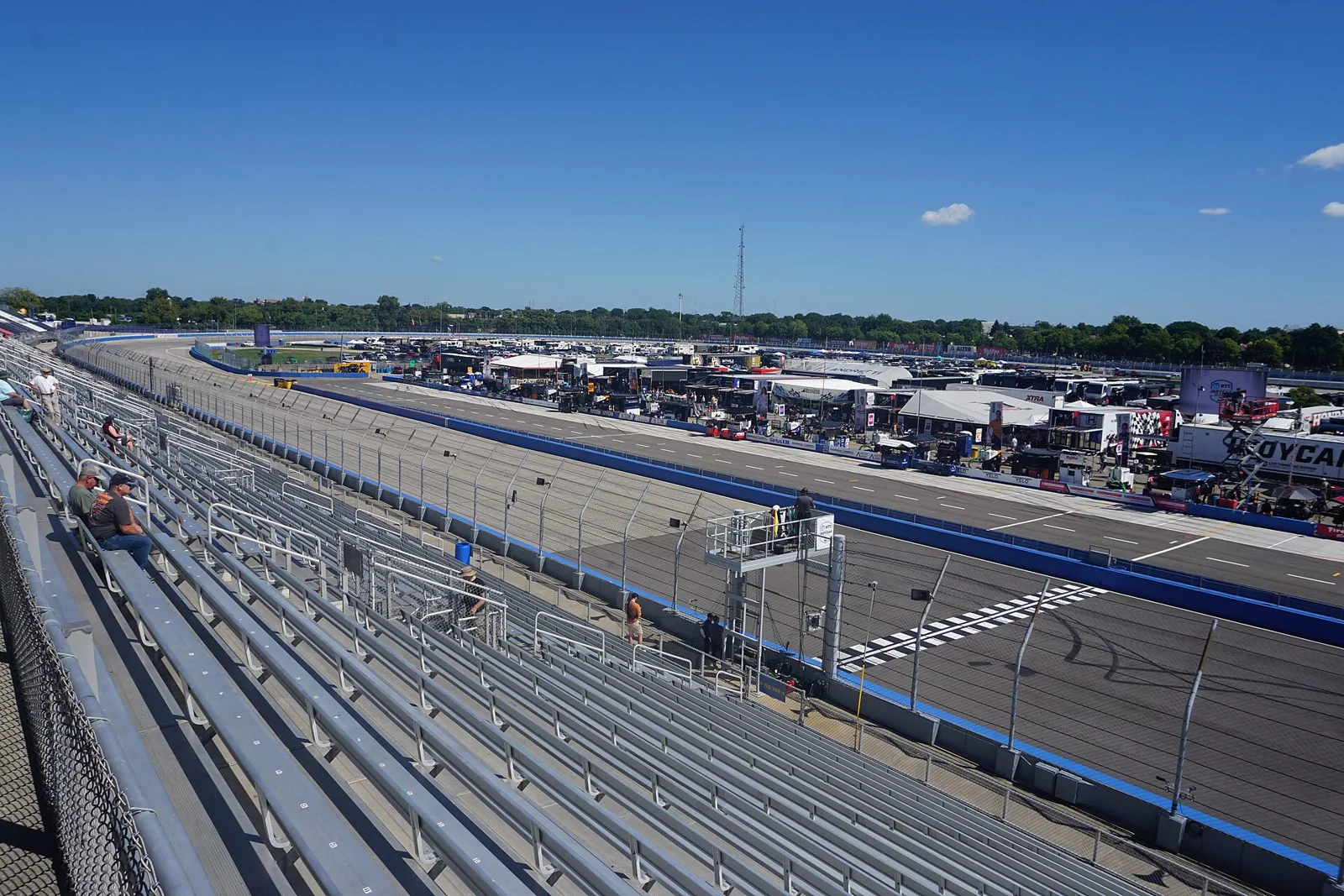
A dirt track from 1903 that grew into a paved home for Indy cars, NASCAR stock cars and midget championships.
The Milwaukee Mile is a 1.015 mi (1.633 km) oval in West Allis, Wisconsin, where motor racing began in 1903. It is the oldest operating motor speedway in the world. Its history includes Indy car, NASCAR and midget championship races, with winners such as A. J. Foyt and Mario Andretti.
Few venues anywhere have been racing for as long as the Milwaukee Mile. Set inside Wisconsin State Fair Park in West Allis, the 1.015 mi (1.633 km) oval has hosted motor racing since 1903, moving from dirt to pavement and from one sanctioning body to another. Its story covers Indy cars, NASCAR stock cars and midget championships.
Where did the Milwaukee Mile start?
The site had been a one-mile private horse-racing track by 1876, and the Agricultural Society of the State of Wisconsin bought it in 1891 for the state fair. The first motorsports event took place on September 11, 1903, and a Chicago driver, Jones, won a short speed contest and posted the first track record with a 72-second lap.
Endurance racing followed soon after. Twenty-four-hour races were run in 1907 and 1908, and Louis Disbrow took the first 100-mile (160 km) race in 1915 at an average of 62.5 mph (100.6 km/h). Those early results show a track that was testing stamina as well as speed.
A 1903 dirt track that outlasted its rivals and became a proving ground for Indy cars and stock cars.
Oldfield, DePalma and the early records
Barney Oldfield set the track record in 1905 and raised it to 70.159 mph (112.910 km/h) in his Blitzen Benz in 1910. His results at the Mile helped make him a legend in American racing.
Ralph DePalma won the first Milwaukee Mile Championship car race in 1911, four years before his Indianapolis 500 win. Oldfield later raced a gold car built by Harry Miller, nicknamed the Golden Submarine for its enclosed cockpit. In June 1917 he also beat DePalma in a run of 10 to 25 mi match races.
Weather also shaped the track's history. The July 17, 1933 race was rained out, and Wilbur Shaw and the other drivers persuaded the promoters to run it the following day. The phrase rain date came from that decision.
When did the Milwaukee Mile become a paved oval?
The track was paved in 1954, when an infield road course was also created. A quarter-mile dirt track stayed inside the oval for weekly programmes during the 1950s and 1960s. The oval was repaved again before the 1967 season, when the dirt track and the older road course were closed to make room for the pit area.
Milwaukee was never a quiet track in its paved years. Gordon Johncock scored his first Indy Car win there in 1965, and Lloyd Ruby swept both USAC races held in 1968. The June 1968 Rex Mays 150 ended in tragedy when a three-car crash and the fire that followed killed Ronnie Duman.
The post-war tradition and the midget years
The first AAA Championship race at the Mile was held in 1939. Rex Mays had already won a 1937 non-championship AAA event that ran 96 laps instead of 100 after a scoring error, and he went on to win in 1941 and again in 1946, after the war.
From 1947 the track held a race directly after the Indianapolis 500, and that tradition became so well known that the 1969 film Winning referred to it. Between 1947 and 1980 the venue hosted a larger number of national title midget, stock and Indy car events than any other American circuit.
The grandstands grew alongside the racing. The original stands dated from 1914, and the 1930s versions seated 14,900 people before a roof went over them in 1938. Aluminum grandstands were installed in September 2002, replacing structures that had stood for decades.
The CART years and the Andretti family
Tom Sneva finished first in the 1983 CART race by 10 seconds, but a post-race inspection found side skirts that sat too low, so Al Unser was given the win. On appeal the decision was overturned two weeks later, and Sneva was awarded the victory.
The last sports car race on the infield road course was held on June 16, 1984, by which time the track had deteriorated. The Andretti family left its own mark. Mario Andretti won the 1985 pole on his way to his fourth career track win, and Michael Andretti won the 1986 and 1987 races. In 1991, Michael, his cousin John and their father Mario finished first, second and third, a first in the worldwide history of auto racing.
Al Unser Jr took the 1990 win when Michael Andretti's car ran dry two laps from the finish. Milwaukee was in danger of losing its CART date in 1992 until the fair board hired Carl Haas to organise the track's activities. Nigel Mansell took his first oval win there in 1993 on the way to the CART championship, Juan Pablo Montoya gave Toyota its first CART win in 2000, and Ryan Hunter-Reay led all 250 laps in 2004. Sebastien Bourdais won the final Champ Car race held at the Mile in 2006.
Who holds the most stock car wins at the Mile?
Don White holds the most stock car victories at the Milwaukee Mile, with 14 wins across AAA and USAC events. In open-wheel racing, the Andretti family produced some of the track's most frequent results, including Michael's back-to-back wins in 1986 and 1987.
The stock car story began with AAA, whose first race at the Mile was held on July 9, 1950 and won by Myron Fohr. AAA ended its competition in 1955, and USAC sanctioned the seasons that followed. Don White's wins came from that long period of AAA and USAC stock car racing.
A. J. Foyt's 1965 effort is one of the track's best stories. He had to tow his front-engine backup dirt car from Springfield, prepared it for pavement himself and qualified it on pole at 107.881 mph (173.618 km/h). He led 16 of 200 laps and finished second, a result that still reads as an unusual one.
The Dairy Bowl and the NFL years
An infield football stadium known informally as the Dairy Bowl once stood near the current media centre, inside the quarter-mile dirt track, so the same ground hosted both football and motor racing. The Green Bay Packers played there from 1934 through 1951, and their 1939 NFL championship game produced a 27-0 shutout of the New York Giants on December 10, securing a fifth league title.
The Milwaukee Chiefs of the American Football League used the stadium in 1940 and 1941. The city's own NFL entry, the Milwaukee Badgers, lasted five seasons from 1922 to 1926 and played at Athletic Park, which was renamed Borchert Field in 1928.
How long is the Milwaukee Mile?
The official length depends on who is timing. NASCAR used 1.000 mi (1.609 km) for timing and scoring, while IndyCar used 1.015 mi (1.633 km). CART used 1.032 mi (1.661 km) between 1997 and 2006, and NASCAR used 1.015 mi for the 2023 Truck race.
The distance matters because lap speeds and records depend on the timing system. Readers comparing results from different eras should check which governing body supplied the figure, since the same oval has been measured in more than one way.
Busch, Truck and ARCA racing
NASCAR first came to the Mile with two Busch Series races in 1984 and 1985, and Sam Ard won the 1984 event. The Busch Series returned on July 3, 1993 and ran every year through 2009. Steve Grissom won that comeback race, and Buckshot Jones took the 1996 race by 0.002 seconds after starting 32nd.
Five drivers who won a Busch race at the Mile later took that year's Busch championship, among them Dale Earnhardt Jr in 1998. Greg Biffle became the first repeat Busch winner with victories in 2001 and 2002, and two Wisconsin natives won Busch races there in 2005 and 2006.
The Craftsman Truck Series began racing at the Mile in 1995, and Mike Skinner won that first event. The 1996 truck race featured 17 lead changes. Ted Musgrave is the only repeat truck winner, with victories in 2001 and 2004, while Ron Hornaday and Greg Biffle each won both a truck race and a Busch race at the track.
What happened after 2009 at the Milwaukee Mile?
On December 16, 2009, Wisconsin State Fair Park officials confirmed there would be no NASCAR or IndyCar races at the Mile in 2010. NASCAR kept its June Nationwide date in Wisconsin, moving it to a race at Road America, and moved the Truck date to August. The track hosted two ASA Late Model Series races that year.
The track's IndyCar history had already been bumpy before that. The 2011 event was poorly attended, partly because of an inexperienced promoter, and the Mile was left off the preliminary 2012 schedule.
When did IndyCar return to the Mile?
IndyCar first came to the Mile in 2004 under the Indy Racing League, and Dario Franchitti won the opener. After the series left in 2015, it returned in 2024 for a doubleheader, ending an eight-year hiatus. Andretti Autosport won three races there, with Tony Kanaan taking the 2006 and 2007 events.
In February 2012 it was announced that IndyCar would return on the weekend of June 15-16. The event was billed as the Milwaukee IndyFest and promoted by Andretti Sports Marketing, which was owned by former Indy driver Michael Andretti. The series left again after 2015, when the promotion company went out of business.
No major professional series raced at the Mile until ARCA came back in 2021. The NASCAR Truck Series came back in 2023, and both the Truck Series and ARCA left in 2025.
Which racing series have run at the Milwaukee Mile?
The track has hosted AAA, USAC, NASCAR, CART, IndyCar, ARCA and regional series such as ARTGO. Its IndyCar era began in 2004, the Champ Car era ended in 2006, and the NASCAR Truck Series and ARCA both left in 2025.
| Series | Milestone | Detail |
|---|---|---|
| AAA stock car | First race, July 9, 1950 | Won by Myron Fohr |
| NASCAR Busch Series | Return on July 3, 1993 | Ran every year through 2009 |
| NASCAR Craftsman Truck Series | First race in 1995 | 17 lead changes in 1996; left in 2025 |
| IndyCar (Indy Racing League) | First race in 2004 | Dario Franchitti won the opener |
| Champ Car | Final race in 2006 | Sebastien Bourdais won |
| IndyCar return | Doubleheader in 2024 | After an eight-year hiatus |