Team Penske took the front row, Rick Mears broke 220 mph in time trials and the finish ended under a disputed penalty.
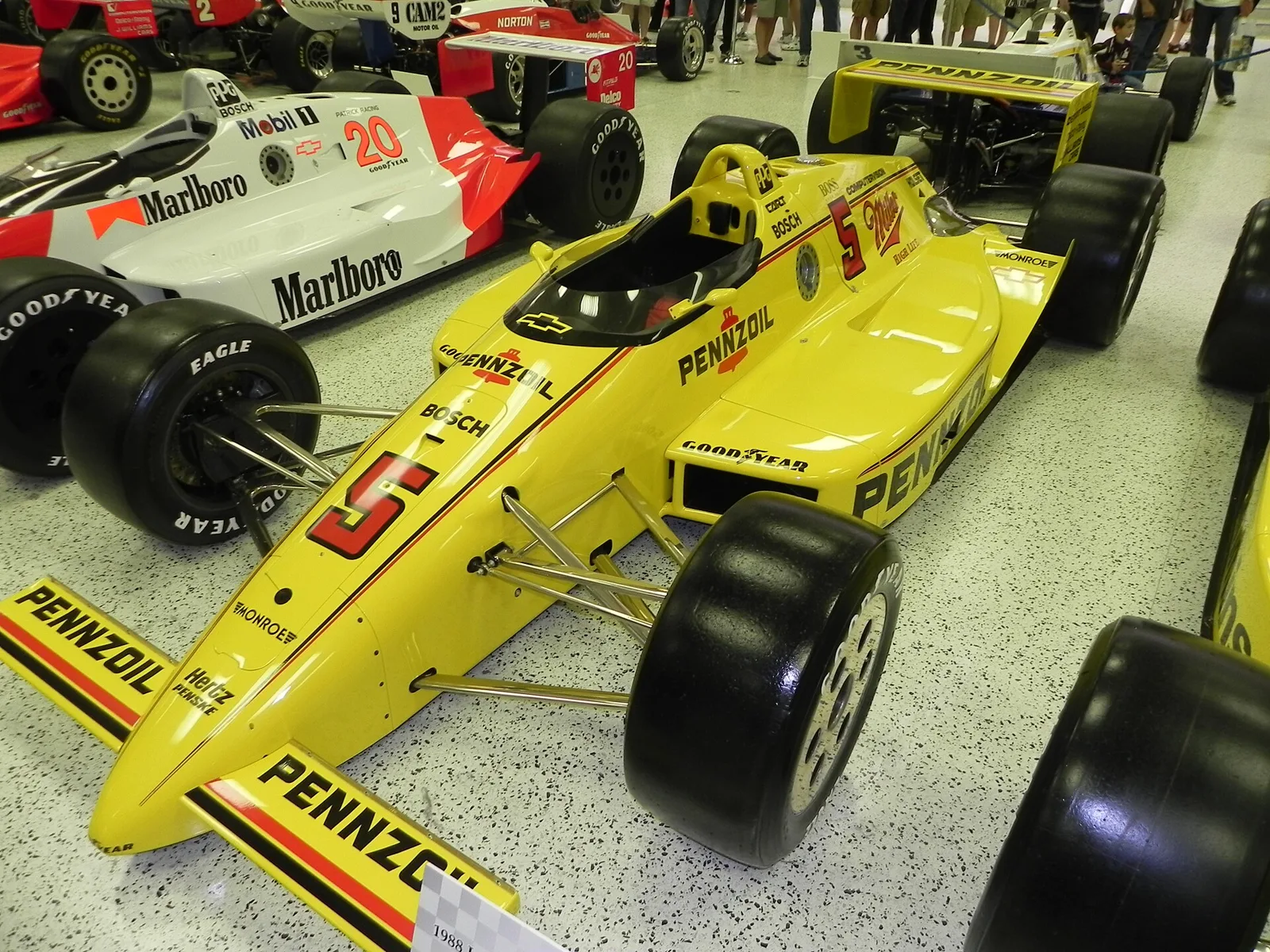
Rick Mears won the 1988 Indianapolis 500 on May 29, 1988, his third Indy 500 victory. Team Penske swept the front row and led 192 of the 200 laps, and Mears set the qualifying benchmark with a one-lap pole at over 220 mph.
The 1988 Indianapolis 500 was the 72nd running of the race, held on Sunday, May 29, 1988, at the Indianapolis Motor Speedway. Rick Mears won his third Indy 500 in a race where Team Penske led 192 of the 200 laps and took the first three places on the grid.
Why did Team Penske dominate the 1988 race?
Team Penske filled the front row, with Rick Mears on pole, Danny Sullivan at the centre of the row and Al Unser on the outside. The three Penske cars then led 192 of the 200 laps, so the team controlled the race from the start and held that position almost to the flag.
The team had good reason for confidence. Penske had introduced a brand-new chassis, the PC-17, after a poor season in 1987 with the PC-16. The new car helped the team return to the front of the field after a difficult year.
The win was also a milestone. It was the 50th Championship car victory for owner Roger Penske and Penske Racing, and the team had made only sparse use of its chassis in the seasons before 1987.
The first driver over 220 mph at Indy, leading a Penske front row sweep that ended under caution.
What made the 1988 Penske cars so strong?
Penske ran the Ilmor-Chevy Indy V-8 for the third year in a row. That engine was the first of six consecutive Indy 500 wins for the Chevrolet Indy V-8, and the first of seven consecutive wins for Ilmor-constructed powerplants.
Cars with the Chevrolet engine occupied the first five grid slots and the top three places at the finish.
Rick Mears and Danny Sullivan had won the first two pole positions of the CART season, and Al Unser Sr., the defending Indy 500 winner, joined them as a third Penske entry.
How fast was Rick Mears in time trials?
Rick Mears became the first driver to break the 220 mph barrier in time trials, with a first lap of 220.453 mph. That lap was a new one-lap track record, and his four-lap total of 2:44.235 averaged 219.198 mph, which was a new four-lap track record.
The pole was his fourth Indy 500 pole, a record at that point. Before the qualifying run he had also set a 222.827 mph unofficial lap in morning practice on pole day, which was a new all-time unofficial track record.
Mears's pole gave the team its first sweep of the three front row spots in Indy history. The three Penske cars of Mears, Sullivan and Unser ranked first, second and third on the grid.
What happened in the pole day qualifying?
Mario Andretti drew the first qualifying attempt on pole day, and his speed was disappointing after a strong week in practice. His first lap of 217.014 mph was his fastest, and his four-lap average of 214.692 mph was well below the speed he had shown a day earlier.
Al Unser Sr. completed his attempt at 215.270 mph, which was good enough to take over the provisional pole position and secure a front row spot. Derek Daly and Scott Brayton then posted runs above 212 mph, and the field stood at ten cars by 1 p.m.
Danny Sullivan set a new one-lap track record of 217.749 mph on his second lap. Sullivan's four-lap average missed the record, though his 216.214 mph figure put him on pole for a time before Mears went out.
What happened on the second weekend of time trials?
At the end of pole day, the field was filled to 19 cars, and 21 cars were in the field after the first weekend of time trials. The second weekend began with a hot day that kept cars off the track for most of the afternoon.
On Sunday May 15, the temperature was 88 degrees, and only two cars completed qualifying attempts in the final hour. Jim Crawford qualified at 210.564 mph, and Bobby Rahal was the other qualifier at 208.526 mph, slower than his speeds from Saturday.
Saturday May 21 added nine cars, bringing the field to 30. Raul Boesel was the fastest of the day at 211.058 mph, with Dominic Dobson second at 210.096 mph and the fastest rookie.
A. J. Foyt secured a starting position that day in his record 31st consecutive Indy 500. Billy Vukovich III, grandson of two-time winner Bill Vukovich, also qualified in the final hour of the day.
How did bump day decide the last spots?
The final day of time trials opened with three positions still unfilled. Scott Atchison was the first car on the bubble, with a speed of 205.142 mph, and Ludwig Heimrath bumped him at 3:45 p.m.
That move put Rich Vogler on the bubble at 206.463 mph. Gordon Johncock made his third and final attempt at 5:43 p.m. at 206.693 mph, bumping Vogler and leaving Johncock himself on the bubble.
Vogler moved into a backup car, and as time ran out he regained his place at 207.126 mph. Johncock was out, and Pancho Carter remained on the outside looking in.
Who were the alternates and who missed the field?
Gordon Johncock was the first alternate, Rich Vogler the second, and Scott Atchison the third.
Gary Bettenhausen, John Jones and Pancho Carter were waved off as too slow. Johnny Parsons had an incomplete run, and Ed Pimm wrecked during qualifying, which ended his attempt.
How did the race start?
At the green flag Danny Sullivan moved into the lead, and Rick Mears held second. Scott Brayton spun in turn two and tangled with Roberto Guerrero, and both cars hit the outside wall.
The green flag came back out on lap 6, and Sullivan pulled away to a comfortable lead. The top five at that stage were Sullivan, Mears, Al Unser Sr., Al Unser Jr. and Mario Andretti.
What were the major incidents in the first half?
Tom Sneva crashed coming out of turn four on lap 34. During a pit stop, Teo Fabi's wheel came off, and the car bottomed out, which ended his race with a terminal oil leak.
Mears fell to 10th place with handling problems. He radioed his crew and asked for the older style wheels, because the car was not handling well with the new flush disc wheels.
A. J. Foyt wrecked on lap 58, and Arie Luyendyk tagged Ludwig Heimrath on lap 64. Steve Chassey crashed in turn four on lap 81 and suffered a concussion.
Mario Andretti retired after gearbox and engine problems, and he was credited with 118 laps in 20th place. Al Unser Jr. also spent time in the pits with a CV joint problem.
How did Jim Crawford take the lead?
Danny Sullivan pitted on lap 93, handing the lead to Jim Crawford, who led eight laps. Those were the only laps not led by the Penske team, and Crawford ran with a noticeably aggressive line through the traffic.
Crawford had returned to the cockpit after serious leg injuries in 1987, and his Buick-powered car gave the Buick V-6 its best finish to that point. At lap 100 he still led, with Mears back in second and Al Unser Sr. third.
On lap 102, Sullivan's front wing adjusters broke, and his car hit the outside wall in turn one. Sullivan had led 92 laps before he was out.
When did Rick Mears take control of the race?
Mears took the lead on lap 113 after a caution for debris, and he held the lead for good from lap 129. With Mears pulling away, the battle for the remaining places was between Al Unser Sr. and Crawford.
Johnny Rutherford crashed in turn one during this stretch. It was his final lap of Indy 500 competition, and he later missed the field in 1989, 1990 and 1992, and he retired officially in 1994.
Emerson Fittipaldi and Bobby Rahal also worked their way up the order. Rahal, running a Judd-powered entry, moved into the top positions as the race wore on.
Why was the finish disputed?
In the final twenty laps, USAC officials considered a two-lap penalty for Emerson Fittipaldi after he passed a car under yellow while leaving the pits. The penalty was first issued, then retracted and reinstated within minutes, and Fittipaldi was dropped to 7th place.
The decision angered Fittipaldi and car owner Pat Patrick, who threatened a protest. On lap 194, Crawford got sideways in turn three and flat-spotted his tyres, and his pit crew had difficulty changing them, which cost him several seconds.
Moments later, on lap 197, a piece of bodywork flew off Michael Andretti's car. The yellow came out, a piece of debris fell from a safety truck, and the caution was extended until the white flag. The race finished under caution, and Rick Mears won his third Indy 500.
What happened after the race?
USAC said Fittipaldi had passed the lapped car of Rich Vogler while leaving the pits. Vogler said he was 8-10 laps down and had waved Fittipaldi by, and he rushed to USAC officials to say so.
USAC re-evaluated the situation and retracted Fittipaldi's penalty on Monday. Fittipaldi was elevated to second, Al Unser Sr. was third, and Crawford finished sixth, the best Buick V-6 finish to that time.
Dick Simon started 16th and finished 9th in his final 500 as a driver, and he announced his retirement from driving during the season finale in Miami.
How was the 1988 race broadcast?
Paul Page called the race on television for the first time, and he went on to anchor the ABC telecast for 14 years. Mary F. Hulman stepped down and was named chairman emeritus, while her daughter Mari Hulman George was elevated to chairperson.
Mary F. Hulman continued to give the starting command through 1996. Don Ohlmeyer was brought in as one of the directors, and the new style of broadcast reflected his influence.
Jack Arute and Brian Hammons served as the pit reporters, and new RaceCam angles debuted for 1988 to give viewers more shots of the cars.
What were the key race statistics?
Mears's lap of 220.453 mph was an all-time official track record, and the four-lap figure was a record for that format too. The race covered 200 laps, and Penske teammates led 192 of them.
| Item | Detail |
|---|---|
| Date | Sunday, May 29, 1988 |
| Venue | Indianapolis Motor Speedway |
| Race distance | 200 laps |
| Winner | Rick Mears, his third Indy 500 victory |
| Pole | Rick Mears, 220.453 mph one-lap record |
| Four-lap pole | 2:44.235, average 219.198 mph |
| Penske laps led | 192 of 200 |
| Crawford laps led | 8, the only laps not led by Penske |
| Second place | Emerson Fittipaldi (elevated after the penalty was retracted) |
| Sixth place | Jim Crawford, best Buick V-6 finish to that time |
Why does the 1988 race still matter?
The win gave Rick Mears his third Indy 500 and gave Roger Penske and Penske Racing their 50th Championship car victory. It also marked the start of six consecutive Chevrolet Indy V-8 wins.
Mears also won the 1987-88 USAC Championship, because the Indy 500 served as the Gold Crown race and its winner was the de facto champion of that series.
The race is also remembered for the first driver over 220 mph, the Penske sweep of the front row and the Fittipaldi penalty that was reversed after the race.