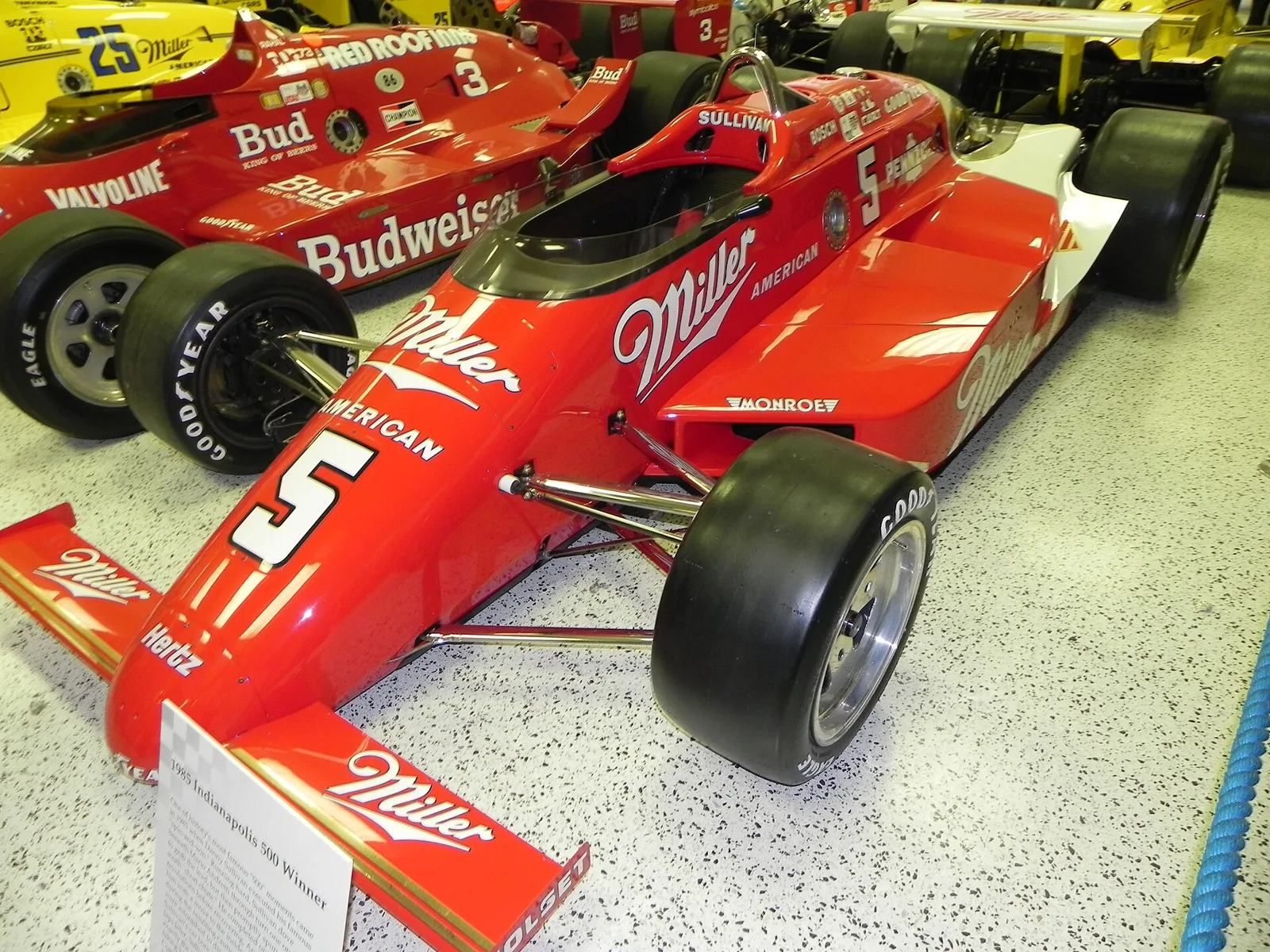
Danny Sullivan recovered from a 360-degree spin in front of Mario Andretti and went on to win by 2.477 seconds, while both Buick pole sitters failed early.
Danny Sullivan won the 1985 Indianapolis 500 on Sunday 26 May 1985, recovering from a spin on lap 120 that Mario Andretti avoided. He led the final 61 laps and finished 2.477 seconds ahead of Andretti, his only Indianapolis victory.
The 1985 Indianapolis 500 was the 69th running of the race, held at the Indianapolis Motor Speedway on Sunday 26 May 1985. Danny Sullivan won it, but the race is remembered above all for a spin he recovered from in front of Mario Andretti. The day also marked forty years of Hulman and George family ownership of the Speedway.
Who won the 1985 Indianapolis 500?
Danny Sullivan won the race by 2.477 seconds over Mario Andretti. He led the final 61 laps and secured the first and only Indianapolis victory of his career. The win also gave Roger Penske his fifth Indianapolis win, which tied the record held by Lou Moore.
Going into the race, the two fastest qualifiers, Pancho Carter and Scott Brayton, were regarded as underdogs because of doubts about their Buick engines. Andretti was the favourite, and the two Buicks both failed early.
Sullivan had misread a radio message from his crew. He believed they had said 12 laps remained, when more than 80 were actually left, so he turned up the boost and went after Andretti for the lead.
A 360-degree spin in front of Mario Andretti on lap 120 turned a near-disaster into the most famous win of 1985.
What was the Spin and Win?
On lap 120, Sullivan pulled to the inside into turn one and tried to pass Andretti below the yellow line, on the rough and flat apron. The car slipped as he came off the apron, and it went around completely in Andretti's path, in the south short chute.
Andretti steered down to the inside and slipped past without contact. Sullivan's engine stalled for an instant, but he found the car pointing in the right direction, got it moving again, and rejoined under power.
Sullivan later put the escape down to a mix of skill and luck. Andretti's split-second choice to take the tighter line came from experience, because two years earlier Johnny Parsons had spun in front of him in almost the same spot, and the outside evasion had sent Andretti into the wall.
The yellow came out, and both leaders pitted for tyres and fuel, which briefly put Emerson Fittipaldi into the lead. Sullivan repassed Andretti cleanly on lap 140, in the same place he had first tried, and he pulled clear over the final 50 laps.
Why were the Buicks so fast in qualifying?
The 1985 race was the breakout race for the stock-block Buick V-6. Carter and Brayton filled the front two grid spots, both in pushrod engines that set new track records as they went. Brayton set a one-lap record of 211.815 mph on his first lap, then a four-lap average of 212.354 mph.
Carter answered less than twenty minutes later with a 212.533 mph average, which was faster overall, although Brayton still held the better single lap.
Carter took the pole by 0.177 seconds. Because the one-lap and four-lap records belonged to different drivers, the headlines were shared, and Brayton also signed Hardee's as a sponsor that week.
Emerson Fittipaldi briefly held third at 211.322 mph, but Mario Andretti bumped him down at 211.576 mph. Bobby Rahal's run of 211.818 mph at 1:13 p.m. took the outside of the front row.
How did the rest of the field fill?
Until 1985, no car starting eighth had ever won the race, which is why the slot was nicknamed the 8-ball spot. Danny Sullivan put his car there, while Mears came back from his 1984 leg injuries and put his car 10th.
Twenty-seven cars qualified on Pole Day, and the first weekend ended with 29 in the field. Rookie Raul Boesel ran 206.498 mph on Third Day, which opened the second weekend, while only two cars made attempts on the second day.
John Paul Jr. fitted a qualifying run in between his IMSA commitments and bumped Derek Daly. George Snider put a Foyt V-6 into the field, and the grid reached 33 cars.
Kevin Cogan got into his backup car on Bump Day and bumped his way back in. Johnny Rutherford was then bumped by Daly at 207.548 mph, before he got into a backup car and ran 208.254 mph, which bumped Michael Roe out.
Tony Bettenhausen Jr., on the bubble at 204.824 mph, held on, because Michael Roe tried twice to bump him and failed both times.
How did the race start and the early laps unfold?
Mary Hulman started the race just before 11 a.m. on a warm day. Bobby Rahal, starting on the outside of the front row, took the lead into turn one, with Scott Brayton second and Pancho Carter sliding back to fourth.
By lap 6 Carter's oil pump had failed, and he finished 33rd, the second polesitter to finish last after Cliff Woodbury in 1929. Carter said the failed pump had come from a Cosworth engine rather than a Buick.
Rahal held the front for the first 14 laps. On lap 15 George Snider and Josele Garza blew engines together, which brought out the first caution, and Andretti made a faster pit stop under the yellow to take the lead on lap 16.
Brayton's day ended on lap 19, when his engine failed after a cracked cylinder wall. Rahal came in on lap 52 with a turbo wastegate fault, and after several long stops he retired with 84 laps still to run.
What happened in the middle of the race?
Andretti continued to dominate the early laps, with Sullivan second, while Fittipaldi and both Unsers stayed in contention. Al Unser Jr. was in the top five before he retired on lap 91 after his engine gave out. Al Unser Sr. was penalised for running over his air hose, which cost him places.
On lap 61, A. J. Foyt's car arrived in the pits with a broken front wing and a poor handling problem, and after a heated exchange with his crew he bumped the fueller. Fuel spilled, a fire started in the pit area, and Foyt was out four laps short of his 10,000-mile career mark at the Speedway.
At the halfway point the lead lap held only four cars, with Andretti at the front, followed by Fittipaldi, Sneva and Sullivan. When the green-flag stops came, Sullivan gained a place to second, the only one of that group to make a fuel-only stop.
What happened to the cars that were trying to catch up?
Once the clean-up was finished, Andretti was back in front, with Sneva second and Sullivan third. Lapped traffic complicated the restart, and the leaders had to work through it. On lap 124 Howdy Holmes drifted into the quarter panel of Rich Vogler going into turn one.
Vogler was sent into the wall and slid in front of the leaders with a concussion and cuts above his eyelid, and he was airlifted to hospital. Sneva locked his brakes and spun wide, and Sullivan slipped by unharmed.
The duel between the two drivers went on, and Sullivan began to pull away over the final 50 laps. Andretti was struggling by then, and Fittipaldi passed him for second for several laps.
How did the finish play out?
Andretti caught a break on lap 175, when John Paul Jr. crashed in turn two and lost a wheel. Emerson Fittipaldi, a factor for most of the afternoon, retired with 12 laps left after his oil pressure fell and a fuel line failed.
On lap 192 Bill Whittington crashed in turn three, which led to a restart with three laps left. Andretti picked off both lapped cars as the green came out, but he could not reel in Sullivan.
With two laps to go Sullivan led by 2.4 seconds. He finished 2.477 seconds ahead of Andretti, claiming his only Indianapolis win.
What did the win mean for Sullivan and Andretti?
Andretti called it his best chance since his 1969 win and was clearly disappointed. He said he had left Sullivan plenty of room on the apron, and that Sullivan had simply lost control. Andretti reportedly refused to speak to Sullivan for almost a year afterwards.
Sullivan later described Andretti as a close friend, even though the two had been at odds for a year.
Sam Posey described the result as a generational shift, with a young driver beating the established Andretti. Foyt was never a factor, and Johnny Rutherford had trouble making the field.
The victory raised Sullivan's profile considerably. He guest-starred on Miami Vice and in a soap opera, finished fourth in the 1985 points standings, and went on to win the CART championship in 1988.
How was the race broadcast?
ABC aired the race on a same-day tape delay, the last year the race was shown that way. Jim McKay anchored his final Indianapolis 500 in that role, and the separate host job was dropped, so McKay did both jobs.
The broadcast earned a rating of 9.7 with an 18 share, which was the lowest such figure in the tape-delay prime-time era. ABC had signed in August to cover the race live from 1986, so 1985 was the last year of the old format.
On radio, the IMS Radio Network carried its last exclusive live coverage, with Paul Page as chief announcer for his ninth year. Lou Palmer's live victory lane interview was the last of its kind, and Gordon Johncock joined Rodger Ward as a driver expert.
Howdy Bell took over turn two from Doug Zink, and Ron Carrell's final turn-one reports included his description of Sullivan's spin. It was also Rodger Ward's final Indianapolis broadcast.
Key figures for 1985
| Measure | Detail |
|---|---|
| Date | Sunday 26 May 1985 |
| Winner | Danny Sullivan, his first and only Indy 500 win |
| Pole | Pancho Carter, 212.533 mph four-lap average |
| Runner-up | Mario Andretti, 2.477 seconds behind |
| Sullivan's leading laps | The final 61 |
| The spin | Lap 120, turn one approach |
| Buick results | Carter 33rd; Brayton out on lap 19 |
| ABC rating | 9.7 with an 18 share |