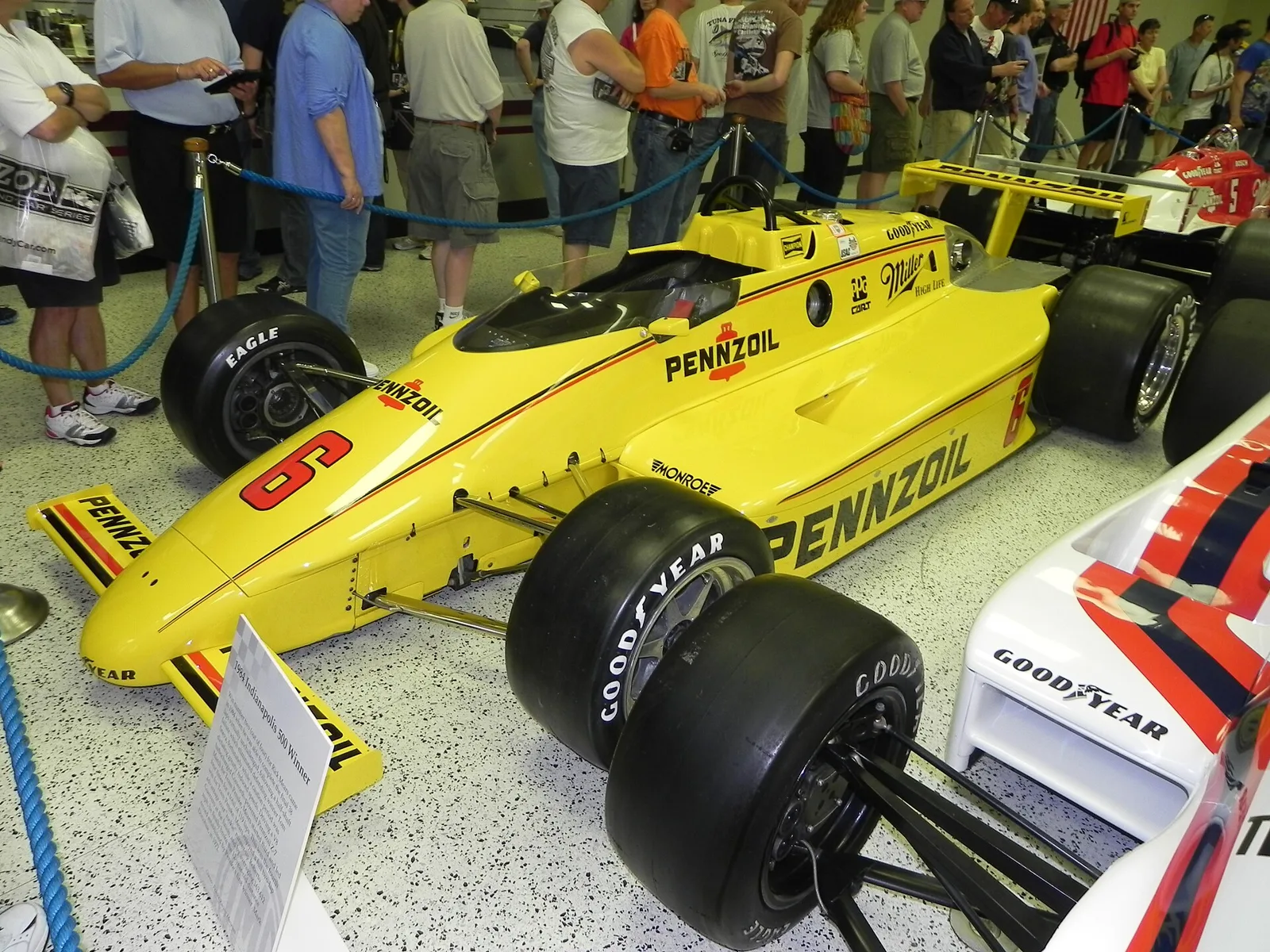
Rick Mears won by two laps after Tom Sneva set the first qualifying lap over 210 mph, with a crash and two late retirements shaping the race.
Rick Mears won the 1984 Indianapolis 500 on Sunday 27 May 1984, finishing two laps clear after Tom Sneva and Mario Andretti dropped out. He set a race speed record of 163.612 mph, and the field included a record 117 entries.
The 1984 Indianapolis 500 was the 68th running of the race, held at the Indianapolis Motor Speedway on Sunday 27 May 1984. Rick Mears won it, his second of four Indianapolis victories, and his margin of two laps tied for the largest since the pack-up rule came in 1979. The race also set a record with 117 entries, and Tom Sneva's pole lap became the first official qualifying lap over 210 mph.
Who won the 1984 Indianapolis 500?
Rick Mears won the 68th race for Penske, taking his second of four Indianapolis victories. Tom Sneva and Mario Andretti both dropped out in the second half, and Mears was alone two laps clear of the rest of the field at the end.
Mears also set a new race speed record of 163.612 mph, breaking the mark that Mark Donohue had set in 1972. He had led from the opening lap, taking the lead in turn one, and he held the position through the closing stages. The race had narrowed to two contenders over the final 100 miles.
Only three months later, Mears was badly hurt in a practice accident at Sanair. The win was therefore one of his last major results before that injury.
Rick Mears won by two laps after Tom Sneva became the first driver to break the 210 mph barrier in qualifying.
How did the pole battle go?
Tom Sneva had left Bignotti-Cotter Racing over the winter after a dispute, and he came to the race with Mayer Motor Racing, a team run by Teddy Mayer and Tyler Alexander, both former McLaren figures. Texaco was his sponsor. Tom Sneva took the pole on Pole Day, Saturday 12 May, with a four-lap average of 210.029 mph, a new record.
He became the first qualifier to top 210 mph on an official lap, and it was his third pole at Indianapolis.
His third lap was 210.423 mph, and his fourth lap was the quickest at 210.689 mph. Sneva had first gone past 200 mph in qualifying during 1977, so his speeds in 1984 built on a record of pushing the limit at the Speedway.
Howdy Holmes, Sneva's teammate, put his car second at 207.977 mph, which pushed Mears onto the outer side of the front row. Michael Andretti qualified fourth, one place ahead of his father, and Mario Andretti started sixth after a run that began at 209.687 mph before fading.
Michael Andretti, a rookie, was the next car out after Mears and ran surprisingly close to him. Pole Day produced 28 qualifiers, and the rest of the places were filled in later sessions. Mears set the first of the day's fast times at 207.847 mph before Holmes moved ahead of him.
How did the rest of qualifying go?
Rain ruled out most of Second Day, Sunday 13 May. Only three cars made attempts, and none completed a run. Johnny Rutherford's second try in a Foyt entry ended with mechanical trouble before he finished a lap. The field reached 33 cars on Third Day, Saturday 19 May, by 1 p.m.
Chris Kneifel was the car on the bubble at 199.831 mph, the slowest of the qualifiers.
Johnny Rutherford, a three-time winner, had used his three allowed attempts and borrowed a backup car from Galles. With ten minutes to spare he took a last run, and his four-lap average of 202.062 mph was enough, although the car smoked through the turns.
Spike Gehlhausen, at 200.478 mph, was then on the bubble, and Gary Bettenhausen's late bump attempt was abandoned after just two laps. Steve Chassey crashed on his own attempt and missed the rest of May with a concussion.
Bump Day on Sunday 20 May was lost to rain, so the field was set at 33 cars the day before.
What was Mario Andretti's month like?
On 11 May Mario Andretti turned 212.414 mph in practice, the quickest lap yet recorded at the track. He qualified sixth, and his race was set to be a serious challenge to the leaders. His race ended on lap 153.
He made a routine stop and was held up in traffic when Josele Garza's car came past him in the pit lane. The two cars made contact, which broke Andretti's nosecone, and the damage was too great for him to continue.
The Miller Pit Stop Contest, the eighth annual edition, was held on Thursday 24 May. Sneva, Holmes, Mears and Michael Andretti had qualified for it automatically, and Mears took a three-second penalty for a loose nut that dropped him from second to fifth in the preliminary round.
What was the Pat Bedard crash?
Pat Bedard, a sportswriter turned racer, crashed heavily in turn four on lap 58. His car turned sideways into the inside of the north short chute, hit the inside wall, flipped and rolled through the grass, then came apart, leaving the tub separate from the engine.
Bedard was hurt, but his injuries were not life-threatening. Danny Sullivan came up too fast under the caution and ran into Roberto Guerrero's car, lifting onto two wheels and damaging his right-front suspension. Sullivan dropped out, but Guerrero carried on.
Debris covered the track, so the caution ran for a long time while the wreck was cleared. Around lap 70 the DataSpeed computer timing and scoring system failed, and the rest of the race was scored by hand. Some lap records were incomplete at times, though the leader was never in doubt.
How did the race unfold?
Mary Hulman started the field just before 11 a.m. under a cool, clear sky. Mears jumped to the front in turn one and posted the opening lap at 195.610 mph, which was an opening-lap record. Geoff Brabham dropped out after one lap with a bad fuel line.
Michael Andretti passed Sneva a few laps later to move into second place.
The first 100 miles were run cleanly, with no incidents. Emerson Fittipaldi, driving a pink car for W.I.T. Promotions, retired after 37 laps with low oil pressure.
On lap 45 Spike Gehlhausen spun in turn one and stopped in turn two without contact, which brought out the first caution. For the second time, Mears moved into the lead on lap 54.
What happened in the middle of the race?
At lap 100 Tom Sneva was in front, with Al Unser Jr. second and Mears third. Mario and Michael Andretti were fourth and fifth, and the other leaders included Rahal, Guerrero, Holbert, Al Unser Sr. and Fabi. Four laps later Fabi retired, his fuel system broken.
Gordon Johncock went into the wall in turn four on lap 103 and hurt his left ankle, and he took a short break from racing afterwards.
Al Unser Jr. was out on lap 131 with a failed water pump. Sneva led laps 142 and 143 during a round of pit stops, and Mears regained the lead on lap 144.
How did the final 100 miles play out?
With Mears and Sneva in front, Scott Brayton stalled on lap 163 and brought out the final caution. Sneva's crew had been weighing one more stop, aiming to reach the finish without it. Smoke and sparks at the rear of Sneva's car in turn three signalled a broken CV joint on lap 168.
He pitted at once and climbed out, which ended his push for back-to-back wins. Mears said afterwards that he felt for Sneva, but that the result was a relief, since Sneva had been his toughest competitor.
Mears then had a commanding lead, two laps ahead of the field. Drizzle drifted in during the last 30 laps, though the heavier rain that had been feared never arrived. He finished the full distance at the record pace of 163.612 mph.
Roberto Guerrero and Al Unser Sr. fought over second. Unser was briefly scored second by hand, and Penske Racing briefly had its first 1-2 finish in the race, until the scoring was resolved and Guerrero was placed second.
How did the rookies do?
Rookies took three of the top five places, with Roberto Guerrero second, Al Holbert fourth and Michael Andretti fifth. The two were jointly named Rookie of the Year. Emerson Fittipaldi, a two-time Formula One world champion, made a quiet debut.
He was running in a pink W.I.T. Promotions car and was out before the race was half over.
Guerrero had an eventful day. He nearly got caught up in the Bedard crash, was hit by Sullivan under the yellow, overshot his pit stall during one stop and spun in turn two. He still finished second, and he was surprised to learn it.
How was the race broadcast?
ABC Sports carried the race on a same-day tape delay, with Jackie Stewart hosting ABC Race Central for the last time. Jack Arute came onto the crew as a pit reporter and stayed in that job for more than two decades, while Larry Nuber made his first Indy assignment as a pit reporter.
A new camera angle was introduced over the flagman's shoulder for the start and the finish. The race was also televised in Brazil for the first time, with Wilson Fittipaldi as announcer, because interest in his son Emerson's debut was high.
On radio, the IMS Radio Network carried the race with Paul Page as chief announcer for the eighth year. Lou Palmer reported from victory lane, and Doug Zink, who joined the network in 1966, worked his final 500 on the crew.
Key figures for 1984
| Measure | Detail |
|---|---|
| Date | Sunday 27 May 1984 |
| Winner | Rick Mears, his second of four Indy 500 wins |
| Pole | Tom Sneva, 210.029 mph four-lap average |
| Margin | Two laps |
| Race speed record | 163.612 mph |
| Runner-up | Roberto Guerrero |
| Entries | 117, a record |
| Pit stop winner | Michael Andretti, the first rookie to win the contest |
| Bedard crash | Lap 58, turn four |