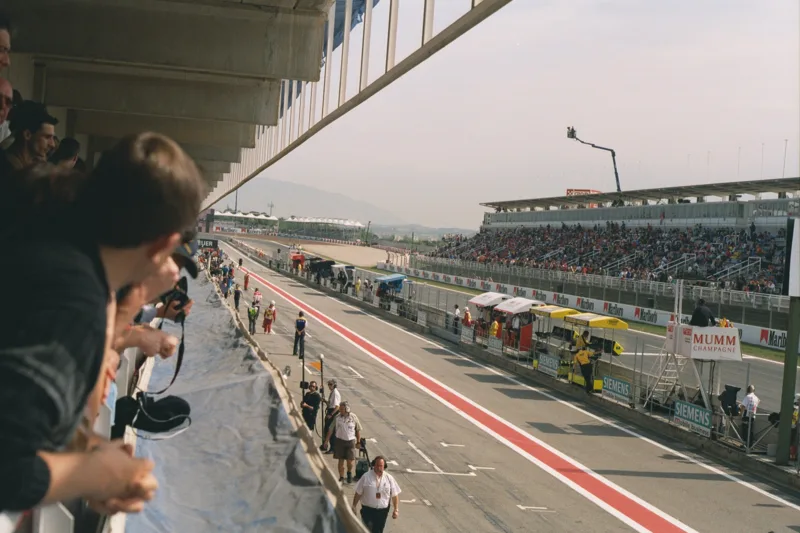
Michael Schumacher took pole and victory at the Nurburgring, where a ten-second penalty for his brother Ralf reshaped the podium behind him.
Michael Schumacher won the 2001 European Grand Prix at the Nurburgring on 24 June from pole position, 4.1 seconds ahead of Juan Pablo Montoya. David Coulthard was third for McLaren, and the win was Schumacher's fifth of the season and 49th of his career.
Michael Schumacher won the 2001 European Grand Prix from pole position at the Nurburgring, the ninth round of the season. Juan Pablo Montoya finished second for Williams after his teammate Ralf Schumacher was handed a ten-second penalty, and David Coulthard completed the podium for McLaren. The race is remembered as much for the first-corner manoeuvre that pushed Ralf towards the pit wall as for the win itself.
What was the background to the European Grand Prix?
The race was the ninth of seventeen Formula One events in 2001 and the sixth European Grand Prix held at the Nurburgring since the circuit returned to the calendar in 1995. It was the last race on the 4.556 km (2.831 mi) layout, which was made 0.592 km (0.368 mi) longer for 2002.
Before the race Schumacher led the drivers' championship with 58 points, ahead of Coulthard on 40 and Barrichello on 24. Ralf Schumacher had 22 points and Hakkinen eight. Ferrari led the constructors on 82 points, with McLaren second on 48, Williams third on 28, Sauber fourth on 15 and Jordan fifth on 13.
Ninety championship points remained in the next nine races, and pundits speculated that McLaren might favour Coulthard over Hakkinen. Schumacher had won four of the previous eight Grands Prix, but he was cautious about his 18-point lead because so many points were still to be scored.
Heinz-Harald Frentzen had been declared fit to return to Jordan after a concussion from a Canadian Grand Prix crash, replacing Ricardo Zonta, who had been on standby. Irvine and Heidfeld were also passed fit after injuries from Canada, and Benetton tried a launch control system during Friday practice.
Few teams made major technical changes. Ferrari, McLaren and Williams all reused the rear wings from Monaco, Williams added new aerodynamic side appendages in front of the air intakes, and BAR introduced a redesigned front suspension and a new nose. Minardi modified Tarso Marques's pedals to suit his large feet.
A pole, a fifth win of the season and a penalty that rearranged the podium made the Nurburgring a race of two brothers and one stop-and-go.
How did qualifying set the grid?
Michael Schumacher took pole with a time of 1:14.960, which became the new track lap record. He set it on his second timed run after changing the car's aero for extra downforce, and it was his seventh pole in nine races in 2001. He completed eight of his twelve laps in the one-hour session.
Ralf Schumacher qualified second, two tenths of a second slower, and held the top spot until his brother's lap. Montoya was third after a car setup error between two runs. Barrichello was fourth after a power steering problem forced him to abort his second run, which led his team to prepare a spare Ferrari for him.
Coulthard and Hakkinen were fifth and sixth. Hakkinen could not accelerate out of the slow corners without losing the rear of his car, and he made an error on the kerbs at the Veedol chicane. Coulthard went off the track at the Coca-Cola hairpin while chasing a second-row start, and yellow flags forced every driver to slow.
Trulli was seventh and felt he could have improved without the slower cars and the yellow flags. Frentzen was eighth, Raikkonen ninth and Heidfeld tenth. Villeneuve was eleventh after another driver ran into the chicane, Irvine twelfth after severe understeer on his final run, and Panis thirteenth after finding less grip than he had in practice.
Alesi was fourteenth, Fisichella fifteenth and de la Rosa sixteenth. Burti moved into Alesi's spare car when his own car had a fuel pressure problem and took seventeenth. The Arrows pair of Bernoldi and Verstappen were eighteenth and nineteenth, while Button, Alonso and Marques made up the back of the grid in twentieth, twenty-first and twenty-second.
How did the race start?
Ralf Schumacher had the better launch because of his car's launch control system, while Michael's system had not been tuned correctly. Michael veered right and put his brother on the inside, against the pit lane barrier, and kept the lead into the Castrol-S chicane. Ralf had to decelerate sharply to avoid a collision.
Montoya kept third on the grid. Barrichello made a slow start because of a launch control issue and dropped from fourth to seventh. Marques ran wide into the gravel at the Castrol-S chicane but rejoined without damage, and Verstappen started nineteenth in the spare Arrows and climbed to fourteenth.
Michael led at the end of the first lap, followed by Montoya, Coulthard, Hakkinen and Trulli. Marques became the first retirement on lap eight, when a gearbox failure caused by voltage fluctuations forced him to the side of the track. The race then became processional, with the cars running in formation for much of the early distance.
How did Ralf Schumacher close on his brother?
Ralf began to close up to Michael during the early laps by setting a series of fastest laps with his BMW-powered car. His older Michelin tyres were warming up and improving his pace, while his brother's Bridgestones were wearing out. The gap fell to under one second by the end of lap seventeen.
Michael locked his rear brakes on the following lap and ran wide into the downhill Dunlop hairpin. Ralf attempted to take the lead on the inside, but Michael defended the racing line. For the next ten laps Ralf pressed his brother hard, while Michael sent his rear wheels off the track on several corner exits as he held the position.
Montoya closed in on the battle by setting a run of fastest laps, and he set the race lap record of 1:18.354 on lap 27. Hakkinen ran wide at the Veedol chicane on lap 22 after flat-spotting a front tyre, and Panis spun into the Dunlop gravel two laps later after an electronic fault in his gear change.
Why did the pit stop manoeuvre cause controversy?
The brothers made their first stops at the end of lap 28, both on two-stop strategies. Michael turned into the pit entry at the last possible moment, crossing the white line and cutting in front of Ralf, which the stewards accepted as legal. Ferrari's crew kept Michael ahead, while Ralf overshot his pit box and lost time.
As both men left the pit lane, Ralf crossed the white line at the pit exit. Ferrari technical director Ross Brawn alerted team principal Jean Todt, who reported the incident to race director Charlie Whiting by email. The stewards then told Williams that Ralf had received a ten-second stop-and-go penalty, which he served at the end of lap 39.
The penalty dropped Ralf from second to fourth, promoted Montoya to second and moved Barrichello up to third. It also ended his realistic hope of winning. Michael's view was that reaching the first corner in front was his first aim, and that his manoeuvre had been permissible under the one-move rule.
Coulthard agreed the move was legal but felt that forcing another driver to take evasive action or brake was not the right way to race. BMW Motorsport director Gerhard Berger said the manoeuvre was hard but that it was racing. Brawn explained that teams often query penalties with the FIA, which is a normal part of the process.
How did the race finish?
Michael Schumacher won by 4.1 seconds from Montoya. It was his fifth victory of 2001 and his 49th career win, leaving him two short of Alain Prost's all-time record. Coulthard finished third, 20 seconds behind, while Ralf Schumacher fell back to fourth as his pace dropped in the closing laps.
Barrichello finished fifth after a one-stop strategy and a heavy fuel load that stopped him from racing close competitors. Hakkinen was sixth, Irvine and De la Rosa seventh and eighth for Jaguar after running a one-stop strategy, and Villeneuve ninth, just behind De la Rosa. Blistering tyres left Raikkonen tenth.
Fisichella was eleventh and Burti twelfth, after grass had got into the radiators of his car when he ran off the track on lap ten. Button finished thirteenth, and both he and Fisichella reported rear tyre handling problems. Alonso was fourteenth and the final driver to finish, despite late engine trouble, and Alesi was the last classified runner even though he had not completed the race.
Only a few cars had reached the finish without trouble. Montoya's second place was his second finish of the season and moved him from eleventh to fifth in the drivers' standings.
What did the drivers and teams say afterwards?
Michael Schumacher said it had been a superb weekend, with pole and the win, and that he and his brother had enjoyed a good race together until the stop-and-go penalty. Montoya said he had good luck and was relieved to finish second after errors in the two races before. He explained that he had been pushing after his second pit stop because his car could go fast.
Ralf Schumacher confronted his brother in the scrutineering garage about being pushed towards the pit lane barrier at the start. He did not discuss the start itself, but he issued a statement saying he was disappointed by the penalty, which he felt may have cost him victory. He left the track that evening without speaking to the media, and two days later said he would have made the same move.
Ferrari president Luca di Montezemolo described the win as one of Schumacher's best ever with the team, and the victory against rivals in Germany as especially satisfying. Barrichello blamed his one-stop plan and fuel load. Hakkinen said tyre vibration and early pitting had cost him positions, and McLaren's Ron Dennis defended him, saying a tyre issue had slowed him before he could finish fourth.
How did the championship standings change?
Michael Schumacher extended his lead in the drivers' championship to 68 points. Coulthard was second on 44 points, 18 ahead of Barrichello in third. The race also lifted Montoya from eleventh to fifth, and it kept Schumacher in a strong position as the season passed its halfway point.
Ferrari kept its constructors' lead on 94 points, with McLaren second on 53 and Williams third on 37. With eight races to go, the title picture looked clear, although Schumacher himself had been careful to avoid calling the championship settled.
What was the final top ten?
| Position | Driver | Team | Note |
|---|---|---|---|
| First | Michael Schumacher | Ferrari | Pole, win and 49th career win |
| Second | Juan Pablo Montoya | Williams | Promoted after Ralf's penalty |
| Third | David Coulthard | McLaren | Twenty seconds behind the winner |
| Fourth | Ralf Schumacher | Williams | Ten-second stop-and-go penalty |
| Fifth | Rubens Barrichello | Ferrari | One-stop strategy |
| Sixth | Mika Hakkinen | McLaren | Tyre vibration and early pit stop |
| Seventh | Eddie Irvine | Jaguar | One-stop strategy |
| Eighth | Pedro de la Rosa | Jaguar | One-stop strategy |
| Ninth | Jacques Villeneuve | BAR | Unable to extract more from his tyres |
| Tenth | Kimi Raikkonen | Sauber | Blistering tyres |
Schumacher topped the classification, with Montoya and Coulthard on the podium. Ralf Schumacher's penalty dropped him from second to fourth, while Jaguar had two cars in the points and Raikkonen finished tenth for Sauber.