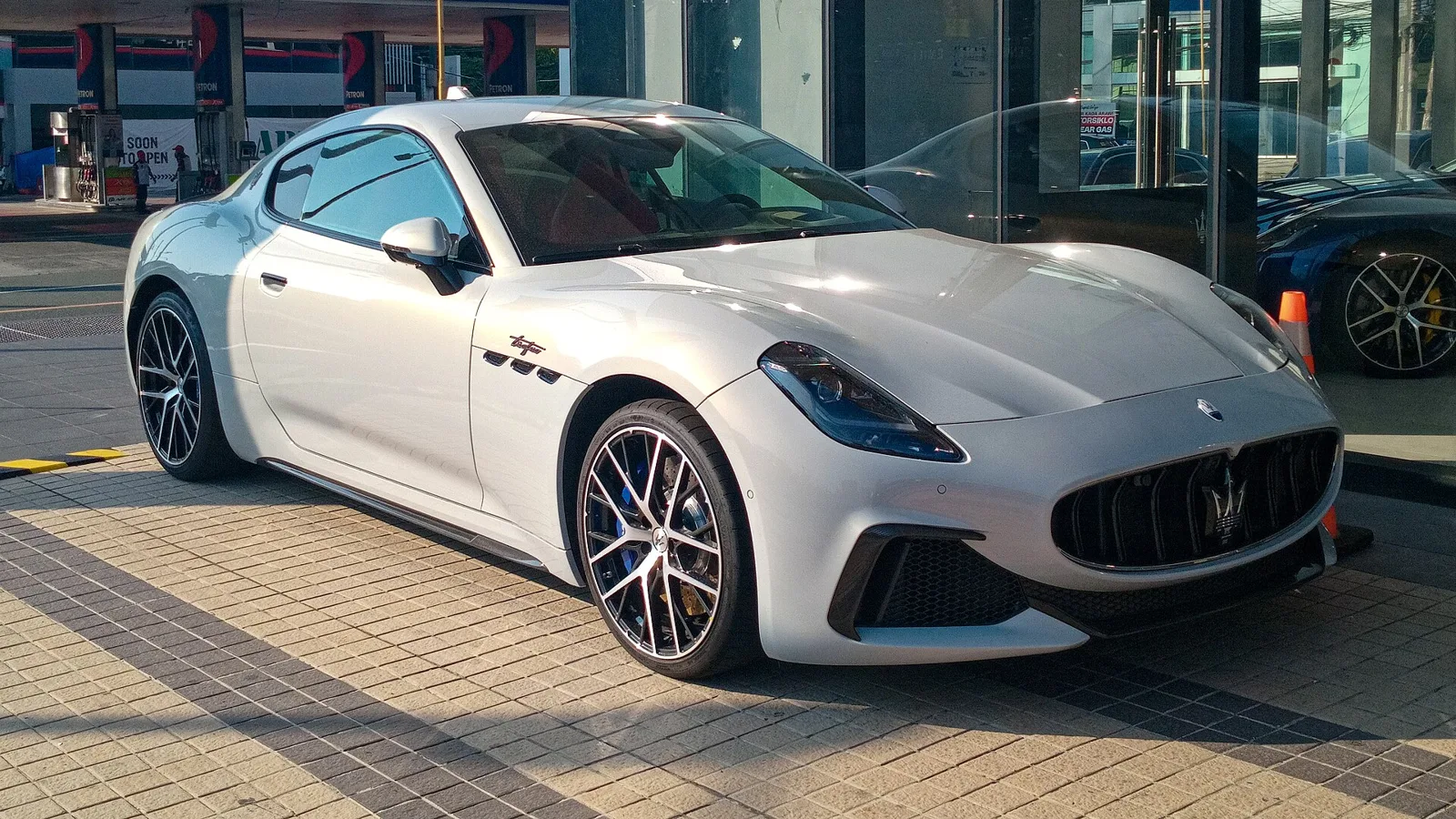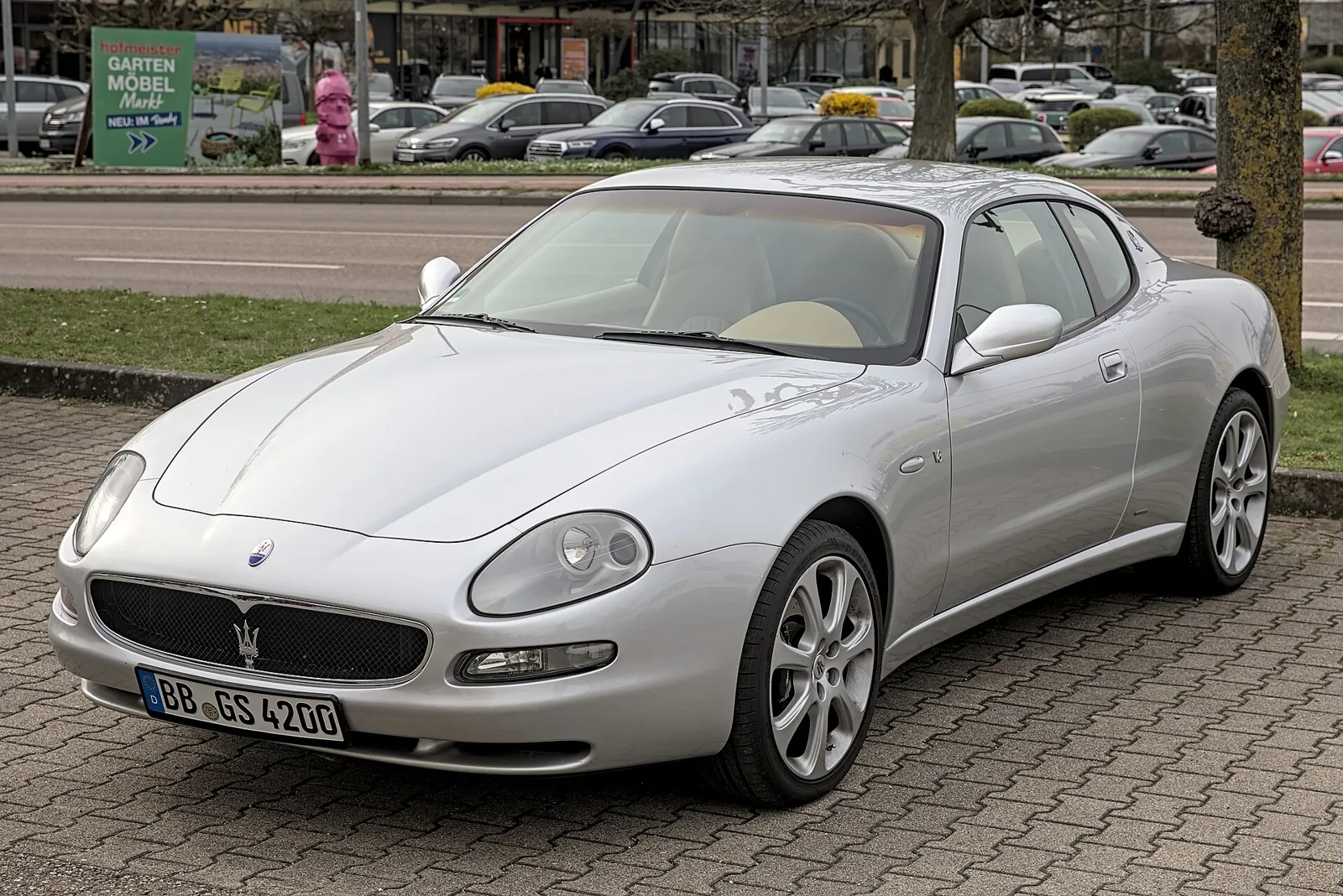
Giugiaro styling, a naturally aspirated Ferrari-Maserati V8 and a GranSport and Trofeo family that carried the car onto the track.
The Maserati Coupe was a four-seat grand tourer built from 2001 to 2008 alongside the two-seat Spyder convertible. Both used a 4,244 cc V8 rated at 390 PS (287 kW; 385 hp), and about 13,423 cars were produced before the GranTurismo replaced them.
The Maserati Coupe and Spyder were grand tourers built by Maserati from 2001 to 2008. Enthusiasts often call both models the 4200 GT, and Giorgetto Giugiaro of ItalDesign styled them. Their arrival also marked Maserati's return to the North American market after a long absence.
Why is the car called the 4200 GT?
The Coupe and Spyder both take the 4200 GT label, which reflects the increase in engine size from 3,217 cc (3.2 litres) to 4,244 cc (4.2 litres). The nickname was needed because the Coupe and Spyder names were confusing. Both could refer to almost any coupe or convertible that Maserati had made, so the shorthand became the way owners and writers identified the pair.
Both cars were based on the 3200 GT, a model that was never sold in the United States. The 4200 GT name therefore links the two generations while signalling that the new cars had a larger engine than their predecessor.
A four-seat grand tourer with a naturally aspirated V8, a Cambiocorsa option and a racing family built on the same shell.
Where did the Coupe and Spyder come from?
The Spyder was unveiled first, at the 2001 Frankfurt Auto Show, and the Coupe followed shortly after at the 2002 Detroit Auto Show. US sales began in March 2002 for the Spyder and in May for the Coupe. The Spyder also earned Forbes' Best GT award for 2001 soon after its introduction.
The Spyder's arrival was a homecoming of sorts, because it returned Maserati to the North American market after 11 years away. Giorgetto Giugiaro of ItalDesign designed the bodywork. He had also designed the Ghibli, the mid-engined Bora, the Quattroporte III and the 3200 GT that came before these cars.
The interior was the work of Enrico Fumia, who based much of the cabin on the 3200 GT. Production took place at the Viale Ciro Menotti plant in Modena, Italy, and 13,423 cars left the line before the GranTurismo replaced the model.
How big were the Coupe and Spyder?
The Coupe was a true four-seater with a wheelbase of 2,660 mm (105 in). That figure sits about 76 mm (3 in) longer than the Jaguar XK8 and 305 mm (12 in) longer than the Porsche 911 (996). Overall length was 4,523 mm (178 in), width was 1,822 mm (72 in) and height was 1,305 mm (51 in).
Curb weight for the Coupe ranged from 1,670 to 1,680 kg (3,682 to 3,704 lb). Its rear seats could take two adults comfortably, which set it apart from the two-seat convertible that shared its design.
The Spyder used a shorter wheelbase of 2,440 mm (96 in), which is 220 mm (9 in) less than the Coupe. Its overall length was 4,303 mm (169 in), and its curb weight ran from 1,720 to 1,730 kg (3,792 to 3,814 lb). The soft top was operated electronically by a pushbutton on the centre console and stowed under a flush hard cover in about 30 seconds.
A late 2004 facelift brought a larger grille with horizontal bars and moved the oval Saetta logo to the C-pillars. The boomerang taillights of the earlier design gave way to conventional units. The Spyder had received a glass rear window in 2003 in place of plastic, so the two body styles evolved together.
What engine powered the Maserati Coupe?
Both models used the F136 R V8 from the Ferrari-Maserati F136 engine family. It displaced 4,244 cc and produced 390 PS (287 kW; 385 hp) at 7,000 rpm, with 450 Nm (332 lb ft) of peak torque at 4,500 rpm. The engine was naturally aspirated, which meant the twin-turbo induction of the 3200 GT was gone.
The V8 had a compression ratio of 11.1:1 and sat in a 90 degree V. Its bore measured 92 mm (3.62 in) and its stroke 80 mm (3.15 in). Thirty-two valves were operated by chain-driven double overhead camshafts, and the cylinder heads and crankcase were cast from an aluminium and silicon alloy.
The engine weighed 184 kg (406 lb). Because the powertrain was now Ferrari-based, Maserati moved away from the forced induction it had relied on for years.
Did the Maserati Coupe have a manual gearbox?
Yes. The six-speed manual came in two forms: the GT, with a foot-operated clutch, and the Cambiocorsa, an automated manual that used paddles behind the steering wheel. The Cambiocorsa offered Normal, Sport, Auto and Low Grip modes, each selected by buttons on the console.
The Cambiocorsa was built by Graziano Trasmissioni and used a Formula One-type gearbox with hydraulic operation and electronic management. In Sport mode the gearchanges took about a quarter of a second, while Auto mode let the car shift itself and still allowed the driver to take over with the paddles. Low Grip, sometimes called Ice mode, made starting and shifting smoother on snow and ice.
The transmission sat at the rear as a transaxle, integrated with the differential. That layout gave both body styles a 48/52 weight distribution between the front and rear axles.
How did the Maserati Coupe handle?
Both models used light alloy double wishbone suspension at the front and rear, supplemented by anti-roll bars. The most sought-after chassis option was Skyhook, an adaptive damping system that used six accelerometers to monitor the wheels and the body. Skyhook recalculated its settings at least 40 times per second and adjusted each shock absorber accordingly.
Sport mode firmed the suspension for better cornering, and the car's computer coordinated the damping with the Cambiocorsa gearbox and the other stability systems. Maserati Stability Program became standard on 2004 models, bringing together traction control, brake force distribution and anti-lock braking in one system.
Brembo four-piston light alloy calipers clamped cross-drilled ventilated discs on all four wheels. The standard 18-inch alloy wheels had 15 spokes, but most buyers chose the optional sport wheels after 2003. Seven-spoke sport wheels became standard by 2005.
What changed in the GranSport?
The GranSport was a sportier Coupe that was first shown at the March 2004 Geneva Motor Show. Its 4,244 cc V8 was rated at 400 PS (294 kW; 395 hp) at 7,000 rpm, and the car reached 100 km/h in 4.85 seconds on the way to a top speed of 290 km/h (180 mph). The extra power came mainly from a revised exhaust and better intake manifolds and valve seats.
Frank Stephenson was responsible for the GranSport's exterior and interior redesign, which was engineered for Ferrari-Maserati design. The bodywork lowered the drag coefficient by 0.02 to 0.33, and the taller sixth gear helped the car reach its higher top speed.
Chrome mesh grilles adorned the front and rear bumpers, and 19-inch Trofeo-design wheels with trident spokes completed the look. Inside, the car had highly contoured sport seats, carbon fibre trim on the dashboard and steering wheel, and a slimmer centre console. An open-top GranSport Spyder followed, introduced at the September 2005 Frankfurt Motor Show.
Which special editions were built?
Special editions were mostly trim packages offered for certain model years or on small numbers of cars. The Spyder 90th Anniversary was limited to 90 cars for North America and 90 for the rest of the world. The MC Victory edition, which had 181 cars, was shown at the 2006 Geneva Motor Show, marking the track results of the MC12 GT1.
Fifteen of the Spyder 90th Anniversary cars were right-hand drive. A 2004 Coupe 90th Anniversary was announced but never produced,.
The Maserati and Cornes 10th Anniversary had 35 units, while the 2006 GranSport Contemporary Classic was distinguished by light blue dials. The 2007 GranSport 10th Anniversary was given a limited edition plaque, and the 2004 Vintage trim added chrome air-exhaust vents and polished wheels.
What was the Trofeo racing car?
The Trofeo was a racing version of the Coupe, introduced in 2003. Its engine was rated at 420 PS (309 kW; 414 hp) through revised mapping and a free-flowing exhaust. The car reached 97 km/h in 4.0 seconds, and its weight fell by 249 kg (550 lb).
Maserati achieved that weight saving by stripping out comfort equipment such as soundproofing, air conditioning and the leather interior, replacing the regular seats with racing seats. Carbon-fibre doors and bonnet took the place of steel, the side glass became plexiglass, and the exhaust used a baffle-free muffler.
A Trofeo racing series was organised for enthusiasts, with a per-race rental charge of about US$20,000. The lighter Trofeo Light was developed for the Italian GT Championship and the FIA GT3 European Championship, and it also raced in the Rolex Sports Car Series.
Were there Zagato or concept versions?
The GS Zagato was a limited-production model with a design inspired by the 1954 Maserati A6G Berlinetta Zagato. Only nine were built, and the car was based on a shorter GranSport Spyder chassis with aluminium bodywork.
The A8GCS Berlinetta concept was presented in 2009 by Touring Superleggera, using the Maserati GranSport as its starting point.
Later, the Maserati 420 Super Monoposto, a right-hand drive one-off, was revealed in July 2016 at the Brooklands Museum.
What are the Maserati Coupe specifications?
The two body styles shared one drivetrain: a naturally aspirated V8 of 4,244 cc with 450 Nm (332 lb ft) of torque, mounted with a rear transaxle that gives 48/52 weight distribution. Variants such as the GranSport and Trofeo changed output and weight, so the table lists those figures separately.
| Specification | Detail |
|---|---|
| Chassis code | Tipo M138 |
| Years built | 2001 to 2008 |
| Engine | 4,244 cc V8, F136 R of the Ferrari-Maserati F136 family, naturally aspirated |
| Output | 390 PS (287 kW; 385 hp) at 7,000 rpm |
| Torque | 450 Nm (332 lb ft) at 4,500 rpm |
| Compression ratio | 11.1:1, 90 degree V |
| Engine weight | 184 kg (406 lb) |
| Transmission | Six-speed manual (GT) or Cambiocorsa automated manual |
| Weight distribution | 48/52 front to rear |
| Coupe wheelbase | 2,660 mm (105 in) |
| Coupe curb weight | 1,670-1,680 kg (3,682-3,704 lb) |
| Spyder wheelbase | 2,440 mm (96 in) |
| Spyder curb weight | 1,720-1,730 kg (3,792-3,814 lb) |
| GranSport output | 400 PS (294 kW; 395 hp) at 7,000 rpm |
| GranSport 0-100 km/h | 4.85 seconds; top speed 290 km/h (180 mph) |
| Trofeo output | 420 PS (309 kW; 414 hp) |
| Total production | 13,423 cars |