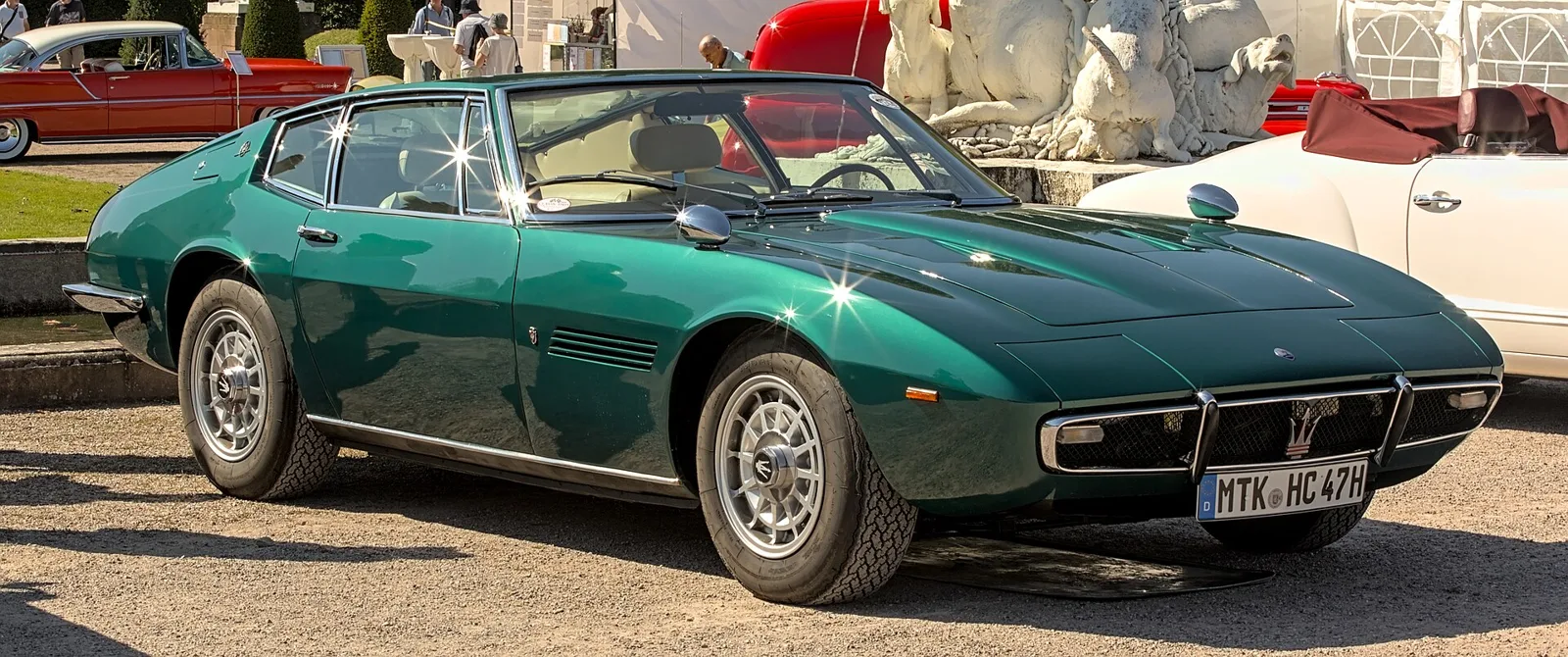
A Giugiaro-styled 2+2 with a 4.7-litre V8 that reached 250 km/h, the 1969 SS that followed, and the later Ghiblis that reused the name.
The Maserati Ghibli I, code AM115, was a two-door 2+2 V8 grand tourer built from 1967 to 1973. It used a 4,719 cc quad-cam V8 producing 310 PS (228 kW; 306 hp), and the later SS version reached 280 km/h (174 mph).
Maserati's Ghibli name comes from a hot desert wind, and the first car to carry it was a shark-nosed grand tourer styled by a young Giorgetto Giugiaro. The original AM115 was a V8 coupe with a 4.7-litre engine, and its SS variant followed in 1969 with more power and a higher top speed.
Where did the Ghibli name come from?
The name comes from Libyan Arabic and describes a hot, dry south-westerly wind that blows across the Libyan Desert. Maserati used the name three times: for the AM115 V8 grand tourer of 1967 to 1973, the AM336 twin-turbo V6 coupe of 1992 to 1998, and the M157 executive saloon of 2013 to 2023.
Sports Car International ranked the original Ghibli ninth on its list of top sports cars of the 1960s.
A shark-nosed 2+2 V8 from a young Giugiaro, whose name Maserati would reuse for two very different cars.
How was the original Ghibli designed and launched?
The Ghibli was first shown as a two-seater concept at the November 1966 Turin Motor Show. Its steel body had a low, shark-shaped nose designed by Giorgetto Giugiaro while he worked at Ghia, and the production model added two rear seats before deliveries began in March 1967.
The concept sported pop-up headlamps, leather sport seats up front, alloy wheels and Pirelli Cinturato N72 tyres in 205R15 size. The production model added two rear seats with no backrest, which let Maserati market it as a 2-door 2+2 fastback coupe.
What engine and transmission did the AM115 use?
The Ghibli used a front-mounted quad-cam 4,719 cc dry-sump V8 producing 310 PS (228 kW; 306 hp). A five-speed ZF manual was standard, and a three-speed automatic was available as an option. The car reached 0-97 km/h (0-60 mph) in 6.8 seconds.
The chassis used a tubular frame with a spot-welded body. The front had double wishbones with coil springs and an anti-roll bar, and the rear used a live axle on semi-elliptic springs with a single longitudinal torque arm.
Top speed was 250 km/h (155 mph). Fuel was carried in two separate 50-litre tanks, filled through flaps set on either side of the roof pillars.
How fast was the Ghibli SS?
The Ghibli SS arrived in 1969 with a 4,930 cc V8 rated at 335 PS (246 kW; 330 hp) at 5,500 rpm. Its 481 N.m (355 lbf ft) of torque arrived at 4,000 rpm, and its top speed of 280 km/h (174 mph) made it the fastest Maserati road car of its time.
The SS engine was stroked up by 4 mm (0.16 in) from the original, and SS models carry an additional /49 designation in their type code, as in AM115/49.
A Spyder version appeared in the same year, with a flush, body-coloured tonneau cover and an optional detachable hardtop. Total SS production amounted to 45 Spyders and 425 coupes.
How many Ghibli I cars were built?
In all, 1,170 coupes and 125 Spyders were produced, including 45 Spyder SS models. Production ended in 1973, and the Khamsin, a Bertone design, took over the following year. Of the total, the coupe made up the bulk of production, while the Spyder represented a much smaller share of the cars built.
What wheels and tyres did the Ghibli use?
Magnesium wheels were fitted as standard, originally with Pirelli Cinturato 205 VR15 tyres (CN72). From 1972 the car switched to 215/70VR15 Pirelli Cinturato CN12 tyres, and Borrani wire wheels were available as an option.
Even by the standards of its time and class, the car was thirsty.
How did the second Ghibli (AM336) differ?
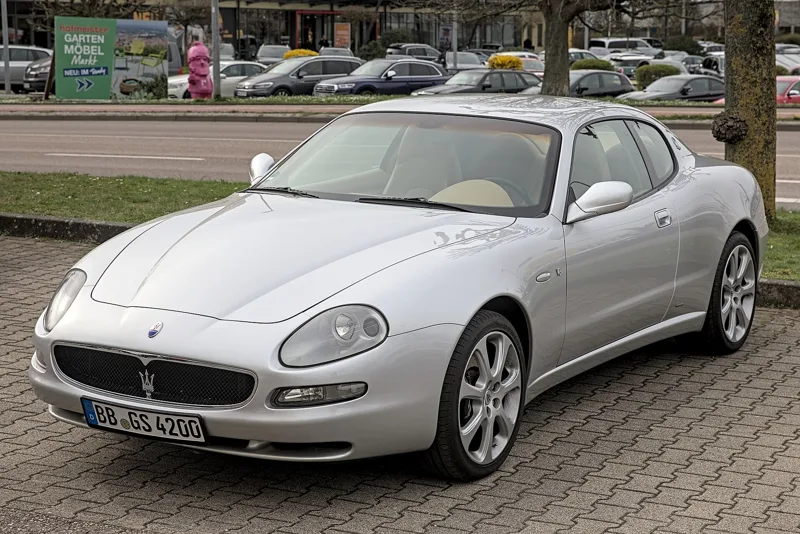
The 1992 Ghibli revived the name for a two-door four-seat coupe with twin-turbocharged V6 engines. It was an evolution of the Biturbo coupes, and its interior and basic bodyshell were carried over from the Biturbo, with a 2.0-litre V6 for Italy and a 2.8-litre for export.
The car launched at the 62nd Turin Motor Show in April 1992, with Connolly leather upholstery and burr elm trim. A four-speed automatic was optional, and the six-speed manual came from the Shamal.
A 1994 update brought a refreshed interior, wider 17-inch alloys, fully adjustable electronic suspension and ABS brakes. The 1995 Ghibli Cup used a 1,996 cc V6 that produced 330 PS (243 kW; 325 hp).
The Cup had 163.0 hp per litre, which at the time was the highest specific output of any street-legal car, beating the Bugatti EB110 and Jaguar XJ220 on that measure.
What were the Ghibli Cup and Open Cup?
The Ghibli Cup was a limited edition that brought features of the Open Cup racer onto the road, with Brembo brakes, tweaked suspension and 5-spoke Speedline wheels. The Open Cup was a single-make racing series for the Ghibli in 1995 and 1996, with twenty-five cars prepared.
The Open Cup cars had their engines tuned to 320 PS (235 kW; 316 hp), with roller-bearing turbochargers, a freer-flowing exhaust and remapped fuel computers. In 1996 an upgrade gave lap times similar to the Ferrari 355 Challenge. The 1995 season held eight races, two in Italy and six across Europe, and several of the original cars later ran in national GT events.
What records did the Ghibli GT set?
The 1996 GT added 7-spoke 17-inch alloy wheels and black headlight housings. On 4 November 1996 at Lake Lugano, Guido Cappellini set a flying kilometre water speed record in the 5-litre class, piloting a speedboat with a Ghibli Cup biturbo V6.
The boat averaged 216.703 km/h (134.653 mph). Maserati celebrated the record with 60 Ghibli Primatist editions in ultramarine blue, trimmed in two-tone blue and turquoise leather. Production of the second-generation Ghibli ended in summer 1998, and the 3200 GT replaced it.
What was the third-generation Ghibli (M157)?
The third-generation Ghibli, Tipo M157, was unveiled at the 2013 Shanghai Motor Show as an executive saloon. It came with three 3.0-litre V6 engines, two twin-turbo petrols and a diesel, and it was the first Maserati production car offered with a diesel engine.
Power outputs were 330 PS (243 kW; 325 hp) and 410 PS (302 kW; 404 hp) for the petrols, and 275 PS (202 kW; 271 hp) for the diesel. An eight-speed automatic was standard on all models, and all-wheel drive was offered on the most powerful V6 except in right-hand drive markets. Production was halted in late 2023 amid slumping sales.
What are the Ghibli I specifications?
| Specification | Detail |
|---|---|
| Type | Front-engine two-door 2+2 grand tourer |
| Years | 1967 to 1973 |
| Engine | 4,719 cc quad-cam dry-sump V8 |
| Output | 310 PS (228 kW; 306 hp) |
| SS engine | 4,930 cc |
| SS output | 335 PS (246 kW; 330 hp) at 5,500 rpm |
| SS torque | 481 N.m (355 lbf ft) at 4,000 rpm |
| Transmission | Five-speed ZF manual, three-speed automatic optional |
| 0-97 km/h (0-60 mph) | 6.8 seconds |
| Top speed | 250 km/h (155 mph); SS 280 km/h (174 mph) |
| Fuel tanks | Two 50 L (13.2 US gal; 11.0 imp gal) |
| Production | 1,170 coupes and 125 Spyders |