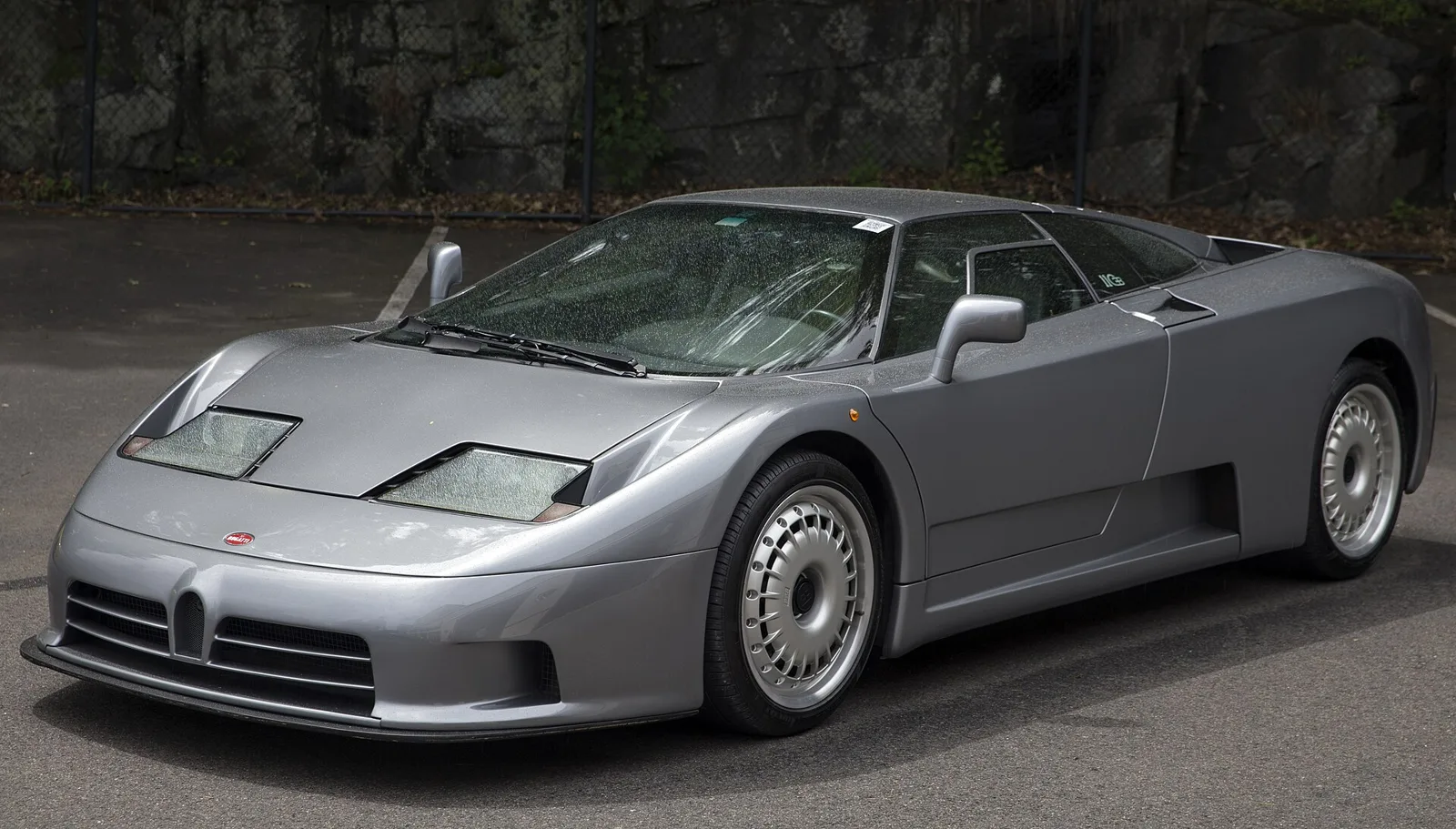
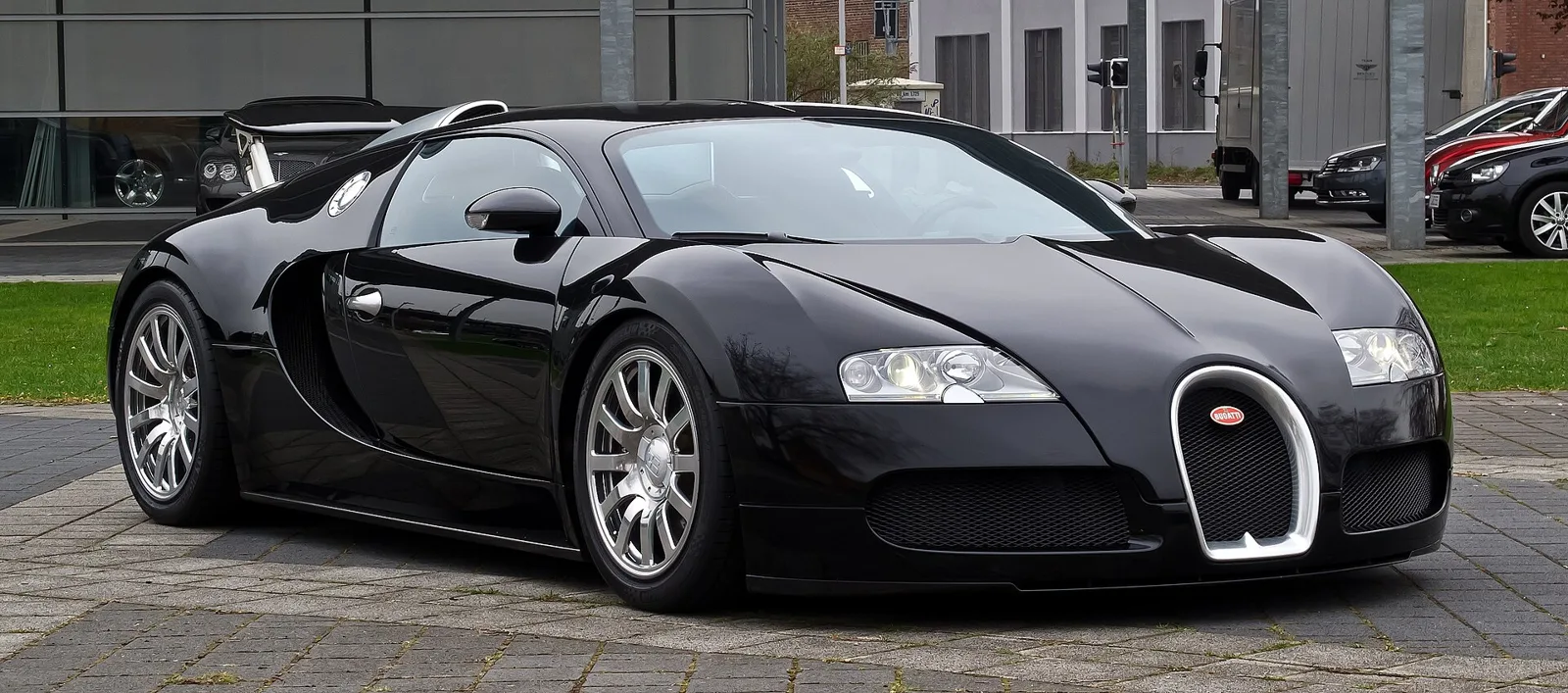
Stanzani's engineering, Gandini's scissor-door body and a carbon chassis that brought Bugatti back to the road in 1991.
Launched in 1991, the Bugatti EB110 was a mid-engined supercar with a 3,500 cc V12 fed by four turbochargers and all-wheel drive. Its carbon fibre chassis and a 1992 Super Sport variant made it a headline car, but only 139 examples were built before the firm failed in 1995.
Bugatti's return to car production came with a 1991 machine that combined four turbochargers, a V12 engine and all-wheel drive. A faster Super Sport followed within a year, yet the firm failed in 1995 after building 139 cars.
Where did the Bugatti EB110 come from?
The EB110 was conceived by Paolo Stanzani in the mid 1980s and developed after talks between Ferruccio Lamborghini and Stanzani in late 1984. Romano Artioli's Autoexpo bought the Bugatti brand in May 1987, and Bugatti Automobili S.p.A. was founded that October. Production ran from 1991 until the company was liquidated in 1995.
Stanzani had worked on Lamborghini cars such as the Miura, Countach, Espada, Urraco, Jarama and Jalpa before he became the sole managing director of Bugatti Automobili. He gave the new supercar the internal code FL12, short for Ferruccio Lamborghini 12-cylinder, and work on the engine and chassis began in 1986.
Much of the early engineering was done by Tecnostile, a Modena firm set up by Oliviero Pedrazzi, Achille Bevini and Tiziano Benedetti after their years on Lamborghini's Miura, Urraco and Countach. Pedrazzi led engine and chassis design, Bevini handled the bodywork and Benedetti dealt with suppliers.
Several Lamborghini people followed Stanzani to the new project on the strength of his reputation. Test driver Loris Bicocchi, employee number 7 at Campogalliano, waited a full year before he began early testing of the prototype.
A quad-turbo V12 in a carbon-skinned chassis, built to bring the Bugatti name back to the road.
How was the EB110 engineered?
The EB110 used a 3,500 cc V12 with four turbochargers, 60 valves and 12 throttle bodies, driving all four wheels through a six-speed manual gearbox. Its final chassis used carbon fibre skins bonded to aluminium honeycomb, a change pressed for by Romano Artioli on safety grounds.
The displacement matched the Formula 1 rules of 1987, and Stanzani judged a naturally aspirated version too weak for a car of this class. Turbocharging was built into the plan from the start. The team chose four small turbochargers rather than two large ones, because two bigger units would have suffered more lag from their greater rotational inertia.
The bore and stroke measured 81 mm by 56.6 mm (3.19 in by 2.23 in). The GT's peak power of 412 kW (560 PS; 553 hp) arrived at 8,000 rpm, and its torque peaked at 611 N m (451 lb ft) at 3,750 rpm. The layout was a clear statement of intent for a Bugatti built to compete with the best supercars of its day.
Four-wheel drive was central to the Stanzani concept. Ferrari had only built a 408 4RM prototype with that layout, and Lamborghini did not put four-wheel drive into production until the Diablo VT arrived in 1993. The EB110 combined the system with active aerodynamics, a carbon monocoque and double wishbone suspension.
Why did the chassis change from aluminium to carbon fibre?
The chassis moved from aluminium to carbon fibre because Romano Artioli was worried about safety and wanted the prestige of carbon in a supercar. Stanzani's aluminium design was cheaper and easier to repair, but Artioli pushed for carbon skins. Production cars ended up with carbon skins over an aluminium core.
The original panels were two aluminium skins with a honeycomb core, each skin between 0.9 and 1.5mm thick and the core between 8 and 12mm deep. Artioli had doubts about the design from the beginning, and he pointed to racing deaths in cars with similar construction as a reason for concern. The argument was partly about safety and partly about how a supercar of the future should be built.
Stanzani asked Aerospatiale for quotes on carbon-composite material, and the French firm offered both aluminium and carbon skins over a honeycomb core. Stanzani judged the carbon-aluminium option financially unviable for Bugatti Automobili, and he told Artioli so. After his departure, Dario Trucco and Oliviero Pedrazzi held further meetings with Aerospatiale engineers in early September 1990.
Torsion tests showed the composite was stiffer than the aluminium tub, but engineers also found it heavier and much more expensive. The carbon chassis kept the same dimensions and panel split lines as the original design. Separate panels were bonded and riveted together, which avoided the need for very large autoclaves and produced a stiffer structure that helped the car meet its ride and handling targets.
How was the EB110 styled?
The EB110 was styled by Marcello Gandini, whose first angular design did not please the company's president. A second version with softer lines and fixed headlamps followed, and Gianpaolo Benedini made the final changes. Scissor doors and a large windscreen survived every revision of the body.
Several designers received the chassis drawings, including Paolo Martin, Giorgetto Giugiaro, Bertone and Gandini. Giugiaro's Bugatti ID90 prototype appeared at the 1990 Turin Auto Show, while Martin's avant-garde proposal was turned down by management. Bertone's own design, drawn by Marc Deschamps, later appeared as the Bertone Lotus Emotion.
Gandini was a natural choice because he knew Stanzani well and had styled cars such as the Lamborghini Miura, the Lancia Stratos and the Alfa Romeo Montreal. His first prototypes were bodied by carrozzeria Ilas and began testing in 1991. The shovel nose and flared rear arches of that first design were what the president disliked most.
Artioli approved a full-size model yet still wanted changes, and Gandini refused those that would alter the car's character. Benedini therefore added a small Bugatti horseshoe badge to the front air intake and took responsibility for the interior with Laurens van den Acker of Design System. The fixed headlamps and cooling ducts in the front bumper came from the second design.
Who took over EB110 development after Stanzani left?
Nicola Materazzi became technical director after Stanzani left. He changed the front-to-rear torque split from 40:60 to 27:73 after drivers complained of understeer. Materazzi left in December 1992, and Mauro Forghieri led technical work until mid 1994.
The split between the two founders came down to philosophy. Stanzani wanted a technically advanced, light car with a short wheelbase, while Artioli wanted a car that represented the Bugatti name, with well-appointed seats and electrical switches. Those interior features added several hundred kilograms to the kerb weight, and Artioli also diluted Stanzani's shareholding as he took a bigger role.
Materazzi had a racing background, with work on the Lancia Stratos GR5, the Ferrari 288 GTO Evoluzione, the F40 and the Cagiva C589. His minimalist views clashed with Artioli's focus on marketing, and that disagreement eventually ended his time at the company.
Forghieri tried to lower the cost of the car, but most designs and contracts were already in place. He also proposed a smaller Bugatti, the EB120, styled by Steve Bernaud, as a way to improve finances. Work on the four-door EB112 continued alongside the coupe until the money ran out.
When was the EB110 unveiled?
The GT made its public debut on 14 September 1991, with the car shown beside the Grande Arche de la Defense near Paris. A gala at Versailles followed with 1,700 guests, and the launch continued in Molsheim on 15 September, 110 years after Ettore Bugatti's birth.
The Super Sport arrived at the 1992 Geneva Motor Show, six months after the GT, offering more power and less weight. It was 150 kg (330 lb) lighter because of carbon-fibre body panels inside and out, and it used a fixed rear wing where the GT had a speed-sensitive electronic one with active air flaps.
Early in 1994, Formula One driver Michael Schumacher bought a yellow Super Sport, which brought the company a great deal of publicity. Schumacher later crashed the car into a truck and blamed inadequate brakes. He repaired it and kept the car until 2003.
Derek Hill, son of Phil Hill, took part in the 1996 24 Hours of Daytona as one of three drivers sharing an EB110 entry in the United States.
How fast was the EB110?
The GT was rated at 412 kW (560 PS; 553 hp) and quoted at 3.46 seconds for 0-100 km/h, with a 342 km/h (212.5 mph) top speed. The Super Sport raised output to 450 kW (612 PS; 603 hp) and reached 355 km/h (220.6 mph) on official figures.
Independent testers recorded different numbers. Auto, Motor und Sport measured 3.6 seconds to 100 km/h for a GT, while Autocar recorded 9.6 seconds to 161 km/h (100 mph) when it tested the GT in March 1994. Sport auto measured 3.3 seconds to 100 km/h for the Super Sport.
Road & Track recorded a standing quarter mile of 12.5 seconds at 192.3 km/h (119.5 mph) for a Super Sport. Its testers suspected that the acceleration figures could have been lowered considerably with a more aggressive use of the clutch.
What are the Bugatti EB110 specifications?
The GT and Super Sport shared a 3,500 cc quad-turbo V12 and a six-speed manual transmission, with the Super Sport tuned for more power and 150 kg (330 lb) less weight. The table below lists the core figures for both cars, with notes on the derivatives that followed.
| Specification | EB110 GT | EB110 Super Sport |
|---|---|---|
| Engine | 3,500 cc V12, four turbochargers | 3,500 cc V12, four turbochargers |
| Valves and throttles | 60 valves, 12 throttle bodies | 60 valves, 12 throttle bodies |
| Power | 412 kW (560 PS; 553 hp) at 8,000 rpm | 450 kW (612 PS; 603 hp) at 8,250 rpm |
| Torque | 611 N m (451 lb ft) at 3,750 rpm | 650 N m (479 lb ft) at 4,200 rpm |
| Transmission | Six-speed manual, all-wheel drive | Six-speed manual, all-wheel drive |
| 0-100 km/h | 3.46 seconds (official) | 3.26 seconds (official) |
| Top speed | 342 km/h (212.5 mph) | 355 km/h (220.6 mph) |
| Weight | Baseline | 150 kg (330 lb) lighter |
| Chassis | Carbon fibre skins on aluminium honeycomb | Carbon fibre skins on aluminium honeycomb |
| Built | 1991 to 1995 | 1992 to 1995 |
What speed records did the EB110 set?
The EB110 GT averaged 342.7 km/h across six runs at Nardo in May 1992, beating the 325 km/h official speed set by the Lamborghini Diablo. A Super Sport reached 355 km/h at the same proving ground in 1993, and a methane-fuelled GT reached 344.7 km/h in 1994.
Jean-Philippe Vittecoq drove the GT to that average on 24 May 1992, and he returned to the Super Sport on 30 May 1993. Those records stood only briefly, because the McLaren F1 reached 386.4 km/h at Ehra-Lessien in 1998.
Gildo Pallanca Pastor drove an EB110 fitted with dedicated wheels and studded tyres at Oulu in Finland on 2 March 1995, averaging 296.34 km/h with a peak of 315 km/h. The run showed that the car could be pushed hard on a surface far from its usual tarmac.
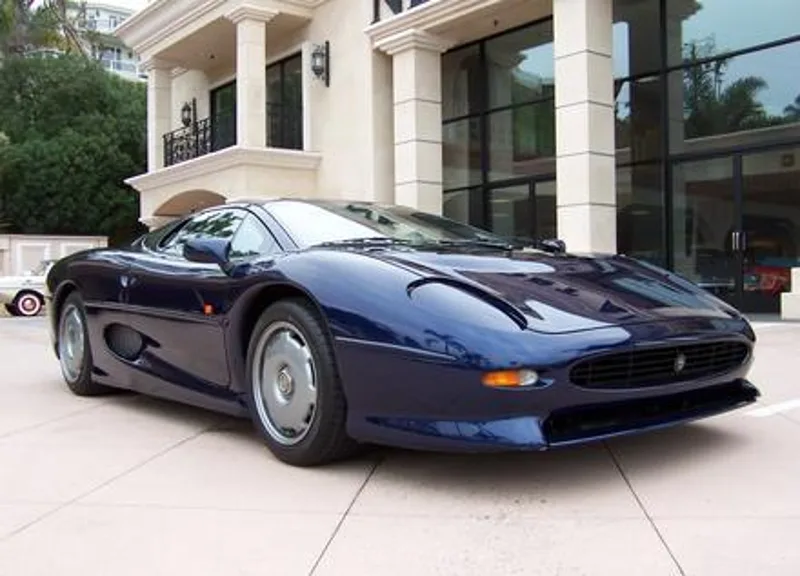
On the Nurburgring Nordschleife, the prototype completed a lap in 7 minutes 44 seconds, according to test driver Loris Bicocchi. That time was faster than the unofficial 7:46.36 set by the Jaguar XJ220.
Did the EB110 race at Le Mans?
Yes. An EB 110 LM started the 1994 24 Hours of Le Mans, qualified 17th overall and fifth in the GT1 class, but did not finish. A second car, commissioned by pharmaceutical entrepreneur Martino Finotto, also retired at the 1996 24 Hours of Daytona with gearbox trouble.
The Le Mans car is now displayed at a French automobile museum. The team's qualifying pace was competitive for a car with only a short racing history behind it, and it reflected the engineering that had gone into the road model.
How did Bugatti Automobili go bankrupt?
Bugatti Automobili went bankrupt in 1995 after Artioli bought Lotus Cars for about 30m pounds ($50m), spent heavily on the EB112 four-door saloon and missed supplier payments from 1993. Dauer of Nuremberg then bought semi-finished cars and parts through the bankruptcy trustee.
The company's chairman had been drawn into several expensive projects at once. The EB110 itself was a finished product by then, but the cash needed to deliver the EB112 and the Lotus purchase had drained the business. Its supplier relationships suffered as a result, and the company could not recover.
What happened to the EB110 after the company failed?
Dauer Sportwagen of Nuremberg bought the remaining parts stock after the bankruptcy and produced a complete spare parts catalogue with exploded diagrams. Between 1999 and 2000 it finished three Super Sport models and one GT with Bugatti badges and minor changes.
Dauer then used the leftover chassis in 2001 and 2002 to produce five heavily revised cars, badged Super Sport Light Weight. Output climbed to 481 kW (654 PS; 645 hp), turbo lag fell and a carbon body cut 230 kg (507 lb). A 526 kW (715 PS; 705 hp) option was available with sports exhaust and a modified ECU.
Dauer Sportwagen went bankrupt in 2008, and the Bugatti parts, including the high-performance Super Sport components, were bought in 2011 by Toscana-Motors of Kaiserslautern. The last EB 110 built by Dauer was finished in 2002, and one unfinished example was completed in 2019.
What is the B Engineering Edonis?
The Edonis was a re-engineered EB110 Super Sport from B Engineering, introduced in 2000 with a 3,760 cc engine producing 507 kW (689 PS; 680 hp). It kept little of the original car beyond its carbon-fibre chassis, and it weighed 1,500 kg (3,307 lb).
Nicola Materazzi conceived the Edonis and Marc Deschamps styled it, with a full exterior and interior redesign. The original four small IHI turbochargers were replaced by two larger units from the same maker, and the four-wheel-drive triple-differential was swapped for a lighter rear-wheel-drive transaxle that saved about 70 kg (154 lb).
The brand claims 365 km/h (227 mph) and a 0-100 km/h time of 3.9 seconds. A 720 bhp version reached 359.6 km/h at the Nardo proving ground. Two prototypes were built from retained parts, one in gold and one in Rosso Pompeiano red, and talks with Hispano Suiza broke down over the valuation of the project.
B Engineering also supplied spare parts and service for the original EB 110 until 2023. That support gave owners a long tail of expert help after the factory had closed.
Frequently asked questions
How many Bugatti EB110s were made?
A total of 139 examples were built during the production run. A small number of post-production cars were completed after the bankruptcy, and the final example by Dauer Sportwagen came in 2002.
Was the EB110 a four-wheel-drive car?
Yes. All four wheels were driven through a six-speed manual gearbox. Materazzi later reshaped the power balance between the axles, moving from 40:60 to 27:73 after understeer complaints.
Did Michael Schumacher really own an EB110?
He did. Schumacher bought a yellow Super Sport in early 1994, crashed it into a truck, repaired it and kept the car until 2003.
Was a tuned EB110 ever built?
Brabus modified one EB110 Super Sport. The car received a bi-colour blue and black leather interior and a custom quad-pipe exhaust, while its exterior and engine remained largely unchanged. Its existence only became public once it was offered for sale in 2013.
.jpg)