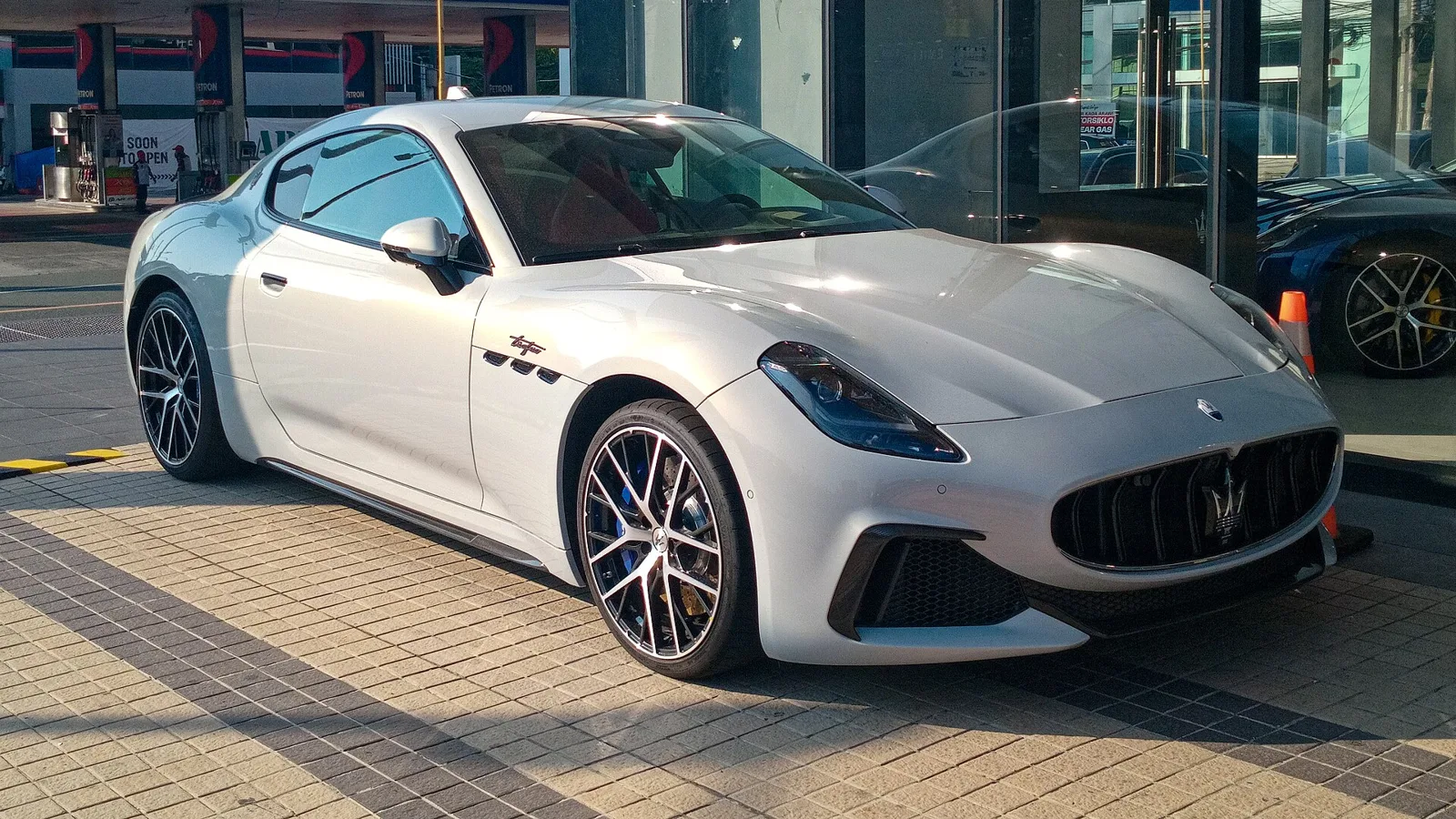
Maserati's grand tourer replaced the Coupe and Spyder, was developed in a record nine months and returned in 2023 with a Nettuno V6 and an electric Folgore.
The Maserati GranTurismo is a grand tourer built in Modena from 2007 to 2019 and again from 2023. Its first generation used a 4.2-litre V8 developed with Ferrari, while the 2023 successor offers Nettuno V6 petrol models and an electric Folgore variant.
Maserati's GranTurismo arrived at the 2007 Geneva Motor Show as the successor to the Coupe and Spyder, and it was designed in a record nine months. Its first generation carried a 4.2-litre V8 developed alongside Ferrari, and the range later grew to include the 4.7-litre S, the MC Stradale and the GranCabrio.
The second generation, revealed in 2022, moved the model onto the Giorgio platform. It offers petrol V6 models and an electric Folgore, and in 2026 it received a mid-cycle facelift that revised its styling and powertrains.
Why was the GranTurismo created?
The GranTurismo succeeded the Maserati Coupe and Spyder. The proposed replacement for the Coupe looked too expensive for Maserati to manufacture, so the Ferrari division launched the California to fill the small-car role instead.
That left Maserati without a coupe, and the GranTurismo was the answer. The car set a record for the speed of its development, moving from design to production in just nine months, which was remarkable for a car of its size.
A total of 28,805 GranTurismo coupes were produced during the first generation, which ran from 2007 until December 2019. The car was built at the historic Modena factory in the viale Ciro Menotti.
A grand tourer built in nine months that became a V8 coupe, a convertible and a fully electric model.
What engine did the first GranTurismo use?
The first GranTurismo used a 4.2-litre (4,244 cc) V8 developed in conjunction with Ferrari. It produced 298 kW (405 PS) and was paired with a six-speed ZF automatic gearbox, which suited the car's grand touring brief.
The 2+2 body was derived from the M139 platform, which the company also used for the Quattroporte V. It had double wishbone front suspension and a multilink rear, and its drag coefficient was 0.33, a respectable figure for a car of this type.
The architecture put the engine inside the wheelbase, in a front mid-engined and rear-wheel-drive layout. That choice gave the car a balanced feel, with a weight split of 49% front and 51% rear in automatic cars.
How did the GranTurismo S perform?
The better-equipped S arrived at the 2008 Geneva Motor Show with a 4.7-litre (4,691 cc) V8 shared with the Alfa Romeo 8C Competizione. It produced 324 kW (440 PS) at 7,000 rpm and 490 N.m (361 lb-ft) of torque at 4,750 rpm.
The S accelerated from 0 to 100 km/h in 4.9 seconds and reached a top speed of 295 km/h (183 mph). Its gearbox was a six-speed automated manual built by Graziano Trasmissioni, which was also used in the Ferrari F430.
The S added unique 20-inch wheels, new side skirts, a small boot lip spoiler and upgraded Brembo brakes. Skyhook adaptive suspension was offered as an option, using aluminium-bodied gas dampers to adjust damping continuously.
North America received the S only for model year 2009, and just 300 units were offered for sale there. That short run made the car a rarity on American roads.
What was the GranTurismo MC?
The GranTurismo MC was the racing version of the S, developed for the FIA GT4 European Cup and based on the Maserati MC concept. It shared the 4.7-litre V8 but was tuned to 450 PS (331 kW; 444 hp), and the car weighed about 3,000 lb (1,361 kg).
The race kit included a six-point harness, a 120-litre fuel tank, carbon fibre bodywork, Lexan windows and 18-inch racing wheels. Brake discs were 380 mm at the front and 326 mm at the rear, and the car used six-piston front calipers.
The MC was unveiled at Paul Ricard and went on sale through the Maserati Corse programme from October 2009. Fifteen racecars were developed, and one of them was raced by Cool Victory in Dubai in January 2010.
What did the MC Sport Line add?
The MC Sport Line was a customisation programme introduced in 2008, based on the GranTurismo MC concept. It added front and rear carbon fibre spoilers, carbon mirror housings and door handles, and 20-inch wheels.
The programme also brought stiffer springs, shock absorbers and anti-roll bars, along with custom Maserati Stability Programme software. The car sat 10 mm (0.4 in) lower than the GranTurismo S, which gave it a sharper stance.
The Sport Line was first offered for the S only, but it was expanded to all GranTurismo variants and eventually to all Maserati vehicles in 2009. That made it one of the brand's wider customisation efforts.
What made the MC Stradale special?
The MC Stradale was announced in 2010 as a strictly two-seat road car with 331 kW (450 PS), and it was 110 kg lighter than the GranTurismo, with a dry weight of 1,670 kg. Its aerodynamics also improved, with a new front splitter and rear air dam.
The MC Race Shift six-speed robotised manual gearbox shifted in 60 milliseconds in race mode, and it shared some electronics and hardware with the Ferrari 599 GTO. The MC Stradale was the first GranTurismo to break the 300 km/h barrier, with a claimed top speed of 303 km/h (188 mph).
Only 497 units of the two-seater were built from 2011 to 2013. Europe took 225 of them, while Japan received 33, Hong Kong 12 and Taiwan 23.
How did the MC Stradale stop and handle?
The MC Stradale used Brembo carbon-ceramic brakes, with 380 x 34 mm ventilated front discs operated by six-piston calipers. Those brakes weighed around 60% less than the steel system, and the stopping distance from 100 km/h was 33 m.
Its suspension was 8% stiffer than the GranTurismo S, and the car rode slightly lower after feedback from racing drivers. Pirelli designed extra-wide P Zero Corsa tyres for the new alloy wheels, which gave better grip.
The 2013 Geneva update brought a 4.7-litre V8 rated 338 kW (460 PS), with 520 N.m (384 lb-ft) of torque on offer. The MC Race Shift gearbox remained, and the top speed stayed at 303 km/h (188 mph).
How did the GranTurismo Sport develop?
The GranTurismo Sport replaced both the S and the S Automatic, and it was unveiled at the 2012 Geneva Motor Show. Its revised 4.7-litre engine was rated 338 kW (460 PS), and the car kept the same basic layout as before.
From 2018 the Sport gained an MC Stradale-inspired front fascia, new headlights, a sportier steering wheel and new seats. A redesigned front bumper and air splitter reduced the drag coefficient from Cd 0.33 to 0.32.
The ZF six-speed automatic became standard, while the automated manual remained available as an option. The option carried steering column paddle shifters, which had been optional on the automatic too.
What were the GranCabrio versions?
The GranCabrio, known as the GranTurismo Convertible in North America, was unveiled at the 2009 Frankfurt Motor Show and built from 2010 to 2019. It kept the four-seat layout of the coupe, making it Maserati's first four-seat convertible.
About 11,715 GranCabrio convertibles were produced, and planned sales for 2010 were 2,100 units, with two-thirds of those intended for the United States. The early cars used the same 4.7-litre V8 as the GranTurismo S Automatic.
The GranCabrio Sport arrived in 2011 with 450 PS (331 kW; 444 hp) and 510 N.m (376 lb-ft) of torque, and the GranCabrio MC followed in 2013 with 460 PS (338 kW; 454 hp). The Fendi edition, designed by Silvia Venturini Fendi, was unveiled at the 2011 Frankfurt Motor Show.
What one-off GranTurismo models were built?
Carrozzeria Touring Superleggera built the Sciadipersia, a coupe based on the GranTurismo that debuted at Geneva in March 2018. It was inspired by the original 5000 GT Shah of Persia, and it set a visual link between the two cars.
The Sciadipersia Cabriolet was introduced in March 2019 on the GranCabrio. A total of 15 coupes and cabriolets were planned, although reportedly only one coupe was made and the other 14 were cabriolets.
The GranTurismo Zeda was the final production example of the first generation. It was presented in a gradient of blue, black and white, which marked the close of the original car's run.
What is the second-generation GranTurismo?
The second-generation GranTurismo, internally designated M189, was revealed in October 2022 and began production in April 2023. It is based on the Giorgio platform, which also underpins a range of combustion and battery electric vehicles from the brand.
The car is made up of 65 per cent alloy by weight, including aluminium and magnesium. It uses double wishbones at the front and a multi-link rear, and adaptive air suspension with adaptive damping is standard.
Its digital dashboard and central touchscreen each measure about 310 mm, and the boot offers 310 litres (68 imp gal; 82 US gal). The Vehicle Domain Control Module changes engine, suspension and transmission behaviour across Comfort, GT, Sport and Corsa modes.
How do the second-generation engines compare?
The petrol models use a 3.0-litre twin-turbocharged Nettuno V6 with an 8-speed automatic. The Folgore runs three electric motors, each producing 400 hp (300 kW), and it uses a single-speed transmission.
The Modena produces 360 kW (490 PS; 483 hp), while the Trofeo was rated 405 kW (550 PS) at launch. Those figures placed the Trofeo at the top of the range, with its higher output reflecting a more focused tune.
The Folgore carries a 92.5 kWh battery pack and was rated for a WLTP range of 540 km (336 mi) in the GranTurismo. Fast charging takes 18 minutes at 270 kW, while slow charging takes 4h30 at 22 kW.
What changed in the 2026 facelift?
A mid-cycle refresh arrived on 18 June 2026 for both second-generation models, aimed at the 2027 model year. The changes covered styling, interior technology and variant powertrains.
The front gained a more prominent shark-nose fascia, with reshaped air intakes and a revised grille graphic. The lights were updated with clear-lens LED taillights, and wider gloss black Tridente wheels increased the track width by 10 mm (0.39 in).
The Trofeo gained 30 kW of extra power, reaching 435 kW (592 PS; 584 hp) through higher boost pressure. The Folgore's range rose to 540 km (336 mi) with the new Wheel End Disconnect system, which switches the car from AWD to RWD in low-load driving.
What are the Maserati GranTurismo specifications?
The table gathers the core figures for both generations, including the first-generation V8s, the MC Stradale, the second-generation engines and the Folgore range. Imperial figures appear in brackets alongside metric ones wherever the original data gives both, and every entry matches the figures set out earlier.
| Specification | Detail |
|---|---|
| First generation built | 2007 to December 2019 |
| Coupes produced | 28,805 |
| First generation V8 | 4.2 L (4,244 cc), 298 kW (405 PS) |
| S variant V8 | 4.7 L (4,691 cc), 324 kW (440 PS) at 7,000 rpm |
| S variant 0-100 km/h | 4.9 seconds |
| MC Stradale | 331 kW (450 PS), dry weight 1,670 kg |
| GranCabrio built | 2010 to 2019, about 11,715 units |
| Second generation | revealed 2022, production from April 2023 |
| Modena output | 360 kW (490 PS; 483 hp) |
| Trofeo output after 2026 | 435 kW (592 PS; 584 hp) |
| Folgore WLTP range | 540 km (336 mi) GranTurismo |
| Boot capacity | 310 litres (68 imp gal; 82 US gal) |
The table shows how much the range grew, from a single V8 coupe to a family spanning V6 petrol and fully electric variants.
Frequently asked questions
Was the GranTurismo available as a convertible?
Yes. The open-top car arrived as the GranCabrio, and it is called the GranTurismo Convertible in North America. It was built from 2010 to 2019, and it was Maserati's first four-seat convertible with a canvas folding roof.
Is there an all-electric GranTurismo?
Yes, the Folgore is fully electric. It has three motors, each giving 400 hp (300 kW), and its fast charging can add a useful amount of range in under half an hour.
What was the GranTurismo MC built for?
The MC was a racing car for the FIA GT4 European Cup. Maserati Corse sold it through its own programme, and fifteen were developed for the European Cup and National Endurance Series.
Did the GranTurismo become a larger car in its second generation?
Yes. Its length and width increased by 78 mm (3.1 in) and 108 mm (4.3 in), while its height stayed the same. Its wheelbase shrank by 13 mm (0.51 in), and the car was built on the Giorgio platform, which is shared with the Grecale crossover.