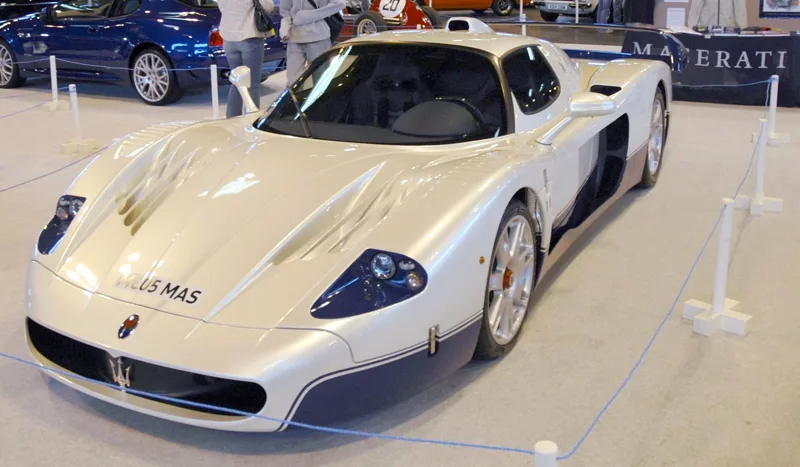
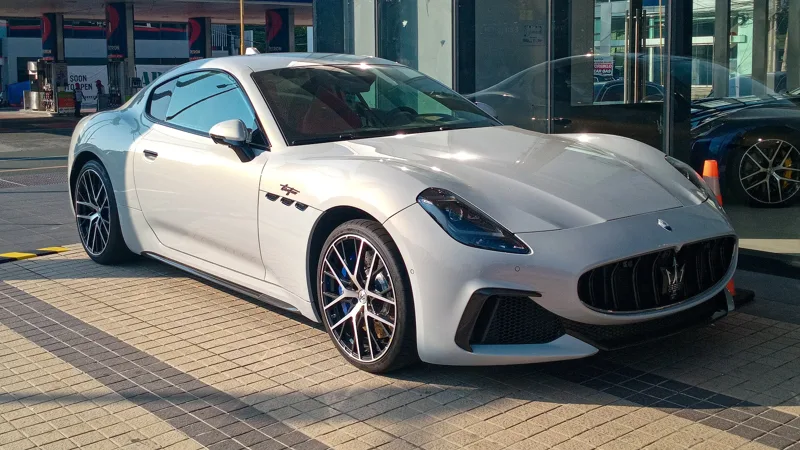
From a hand-built V8 saloon styled by Pietro Frua in 1963 to a turbocharged finale in late 2023, the Quattroporte kept its four-door purpose throughout.
The Maserati Quattroporte is a full-size luxury saloon from the Italian maker, built in six generations. The first car arrived in 1963 with a V8, and production of the sixth generation ended in late 2023 with no successor planned. Across that span the model used V8s, V6s and a diesel V6.
The Maserati Quattroporte is a four-door luxury saloon that the Italian maker built across six generations, beginning with a V8 car shown in 1963. The name means four doors in Italian. Over the decades the model moved from hand-built grand touring to a Citroen-linked front-drive design, then to turbocharged V6 and V8 engines before production ended in late 2023.
Where did the first Quattroporte come from?
Pietro Frua styled the first Quattroporte, and Vignale built its bodies. Frua took inspiration from a 1962 5000 GT made for Prince Karim Aga Khan. The car appeared at the October-November 1963 Turin Motor Show, and regular production began in 1964.
Maserati aimed the saloon at buyers who wanted a grand tourer for Europe's new motorways. It was sold alongside the Facel Vega and the Lagonda Rapide, and early cars were pitched at 200 km/h (124 mph). The company claimed 230 km/h (143 mph) for the first series, which was the figure used in its brochures.
Six generations of four-door flagship, from a hand-built V8 saloon to a turbocharged finale in late 2023.
What engine did the first Quattroporte use?
The first car introduced a quad-cam, all-aluminium V8 that had two chain-driven overhead camshafts per bank and 16 angled valves. Four downdraft twin-choke Weber carburettors fed it. The 4.1-litre unit made 260 PS DIN (191 kW; 256 hp) at 5,000 rpm.
The chassis reflected a car meant for long-distance touring. It used a steel unibody with a front subframe, and the first series carried its rear axle on a De Dion tube with inboard brakes. Those choices suited a fast grand tourer rather than a sports car.
How did the Series II change the first car?
The 1966 Series II adopted twin headlights from the US model and replaced the De Dion rear end with a leaf-sprung solid axle. The interior was redesigned around a full-width wood-trimmed fascia. A 4.7-litre version with 290 PS (213 kW; 286 hp) DIN arrived in 1968, and about 500 Series II cars were built.
The 4.7-litre car was quoted at 255 km/h (158 mph), a clear step up from the first series. The first generation ended in 1969 with 776 Tipo 107 Quattroportes in total, of which 230 came from the first series alone.
Seen against the first car, the Series II was a refinement rather than a reinvention. Buyers kept the same grand touring character, but the rear end became more practical and the cabin looked more up to date. The twin headlights also tied the European car more closely to the US version, which simplified the range.
Why did the Quattroporte II look so different?
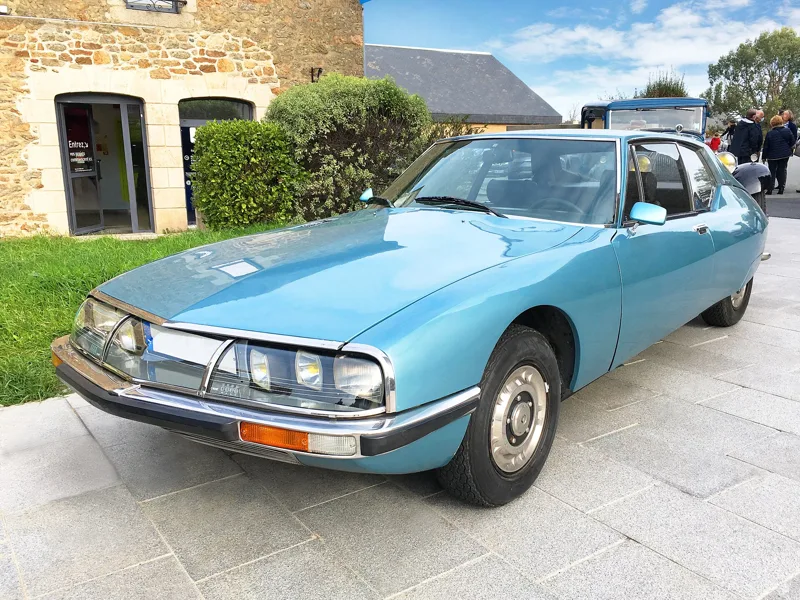
The second generation rode on a stretched Citroen SM chassis and used a front-mid-engine, front-wheel drive layout with hydropneumatic suspension. A V6 provided the power. Only twelve production cars were built between 1976 and 1978, because the oil crisis and Citroen's financial collapse blocked European approval.
Maserati had wanted a V8 for the model, but the old Tipo 107 engine was too large for the Citroen-based chassis. A V8 prototype was built by joining two V6 blocks, and the engineering bill reached about four billion lire. Alejandro de Tomaso took over the company, cancelled the V8 programme and removed the French influence.
In hindsight the second generation is best read as a detour. Its front-wheel drive, hydropneumatic suspension and Citroen-derived chassis set it apart from every other Maserati, and once the French link was cut the company returned to the rear-wheel layout that the earlier cars had established.
How did the third generation Royale differ?
The third generation returned to rear-wheel drive and was styled by Giorgetto Giugiaro. The Royale was a built-to-order luxury version presented in Modena on 14 December 1986 with a 4.9-litre V8 at 300 PS (221 kW; 296 bhp). A limited run of 120 cars was planned, but only 53 were completed by 1990.
Coachbuilders also worked on the car. A Diomante limousine was 65 cm longer and cost 210 million lire in 1986. Across the whole third generation, including the Royale, 2,155 Quattroportes were built, and 120 units were sold in Italy in 1980 alone.
The third generation bridged the hand-built cars of the early years and the factory-built models that followed. Its engine was a development of the original quad-cam V8, so the character that buyers associated with the badge carried straight through.
Was the fourth generation a V8 car?
The fourth generation began with twin-turbocharged V6 engines and later added a 3.2-litre V8 that produced 335 PS (247 kW; 330 hp). Its body, penned by Marcello Gandini, had a drag coefficient of Cd=0.31. Production of the model ended in May 2001.
The car weighed at least 300 kg (661 lb) less than the third generation, a result of its compact Biturbo underpinnings. Export cars used a 2.8-litre V6 with 284 PS (209 kW; 280 hp), and the V8 claimed a top speed of 270 km/h (168 mph). Maserati made 2,400 units in total, and 730 of them were Evoluzione cars from the later update.
The fourth generation is often overlooked because it was smaller than the cars around it. The compact footprint was part of the brief, and the weight saving over the third generation was the main engineering gain. Buyers who wanted a V8 had to wait for the 3.2-litre engine to arrive.
What changed with the fifth generation?
The fifth generation, codenamed M139, debuted at the Frankfurt Motor Show on 9 September 2003. Ken Okuyama, then chief designer at Pininfarina, led the exterior and interior design. The platform was 50 cm (19.7 in) longer than its predecessor, and the wheelbase grew by 40 cm (15.7 in).
The first V8 was a 4.2-litre unit with 400 PS (294 kW; 395 hp). It reached 0-100 km/h in 5.2 seconds and a top speed of 275 km/h (171 mph). Early cars used the DuoSelect automated manual, and a ZF six-speed automatic launched in 2007 became the main choice from then on.
The 2008 facelift brought the 4.7-litre S with 430 PS (316 kW; 424 hp) and 490 Nm (361 lb ft). Over 5,000 cars were built in 2006 alone, and the last fifth-generation car left the line on 20 December 2012.
The fifth generation was the car that brought the Quattroporte to a far wider audience. Output of over 5,000 cars in a single year shows how far the model had moved beyond a niche product, and the move to a six-speed automatic widened its appeal further.
What did the sixth generation offer?
The sixth generation was introduced at Detroit in January 2013 with a 3,171 mm (124.8 in) wheelbase and a mixed steel and aluminium body. Engines were a twin-turbo V6, a twin-turbo V8 in the GTS and a diesel V6. Every version drove through an 8-speed ZF automatic.
The GTS made 530 PS (390 kW; 523 hp) at launch and 568 PS (418 kW; 560 hp) from 2018. It reached 0-97 km/h (0-60 mph) in 4.2 seconds. Overboost lifted torque from 650 Nm (479 lbf ft) to 710 Nm (524 lbf ft).
The Q4 system could divert up to 50% of engine torque to the front wheels when needed, and otherwise the car ran rear-wheel drive. The sixth generation's drag coefficient of Cd=0.28 sat below the Cd=0.31 of the fourth generation. Lorenzo Ramaciotti guided the design team.
The sixth generation's engine line-up was the most varied of the six. A turbocharged V6 served as the entry point, the GTS V8 sat at the top and the diesel V6 covered markets where that engine made more sense. The choice gave buyers a clear route from comfort to outright performance.
Why does the Quattroporte matter today?
The Quattroporte matters because it kept a four-door performance saloon in Maserati's line for six generations. Its engineering ranged from a hand-built V8 to a front-drive Citroen-era experiment and finally to turbocharged V6 and V8 engines. The line closed in late 2023, with no successor planned.
Collectors tend to prize the first series for its hand-built character, while later cars suit owners who want a large, quick saloon with modern equipment. Each generation answered a different set of pressures, from changes of ownership at the company to the demands of export markets and the rise of turbocharged engines.
Which Quattroporte suits which buyer?
The right Quattroporte depends on what the buyer wants from it. Early V8 cars suit owners who value the original character, while the fourth generation offers a compact four-door layout. The sixth generation's GTS is the choice for buyers who want the most performance from the family.
For a driver focused on pace, the GTS and its 0-97 km/h (0-60 mph) time of 4.2 seconds make the case clearly. Buyers who want a lighter, more compact car should look at the fourth generation, whose weight saving over the third was a deliberate target.
Which special editions were built?
Limited editions included the Collezione Cento, limited to 100 examples in 2008, and the Cornes Serie Speciale, capped at 50 cars for the Japanese market. The Zegna Limited Edition ran to 100 cars for worldwide markets, made with the Italian fashion house.
Carrozzeria Touring showed a Bellagio Fastback at Villa d'Este in 2008. One sold for 117,600 euros in 2013. The Quattroporte V also served as a hearse at the 2010 funeral of Lech Kaczynski, the Polish president.
How did the Quattroporte race?
Swiss Team fielded Quattroporte EVO racers from 2009 onwards, based on the 4.2-litre fifth generation. Andrea Bertolini won the 2011 season championship in one of the team's cars. The programme ran for four seasons, closing after 2012.
Specifications across the generations
The table below gathers the core figures for each generation. Where a value belongs to one version only, the table names that version so the figures do not blend together.
| Generation | Engine | Output | Notes |
|---|---|---|---|
| Series I (1963-1966) | 4.1-litre V8 | 260 PS DIN (191 kW; 256 hp) at 5,000 rpm | Claimed 230 km/h (143 mph); 230 built |
| Series II (1966-1969) | 4.7-litre V8 | 290 PS (213 kW; 286 hp) DIN | Claimed 255 km/h (158 mph); 776 cars in total |
| Quattroporte II (1976-1978) | V6 on Citroen SM chassis | Front-mid-engine, front-wheel drive | Only twelve production cars |
| Quattroporte III (1979-1990) | 4,930 cc V8 | 280 PS (206 kW; 276 hp) | 2,155 built including Royale |
| Quattroporte IV (1994-2001) | 3.2-litre V8 | 335 PS (247 kW; 330 hp) | 2,400 built, 730 Evoluzione |
| Quattroporte V (2003-2012) | 4.2-litre V8 | 400 PS (294 kW; 395 hp) | Over 5,000 built in 2006 |
| Quattroporte VI (2013-2023) | 3.8-litre twin-turbo V8 (GTS) | 530 PS (390 kW; 523 hp) at launch | 8-speed ZF automatic |
Frequently asked questions
How quick was the 4.7-litre Series II?
The 4.7-litre Series II produced 290 PS (213 kW; 286 hp) DIN and carried a claimed top speed of 255 km/h (158 mph). That version arrived in 1968, after the 1966 update had already added the twin headlights.
How many fifth-generation cars were built in 2006?
Over 5,000 cars were built in 2006 alone, a figure that shows how widely the fifth generation sold in its middle years. The M139 platform first appeared at Frankfurt in 2003, and production of the model closed in December 2012.
How fast is the sixth-generation GTS?
The GTS reaches 0-97 km/h (0-60 mph) in 4.2 seconds. Its twin-turbo V8 made 568 PS (418 kW; 560 hp) from 2018, and Overboost lifted torque to 710 Nm (524 lbf ft).
Did the sixth generation win any awards?
The GTS won Best Luxury Vehicle from the Washington Automotive Press Association in 2019, a recognition of its luxury positioning. Awards of that kind helped the sixth generation stand out in a crowded segment, alongside its strong performance figures from the GTS range.
Why did the Quattroporte end?
The sixth generation was produced until late 2023, and no successor was planned. The final cars closed a story that began in 1963, leaving no direct replacement for the flagship in the range.