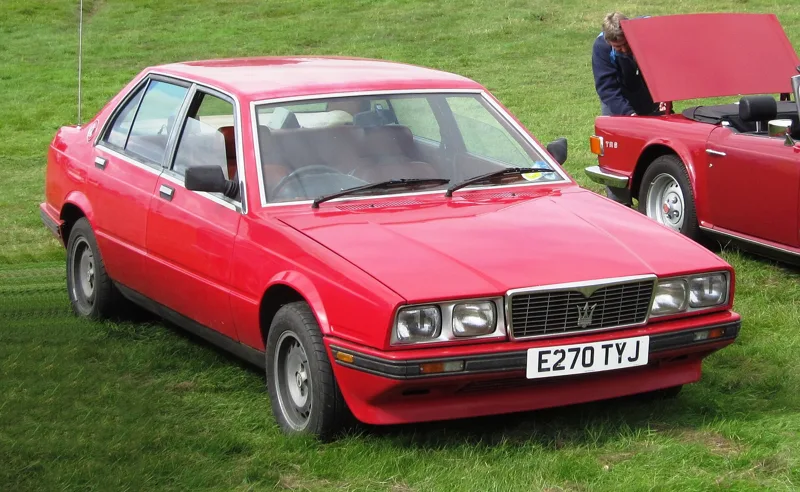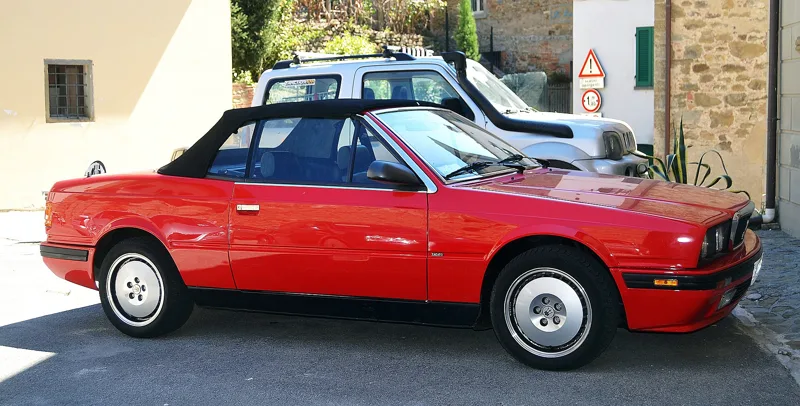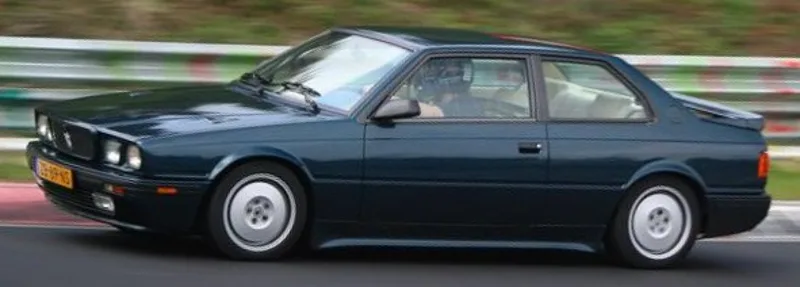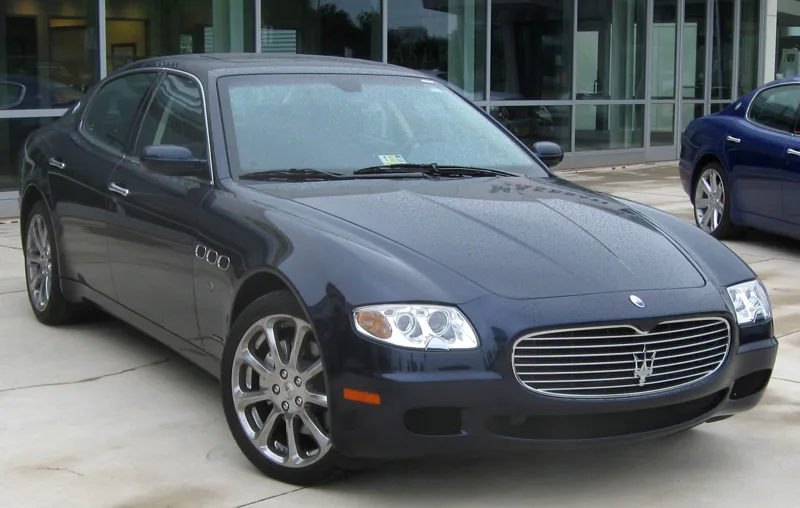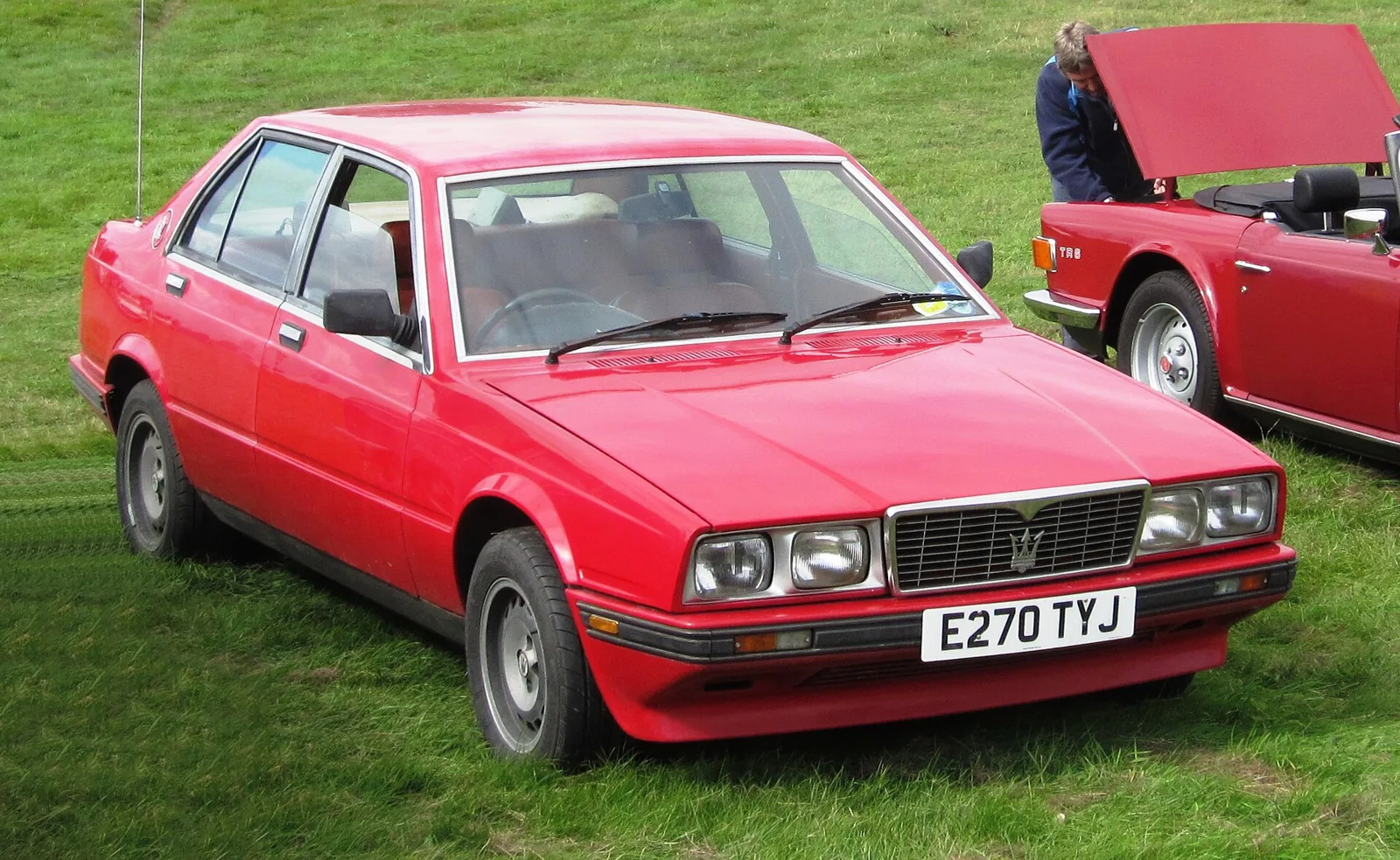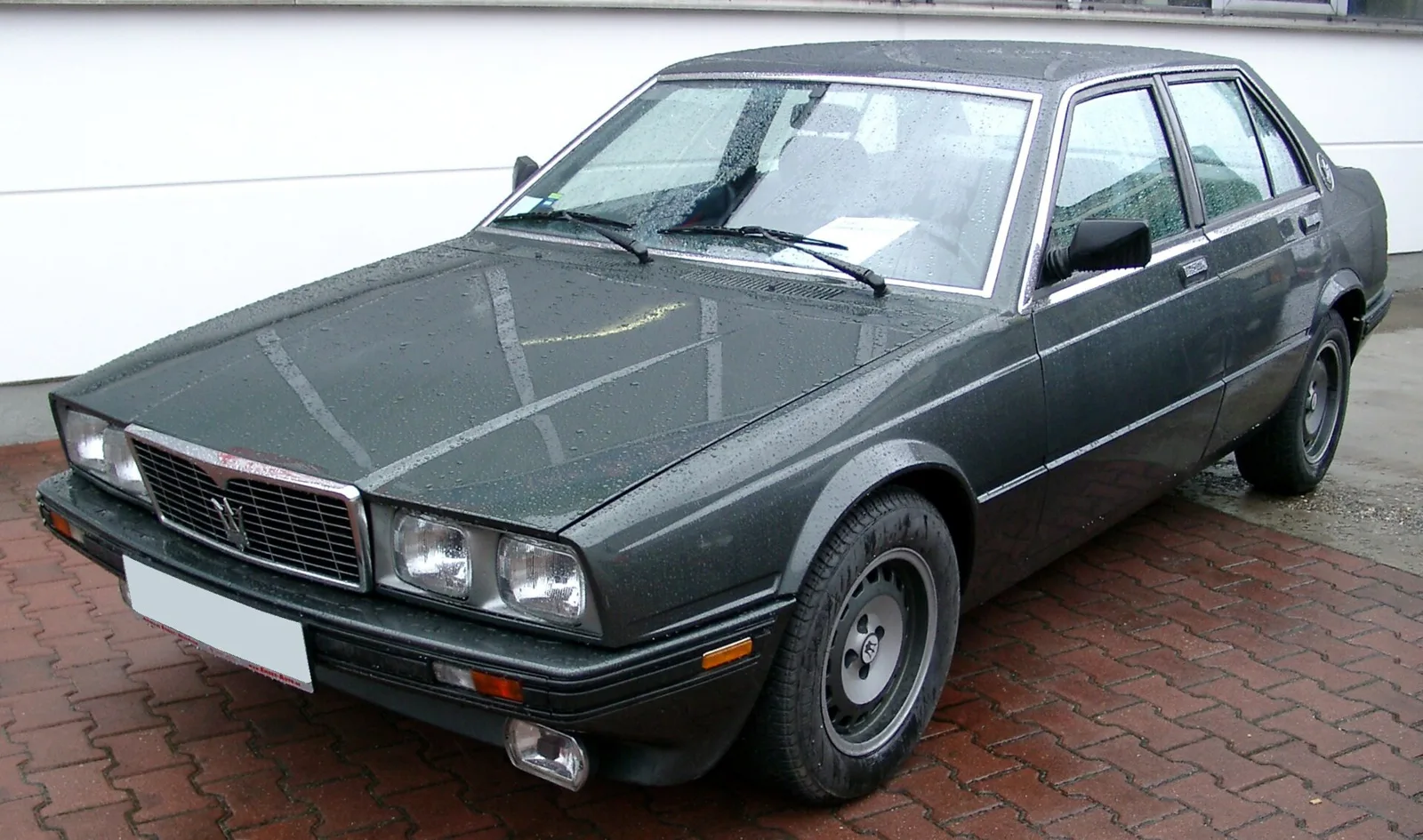
A four-door Biturbo built for Italian buyers from 1985 to 1988, with a twin-turbo six, a carburettor-to-injection switch and a sporty S.
A four-door Biturbo saloon for Italian buyers, the 420 used a twin-turbo six-cylinder and switched from carburettors to injection in 1986. It came in four versions across three years, and 4,766 Biturbo variants were built in that time.
The Maserati Biturbo 420 was a four-door saloon sold only in Italy, where a tax rule had shaped the whole Biturbo idea. Built from 1985 to 1988 on the coupe's technology, it came in four versions, with the 420 S, 420 i and 420 Si sitting beside the basic car. Every one of them used a twin-turbo six-cylinder engine.
Why did Maserati need a cheaper car?
Maserati needed a cheaper car after Alejandro De Tomaso took control in 1975. He wanted the firm to become a series manufacturer rather than a maker of hand-built, expensive sports cars. The answer was a compact, automated-production car with a smaller engine, which became the Biturbo.
Italian tax law sharpened the point. It charged a 38 percent sales tax, instead of 19 percent, on cars with a displacement of 2,000 cc and more. The Biturbo was presented publicly in December 1981, after three years of development, with a just under 2.0-litre (122 cu in) six-cylinder and two turbochargers.
The export car grew to 2.5 litres (153 cu in) from 1983 onwards. Maserati refined both versions over the following years. An S model arrived in 1983, called Biturbo S for Italy and Biturbo ES for export. From 1986 electronic petrol injection replaced the outdated carburettors, and injection models gained an 'i', for iniezione.
Maserati ran two parallel plans for the Biturbo range. Export cars used the 2.5-litre six, while Italian cars kept the 2.0-litre engine in basic and S forms.
A tax rule shaped the Biturbo 420, and the Italian saloon outsold its export twin.
What made the four-door 420 different?
The four-door saloon arrived at the end of 1983, added to a range that had only two-door coupes. It used the lengthened floor and drive technology of the coupe, but its body was new and shared no parts with the coupe. Only in 1985 did Maserati add a 2.0-litre saloon for Italy.
The four-door first appeared as the export Biturbo 425, with the 2.5-litre six. Maserati judged the larger engine better suited to the heavier saloon. The Italian 420 proved more varied, with a basic and an S version in both carburettor and injection form. Export buyers got only one power level of the 2.5-litre engine.
Body, platform and interior
The saloon used the lengthened floor of the Biturbo coupe, introduced in 1981, but its wheelbase grew by 85 mm to 2,600 mm (102.4 in). It was about 100 kg (220 lb) heavier than the coupe with the same engine. Its shape came from Pierangelo Andreani, a former Pininfarina designer, and the different dimensions meant no coupe panels could be carried over.
Inside, the dashboard was covered in artificial leather. The instrument carrier had a semicircular form, first introduced on the coupes at the same time. The seats had fabric upholstery as standard, designed by Missoni, and gathered leather seat covers were available for extra money.
The styling changes Maserati had made to the coupe in 1985, marked as Biturbo II, were standard on every 420 saloon from the start. The saloons carried no additional II designation.
What was under the bonnet?
The 420 used a 2.0-litre (122 cu in) six-cylinder V engine with an aluminium block and a 90-degree bank angle. Two exhaust turbochargers boosted it, and an intercooler came as standard. Each cylinder had two intake valves and one exhaust valve, and each bank had its own camshaft.
The 1985 cars used a multi-barrel carburettor, designated Tipo AM 452. The basic car produced 185 PS (136 kW) at a compression ratio of 7.4:1, while the S reached 210 PS (154 kW) at 7.8:1. Critics called the carburettor obsolete as soon as it appeared.
From 1986 electronic fuel injection replaced the carburettor. The basic Tipo AM 470 produced 138 kW (188 PS), and the Si version, Tipo AM 471, delivered 162 kW (220 PS). Injection made hot starting easier and improved low-speed response, which addressed the main complaints about the early cars.
Did the 420 handle as well as its engine suggested?
Not in the view of contemporary test reports, which judged the chassis overwhelmed by the engine's power. The front used MacPherson struts and the rear semi-trailing arms, with coil springs, hydraulic dampers and anti-roll bars on both axles. Oversteer set in early, and the reports criticised strong load-change reactions.
The five-speed manual was standard across the Biturbo range, with a three-speed automatic as an option. Power reached the rear wheels through a split propeller shaft. Braking came from servo-assisted disc brakes.
Apart from the engine, the 420 was technically identical to the Biturbo 425 presented in 1983. The two saloons therefore shared their chassis and body, and differed mainly in the engine they carried.
How many were built?
Maserati had the 420 in its range for three years, in four versions, and built 4,766 Biturbo variants in that time. The export 425 accounted for 2,372 cars from 1983 to 1987, so the smaller Italian saloon proved the more successful of the two. Within the 420 family, the basic car made 2,810 vehicles in 1985 and 1986, and the 420 i made 1,142 over two years.
The individual models
Biturbo 420
The base Italian saloon used the 185 PS carburettor engine in its lower-compression form, Tipo AM 452. Production ran through 1985 and 1986.
Biturbo 420 S
The S was the four-door partner to the two-door Biturbo S. It used the higher-compression version of the Tipo 452 engine, which made 210 PS, five more than the coupe. Its top speed was 220 km/h (137 mph). The bonnet had extra air inlets with two intercoolers beneath them, and every car was two-tone with a black lower body. From 1985 to 1986, 254 were built.
Biturbo 420 i
For model year 1986 the injection engine Tipo AM 470 replaced the carburettor base engine, turning the car into the 420 i. The car had no technical or styling changes. It stayed in the range to the end of 1987.
Biturbo 420 Si
The Si was the four-door version of the two-door Biturbo Si, offered alongside the 420 i. Its 220 PS injection engine gave a factory top speed of 228 km/h (142 mph). Maserati built 524 until the end of 1987.
A timeline of the four versions
- 1985: the 420 with its 185 PS carburettor engine and the 420 S with 210 PS go on sale, and production runs through 1986.
- From model year 1986: the 420 i takes the 188 PS injection engine, and the 420 Si is offered beside it with 220 PS.
- End of 1987: the 420 i and 420 Si leave the range, and production of the 420 family ends.
When did production end?
Production of the Biturbo 420 and the Biturbo coupe ended with the 1987 model year. In Italy the Maserati 222 replaced the coupe, and its four-door 422 and 4.18 versions succeeded the 420. The 422 took the drive unit of the 420 Si as its base engine.
The Biturbo name had come under a cloud after numerous quality defects, so the successor models dropped it altogether.
Reception and legacy
Contemporary reviewers were not kind to the chassis, and they had called the carburettor obsolete from the start. Injection in 1986 removed most of the problems that had hurt the early Biturbo models, and the name itself had become a liability. Because the Italian saloon outsold its export twin, the 420 was the more popular of the two four-door Biturbos at home.
The numbers point the same way. The export 425 built 2,372 cars between 1983 and 1987, while the basic 420 alone built 2,810 in 1985 and 1986.
Its successors, the 422 and 4.18, carried the four-door line forward without the Biturbo name.