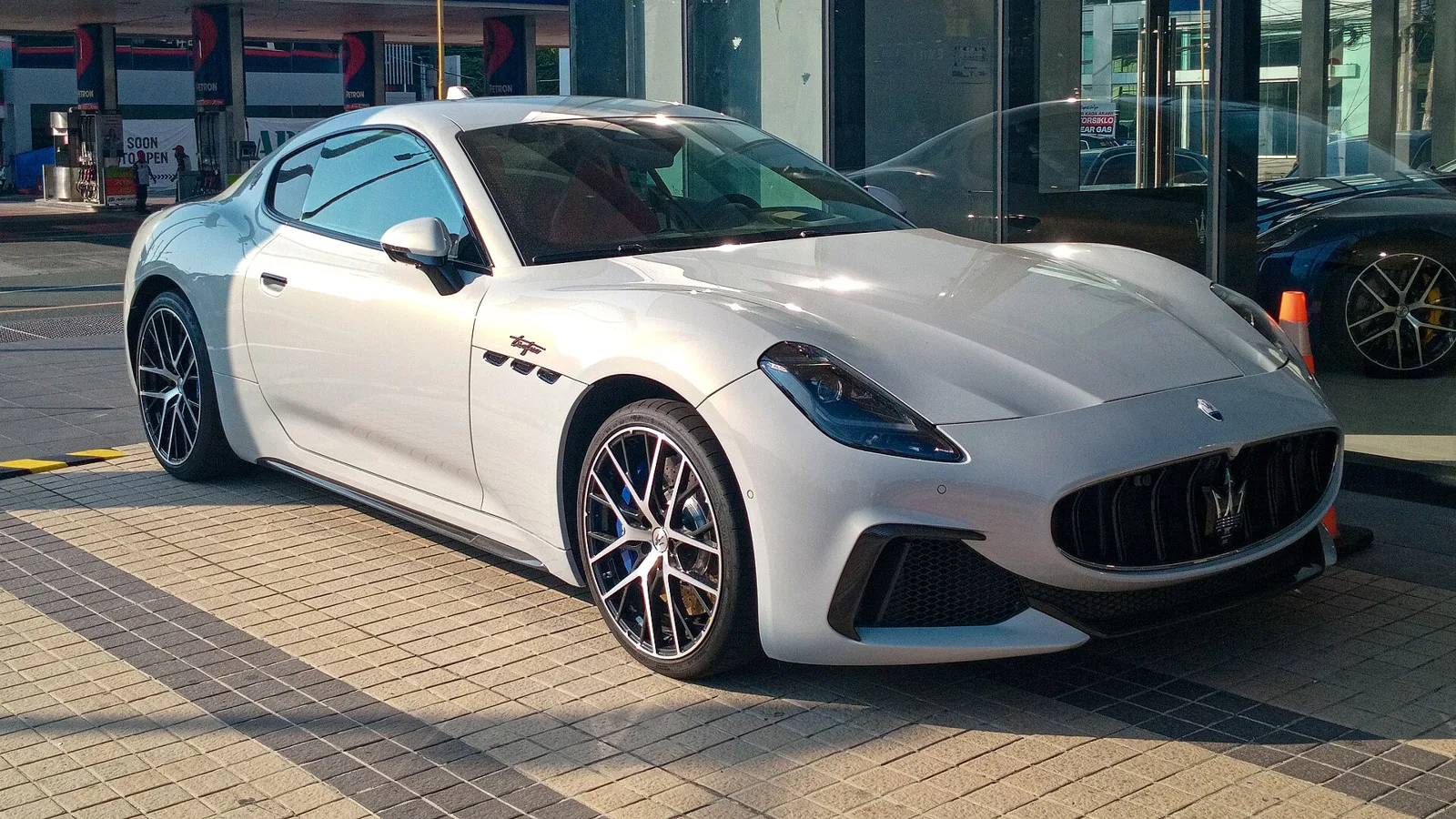
Pininfarina styling, Ferrari-built V8s and the 2008 update of Maserati's four-door saloon, built from 2003 to 2012.
The Quattroporte V was Maserati's fifth-generation saloon, produced from 2003 to 2012. Its body was styled by Pininfarina, and it used rear-wheel drive with 4.2-litre and 4.7-litre V8 engines built at Maranello. The car was updated in 2008, and about 24,000 were built.
The Maserati Quattroporte V was the fifth generation of the marque's four-door, built from 2003 to 2012. About 24,000 cars were made, and the final one rolled out of the Modena plant on 20 December 2012. The car set out to recover the elegance of the original Quattroporte while still delivering the performance expected of a grand tourer.
Why did Maserati bring back the Quattroporte?
Maserati revived the Quattroporte to repair a brand image clouded by the Biturbo-derived cars and to win sales in the United States and the Middle East. The new car was meant to be a grand tourer that was pleasant to drive yet comfortable for five people.
The fourth series had a modest success in sales, but it could not undo the damage done by models that the public never praised for their engineering. The new car was designed under the close watch of Ferrari, after the two companies merged in a reorganisation wanted by the Fiat group, which owned both brands.
Not everyone at the top wanted the model back. Executives were initially opposed because industrialisation and production costs looked excessive. The 3200GT and Coupe had won only modest commercial success, however, and the brand needed a new product.
The brief was to bring back the look of the first Quattroporte in a modern form. Pininfarina won the styling job, and the first sketches and small-scale prototypes were shown at the Museum of Contemporary Art in Tokyo in April 2002. In September 2002 the president of Maserati, Luca Cordero di Montezemolo, said development was nearly finished, with the world premiere set for the Frankfurt motor show in autumn 2003.
A Ferrari-built V8 in a Pininfarina-styled body, with a return to the elegance of former times.
What did the Quattroporte V look like?
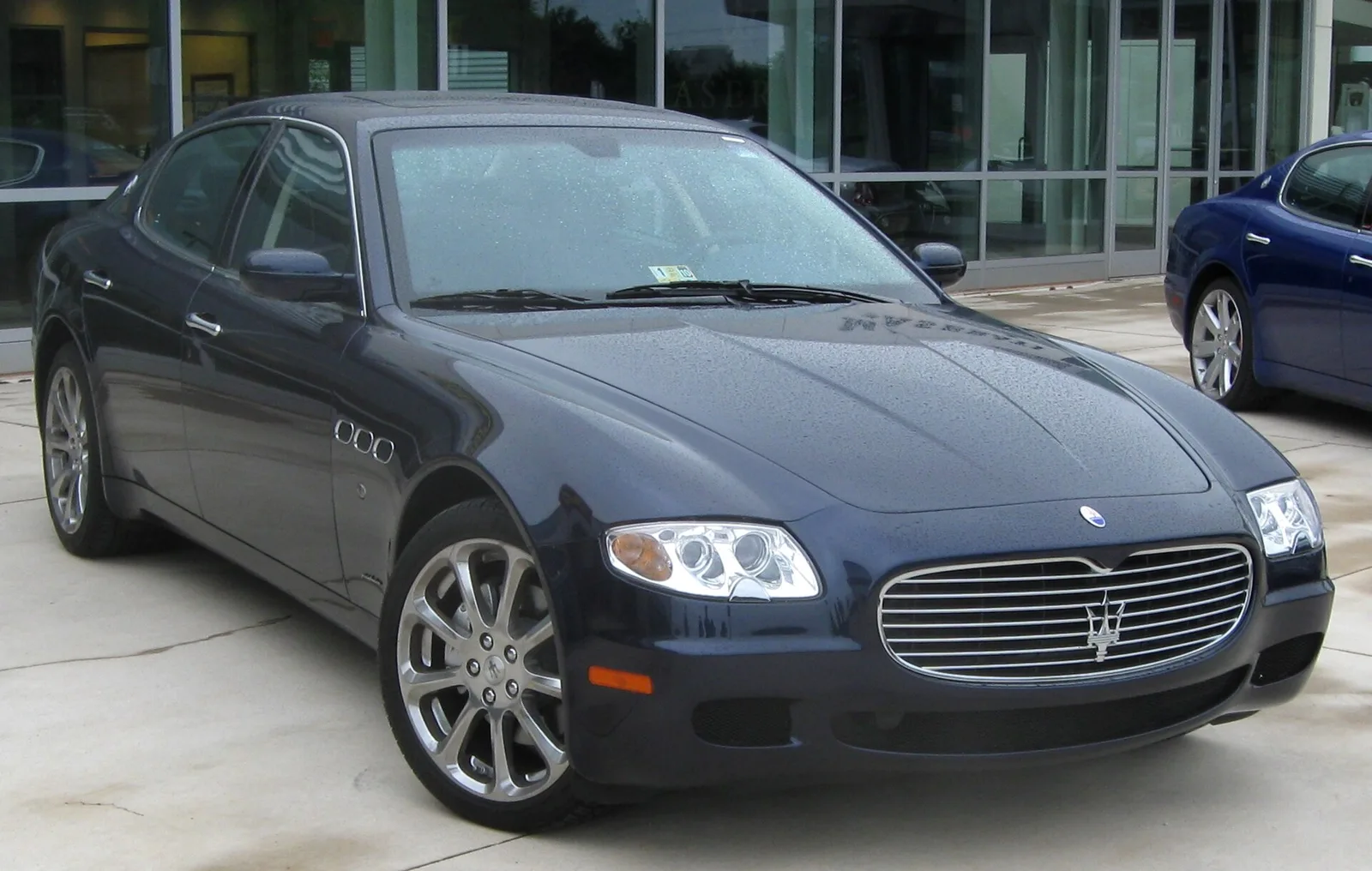
Pininfarina styled the body, which is more than 5.0 metres (16.4 ft) long, with a raised chrome-edged grille carrying the trident. The most exclusive cars had a chrome-barred grille of 15 bars, while sportier versions had a dark grille. LED rear lights and twin exhaust tips completed the look.
The small front lights were built into the lower bumpers, which made the bonnet look enormous and deeply ribbed. The flanks carried raised wheel arches and three chrome-edged air intakes on the front wings. A Pininfarina badge sat low on the side, and a chrome Maserati badge went on the rear pillar.
The boot holds 450 litres, enough for golf bags or a matched set of suitcases made by Maserati. There was no spare wheel as standard, so an inflation kit with a compressor took its place. A 17-inch spare wheel could be specified as an option.
Which features did the interior offer?
The dashboard swept around a large satellite navigation screen and a round quartz clock, with dual-zone climate control beside it. Much of the dash and doors used fine woods, and the front seats adjusted electrically in 14 positions.
The Maserati Multimedia System, developed by Magneti Marelli, combined the on-board computer with satellite navigation, a CD radio with MP3, a 30 GB hard disk, USB and Bluetooth input and voice commands. Bose Surround Sound System speakers were fitted, and the controls sat on the multifunction steering wheel.
Rear passengers could order a package with LCD screens built into the headrests, a DVD player and rear climate control. Standard equipment included cruise control, light and rain sensors, an alarm, and automatic door locking that switched the lights off.
Heated and massaging seats were among the accessories, along with a refrigerated compartment in the central armrest. Dashboard inserts in Poltrona Frau leather were also offered, and they were fitted by hand.
How did the Quattroporte V handle?
The chassis was a new rear-wheel-drive platform built for Maserati, with four-wheel independent suspension using aluminium arms. Weight was split 49% front and 51% rear, and four 330 mm (13.0 in) ventilated discs were fitted at the front and rear. The stability system combined ESP with ABS.
The same platform later went under the GranTurismo and GranCabrio, and a shorter-wheelbase version was used for the Alfa Romeo 8C Competizione and 8C Spider, which were built at Modena. Torsional rigidity was high, which let the car pair comfort with a sporting feel.
Antidive and Antisquat geometry stopped the body from bobbing during acceleration and braking. The engine sat further back towards the cabin than before, and drivers could switch the suspension between Sport and Normal settings to suit the road.
Occupants were protected by two-stage front airbags, side and head airbags, ISOFIX anchor points on the rear seats, and laminated glass.
Which engines did the Quattroporte V use?
The first cars used a naturally aspirated 4.2-litre (256 cu in) V8 built at Maranello by Ferrari engineers, rated at 400 PS (294 kW; 395 hp). A 4.7-litre (287 cu in) V8 arrived in 2008, and an uprated version of it made 439 PS (323 kW; 433 hp) from 2009.
The 4.2 had an aluminium and silicon block and heads, with four valves per cylinder and two overhead camshafts per bank. The camshafts were driven by chain and fitted with continuous phase variation, and the engine used dry-sump lubrication. Maximum torque was 451 Nm (333 lb ft) at 4,500 rpm, and combined CO2 output was 345 grams per kilometre.
The 0-100 km/h sprint took 5.2 seconds, with a top speed of 275 km/h (171 mph). The 4.2 came with a robotised DuoSelect six-speed gearbox, usable in sequential mode. Ferrari developed it from an evolution of the earlier CambioCorsa, and its quick gear changes drew criticism from American buyers, who wanted a conventional automatic.
From 2007 a six-speed automatic developed with ZF was offered. It softened the shifts and lifted fuel economy to 6.8 km/l, but it cut the top speed to 270 km/h (168 mph) and needed 5.6 seconds for the sprint. Its maximum torque of 460 Nm (339 lb ft) arrived at 4,250 rpm.
The 4.7 was derived from the 4.2, with a wet sump and electronic injection with variable valve timing. It gave 430 PS (316 kW; 424 hp) at 7,000 rpm and 490 Nm (361 lb ft) at 4,750 rpm. It reached 100 km/h in 5.4 seconds and had a declared top speed of 280 km/h (174 mph), with emissions of 365 grams per kilometre and Euro 5 approval.
The 439 PS version gained its extra power from engine control and exhaust changes. It reached 285 km/h (177 mph) and 100 km/h in 5.1 seconds, which made it the most powerful and fastest saloon Maserati had produced. It was offered only on the Sport GT S. In Manual Mode the driver chooses each gear change, which can happen up to high engine speeds, while Auto Sport hands those decisions to the software.
What did the 2008 update change?
The 2008 update reworked the front and rear styling with LED lights and new grille fins, and it lengthened the car to 5.10 metres (16.7 ft). Sales from 2003 to June 2008 passed 15,000 units, and the 4.7 V8 arrived with a six-speed ZF gearbox.
The update added a sportier setting, and the trim choices grew with new upholstery colours and dashboard finishes. Buyers in Britain took to the model, with 1,000 units delivered there by 2009. The series is still counted among the most appreciated cars the trident brand has made.
What were the Executive GT and Sport GT versions?
Both joined the range at the September 2005 Frankfurt motor show. The Executive GT added wood trim, cream fabric dashboard inserts and 19-inch nine-spoke alloys, while the Sport GT had firmer suspension and a robotised gearbox with quicker shifts, plus carbon-fibre interior trim.
The Executive GT took over the accessories of the earlier Executive package. On top of them it added two-tone colour schemes throughout the cabin, chrome trim along the bodywork and grille, and interior wood with cream fabric inserts on the dashboard.
The Sport GT used a robotised gearbox whose gear-change times were cut by 35%, together with carbon-fibre interior trim and modified exhausts. Its suspension was stiffened.
The Sport GT S arrived in November 2007 at the top of the range. It kept the 4.2-litre engine but added a six-speed automatic, a lowered racing-style suspension set 10 mm lower at the front and 25 mm at the rear, and cast-iron and aluminium brake discs made by Brembo. It was produced until the 2008 restyling.
At the 2009 Detroit motor show a Sport GT S with the 4.7 V8 at 439 PS was shown. It was faster than the 2007 car, gained carbon-fibre inserts and a changed exhaust, and its automatic gearbox was revised to shorten gear changes.
Which special editions were built?
Special editions included a 60-unit car for the American market, listed in the catalogue of a US luxury retailer, a run of one hundred cars called the Collezione Cento, and the Centurion Edition for British owners of a black charge card. The first two were aimed mainly at American buyers.
The 60-unit edition was built towards the end of 2004 and finished in Pontevecchio burgundy with exclusive 19-inch alloy wheels and a mahogany dashboard. Its entire run sold out between 12.00 and 12.03 on 14 October 2004.
The Collezione Cento was presented in January 2008. It was painted ivory and fitted with polished 20-inch alloy wheels, and its cabin had Poltrona Frau upholstery with diamond-shaped stitching. Rear screens with USB and SIM card input, a CD and DVD player, and rear climate control completed the package.
The Centurion Edition reached Britain alone in March 2009, with black paint and an ice-coloured cabin upholstered in Poltrona Frau. The Centurion logo appeared on the headrests and the dashboard, and both the 4.2 and 4.7 V8 engines were available.
At the 2010 Geneva show Maserati presented the Sport GT S Awards Edition, celebrating 65 awards the model had received in over six years on the market. It kept the 439 PS engine and sporty suspension, and it added Poltrona Frau and Alcantara upholstery with 20-inch satin alloy wheels and mirror-polished Brembo brake calipers.
Did the Quattroporte race?
The Swiss Team ran a competition Quattroporte in the Italian Superstars championship from 2009, driven by Andrea Chiesa. It weighed about 1,430 kg (3,153 lb) and used a naturally aspirated 4.2 V8 uprated to 450 PS (331 kW; 444 hp), with a six-speed sequential gearbox.
The bodywork was changed in many places to improve aerodynamics. The Quattroporte Superstar made its debut at the Franciacorta circuit in May 2009.
Quattroporte V specifications
| Specification | Detail |
|---|---|
| Production | 2003 to 2012, about 24,000 units |
| Length | More than 5.0 metres (16.4 ft); 5.10 metres (16.7 ft) after 2008 |
| Engine at launch | 4.2-litre (256 cu in) V8, 400 PS (294 kW; 395 hp) at 7,000 rpm |
| Engine from 2008 | 4.7-litre (287 cu in) V8, 430 PS (316 kW; 424 hp) at 7,000 rpm |
| Uprated 4.7 | 439 PS (323 kW; 433 hp), Sport GT S only |
| Torque, 4.2 | 451 Nm (333 lb ft) at 4,500 rpm |
| Torque, 4.7 | 490 Nm (361 lb ft) at 4,750 rpm |
| 0-100 km/h, 4.2 | 5.2 seconds |
| Top speed, 4.2 | 275 km/h (171 mph) |
| Brakes | Ventilated discs, 330 mm (13.0 in) |
| Weight distribution | 49% front, 51% rear |
| Boot | 450 litres |
| Fuel use | 5.2 km/l declared average, 4.2 |