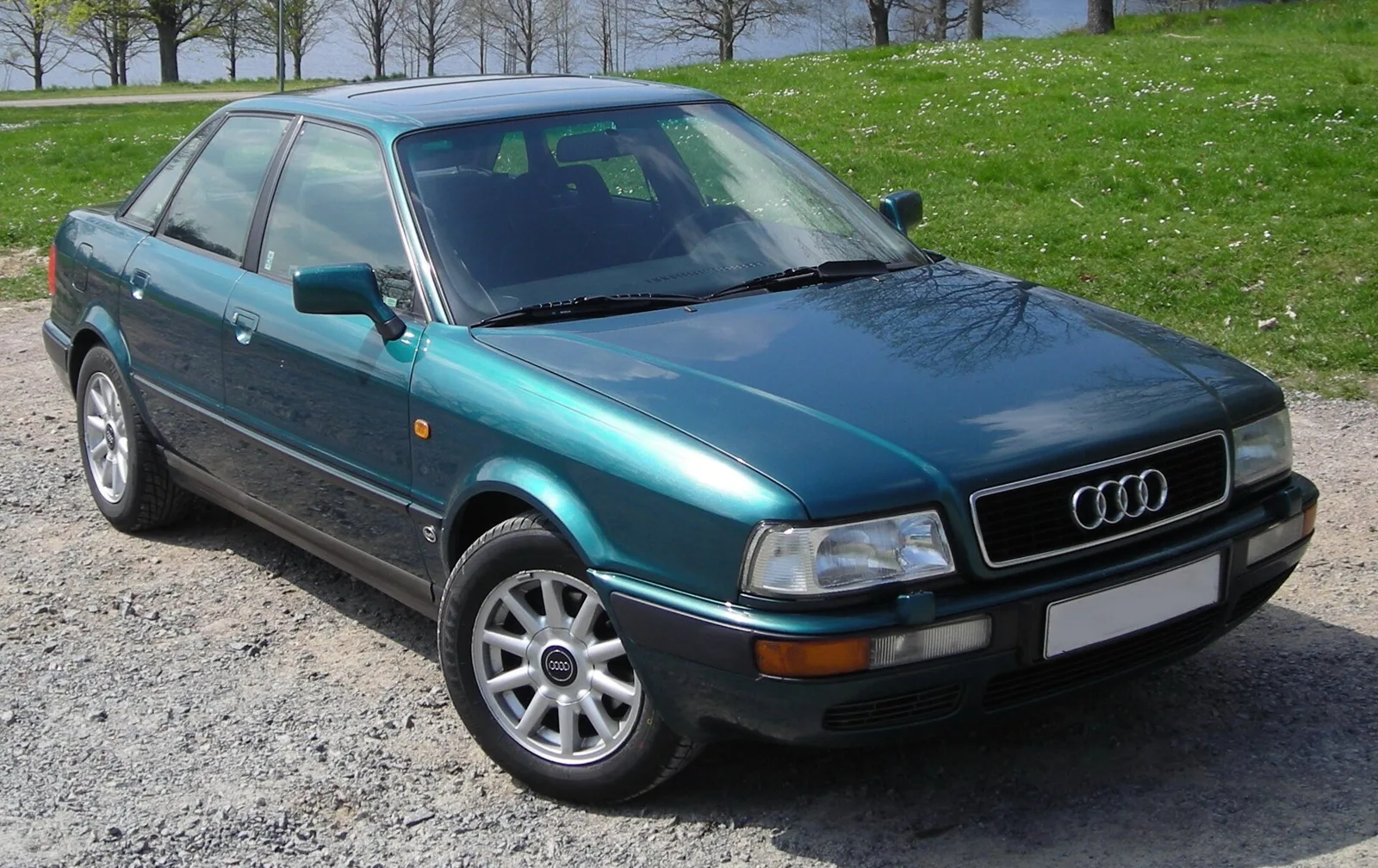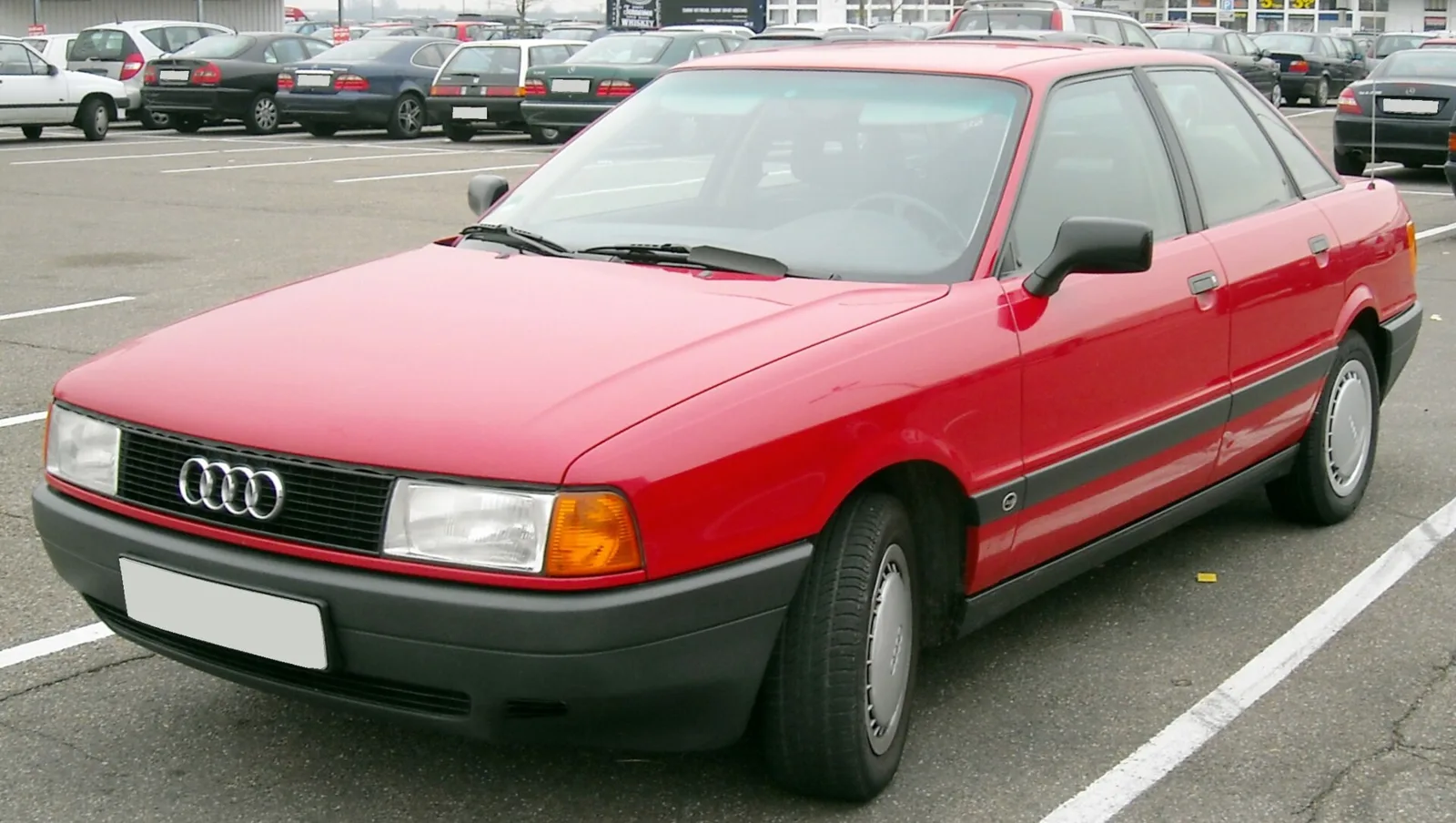
A galvanised, wind-cutting saloon with a Cw of 0.29, Procon-ten safety and more than 1.2 million cars built before the B4 took over.
The Audi 80 B3 was the third generation of Audi's 80 saloon, shown in 1986 with a fully galvanised body and a Cw of 0.29. It replaced the B2, was built in 1,297,801 units, and was the most exported Audi 80 generation before the B4 took over.
The Audi 80 B3, also known as type 89, was the third generation of the Audi 80. It was shown in summer 1986 with a fully galvanised body and a drag coefficient of 0.29. It replaced the Audi 80 B2, and 1,297,801 units were built, more of them exported than for any other Audi 80 generation.
Why was the Audi 80 B3 so slippery?
The B3 carried the aero design line that Audi had set with the Audi 100 C3 in summer 1982. Its drag coefficient (Cw) was 0.29, better than the 0.30 to 0.32 of the contemporary Audi 100. The project began in 1979 during the second oil crisis, with a target of cutting consumption by at least 30 percent against the predecessor.
The first 1:4 and 1:1 scale models were made as early as 1979. Refining the lines took the next four years, done by the design team under J. Mays and Hartmut Warkuss.
A galvanised, slippery saloon that became the most exported Audi 80 generation.
How was the B3 tested before launch?
The first running prototypes were built in 1983 for reliability tests. They ran in the Sahara, the Kalahari and Death Valley, and also in China and Lapland. Industrialising the project meant heavy investment in the Ingolstadt lines, where 450 robots sped up mass production while small teams still finished the work by hand.
Modernising the plant also changed how production work was organised and divided among the workforce. The new Audi 80 B3 reached the market in September 1986.
What made the B3 body different?
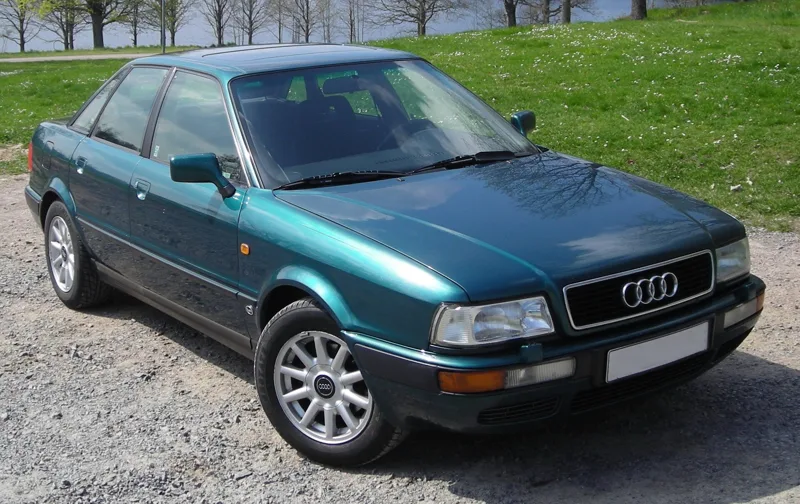
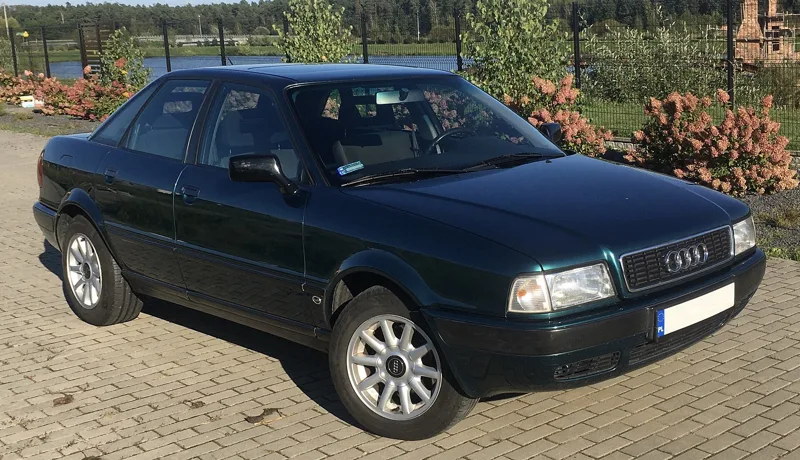
Almost every edge disappeared from the three-box saloon, and all surfaces were shaped in three dimensions for the first time. The bulging, doubly curved window areas typify the design. Wraparound headlamps, a bonnet that ran into them, and glass set flush with no drip rails gave the body its smooth look.
Audi saw the design as a further step towards premium status, and the body was counted as a milestone in automobile design.
The external dimensions stayed close to those of the predecessor, but the look was new. The windscreen was raked more steeply, and the side glass was slightly curved. The door handles sat flush, the rear pillar and rear window were raked and integrated, and the tail lamps were set high to limit damage in light rear-end collisions.
How roomy was the interior?
The car had space for four people and was homologated for five. A steeply raked rear window pushed the rear seat forward for headroom, which in turn moved the front seats forward to give rear legroom. The raked windscreen allowed the dashboard to move forward as well. Build quality and surfaces were praised, although the basic equipment was called sparse.
Testers were less kind about the boot, which was small and irregularly shaped, and about the emergency spare wheel that came instead of a full-size one. The standard kit had front head restraints, seat belts at both rows, central locking, halogen headlamps and rear fog lamps.
What was under the bonnet at launch?
The B3 kept the architecture of its predecessor. The engine sat longitudinally at the front and drove the front wheels. Discs were used at the front and drums at the rear, with MacPherson struts up front and a torsion crank axle with a Panhard rod at the back. Power steering was optional, even on the top models.
Quattro versions had disc brakes on both axles and an independent rear suspension with wishbones, though power steering was optional there too. The body was a fully galvanised load-bearing structure, meant to stop the rust that was still common in the 1980s. Despite efforts to save weight, the B3 was about 110 kg (243 lb) heavier than the B2.
Which engines did the B3 offer at launch?
At market launch the range ran from a 1.6 carburettor with 75 PS (74 hp) to a 1.9 E Kat with 113 PS (111 hp), plus two diesels. The range was broad, from the carburettor engines through fuel injection to the turbo diesel.
The 1.6 carburettor displaced 1,595 cc (97.3 cu in) and made 75 PS (74 hp), while the 1.8 S carburettor had 1,781 cc (108.7 cu in) and 90 PS (89 hp). The 1.8 E used the same capacity with K-Jetronic fuel injection, lifting output to 112 PS (110 hp). The 1.9 E Kat, with 1,847 cc (112.7 cu in) and electronic injection, produced 113 PS (111 hp).
On the diesel side, the 1.6 D had 1,588 cc (96.9 cu in), indirect injection and 54 PS (53 hp). Its turbocharged sibling, the 1.6 TD, shared that capacity and delivered 80 PS (79 hp).
Markets differed. In Austria the 1.6 D was throttled to 50 PS (49 hp). The 1.8 with 90 PS could be ordered with a catalytic converter, which gave 88 PS (87 hp). In some markets, Italy for one, a 1.8 with 75 PS (74 hp) was offered in place of, or alongside, the 1.6. All petrol engines except the 1.6 and that 1.8 could be ordered with quattro.
Front-drive models had a four-speed manual, while quattros had a five-speed that could also be ordered on front drive. A three-speed automatic was offered for the 1.8 and 1.9-litre front-drive models.
What changed during the production run?
The second-generation Audi 90, based on the B3, arrived in May 1987 with five-cylinder engines and the 1.6 TD. In mid-1987 the spare wheel moved from horizontal to vertical, on the left in the boot. A catalysed 1.6 petrol engine with 70 PS (69 hp) came for Austria and Switzerland, while the 75 PS (74 hp) 1.6 ran out elsewhere as too weak.
The car's success led Audi to move production of the Audi 100 to Neckarsulm, so that Ingolstadt could build only the Audi 80. Output reached 443,000 units in 1987. From 1987 the B3 was also exported to the USA, solely with a catalysed 2.3-litre five-cylinder engine producing 133 PS (131 hp), in front- and all-wheel-drive form.
The 1.8 fuel-injection engine gained an optional catalytic converter in March 1988 with no loss of power. In summer 1988 a new 2.0 with a catalytic converter replaced the 1.9. In August 1989 a 1.9 diesel with 68 PS (67 hp) took the place of the 1.6 D, and the whole petrol range had catalytic converters by 1989.
In 1990 the rear track was widened, and during an internal reorganisation the Type 89 was renamed Type 8A. The 2.0 16V with 137 PS (135 hp) arrived in May 1990 as the first multi-valve engine in an Audi 80. In August 1990 the KE-Motronic 2.0 offered 115 PS (113 hp; 85 kW). Fifteen prototypes with a 1.4-litre engine were built, but none reached production.
Did the B3 spawn other models?
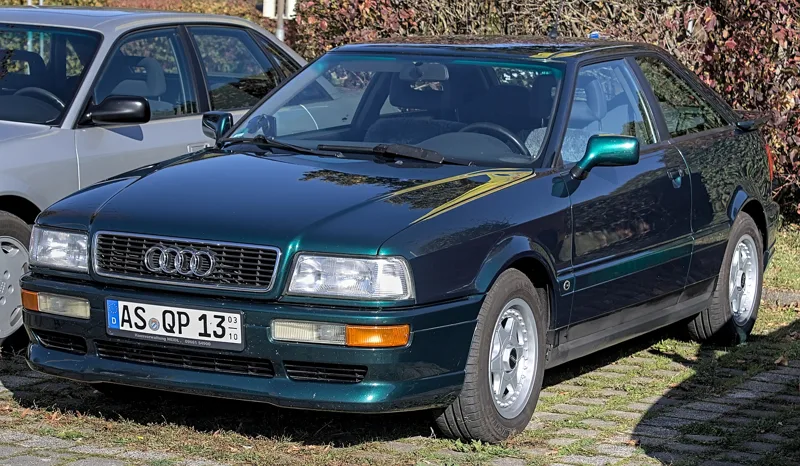
From autumn 1988 a sports coupe on the same platform was sold as the Audi Coupe. In summer 1990 the Audi S2 Coupe arrived with a 220 PS (217 hp) five-cylinder turbo engine. The Cabriolet followed in June 1991, developed from the B3 and wearing the detailing of the B4.
The S2 Coupe's revised front end was used in slightly altered form on the B4 saloon. Production of the coupe line ran until the end of 1996. The coupe idea was dropped, and the Audi TT took over the sporty role. Cabriolet production ran until summer 2000, after modifications in spring 1997.
Is the B3 designation disputed?
Some claim Audi never used the B3 label officially, which is not correct. The term was used during the development of the type and again later, in Audi's historical retrospective. Clear contemporary evidence appears in a publication by Othmar Wickenheiser.
Specifications at a glance
| Specification | Detail |
|---|---|
| Introduced | Summer 1986; market launch in September 1986 |
| Body | Three-box saloon, fully galvanised |
| Drag coefficient | Cw 0.29 |
| Engines at launch | 1.6 (75 PS; 74 hp) to 1.9 E Kat (113 PS; 111 hp), plus 1.6 D and 1.6 TD diesels |
| Weight | About 110 kg (243 lb) more than the B2 |
| Built | 1,297,801 units |
| Exported | 668,764 units |
| Successor | Audi 80 B4, autumn 1991 in Germany |