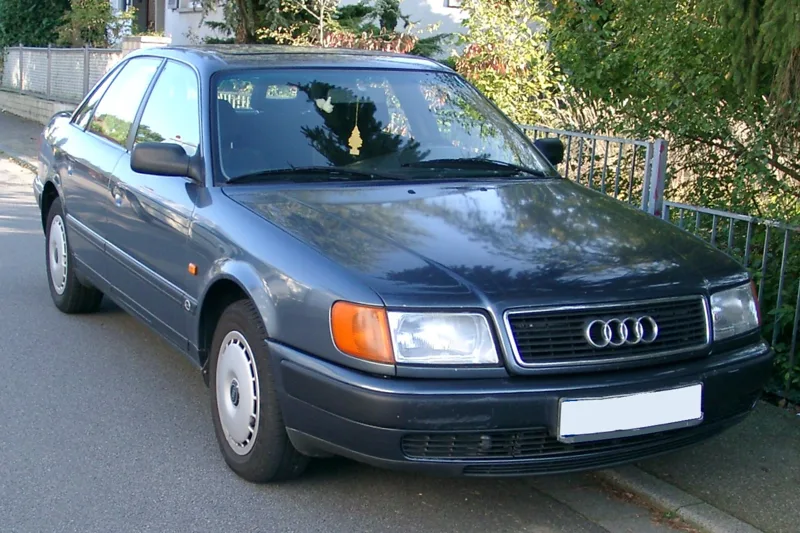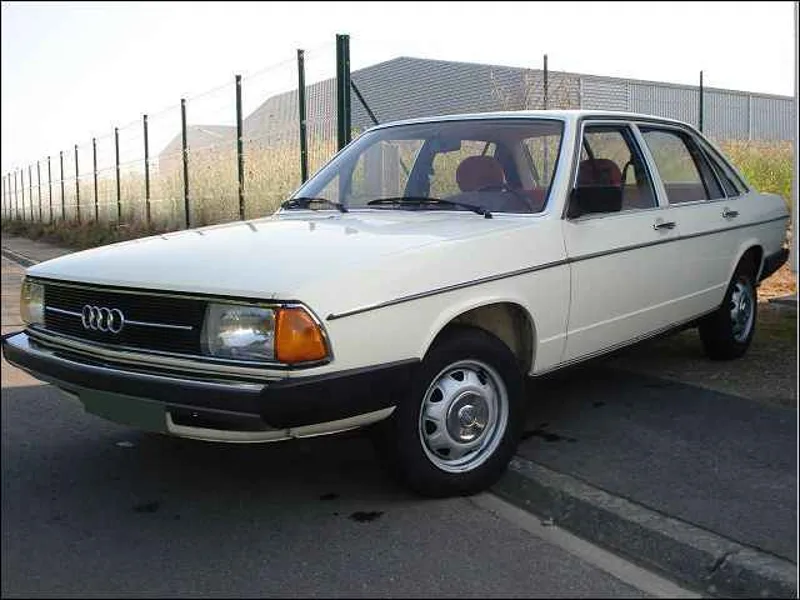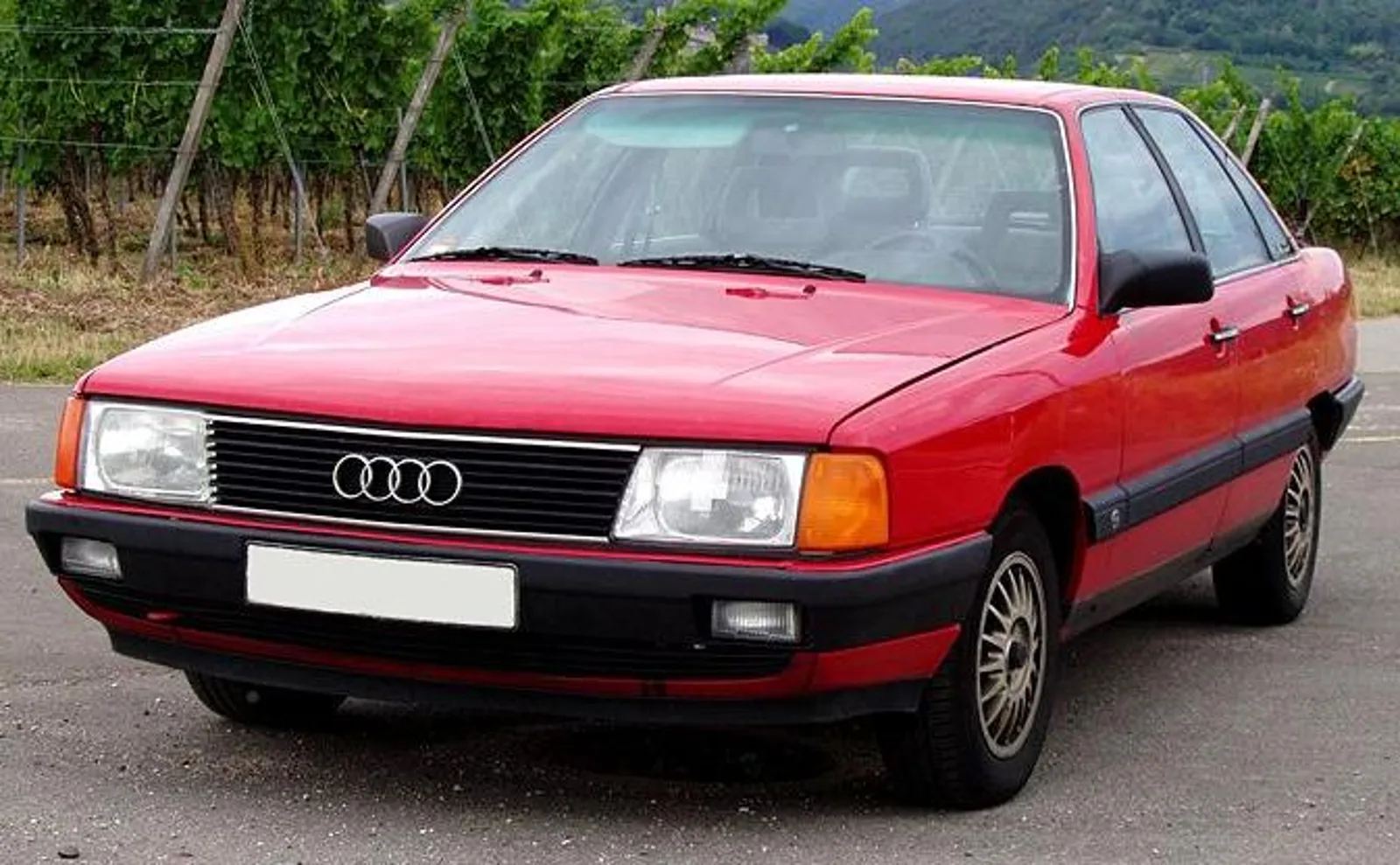
On sale from 1982, the C3 set the aerodynamic benchmark of its day, fully galvanised its body and brought direct-injection diesel to the Volkswagen Group.
The Audi 100 C3 was an upper-middle-class Audi launched in August 1982 and replaced by the Audi 100 C4 in December 1990, though the 2.4-litre diesel stayed in production until summer 1991. It pioneered permanent quattro all-wheel drive in its class from 1984 and introduced the first Volkswagen Group TDI, a direct-injection turbo diesel, to series production.
The Audi 100 C3, internally called type 44, combined a very streamlined body with permanent quattro all-wheel drive in the upper-middle class. It also brought the first turbocharged direct-injection TDI diesel into the Volkswagen Group's series production, and it won many awards on the way.
Where did the Audi 100 C3 come from?
The C3 took most of its technology from the Audi 100 C2 of 1976. Its exterior design, shaped around aerodynamics, was fixed in 1979 together with VW board member Toni Schmucker and design chief Hartmut Warkuss, after an in-house design by Peter Birtwhistle beat two alternatives, one by Giorgetto Giugiaro and one by Audi designer Martin Smith.
Ferdinand Piech led the technical development, and the team made heavy use of the VW wind tunnel in Wolfsburg to reach an above-average drag figure. Martin Smith's rejected alternative was realised in 1981 as the Audi research car, which showed many features of the final car at the IAA that year.
Market launch came in August 1982. The design language and technical details shaped car styling through the 1980s.
The family grew quickly. In August 1983 the Avant estate with a hatchback tail arrived, followed by the Audi 200, which had the body and chassis of the Audi 100 but a stronger engine and better equipment. Compared with the first Avant of 1977, the company moved away from the hatchback concept towards a more typical estate form.
An aerodynamic saloon of 1982 that carried quattro into the upper-middle class and the TDI into series production.
What was the C3's drag figure, and why did it matter?
The C3 had a drag coefficient of 0.30, which at the time was regarded as the most streamlined production car of its era. Its flush-fitted, raised side windows were part of the result, and the car won many awards for it.
Drag figures drew the attention of the press and manufacturers, who used them to prove economy or quieter running. Thanks to its lightweight construction and low air resistance, the C3 used less fuel than comparable cars of the time.
The phrase 'aerodynamics world champion', also cw world champion, began with motoring journalists and was later taken over by Audi for its press work. It has been used since the C3 for models with particularly low cw values. The European average in 1982 sat above 0.4, and cutting cw by ten percent saves roughly four percent of fuel at the same frontal area.
How did Audi make the C3 lighter and easier to build?
Lighter materials did much of the work. Special toughened glass grades reduced glass cross-sections, the spare-wheel well was made of glass-fibre plastic, and radiators and condensers were made of aluminium.
Audi invested heavily in production. A new paint shop opened in 1981, and the new car was partly galvanised at launch. The floor assembly was one deep-drawn piece with no welded seams, and robot welding lines took over from hand-jigged assembly. Driverless transport systems moved bodies through the body shop for the first time.
Ergonomics improved too. Swivel hangers reduced strenuous overhead work at final assembly. The headliner, once hooked and glued by hand, was fitted as a prefabricated moulded part through the windscreen opening, which cut cycle times and costs and gave better acoustics.
When did quattro arrive on the C3?
Audi had announced at the start of the 1980s that all-wheel drive would gradually be offered on every model. From November 1984 the C3 was available as a quattro, with permanent four-wheel drive through a centre differential, and the rest of the range gradually followed.
A well-known advertisement of the period showed such a car climbing a snow-covered ski jump. The idea was repeated later with the Audi A6. For the filming the cars went up the jump under their own power, secured only by a wire rope.
What changed with the 1988 facelift and the 2.5 TDI?
The January 1988 facelift brought a redesigned interior, door handles fitted flush into the body and a driver's airbag. The five-cylinder engine defined this generation, and over 20 engine variants were offered for the car altogether, from a 51 kW (69 PS; 68 hp) diesel to a 121 kW (165 PS; 163 hp) turbo. The Basis, CC, CS and CD equipment lines were dropped.
In January 1990 the Audi 100 2.5 TDI arrived. After the Fiat Croma of 1987 and the Austin Montego of 1988, it was the third series-production car with direct-injection diesel. Its 120 PS (88 kW; 118 hp) engine made 265 Nm (195 lb ft) at 2,250 rpm, along with low fuel consumption.
Audi is credited with pioneering the technology, an advantage the Volkswagen Group used against rivals during the 1990s.
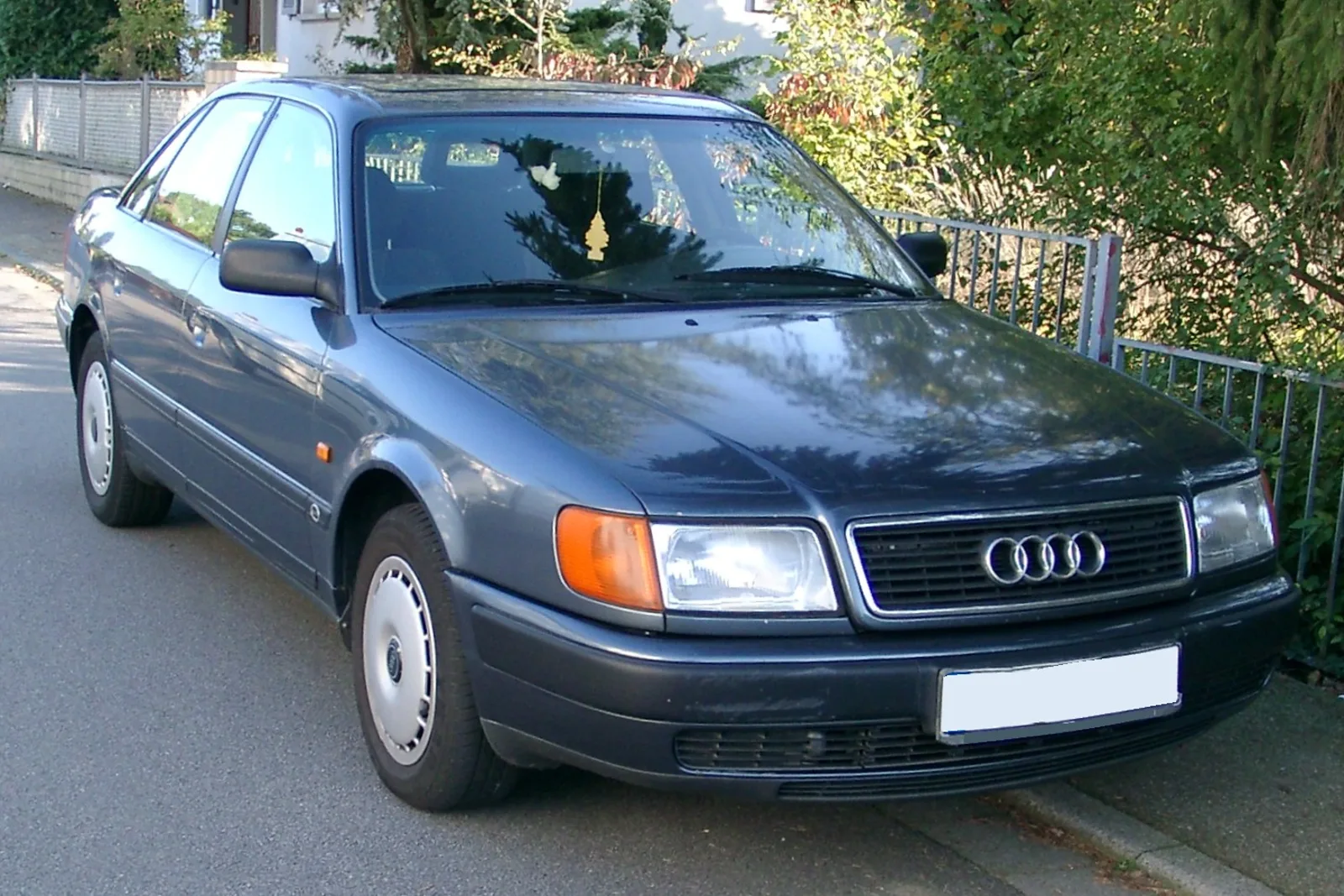
In December 1990 the C3 gave way to the Audi 100 C4. A 2.4-litre (146.5 cu in) diesel kept the C3 in production until summer 1991, the Audi 200 ran until then too, and the V8 derived from the 200 continued until mid-1994.
Full galvanising and corrosion testing
About 35 percent of the body used galvanised steel at launch. From September 1985, for model year 1986, the whole body was fully galvanised. Hidden parts used hot-dip galvanised sheet on both sides, while visible parts such as the bonnet, wings, doors and tailgate got electrolytically galvanised sheet, because hot-dip sheet can show an orange-peel effect under paint.
The zinc coating across the body weighs about 5 kg. The earlier anti-corrosion measures, from zinc phosphating to hot flood-wax preservation, were kept in full.
Audi's contract-built Porsche 924 and 944 at Neckarsulm had given it experience. Road tests from 1975 covered corrosive settings, from acid rain and minus 40 degree winters with aggressive de-icing salts to Florida's thin ozone layer and salty sea air.
The corrosion protection centre at Ingolstadt opened in 1982 at a cost of 12.5 million DM. Its centrepiece was the then so-called '30-cycle test', now called the INKA test, run in a three-chamber system. It reproduced six years of vehicle life within 14 weeks, after a pre-conditioning run of 2,000 km at the Ehra-Lessien test ground.
Ferdinand Piech, then Audi's technical board member, pushed for galvanised steel. At Porsche in the early 1970s he had found it irritating that the 911 rusted around its torsion bars after three or four years. VW board chairman Toni Schmucker opposed him, wanting no public argument over an 'Audi product advantage' and a 'Volkswagen shortfall' in the new Golf.
What was the Audi duo hybrid?
The Audi duo was a hybrid built on the Audi 100 Avant quattro, shown at the 1990 Geneva show and developed with a specialist firm in Kulmbach. It combined a 2.3-litre (140.4 cu in) five-cylinder engine driving the front wheels with an electric motor on the rear wheels.
The electric motor produced 9.3 kW (12.6 PS) and drew on a 181 kg (399 lb) battery of 54 nickel-cadmium cells connected in series, giving 58.8 volts. The batteries sat in the spare-wheel well and could be ready again in 45 minutes with fast charging, and they could also be recharged while driving.
The car offered a range of about 30 km, with an electric top speed of 50 km/h (31 mph). A petrol-electric hot-water heater supplied warmth to the cabin when needed. Steering and brake assistance ran on a further electric motor. The combustion engine could be started with the ignition key, or, once the car was in neutral, the electric drive was switched on with an 'E' button.
The extra cost over a conventional car was about 25,000 DM. Target buyers were municipalities, utilities and transport services working in quiet zones or during smog alerts. In the end three prototypes were built, because there was little demand for series production.
The second generation, shown in March 1992 on an Audi 100 Avant quattro (C4), had a petrol engine, a water-cooled, permanently excited synchronous motor and a sodium-sulphur battery. The third generation, built for series production on the front-drive Audi A4 Avant (B5) with a TDI diesel, was shown in 1996. Of that version 90 cars were built in series, and a fleet trial began in Erlangen in April 1997.
How did the aluminium body experiments end?
Audi first tested aluminium on its research car, and in September 1981 a 161 kg (355 lb) all-aluminium body for the Porsche 928 was displayed at the IAA. Audi then began secret work with an aluminium supplier on an all-aluminium body for volume production.
That project started in mid-1982, and a prototype C3 body in conventional shell construction was completed by the end of 1984. In May 1985, four and a half years after Porsche, a prototype aluminium body of about 149 kg (328 lb) was shown at the Hannover Messe. Testing showed that simply swapping the material saved weight but brought problems with fatigue, corrosion and acoustics.
By the May 1985 show Audi was already working in Ingolstadt on space-frame bodies. It concluded that a completely new technology was required. It chose an aluminium space-frame design, which reached series production only in the upper-class Audi A8 D2 from 1994.
What was the Schanze advertisement?
The 1985 'Schanze' advertisement, which won a Golden Lion at the Cannes advertising film festival, showed a weight-reduced, tornado-red Audi 100 CS quattro climbing a ski jump in Finland. A cable brake held the car against sliding back, and the commercial ran in spring 1986.
The Dusseldorf agency team/BBDO produced it with its production company TV-Company. The car was a quattro with 136 PS (134 hp) and studded tyres, and the Pitkavuori jump at Kaipola was the setting.
The 66-second version ran before films in German cinemas, and a version cut to 30 seconds ran on German television.
Debate continues over whether the visible safety cable also pulled the car up. The making-of film and a statement by the driver, Harald Demuth, are said to rule that out.
In January 2005, for the 25th anniversary of quattro drive, Audi made 'Schanze 2005' itself, without an agency, at the now closed and run-down Pitkavuori jump. A grey Audi A6 4.2 quattro (type 4F, C6), producing 246 kW (335 PS; 330 hp), climbed the jump. In 2019 scenes from the 1986 commercial were reused for a clip about the fully electric Audi e-tron extreme.
How durable is the Audi 100 C3 today?
The C3 is regarded as reliable and easy to service, and its fully galvanised body from model year 1986 makes it almost immune to rust. Many have passed into enthusiasts' or tuners' hands, and many used cars were exported, where large numbers are still in use.
The five-cylinder engines in particular are considered durable, and mileages above 500,000 km are not rare.
From December 2023 to June 2024 an Audi 100 C3 was displayed in the special exhibition 'Form vollendet' at the August Horch Museum in Zwickau.
Key specifications at a glance
| Item | Figure |
|---|---|
| Drag coefficient (cw) | 0.30 |
| Audi duo engine (first generation) | 2.3-litre (140.4 cu in) five-cylinder, 100 kW (136 PS) |
| Audi 100 2.5 TDI | 120 PS (88 kW; 118 hp), 265 Nm (195 lb ft) at 2,250 rpm |
| Engine range, all variants | 51 kW (69 PS; 68 hp) diesel to 121 kW (165 PS; 163 hp) turbo |
| Audi duo electric top speed | 50 km/h (31 mph) |
| Audi duo battery | 181 kg (399 lb), 54 nickel-cadmium cells, 58.8 volts |
| Aluminium prototype body | About 149 kg (328 lb) |