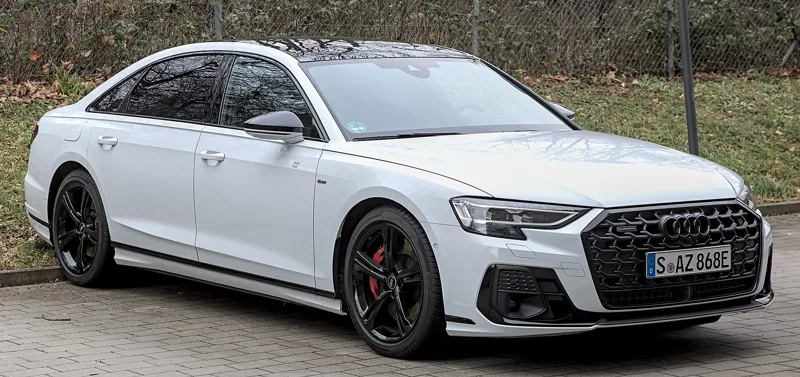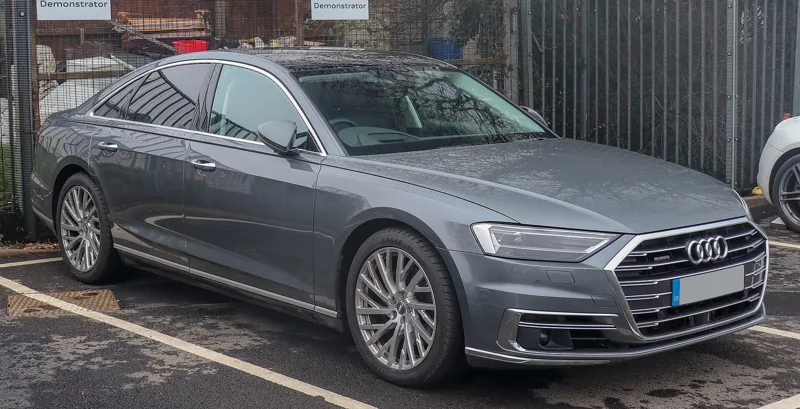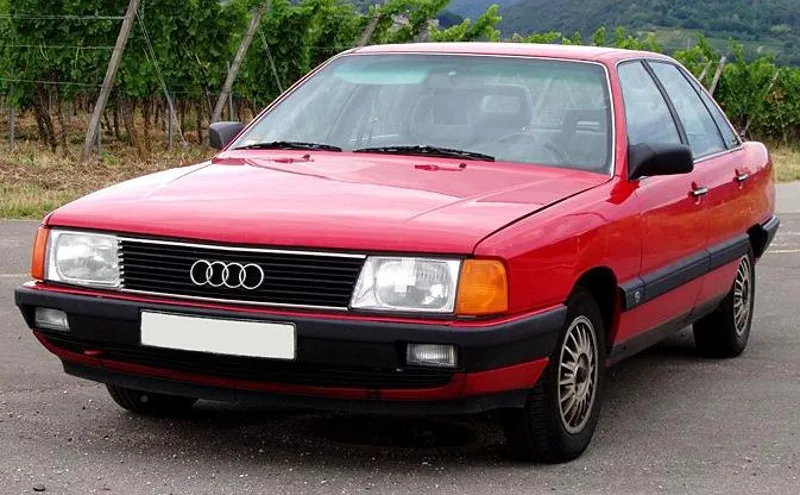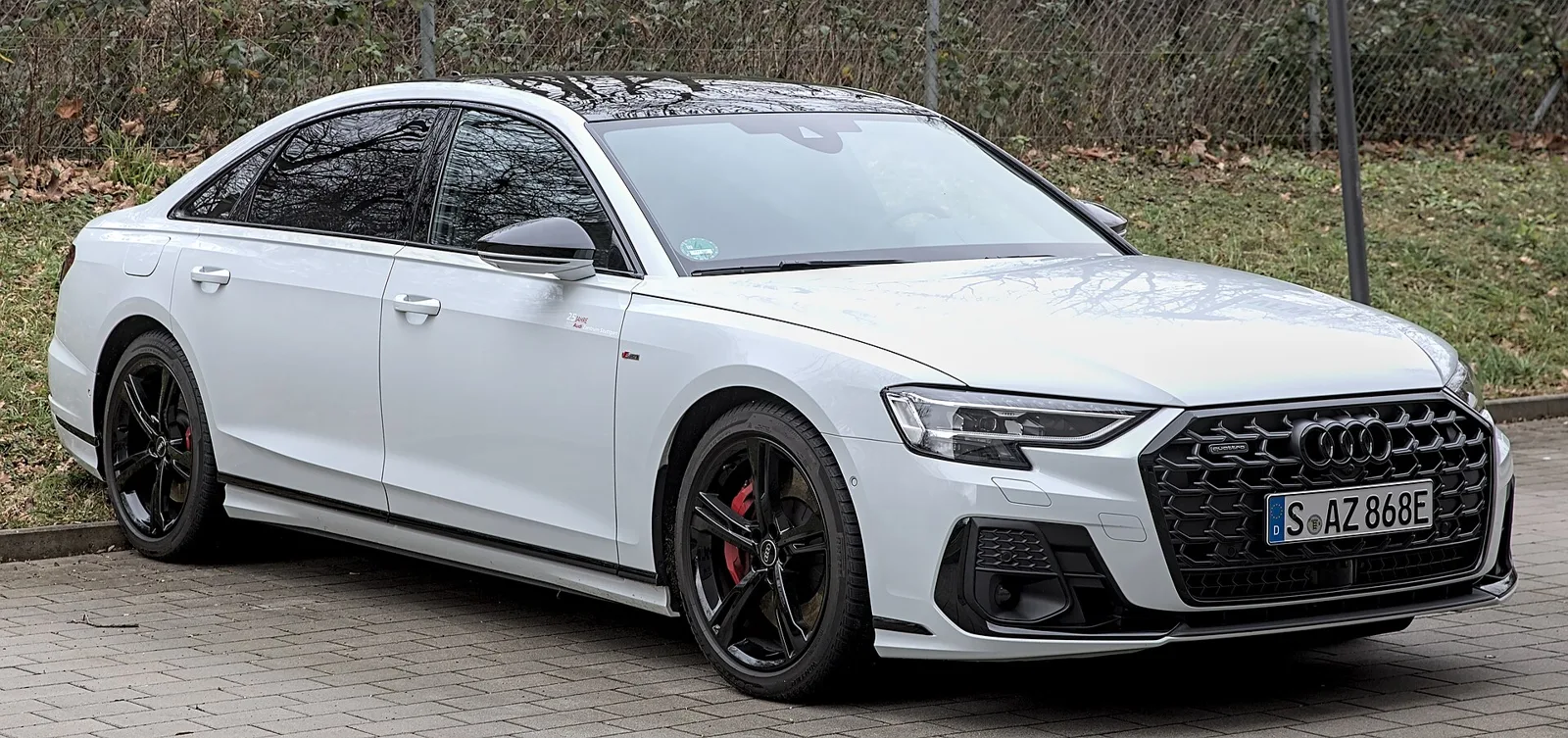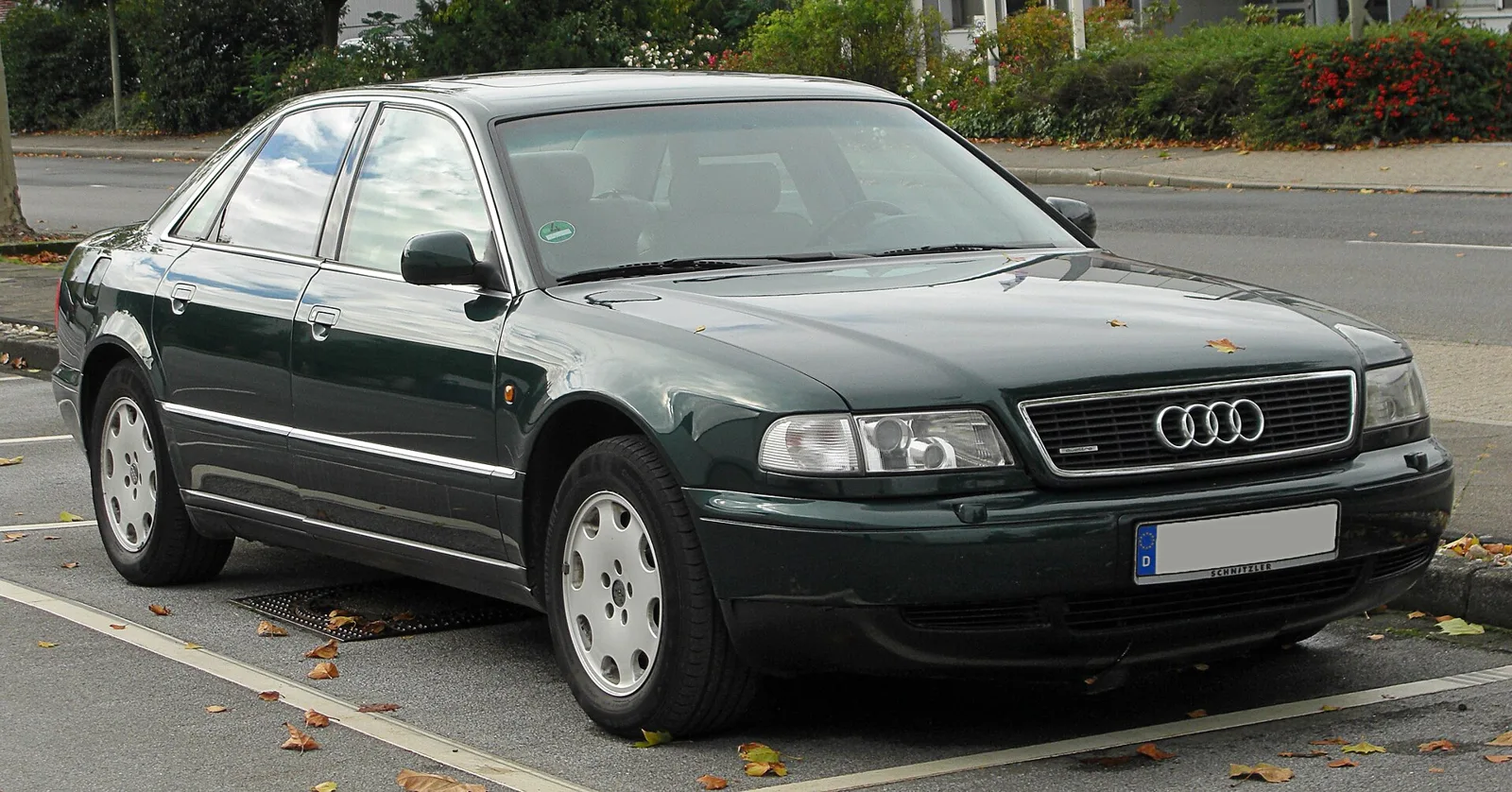
A 1994 luxury saloon built on aluminium and light alloys, with engines from a 2.8-litre V6 to a 6-litre W12.
Built from 1994 to 2002, the Audi A8 D2 was a German luxury saloon whose aluminium and light alloy body saved weight against steel rivals. Its engines ran from a 2.8-litre V6 to a 6-litre W12, and the car was the first Audi built on the new chassis.
The Audi A8 D2 is the first generation of the company's luxury saloon, built from 1994 to 2002 and known internally as Typ 4D. Its designers wanted a car that weighed markedly less than its competitors, and aluminium with light alloys was the route they chose. Engines ran from a 2.8 V6 at launch up to a 6-litre W12 by 2001.
Why did Audi set out to build a lighter luxury saloon?
Audi aimed for a high-end saloon that was considerably lighter than any rival in its class, partly to offset the roughly 100 kg penalty of its standard all-wheel drive. The work started in 1982, when Ferdinand Piech, about to become Audi's chief executive, struck a collaboration deal with Alcoa.
The first car to use the new chassis was to be the heir to the Audi V8, a flagship saloon from 1988. Before it appeared, Carl Hahn, who headed the Volkswagen Group at the time, said Audi would take on BMW and Mercedes-Benz head-on.
Aluminium was the point: a luxury saloon built to weigh far less than its rivals.
From concept to showroom
Chris Bird and Dirk van Braeckel produced the design that was picked in 1991. Hartmut Warkuss, Audi's chief of design at the time, oversaw it, and it was locked for production the following year. Earlier concepts, the Audi Spyder quattro and Avus quattro, had previewed aluminium structures and bodies, technology meant for the future flagship.
Measured against the V8 it replaced, the new saloon was bigger. Its dimensions were 503 cm (198 in) in length, 188 cm (74 in) in width and 142 cm (55.9 in) in height, yet it was also described as more agile, faster and roomier.
The Aluminium Space Frame concept was presented in September 1993 at Frankfurt as a prototype of the A8. It wore a polished aluminium body and carried a 3.4-litre V8 turbodiesel rated at 200 PS (147 kW; 197 hp), then the most powerful car diesel anywhere. Two months on, Tokyo saw the concept again, now with a 4.8-litre W12 making 354 PS (260 kW; 349 hp).
The production car was unveiled at Geneva in March 1994, and customers received their first cars in May.
What did the A8 D2 look like?
The A8 D2 looked new, although it kept the sober stance of the V8 it succeeded. Its rounder, smoother shapes were drawn for better aerodynamics, with a steeper bonnet, a grille reduced in height and wraparound rear lights with rounded corners.
The bonnet line carried on along the beltline, which also leaned slightly forward to suggest motion when seen from the side. The tail was more imposing than the outgoing car's.
Inside, a four-spoke wheel faced the driver, flanked by two large round dials: rev counter to the left, speedometer to the right. The cruise control readout sat between them, with warning lamps just beneath. The dashboard centred on a console in burr wood veneer, carrying three central air vents and controls for climate, radio, hazard lights and auxiliary functions, with two more pairs of vents at the sides. The central tunnel wore the same wood trim, and the boot held 525 litres.
Structure, suspension and brakes
An aluminium and light alloy shell and body panels saved, depending on the engine, between 2.5 and 4 quintals against rivals still built from steel. The front suspension dropped the MacPherson layout for double wishbones, and the rear followed with a double-wishbone arrangement of its own. Oleo-pneumatic dampers sat at both ends, and light alloys went into the auxiliary subframes as well.
Discs grabbed all four wheels. Lower-powered cars had ventilated discs at the front only, while V8 cars added ventilated discs at the rear. Electronic aids included ABS and EDS traction control. The steering was rack-and-pinion with hydraulic assistance.
Which engines did the A8 D2 offer at launch?
At launch the A8 D2 offered two petrol engines, both naturally aspirated and fed by indirect electronic injection. The 2.8 V6 produced 174 PS (128 kW; 172 hp) from 2,771 cc (169.1 cu in), while the 4.2 V8 made 300 PS (221 kW; 296 hp) from 4,172 cc (254.6 cu in).
The V6 had a single overhead camshaft and two valves per cylinder. The V8 used double overhead camshafts and four valves per cylinder.
Both engines sat at the front in a longitudinal layout. The V6 could drive the front wheels or all four, but the V8 was all-wheel drive only. A 5-speed manual came with the V6, and a 4-speed automatic could be ordered in its place. On the V8 the automatic was the standard choice.
Range updates from 1995 to 1997
July 1995 brought an intermediate V8 with a displacement of 3,697 cc (225.6 cu in) and an output of 230 PS (169 kW; 227 hp). The V6 followed in spring 1996, when a 5-valve cylinder head and double overhead camshaft timing lifted its output to 193 PS (142 kW; 190 hp).
The S8 arrived three months later, pitched against the BMW 750i and Mercedes-Benz S 500. Its 4.2-litre V8 was extensively revised, with new camshafts, intake manifolds and a higher compression ratio, which lifted output to 340 PS (250 kW; 335 hp), up from 299 PS (220 kW; 295 hp). Only all-wheel drive was offered, with a 6-speed manual, 18-inch six-spoke alloys and a suspension lowered by 20 mm, plus gas-filled dampers and thicker anti-roll bars.
Early in 1997 the first diesel joined the range. The 2.5 TDI was a direct-injection turbodiesel V6, producing 150 PS (110 kW; 148 hp).
How did the A8 D2 change in 1998 and 2001?
A very slight mid-life restyling at the end of 1998 changed the door handles, alloy wheels and steering wheel, and added a 5-inch display with satellite navigation. In early 2001 the long-wheelbase A8 L arrived, its wheelbase growing by 13 cm to 3.01 m and with two engines planned for it, the 4.2-litre V8 and the new 6-litre W12.
Engine changes in 1998 pushed the two less potent V8s to 260 PS (191 kW; 256 hp) and 310 PS (228 kW; 306 hp). The S8 was revised in June 1999 to 360 PS (265 kW; 355 hp) without any change of displacement. A year on, a twin-turbo V8 with common rail technology joined the diesel side. It displaced 3,328 cc (203.1 cu in) and produced 224 PS (165 kW; 221 hp). Late that summer the 2.5 TDI was upgraded, going from 150 to 180 PS (132 kW; 178 hp).
The 6-litre W12 used four valves per cylinder and reached 420 PS (309 kW; 414 hp). It was intended for the standard-wheelbase A8 and the long-wheelbase A8 L alike.
Audi A8 D2 specifications at a glance
| Specification | Detail |
|---|---|
| Internal code | Typ 4D |
| Production | 1994 to 2002 |
| Launch | Geneva Motor Show, March 1994; first deliveries in May |
| Body and structure | Aluminium and light alloys; 2.5 to 4 quintals lighter than steel rivals |
| Length, width, height | 503 cm (198 in), 188 cm (74 in), 142 cm (55.9 in) |
| Wheelbase | 2.88 m; 3.01 m on the A8 L |
| Luggage capacity | 525 litres |
| 2.8 V6 | 2,771 cc (169.1 cu in); 174 PS (128 kW; 172 hp) |
| 4.2 V8 | 4,172 cc (254.6 cu in); 300 PS (221 kW; 296 hp) |
| S8 | 340 PS (250 kW; 335 hp) from 1996; 360 PS (265 kW; 355 hp) from June 1999; all-wheel drive |
| 2.5 TDI V6 turbodiesel | 150 PS (110 kW; 148 hp) from 1997; 180 PS (132 kW; 178 hp) a year after the 1999 S8 update |
| 6-litre W12 | 420 PS (309 kW; 414 hp) from 2001 |
| Gearboxes | 5-speed manual or 4-speed automatic (V6); automatic standard on the V8 |
Was there an A8 coupe or armoured version?
Audi explored a coupe and an armoured variant, but only the armoured A8 L Security reached customers, built to order late in the car's life. The two-door A8 Coupe, shown at the Geneva Motor Show in 1997, remained a one-off example.
Audi management feared a commercial flop. The 8 Series, another possible rival with a sharper and sportier line, had not sold in exciting numbers, so the coupe was never put into final production.
The armoured A8 L Security used much thicker panels and windows 4.5 cm thick. A single window could weigh as much as 60 kg, so it needed a special pneumatic winder. Only the 420 PS (309 kW; 414 hp) W12 had enough output to move a body of that mass.
Approval depended on a test by the Beschussamt, a German agency that exposed the car to actual gunfire. Given the commercial purpose of the model, customisation options were extensive.
What the A8 D2 meant for Audi
The target was clear from the start: confront BMW and Mercedes-Benz with a car far lighter than its class. The A8 D2 was built around aluminium and light alloys to make a luxury saloon far lighter than its rivals.
It left the catalogue in September 2002, clearing room for its successor. Across its life it spanned a 174 PS V6 at the bottom and a 420 PS W12 at the top, with V8s and a diesel in between.