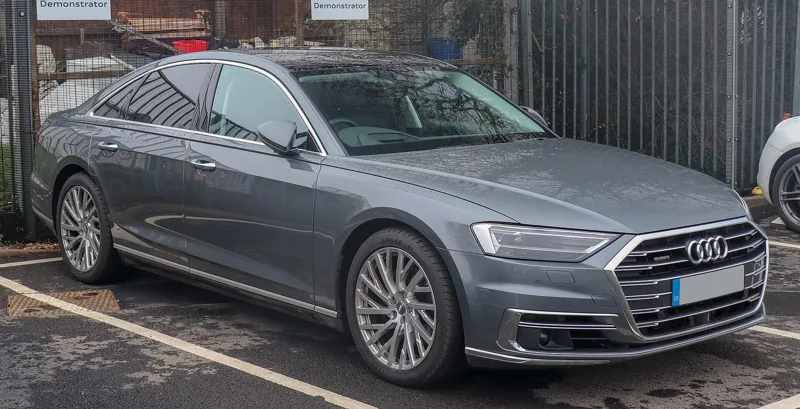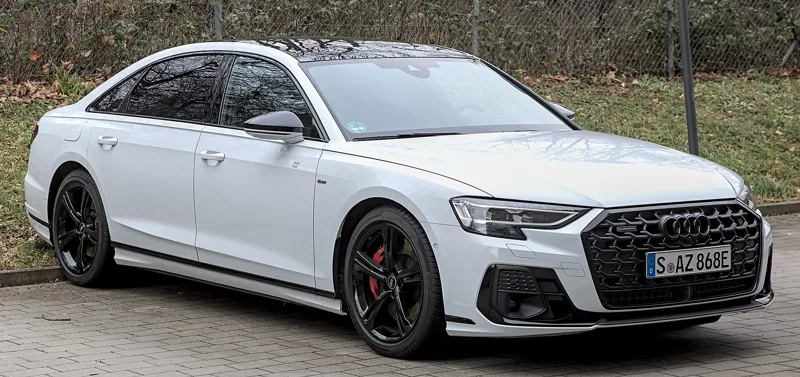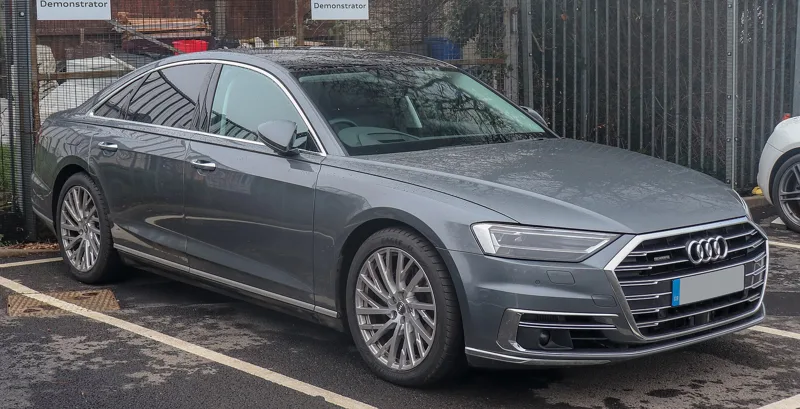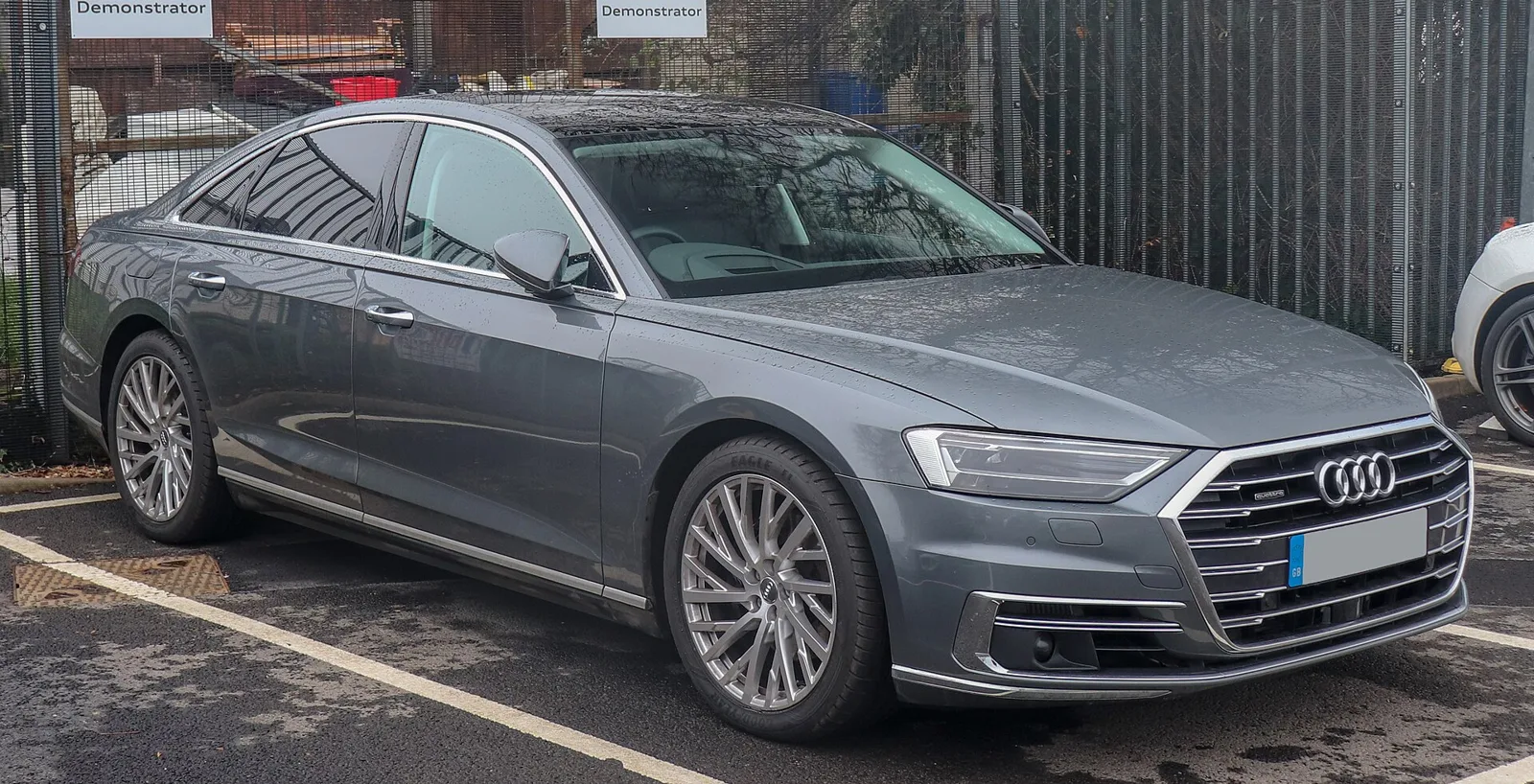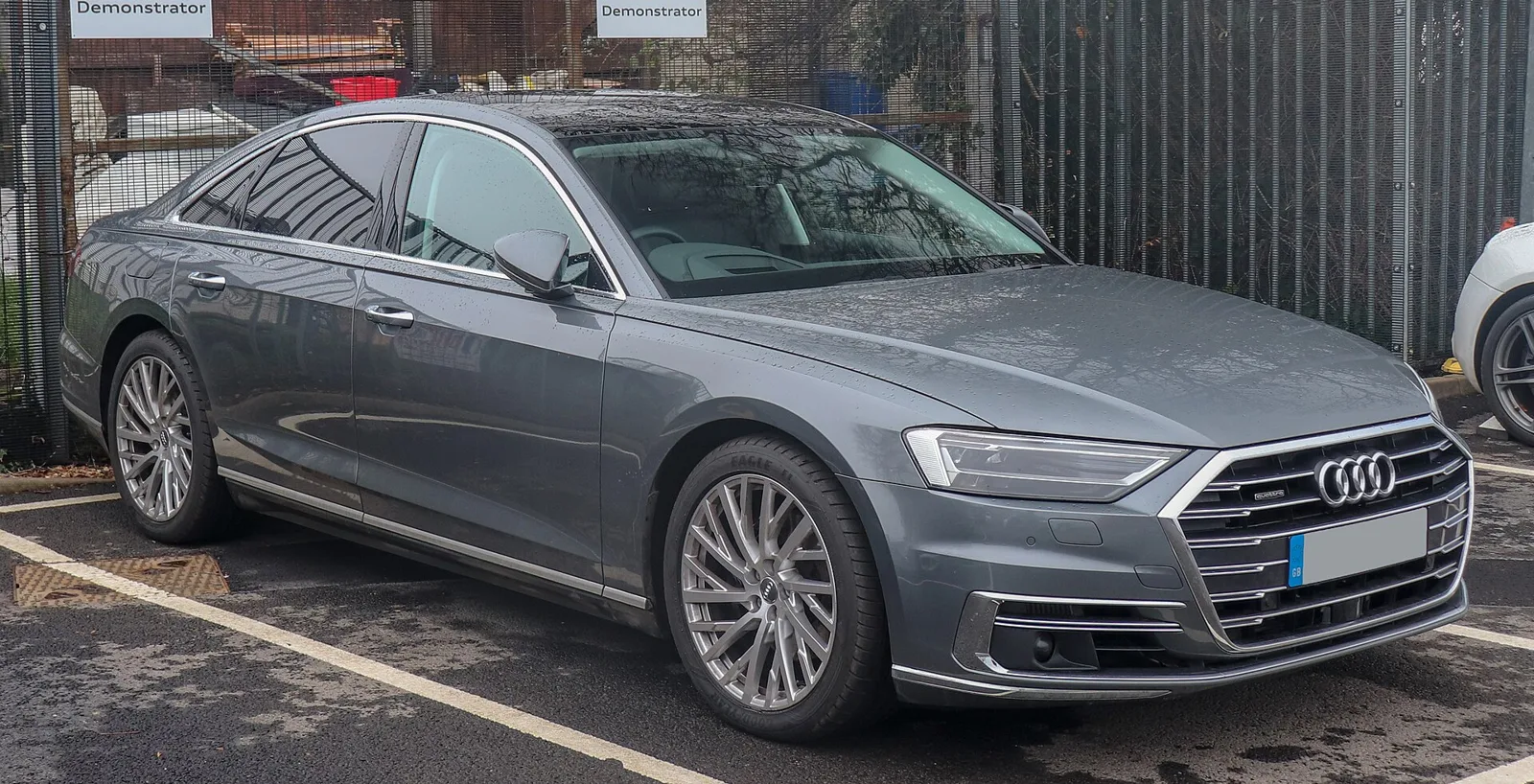
Two long-running luxury saloons that overlapped for several years, compared on engineering, design, safety and what each maker chose to offer.
The Audi A8 is an all-aluminium full-size saloon that began in 1994 and reached its fourth generation in 2017. The Lexus LS XF40 was the fourth-generation flagship, built from 2006 to 2017 on a reinforced steel body. The two cars overlapped until late 2009.
The Audi A8 and the Lexus LS are both full-size luxury saloons, and the record shows the two competing in the same segment from the start. The first A8 arrived in 1994 with an all-aluminium body, while the fourth-generation Lexus LS, the XF40, went on sale in 2006 as the brand's flagship. Their careers overlapped for several years, and each took a different route to its engineering.
This comparison focuses on the first two A8 generations and the XF40 LS, the period in which both were on sale. Where a figure is missing for one car, the gap is shown rather than estimated, and metric figures come first with imperial values in brackets.
Did the Audi A8 and Lexus LS compete head to head?
Yes, at least in the early years. The first A8 was designed to rival the Mercedes-Benz S-Class and the BMW 7 Series, and it also competed against the Jaguar XJ and the Lexus LS. The XF40 LS launched in 2006, while the second-generation A8 stayed on sale until late 2009.
The Lexus project started far earlier than the XF40. Toyota chairman Eiji Toyoda launched the F1 project in August 1983, a clandestine effort to build a world-class luxury sedan. Over six years, 60 designers, 1,400 engineers across 24 teams, 2,300 technicians and more than 200 support staff produced about 450 flagship prototypes and 900 engine prototypes, at a cost of over US$1 billion.
The Audi began from a different premise. In 1982 Ferdinand Piech signed an agreement with the Aluminum Company of America, aiming for a car much lighter than its rivals, because standard all-wheel drive was around 100 kg (220 lb) heavier than rear-wheel-drive competitors. The result was an all-aluminium monocoque, the Audi Space Frame, which the record describes as the first mass-market car with an aluminium chassis.
Two full-size flagships that began from different premises: an aluminium Audi built to save weight, and a steel Lexus shaped by a long flagship programme.
How were the two cars engineered and designed?
The A8 was built on the Volkswagen Group D2 platform, an all-aluminium monocoque marketed as the Audi Space Frame. Its final design, by Chris Bird and Dirk van Braeckel, was chosen in 1990 and frozen for production in mid-1991. The XF40 was designed by Yo Hiruta under the L-finesse philosophy first shown on the GS in 2001.
The XF40 was the first LS to receive that styling language. Its body forms run the length of the car, with a fastback rear decklid. Compared with the previous LS, the lift coefficients fell to 0.02 at the front and 0.01 at the rear, while drag stayed at Cd 0.26. Design patents were filed in the United States on 3 October 2005.
The fenders were pressed with a 5200-ton press, which the record says was the world's strongest stamping press when introduced. The paint was wet-sanded twice by hand between coats, and both window frames were die-cast in zinc, chrome-plated and polished by hand.
The D3 A8 followed a design process that began in Ingolstadt in 1997. Six full-size exterior clay models were reduced to two in late 1998, and the final theme was chosen at the end of 1999 by Miklos Kovacs and Imre Hasanic. The horizontal instrument panel was developed in parallel, with four full-size interior models built.
What engines did the two cars offer?
The first A8 offered a 2.8-litre V6 with 142 kW (193 PS; 190 bhp) and a 3.7-litre V8 with 169 kW (230 PS; 227 bhp), while the quattro used a 4.2-litre V8 rated at 221 kW (300 PS; 296 bhp). The XF40 came as the LS 460 V8 and the LS 600h hybrid, with no LS 460 displacement given.
The front-drive 3.7-litre V8 was dropped for the 2000 model year. The 2001 model year brought a 6.0-litre W12, made by joining two VR6 engines at the crankshaft, but only 750 of the W12 cars were built from 2001 until the model's discontinuation in 2003.
The LS 460 Sport arrived for the 2010 model year, based on the 2009 update. It was limited to the rear-wheel-drive standard-wheelbase model and had sport-tuned air suspension, Brembo brakes, forged alloy wheels, paddle shifters, a body kit and a two-tone interior. Its Sport Direct Shift transmission also appeared in the IS F.
What performance versions did each maker sell?
Audi's S8 arrived in Europe in 1996 with a 4.2-litre V8 rated at 250 kW (335 hp). From late 1999 it used five valves per cylinder, raising output to 265 kW (355 hp) and torque to 430 Nm (317 lb ft). Lexus's equivalent was the LS 460 Sport, which kept the standard V8 but added sport suspension and brakes.
The S8 had 18-inch Avus alloy wheels as standard, and 20-inch polished RS wheels became an option after the 1999 facelift. European-market cars came with a six-speed manual from launch, while most other markets had a five-speed ZF Tiptronic a year later. Production of the D2 S8 ended in September 2002.
How did the long-wheelbase versions differ?
The D2 A8 L added 5 inches (127 mm) of rear legroom, and the D3 A8 L added 120 mm (4.7 inches) plus 11 mm (0.43 in) of height. On the LS, the stretched model has noticeably longer rear passenger doors, and its Executive package adds a rear DVD system.
Safety and driver assistance
Audi introduced the first series production electronic stability control for all-wheel-drive vehicles in 1997, on the A8 and A6. The record calls them the world's first production cars with both front and rear side airbags. The D2 A8 gained six interior airbags for 1997 and side curtain airbags in 1999.
The XF40 introduced the Rear Pre-Crash system, described as the first active rear collision safety feature in an automobile. Its headrests can move up 25 mm (0.98 in) and forward 60 mm (2.4 in) to cradle the head. Lexus fitted eight to ten standard airbags, depending on model, and up to eleven with upgraded rear seats.
The LS 600h L received a Driver Monitoring System, which uses a CCD camera on the steering column to track eye movement and brakes automatically if the driver is inattentive and a collision is imminent. Dynamic Radar Cruise Control, a Brake Hold button and Intelligent Parking Assist were also offered. Lane Keeping Assist was not available on the LS 600h because it conflicted with the LED headlamps.
Did the A8 coupe reach production?
No. IVM Automotive of Munich built a two-door A8 coupe in 1997, which was unveiled at the Geneva Motor Show that year. Audi decided against production, citing lower-than-expected sales of rivals such as the BMW 8 Series (E31) and the Mercedes-Benz S-Class Coupe. Only one A8 coupe was ever built.
The single prototype, painted Ming Blue pearl, remains with IVM Automotive in Munich. Its last public appearance was in 2002, on a series of test drives. It had a re-engineered aluminium body, shorter than the saloon, and no central B pillar.
Did either car win major recognition?
The record notes that the XF40 received numerous accolades, including the World Car of the Year award in 2007. It lists no award for the A8. The A8 does have a political milestone: in 1998 German Chancellor Gerhard Schroder chose it as his official state car, breaking the tradition of Mercedes-Benz S-Class models.
Schroder moved on to the Volkswagen Phaeton, the sister model of the next-generation A8, after his re-election in 2002.
How long did each generation run?
The first A8 generation ended production at number 105,092 on 4 August 2002. The second generation arrived in late 2002 and was replaced in late 2009. The fourth generation followed in 2017, and March 2026 reports said Audi had stopped taking new orders in Germany from 18 February 2026.
The LS line began with the LS 400 in January 1989. The second generation came in 1995 and the third in 2000, and the XF40 was the fourth. It was built at Tahara from August 2006 until October 2017, when the XF50 LS took over.
Side-by-side specifications
| Specification | Audi A8 | Lexus LS (XF40) |
|---|---|---|
| Launch | First generation February 1994; second generation November 2002 in Europe | LS 460 January 2006; LS 600h April 2006 |
| Production | Orders in Germany reported stopped from 18 February 2026 | Built at Tahara from August 2006 to October 2017 |
| Successor | Successor confirmed in works, March 2026 reports | XF50 LS |
| Body structure | All-aluminium Audi Space Frame | Reinforced steel body |
| Drive | Front-wheel drive or permanent quattro all-wheel drive | LS 460 Sport rear-wheel drive; other layouts not given |
| Engines at launch | 2.8-litre V6; 3.7-litre V8 (dropped for 2000); 4.2-litre V8 quattro | LS 460 V8; LS 600h hybrid; LS 460 displacement not given |
| Power | 4.2-litre quattro 221 kW (300 PS; 296 bhp); S8 265 kW (355 hp) | LS 460 output not given |
| Torque | S8 430 Nm (317 lb ft) | not given |
| Gearbox | S8 six-speed manual in Europe from 1996; five-speed Tiptronic elsewhere | Sport Direct Shift in LS 460 Sport |
| Airbags | Six interior airbags added in 1997 | Eight to ten standard, up to eleven |
| Wheelbase | Short and long (A8 L) | Short and long (L suffix) |
| Development | Final design frozen mid-1991; development cost US$700 million | Over US$1 billion for the F1 project |
| Coupe | One prototype built in 1997; not produced | not given |
| Drag | not given | Cd 0.26 |
| Recognition | not given | World Car of the Year 2007 |
| Sales targets | not given | 30,000 LS 460 a year in the US; about 65 percent standard wheelbase |
| State use | Official state car from 1998 | not given |
Which buyer suits each car?
On the figures available, the A8 suits a buyer who values an all-aluminium body, a choice of front-wheel or quattro drive and a long line of S8 performance versions. The LS suits a buyer who wants a flagship with a hybrid option, a long-wheelbase Executive package and an extensive safety list.
Both cars fit the full-size luxury brief, but they took different routes. The A8 had a longer run of generations and a steady sequence of changes, while the XF40 had a single defined production span from 2006 to 2017 and a set list of safety systems. The record gives reasons to prefer one only in terms of those differences.
Buyers of the XF40 after the 2009 update would have received active Eco Mode, a self-repairing clear coat and a five-seat Executive option. The A8 coupe, by contrast, never reached a buyer at all.
What does the record leave open?
Several points are missing. The record gives no price for either car, no sales totals for the A8, and no displacement for the LS 460. The third-generation A8 engine range is not described. The March 2026 order stop appears as press reports rather than a confirmed decision, and it should be read that way.