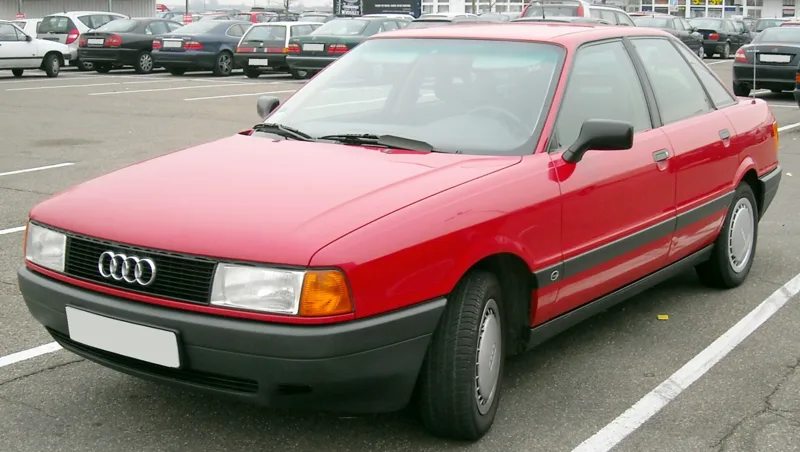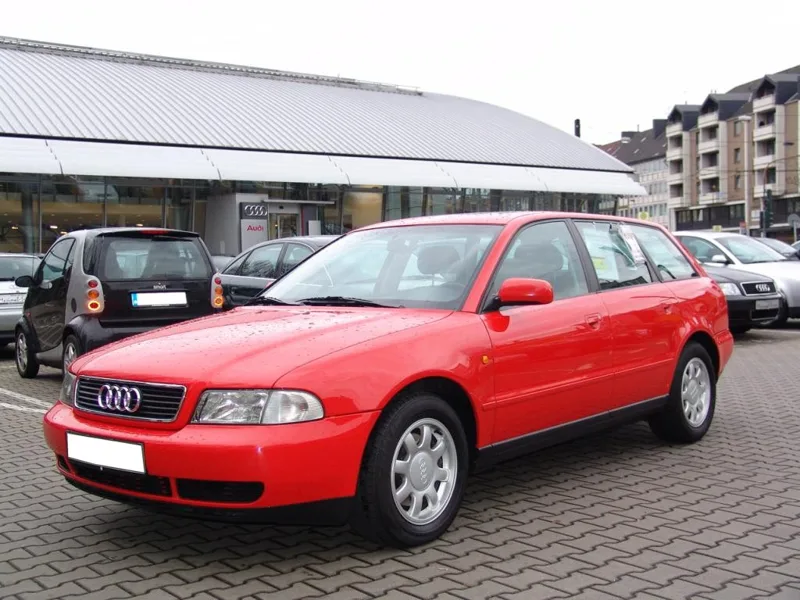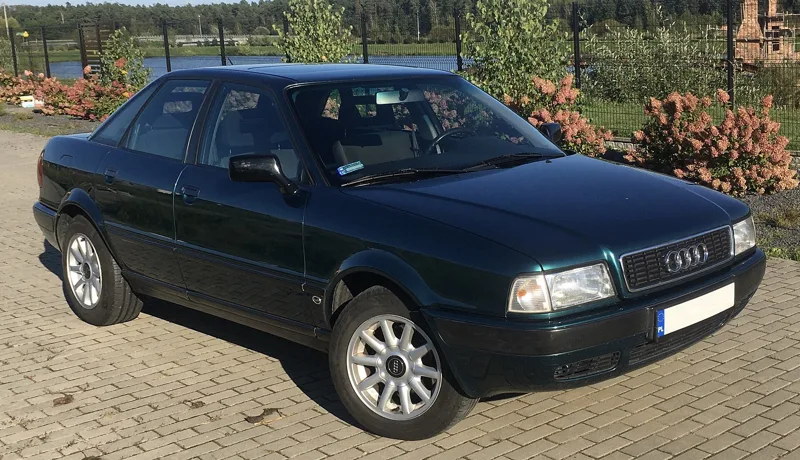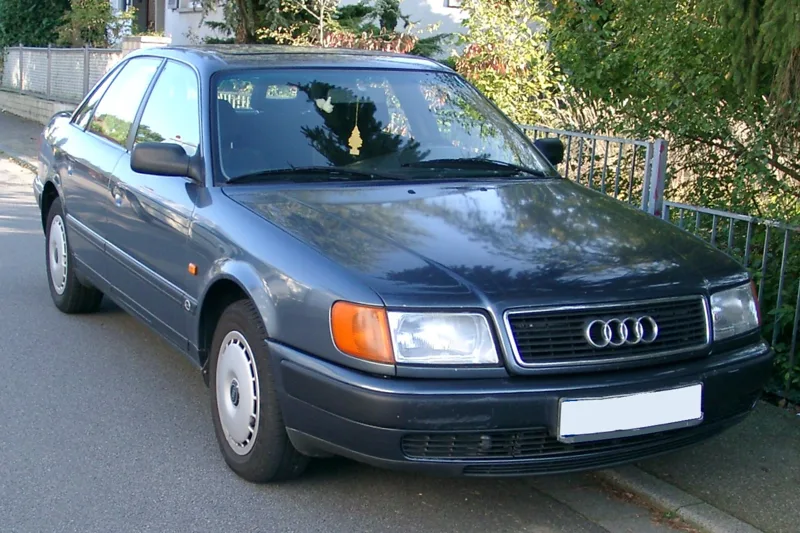
A reworked B3 with a longer body, a compound-link rear axle, six-cylinder engines and an RS2 developed with Porsche.
Audi's 1991 saloon, followed by an estate in 1992, was a reworked B3 with a longer body, a compound-link rear axle and launch engines from 90 PS to 174 PS. Production topped 826,000, and the car merged the Audi 80 and 90 ranges in Europe.
The Audi 80 B4 reached showrooms in September 1991 as the fourth and final generation of the Audi 80 range. Its engineers reworked the B3 rather than starting again, and the car replaced the twin 80 and 90 line-up in Europe with a single, higher-placed model. More than 826,000 were built, and the 2.0 E and TDI were its most popular engines.
Where did the Audi 80 B4 come from?
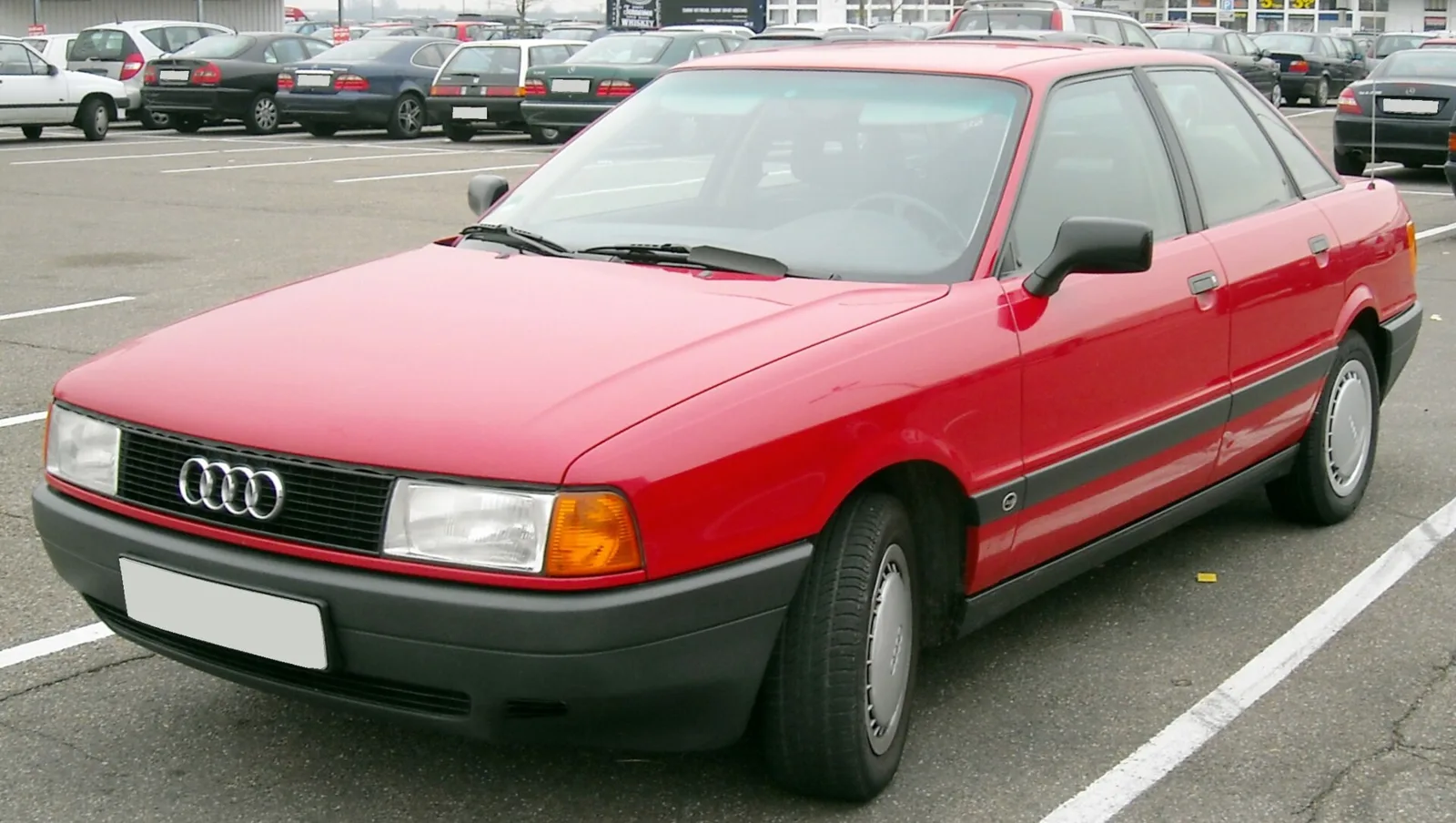
The B4 was a development of the B3 rather than an all-new car. It kept much of the roof and the basic concept, but added a new front, a longer body and a redesigned rear axle. The car arrived in September 1991 as the final Audi 80 generation, the fourth in the line.
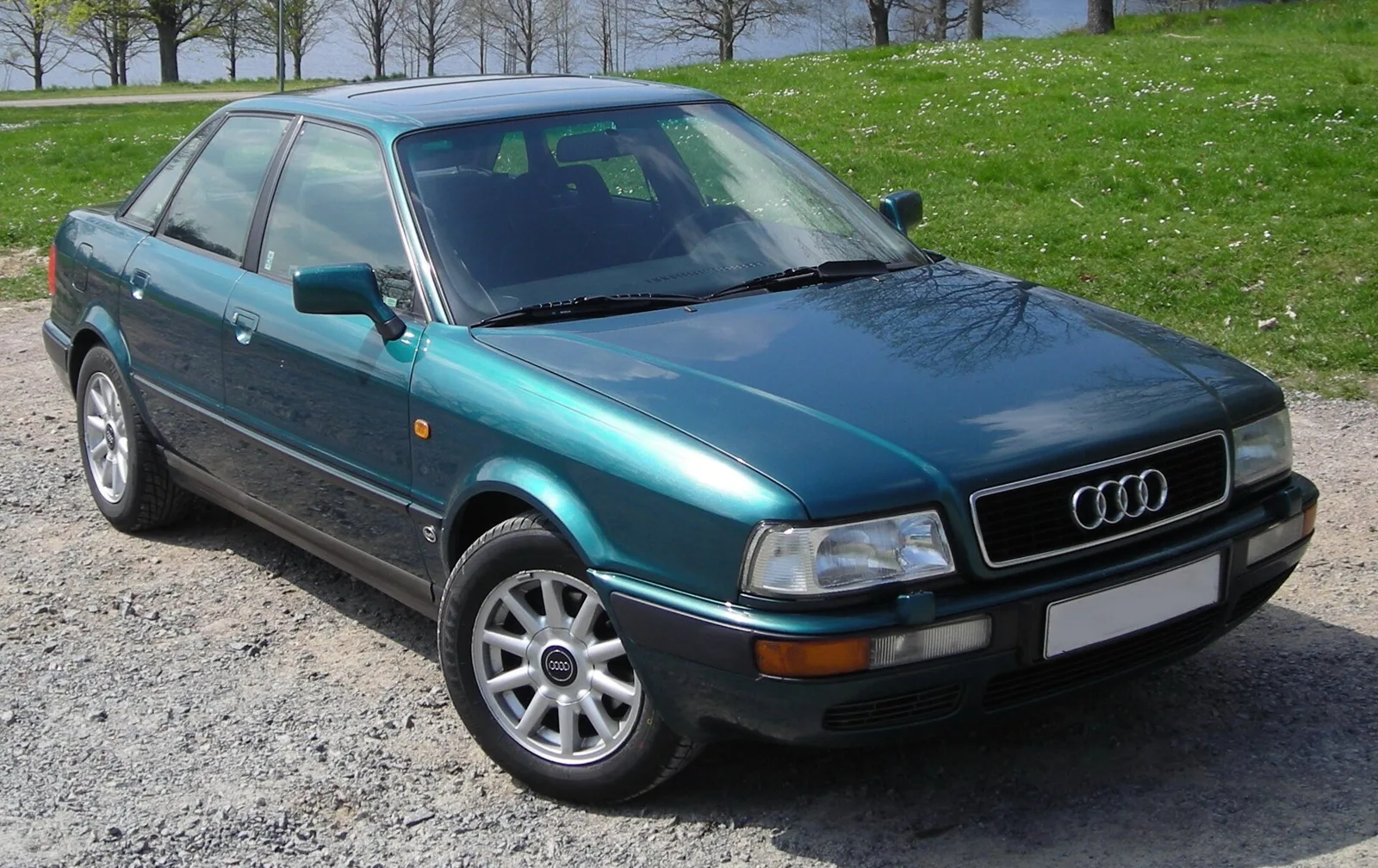
The front received a bonnet with an integrated grille, the same arrangement already seen on the Audi V8 and the Audi 100 C4, along with bumpers in the same colour as the bodywork. The rear window curves less strongly at the top than the B3's did, but the windscreen and much of the roof carried over unchanged.
Under the skin the layout stayed familiar. The engine still sat longitudinally, all-wheel drive remained available alongside front-wheel drive, and the MacPherson front suspension carried on. The change came at the rear, where the rigid twist-beam axle gave way to a compound-link axle. Each wheel got its own coil spring and hydraulic telescopic damper.
The rear axle also solved a packaging problem. The B3's twist-beam axle took up a lot of room and gave the boot an awkward shape that drew criticism. The new layout allowed a flat boot floor and a horizontal fuel tank. It also needed a longer wheelbase, which made the car just under 8 cm longer. Overall it measured 9 cm (3.5 in) more than the B3. Bigger wheels disguised the stretch, so the trailing edge of the rear door sat where it had before.
The estate followed from the same change. The horizontal tank let the rear seat backs fold and the boot become a smooth, deep space, and Audi showed the Avant in summer 1992. Its tail lights are identical to the B3's, a sign that the estate had been developed during the B3 years.
A longer, flatter boot and six-cylinder engines let Audi sell one premium 80 instead of two.
How did the B4 differ from the B3?
Most of the differences were in safety, equipment and engines. Driver airbags became standard from model year 1994 and ABS from January 1993, the range started at 2.0 litres, and the bumpers, lights, wheels and interior trim were all revised.
- Driver airbag standard from model year 1994, with a passenger airbag standard from 1995.
- Anti-lock braking standard from January 1993.
- Bumpers and light units were reworked. Indicators and fog lights sat inside the bumper on every model except the basic four- and five-cylinder versions.
- 15-inch wheels as standard, against 14-inch on the B3.
- Rear seat backs that fold asymmetrically, with central locking on the saloon from the 2.3E.
- The hazard warning switch moved from the steering column stalk to the centre console.
Almost every model had four disc brakes, and the basic version with the 2.0-litre carburettor engine kept drum brakes at the rear. Power assistance came as standard with the rack-and-pinion steering, and the Procon-Ten safety system, developed by Audi, was standard equipment too.
Inside, the materials were upgraded, especially the seat covers and trim, and the door panels were changed. Insulation was improved as well.
The six-cylinder cars were easy to tell apart. Their front indicators sat inside the bumper, and they had double main headlights, a development of the units used on the Audi 90 and the coupes up to model year 1991. Late S2 and RS2 models, and Cabriolets from 1998, used halogen DE headlights, which can be switched to left-hand traffic with a switch in the housing.
Quattro cars are harder to miss from behind. Six-cylinder models and quattro vehicles carry a double exhaust tailpipe, and the TD and TDI models had one too, bent downwards so that soot could drain away. Quattro models also have a wheelbase 1 cm shorter, so the rear wheels sit a little more centrally in the arch, and the rear axle is a touch broader.
Engine line-up and key figures
| Engine | Displacement | Output | Details |
|---|---|---|---|
| 2.0 | 1,984 cc (121.1 cu in) | 90 PS (66 kW; 89 hp) | Single-point fuel injection |
| 2.0 E | 1,984 cc (121.1 cu in) | 115 PS (85 kW; 113 hp) | Electronic fuel injection |
| 2.3 E | 2,306 cc (140.7 cu in) | 133 PS (98 kW; 131 hp) | Five-cylinder, KEIII-Jetronic |
| 2.8 E | 2,771 cc (169.1 cu in) | 174 PS (128 kW; 172 hp) | V6, a new addition to the B4 range |
Every engine had a catalytic converter. Apart from the 2.0-litre carburettor engine, every engine could be combined with all-wheel drive, and the standard gearbox was a five-speed manual, with a four-speed automatic available on request.
The B4 began with engines of 2.0 litres and above. Audi dropped the 1.6 and 1.8 litre entry engines of the B3, and at launch the range was petrol only. In effect, the smallest engine in the range became a 2.0.
Why did the Avant, S2 and RS2 matter?
The Avant was the practical choice, but the performance versions gave the family its sharpest models. The S2 and RS2 both used a turbocharged 2.2-litre five-cylinder, and the RS2 produced 232 kW (315 PS), more than any Audi road car before it.
The RS2 had an unofficial forerunner. The tuner SMS, which had been active for Audi in the DTM and helped develop the S2, offered an S2 Revo first at 270 PS (199 kW; 266 hp) and later at 308 PS (227 kW; 304 hp). It was ordered through Audi dealers, and such cars are scarce today.
Both the S2 and RS2 used a 2.2-litre five-cylinder with four-valve technology and a turbocharger. Before the engine was fitted in the B4, it also received a contactless ignition with single coils. Output stood at 169 kW (230 PS) for the S2 and 232 kW (315 PS) for the RS2, for which Porsche fitted an optimised turbocharger, a modified exhaust manifold and metal catalytic converters.
Porsche's role went well beyond the engine. The RS2 was built at Audi's Neckarsulm plant, on the same line where the Porsche 944 had run from 1981 to 1991, and Porsche contributed brakes, chassis, mirrors, wheels and the engine itself.
The S2 arrived as a saloon in 1993, but only 306 were built. The RS2 came only as an estate, while the S2 was also offered as a coupe and, in a few cases, as a saloon. The RS2 and the five-cylinder S2 both had a six-speed manual gearbox.
Which special editions were built?
The Europa, introduced from model year 1994, had more extensive basic equipment than the standard car. Electric exterior mirrors came as standard, along with ten-spoke alloy wheels on 205/60 R15 V tyres. The package also included an electric sunroof, with manual air conditioning optional, along with a steering wheel with airbag, rear headrests and five special paint colours.
The Competition of 1994 was a limited model built for homologation in the STW touring car series, with 2,500 units made. It had headlights borrowed from the Audi Coupe, 7x16 alloy wheels, the front and rear aprons and rear spoiler known from the S2, and permanent quattro all-wheel drive.
Its engine, code ACE, started from the two-litre four-cylinder of the 2.0 and 2.0 E. A new injection setup on the intake side and a sixteen-valve head pushed the engine up to 103 kW (140 PS; 138 hp), and the same engine was also used in a small number of ordinary B4s. Each Competition came with a key fob carrying its serial number, such as 583/2500. The spoiler extras were not approved for public roads. The paint options were three: a pearl-effect black called Volcano Black, Laser Red and Crystal Silver, a palette that echoed Audi's traditional colours, especially in rallying.
Racing history: the DTM car and the Competition
The 1993 DTM entry was a racing car built on Audi 80 underpinnings, fitted with a six-cylinder unit of 2.5 litres. Peak output was 285 kW (388 PS; 383 hp), reached at 10,500 rpm. It was meant to replace the Audi V8, which the new rules no longer allowed to start. Audi quit the DTM before the season began, so the car never raced, and Audi AG still owns it.
The Competition's aerodynamic extras had a similar origin. The sporting rules required racing bodywork to match the series cars, so the spoiler extensions, the aluminium profile and the lip for the front apron were supplied, although none was approved for public roads.
The two cars had different fates. The Competition existed to satisfy the STW rules and reached buyers, while the DTM racer stayed with Audi.
When did production end?
Saloon production stopped in December 1994, and the estate was built until December 1995. Some saloons were not registered until early 1995. The Audi Cabriolet, which was based on the Audi Coupe rather than the B4, was made until August 2000.
Audi's replacement was the A4 B5, which arrived in November 1994. The RS2 continued to be built with Porsche until May 1995, and four particularly rare RS2 saloons were also produced.
The Cabriolet was updated in April 1997. Its front bumper was reshaped, double ellipsoid headlights with projector lenses were offered (already known from the S2 and RS2), and a third brake light went into the boot lid. The instrument cluster, essentially unchanged since 1986, got new paint colours and better interior trims, while its technology stayed the same.
How did the North American cars differ?
North American cars were sold as the Audi 90, not the Audi 80. The 2.6E and 2.8E were the only engines on offer, and they came first as saloons, with cabriolets following later. Crash and lighting rules forced different bumpers, and the indicators sat beside the headlights.
The North American bumpers carried a clearly protruding transverse bead, and the V6 could not use the European light units. The fog lights were mounted noticeably lower in the front bumper. White indicator lenses were barred, so the orange ones known from the B3 were kept. The rear indicators were red and doubled as a second tail light, while at the front they served as yellow parking lights.
Many cars sold there were specified with automatic transmission, cruise control and power windows. Double airbags and leather trim were also much more widespread than in Europe.
Why does the B4 still matter in Germany?
The B4 made the Audi 80 a single premium model, and its build quality kept it on German roads for a very long time. It still appears as a youngtimer, and several German states used it as a police patrol car, some of them up to around 2000.
For Audi the car marked a strategic shift. Dropping the twin 80 and 90 names in favour of one higher-placed model, and bringing six-cylinder engines into that range, supported the idea of Audi as a premium brand alone.
The car also had a second life on screen. The lead characters of two 2010s German television series, Alles Klara and Hubert ohne Staller, drove it as shorthand for an old car, and the early-evening ARD series Hubert und/ohne Staller still shows it today.