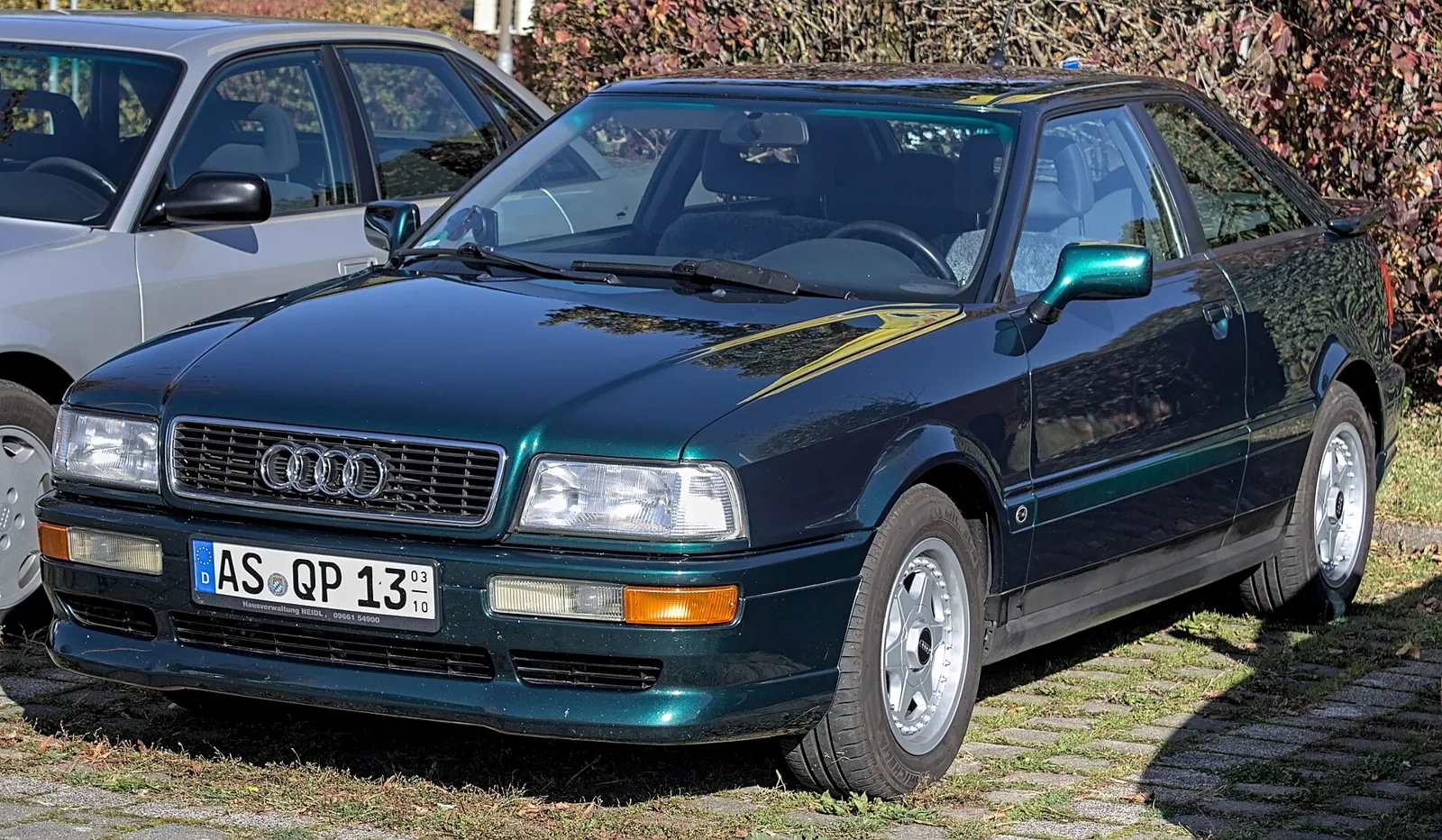
The second-generation Audi Coupe, built on the Audi 90's mechanics, sold well in its first two years before a long decline ended production in 1996.
The Audi Coupe B3 was the second-generation Audi Coupe, a three-door car with the mechanics of the Audi 90, built from 1988 to 1996. It sold almost 33,000 examples in its first two years, but across its whole run it fell well short of the coupe it replaced.
The Audi Coupe B3 was a three-door car that took the mechanics of the Audi 90 into a more rounded, more practical body. Its sales were strong at the start, but its later years were a long decline.
What did the Audi Coupe B3 replace and why?
The B3 succeeded the B2-based coupe and was built on the Audi 90's mechanics rather than the Audi 80's. The company wanted a more spirited coupe, so the Audi 90 was chosen as the base, and the car was planned to take still more powerful engines, like those intended for the coming fourth-generation Audi 100.
Its brief was comfort, roominess and practicality, alongside a more aggressive temperament. Weak entry engines of the earlier range, such as the 1.8 with 90 PS or, in some markets, the 1.6 with 75 PS, were dropped from the line-up for this model.
Concepts first used on the Audi 100 C3 were applied to the new coupe, which was due to share ideas with the third generation of the Audi 80 then under development. The body was given rounder edges, more interior space and a larger rear hatch than the car it followed.
A 1983 project had imagined an estate version to sit alongside the saloon, with a fastback tail and steeply raked pillars like those of the contemporary Audi 100 Avant. That estate never left the prototype stage, but its ideas were carried into the new coupe. It appeared in autumn 1988, barely more than a year after the previous coupe left the range in July 1987.
The Coupe B3 sold well for two years, then spent the rest of its life slowly fading from the showroom.
How was the Typ 89 styled and laid out inside?
The B3 was about 54 mm shorter than its predecessor but a little wider and taller, with a much higher belt line and smaller side windows. Its three-door body with a large hatch made the boot easier to reach, although capacity fell to 359 litres from 370 litres.
The higher belt line gave the body an impression of solidity and robustness, and the side glass was much reduced in height as a result. Compared with the earlier coupe, the body was marked by many rounded edges and almost no sharp ones, as on the 80 and 90 saloons.
The front echoed the Audi 90, with a horizontal design around the black chequered grille and rectangular light clusters with white indicators. The red plastic band across the rear joined the rectangular rear light clusters, a detail the Audi 80 lacked.
The cabin was similar to the Audi 90's, with additions such as an ammeter and an oil pressure and temperature gauge. Three extra gauges sat low in the centre console, and they drew doubts about how easy they were to read.
Passenger room was good for the class, and two people could sit comfortably in the back. Getting to the rear seat was awkward with only two doors, but the folding backrest increased the load capacity of the small boot.
Burr-wood inserts were visible on the richer versions. Overall the Typ 89 presented a higher level of finish and elegance than the coupe that came before it.
What was under the bonnet and how did quattro work?
Permanent all-wheel drive used a Torsen centre differential that normally split torque exactly in half between the axles and could send up to 75% to the front or the rear. This was the second-generation quattro system, used across Audi all-wheel-drive cars from the late eighties through much of the following decade.
The layout was the usual one, with a longitudinal front engine and either front-wheel drive or permanent all-wheel drive. The two differentials on each axle were open types, but the front one could be locked manually by the driver.
Suspension was MacPherson at the front across the range. Front-drive cars kept an outdated rigid axle with a Panhard rod and longitudinal arms at the rear, while quattro models used a MacPherson layout at the rear as well.
Braking used discs on all four wheels, with ventilated front discs, and ABS was standard on all-wheel-drive versions. The gearbox at launch was a five-speed manual.
What engines did the Coupe B3 launch with?
At debut the Typ 89 came with two five-cylinder engines: the 2.3E single-cam unit with 136 PS (100 kW; 134 hp), and the 2.3E 20v twin-cam with 170 PS (125 kW; 168 hp). Both were offered with front-wheel or all-wheel drive, and both used a five-speed manual.
Other markets had their own specifications, including 1.9-litre and 2.2-litre engines. Further specific engines arrived later for some foreign markets, so the range varied from one country to the next.
From October 1988 the car was introduced gradually across Europe. In early 1989 a base 1.8-litre engine of 113 PS (83 kW; 111 hp), the same unit as in the Golf GTI 8V, was offered for some foreign markets.
In May 1989 a four-cylinder 2-litre with 115 PS (85 kW; 113 hp) extended the range downwards in many European countries. In August, again only for some foreign markets, a five-cylinder 2-litre with twin cams, four valves per cylinder and 160 PS (118 kW; 158 hp) joined the list.
How did sales and output develop?
Early demand was strong: more than 17,000 cars were sold in 1989 and almost 16,000 in the year after. Total output of 73,858 did not reach half that of the previous coupe.
The Typ 89 did not enjoy the same success as the earlier Coupe Typ 81/85, and the gap between the two was clear in the production figures.
Power changes followed. In March 1990 the single-cam 2.3's output fell from 136 PS to 133 PS (98 kW; 131 hp), because of a less aggressive camshaft profile rather than a catalytic converter.
The 20v's output also dropped, from 170 PS to 167 PS from July 1990, because of a slightly less efficient exhaust manifold. These early changes were small, but they came during the car's most successful period.
What was the S2 and what changed in the 1991 restyle?
The S2 Coupe arrived in September 1990 as the top model, available only with all-wheel drive, with a 2,226 cc turbocharged engine producing 220 PS (162 kW; 217 hp). It was conceived as the heir to the Audi quattro, and its redesigned front resembled the V8 flagship.
The S2's front separated the light clusters from the radiator grille, which was framed in body colour. That treatment anticipated by a couple of years the restyling that gave rise to the fourth generation of the Audi 80.
In July 1991 a restyling aligned the whole Coupe range with the S2's front and with the newborn Audi 80 B4. Trim changed inside, all engines received catalytic converters, and the first V6 for the Coupe made its debut.
That V6 was a single-cam 2,771 cc (169.1 cu in) unit with 174 PS (128 kW; 172 hp), offered with both front-wheel and all-wheel drive. A year after the restyling a 2-litre twin-cam with up to 140 PS (103 kW; 138 hp) arrived, sitting between the basic single-cam 2-litre and the top V6.
At the same time a new single-cam V6 of 2.6 litres and 150 PS (110 kW; 148 hp) arrived, again only for some markets. Two months after the twin-cam's arrival, the S2's power rose from 220 PS to 230 PS (169 kW; 227 hp), and a six-speed gearbox came with it.
How did the Coupe B3 decline and end?
From the end of 1993 the range was pruned, and when the whole model ceased production and sales at the end of 1996, only three engines were still listed. Those were a 2-litre single-cam with 115 PS, a 2-litre twin-cam with 140 PS, and the 2.3 with 133 PS in some markets. Production totalled 73,858 examples.
In late 1993 the single-cam 2.3 with 133 PS was removed from the price list, and other engines disappeared gradually. The model's total output stayed below half of the earlier coupe's, and those figures remain the clearest evidence of its difficulties.
The symptoms of that failure were seen in the S2 Coupe as well.
What came after the Coupe B3?
No immediate heir followed the Coupe B3. The Audi TT of October 1998 was more compact and sat on a segment C platform, so it was not a direct replacement. A true heir arrived only in 2007 with the Audi A5.
The gap between the end of production in 1996 and the arrival of the A5 in 2007 was a long one, and the Audi TT was a different kind of car. The coupe line therefore had no straightforward continuation during those years.
What are the Audi Coupe B3 specifications?
Front-wheel drive and quattro all-wheel drive were offered across most of the range. The top-of-the-range version was the turbocharged S2, which was available only with all-wheel drive, and its output rose from 220 PS to 230 PS during its life.
| Specification | Detail |
|---|---|
| Type | Typ 89, second-generation Audi Coupe |
| Body | Three-door coupe with large hatch |
| Drive | Front-wheel drive or quattro all-wheel drive |
| 2.3E | 2,309 cc (140.9 cu in), single-cam, 136 PS (100 kW; 134 hp) |
| 2.3E 20v | 2,309 cc (140.9 cu in), twin-cam, 170 PS (125 kW; 168 hp) |
| S2 | 2,226 cc (135.8 cu in) turbo, 220 PS (162 kW; 217 hp), later 230 PS (169 kW; 227 hp) |
| V6 | 2,771 cc (169.1 cu in), 174 PS (128 kW; 172 hp) |
| Gearbox | Five-speed manual, six-speed on the S2 |
| Boot | 359 litres |
| Production | 1988 to 1996, 73,858 examples |