The E21 replaced the 02 Series in 1975, sold 1,364,039 cars by 1983 and gave the 3 Series its shape, its six-cylinder flagship and its racing debut.
The BMW 3 Series E21 was the first generation of BMW's compact executive range, built from June 1975 to December 1983. It replaced the 02 Series and was offered as a two-door saloon or coupe, with four-cylinder and six-cylinder engines. The 323i was the flagship model.
BMW's first 3 Series arrived in 1975 as a sporty two-door car, and it quickly built a reputation for driving feel. Its production run of 1,364,039 cars laid the groundwork for a nameplate that carried on for decades. The E21 is the car that set the template.
Where did the E21 come from?
The E21 was built from June 1975 to December 1983 and replaced the BMW 02 Series. Majority shareholder Herbert Quandt, who held 51%, directed BMW to find a successor for the ageing 02 Series. The car was shown to the public in July 1975 at the Munich Olympic Stadium.
The E21 was a compact executive car, and BMW built it exclusively as a two-door sedan or coupe. Unlike its predecessor, it had no Touring body with a sloped rear hatch. Convertibles came later through the Baur conversion rather than from the factory.
A 1975 two-door that gave the 3 Series its shape, its six-cylinder flagship and its racing debut.
What did the E21 look like?
The kidney grille stood out clearly from the radiator cover, and it dominated the car's front view. The styling bore a resemblance to the E12 5 Series, which was in production when the E21 was introduced. The C-pillar carried a Hofmeister kink, a BMW signature found on many models.
Paul Bracq, BMW Director of Design from 1970 to 1974, is credited with setting the design direction of the E21. Six-cylinder versions were easy to spot thanks to quad round headlights, where the basic cars made do with two. The Design Museum London has listed the E21 among fifty cars that changed the world.
How was the interior designed?
The cockpit marked a new design concept, with the centre console and central dashboard area angled towards the driver. The instruments read fuel, speed, engine revs and water temperature from left to right, a layout borrowed from the 1936 328 sports car. Those ideas became part of BMW's interior philosophy for years to come.
For passive safety, all edges and control elements were rounded off and padded. The 1979 facelift revised the centre section of the dashboard, swapping slider heat and ventilation controls for rotary knobs. A digital clock took the place of the old analog unit, sitting below the instrument cluster.
Which engines did the E21 use?
The first models used carburetted four-cylinder petrol engines of 1.6 L, 1.8 L and 2.0 L. Fuel injection arrived on the 320i in late 1975, and in 1977 a carburetted inline six replaced the 320 and 320i. That six-cylinder step gave BMW a path to more performance without changing the car's shape.
In 1978 the 3 Series received its first fuel-injected six in the 323i, a flagship performance model. In 1981 a detuned 1.6 L was offered in the 315 as a bottom-end option. The engine range therefore ran from economy four-cylinder units up to the 2.3 L six, with a choice for almost every type of buyer.
How fast were the 316 and 318?
The 316 was the base model from 1975 to 1981, with a 1.6 L M10 engine producing 90 PS (66 kW; 89 hp). Its 0-100 km/h time was 14 seconds, and it peaked at 160 km/h (99 mph). From 1980 the engine grew to 1.8 litres, which lifted the top speed to 163 km/h (101 mph).
The 318 used a carburetted four-cylinder producing 98 PS (72 kW; 97 hp). Its sprint to 100 km/h took 12 seconds, and it topped out at 165 km/h (103 mph). In 1980 the fuel-injected 318i replaced it, covering the sprint in 11.5 seconds and reaching 173 km/h (107 mph).
What changed for the four-cylinders in 1980?
For the 1980 model year the carburetted 1.8 L M10 was revised for the updated 316, while a fuel-injected 1.8 L replaced the carburetted 318 as the mid-range model. The cars kept their four-cylinder layout throughout.
In Sweden the fuel-injected 1.8 L was sold with 320i badging, which set it apart from the 318i through extra standard equipment. Swedish rules restricted output to 102 PS (75 kW), a limit that also applied in Switzerland.
What was the 320 family?
The first 320 used a four-cylinder engine with a Solex 2-barrel carburettor. Zero to 100 km/h took 11.5 seconds, and the car peaked at 170 km/h (106 mph). The fuel-injected 320i, released in late 1975, improved on that with Bosch K-Jetronic injection and managed the sprint in 10.5 seconds.
In 1977 the 320 switched to the M20 straight-six, which enthusiasts call the 320/6. Its Solex 4-barrel carburettor delivered 0-100 km/h in 10.0 seconds and a peak of 181 km/h (112 mph). The badge stayed as 320, even though the engine was a six.
What changed at the 1977 Frankfurt show?
At the 1977 International Auto Show in Frankfurt, BMW unveiled new E21 variants with M20 six-cylinder engines, which were first called M60. The 320/6 replaced the four-cylinder 320, and the 323i joined as the range-topping model. The braking system was upgraded at the same time.
The 323i's 2.3-litre engine made 105 kW (141 hp), and the car gained disc brakes on all four wheels, which was not available elsewhere in the range.
Was the 323i the flagship?
The 323i was the flagship E21 performance model from its introduction in 1977. It used a 2.3-litre six with Bosch K-Jetronic fuel injection, managed 0-100 km/h in 8.7 seconds and peaked at 190 km/h (118 mph). It was also the only E21 with disc brakes on all four wheels.
The 1977 launch figures put the 323i at 105 kW (141 hp), with a top speed of 200 km/h (124 mph). Options included power steering, a 5-speed close-ratio dogleg sport gearbox and a 25% limited slip differential, which made the car more capable on a winding road.
What was the 315?
The 315 was the economy model introduced in 1981 as a reaction to the second oil crisis of late 1979. It used a tuned version of the 316's 1.6-litre engine producing 75 PS (55 kW; 74 hp), and it covered 0-100 km/h in 14.8 seconds, with 154 km/h (96 mph) as its ceiling.
To lower the price further, the 315 had bumpers with exposed screws, a vinyl-covered parcel shelf and a single external mirror. It was the last E21 built, and it ran alongside the early E30 models until production ended in December 1983.
How did the E21 handle?
The E21 had a wheelbase of 2.6 m (102 in), which kept the overhangs at both ends minimal. Its track measured 1,364 mm at the front and 1,377 mm at the rear, giving a balanced stance on the road.
Rack and pinion steering sat with MacPherson strut suspension at the front, while semi-trailing arms handled the rear. That rear layout causes camber changes, which can bring on oversteer at the limit. Front discs and rear drums were standard, except on the 323i, which had discs all round.
Transmissions began with a 3-speed ZF 3HP22 automatic for the 318 and 320, alongside a 4-speed Getrag 242 manual. The 5-speed Getrag 245 offered either an overdrive fifth gear or close ratios, the latter as an option.
How did the US models differ?
In the United States the E21 was sold as the 320i from model years 1977 to 1983. It was a four-cylinder car, because the six did not meet US emissions rules at the time. US models carried a thermal reactor and came standard with air conditioning, and from 1980 they moved to a 1.8 L engine.
American rules also called for larger diving-board bumpers, which added 16 cm (6 in) to the car's overall length, making it 4.5 m (177 in). Sealed beam headlights, a speedometer in miles per hour and fuel gauge markings of full, half and reserve completed the changes.
What was the Baur TopCabriolet?
Karosserie Baur offered a cabriolet conversion called the TopCabriolet, built from 1978 to 1981 with all available engines. It combined a targa roof section that fitted in the boot with an independent rear soft-top, and the boot cover protected the plastic rear window.
Cars were sold through the BMW dealership network and carried the BMW warranty. A total of 4,595 TopCabriolets were made before production ended in 1981, which makes them one of the rarer ways to own an E21.
How many E21s were built?
Production of the E21 ran from June 1975 to December 1983, with a total of 1,364,039 cars. Of those, 4,595 were in Baur TopCabriolet trim. The figure marked a strong run for a car that had started life as a replacement for a smaller predecessor.
The optional S Package, sold as the 320iS in 1981, was a sharper version with Recaro sport seats, a rear anti-roll bar and a 5-speed transmission. Just 2,500 320iS cars were produced, and the package gave up the factory air conditioning to make room for its extras.
Did the E21 race?
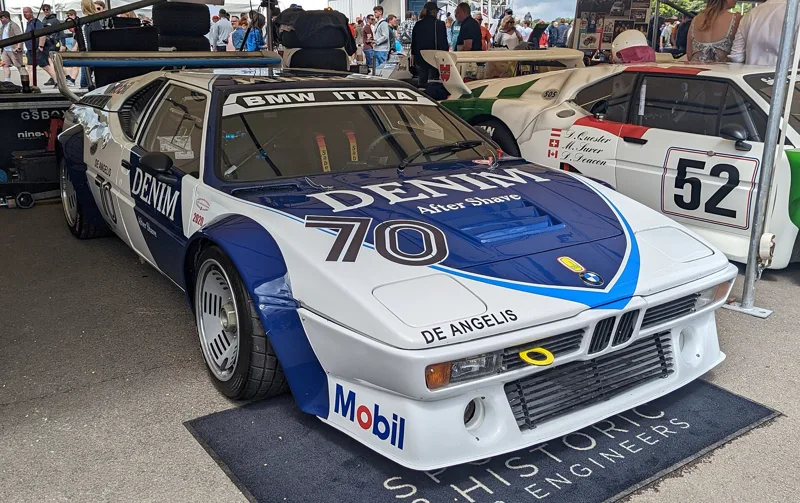
The Group 5 version of the BMW 320 replaced the 3.0 CSL in 1977 and was nicknamed the Flying Brick for its blocky body. Its Formula Two engine was tuned to 225 kW (302 bhp) by BMW Motorsport, and the car was developed in just over 12 weeks.
The Group 5 320 won its first race at Zolder in 1977, with Marc Surer at the wheel. It later took the 1981 and 1982 Guia Race of Macau. There was no BMW M3 for the E21 generation, but several limited editions were built on the 323i.
The McLaren team also ran the Group 5 320 in the American IMSA series. The BMW Junior Team's drivers included Manfred Winkelhock, Eddie Cheever and Marc Surer, who helped spread the car's reputation on the track.
Why did the E21 matter for later BMWs?
The E21 set the pattern for the 3 Series, pairing a compact two-door body with a range of economy and performance engines. Its angled cockpit and instrument layout became part of BMW's interior philosophy, and the nameplate carried on through the E30 that followed in 1982.
Enthusiasts point to the balance of usability and driving feel as the reason the model caught on. The sporty two-door shape and the 323i's six gave the range a clear flagship, while the four-cylinder cars covered everyday use.
Frequently asked questions
When did the E21 go out of production?
The E21 ended production in December 1983, after running from June 1975. It was replaced by the E30 3 Series in 1982, and the last E21 cars were built alongside the early E30 models.
How quick was the BMW 323i?
The 323i covered 0-100 km/h in 8.7 seconds, peaking at 190 km/h (118 mph). The 1977 launch figures for the same model listed 105 kW (141 hp) and a top speed of 200 km/h (124 mph).
Was there an M3 version of the E21?
No. BMW did not build an M3 on the E21 platform. Several limited-edition models were built on the 323i, which had the largest engine in the range.
How many TopCabriolets were made?
A total of 4,595 TopCabriolets were manufactured by Baur, with production running from 1978 until 1981. They were sold through the BMW dealership network with the BMW warranty.