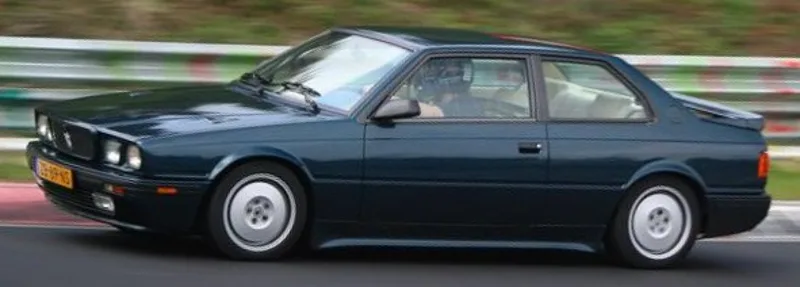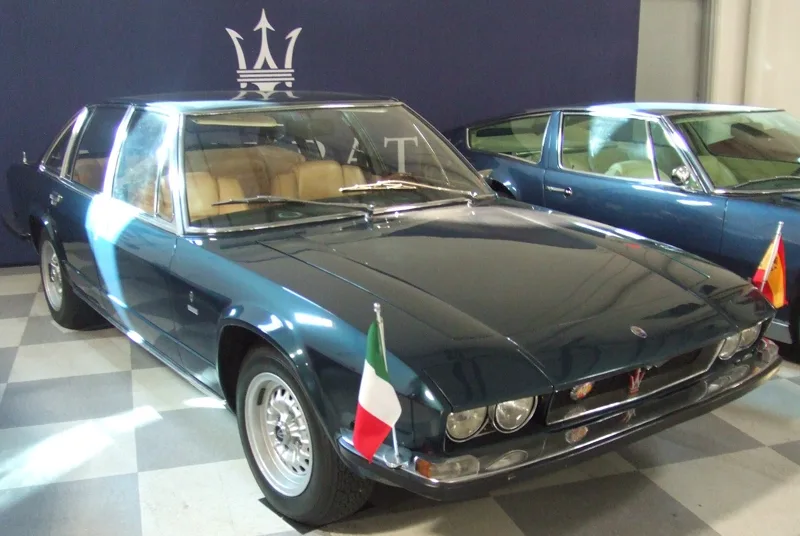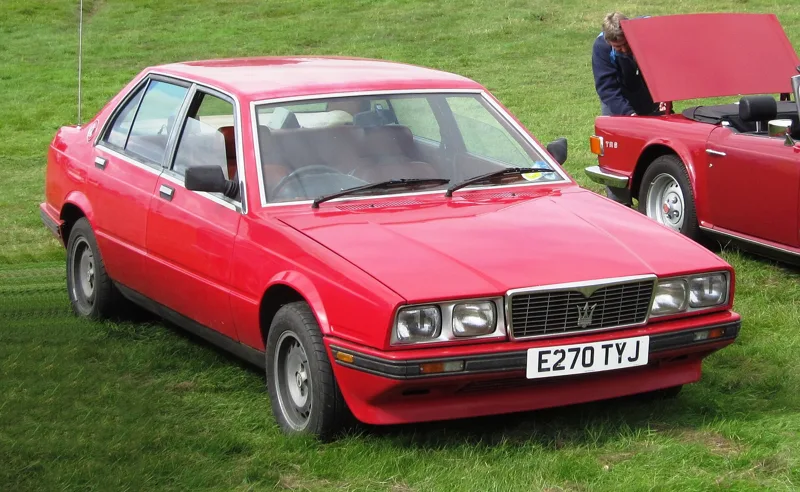
A borrowed De Tomaso chassis, Maserati's own eight-cylinder engines and almost 2,200 saloons built between 1979 and 1990.
The Maserati Quattroporte III was a saloon built from 1979 to 1990 on a De Tomaso Deauville chassis. It used 4.2-litre and 4.9-litre eight-cylinder engines, and about 2,200 were built, making it Maserati's most-built model before the Biturbo era.
The Maserati Quattroporte III was a large saloon built from 1979 to 1990 on a chassis borrowed from the De Tomaso Deauville. It used Maserati's own eight-cylinder engines inside a body drawn by Giorgetto Giugiaro. With the Kyalami coupe it was the first Maserati model created after Alejandro de Tomaso took control of the company, and across 13 production years it became the most-built Maserati before the Biturbo era.
Behind that run lay a long chain of owners and abandoned plans. Citroen had bought Maserati in 1967, and its four-door successor to the Quattroporte I never reached series production. The Quattroporte III was the next attempt to fill that gap.
Where did the Quattroporte III come from?
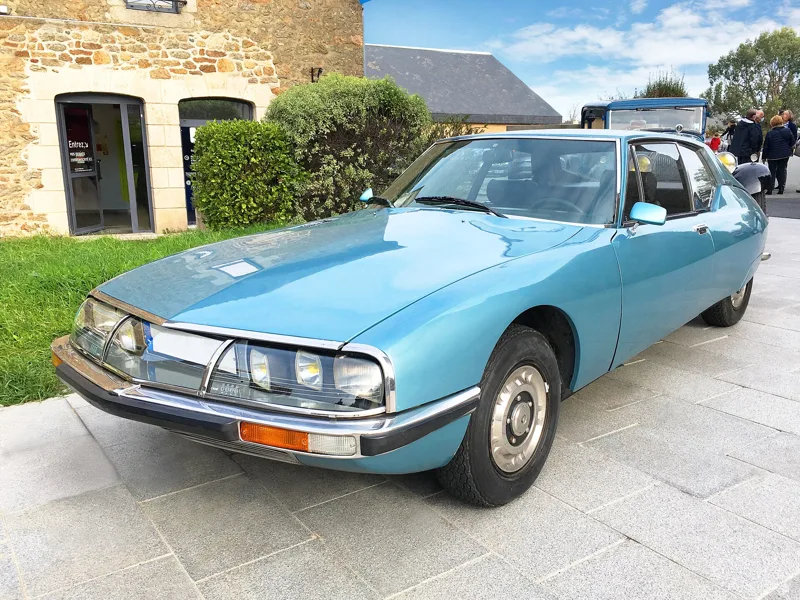
The Quattroporte III grew out of a sequence of attempts to replace the Quattroporte I, which had been on sale since the autumn of 1963 and was built until the end of 1970. Early in its life the car had sold well, but by its final years it looked outdated. Citroen's answer was the Quattroporte II, a front-drive four-door based on the Citroen SM coupe introduced in summer 1970, and it used the SM's six-cylinder engine.
The Quattroporte II was shown at the Paris Motor Show in October 1974, but it never went into series production. When Alejandro de Tomaso took over Maserati in August 1975, somewhere between five and 13 of the cars had been built. He dropped further work on the model at once. He still believed in a market for expensive sporting saloons, but he wanted the Citroen legacy gone as soon as possible.
A chassis borrowed from De Tomaso, Maserati's own eight-cylinder engines and a body later described as monolithic.
Why did De Tomaso reuse a chassis from another car?
De Tomaso needed a new Maserati quickly to show that the company could act. A fresh saloon from scratch would have taken too long, so he drew on parts already inside his own group. The Kyalami, shown in March 1976, had followed the same route. For the Quattroporte successor, the chassis of the De Tomaso Deauville saloon became the technical base, changed only slightly.
The Deauville floor pan and chassis were used completely. The wheelbase was lengthened by 30 mm (1.2 in), and that was the main difference. Front and rear, the car used wishbones and coil springs, which set it apart from the Quattroporte I with its rigid rear axle and leaf springs. The rear arrangement was essentially a copy of the Jaguar XJ's.
The chassis also brought four Girling disc brakes and power-assisted ZF rack-and-pinion steering as standard. From 1984 a Gleason limited-slip differential with a variable locking effect was fitted, and Maserati became the first car maker to offer that design in a series production car.
What engines powered the Quattroporte III?
The Quattroporte III used only eight-cylinder engines, each with four overhead camshafts. Four Weber twin-barrel carburettors mixed the fuel, and petrol injection was never offered during the production period. The engines differed mainly in displacement and compression, and the smaller unit was the one the car started with.
For the first three production years the 4.2-litre (256.3 cu in) engine was the base unit. It produced 255 PS (252 hp) at first and 246 PS (243 hp) later. The 4.9-litre (299.0 cu in) version was available for the whole production run, and from 1982 it was the only engine offered. Until summer 1986 it produced 282 PS (278 hp), and then compression was raised so that output reached 300 PS (296 hp) in the Royale.
Power went through a five-speed manual ZF gearbox at first. From 1981 a three-speed TorqueFlite automatic from Chrysler was offered as an alternative, and 85% of all customers ordered it.
Specifications at a glance
| Specification | Detail |
|---|---|
| Production | Summer 1979 to end of 1990 |
| Factory designation | Tipo AM 330 |
| Chassis | De Tomaso Deauville, wheelbase 30 mm longer |
| Engine (base) | 4.2-litre (256.3 cu in) eight-cylinder, four overhead camshafts |
| Power (4.2-litre) | 255 PS (252 hp), later 246 PS (243 hp) |
| Engine (larger) | 4.9-litre (299.0 cu in), only engine from 1982 |
| Power (4.9-litre) | 282 PS (278 hp) to 1986; 300 PS (296 hp) in the Royale |
| Fuel system | Four Weber twin-barrel carburettors |
| Gearbox | Five-speed ZF manual; three-speed TorqueFlite automatic from 1981 |
| Brakes | Four Girling discs |
| Output | 2,088 Quattroporte III to mid-1986; 53 Royale to 1990 |
How was the body built and styled?
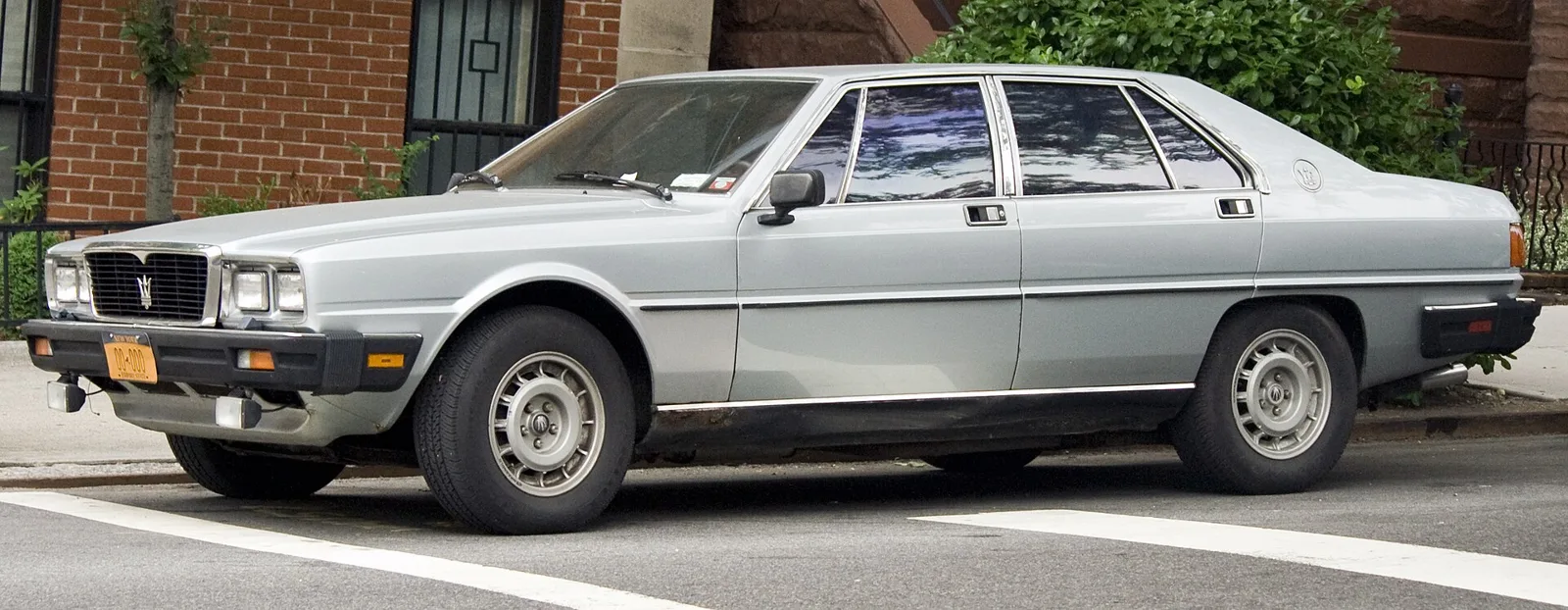
The body was a self-supporting steel structure, designed by Giorgetto Giugiaro. His starting point was his own Maserati Medici concept, which had shaped a generation of cars in the 1970s, from the VW Golf I to the Lancia Delta and the DeLorean DMC-12. The Quattroporte III carried the Medici's taste for straight lines, with a trapezoidal passenger cell and a tall nose.
Innocenti in Milan built the bodyshell. That works specialised in small cars and had belonged to the De Tomaso group since 1975. Sheet metal came from the pressing specialists Silver Car and its successor, Golden Car, in Caramagna Piemonte, and parts of the finishing were done by hand.
The front was dominated by two square twin headlamps borrowed from the Fiat 125 and a chromed grille. High, wide rear lights completed the look. Volkswagen later borrowed that rear arrangement for its Passat derivative, the Santana. The shape has since been called massive, defiant or monolithic. Inside, the seats were leather, brown at first and joined by white from 1986, and wood trim covered the dashboard and parts of the doors.
What made the Royale different?
The Maserati Royale, produced from summer 1986, was very close to its predecessor both outside and in its engineering. The main mechanical change was an increase in compression to 9.5:1, which lifted output to 300 PS (296 hp). The factory also fitted a refrigerator for rear passengers and picnic tables that folded out of the door trims. The seats were more heavily padded than in the Quattroporte III, according to the maker.
How many Quattroporte IIIs were made?
Between summer 1979 and mid-1986 Maserati built 2,088 Quattroporte III cars, of which 51 had the 4.2-litre engine. From summer 1986 to the end of 1990 it made 53 of the revised Royale. Across 13 production years the total came to almost 2,200 cars, and most were sold in the USA, as De Tomaso had predicted.
The car no longer had a unique position by the time it was on sale. The Mercedes 450 SEL 6.9 and the Jaguar XJ 12 offered similar performance and the refinement of the larger series. Later, the Quattroporte and Royale faced the Bentley Mulsanne and the Aston Martin Lagonda.
Which special versions were built?
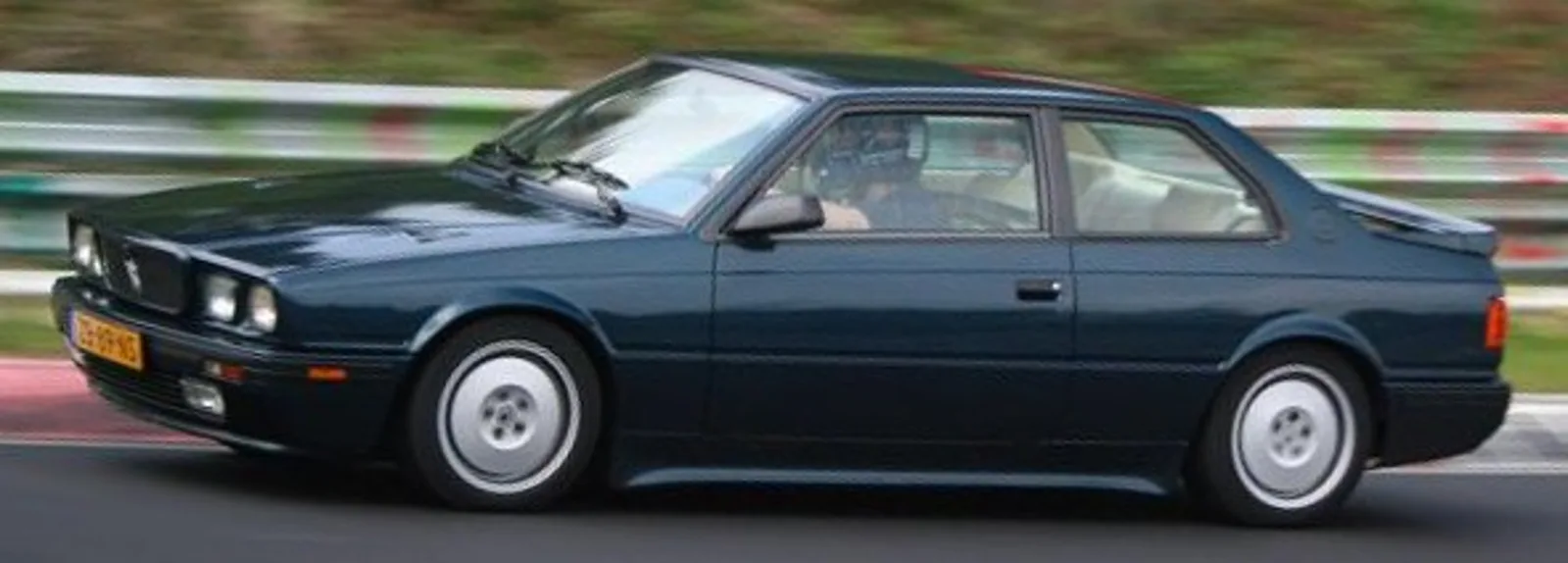
The Carrozzeria Pavesi in Milan armoured several Quattroporte saloons in the early 1980s, and the buyers were mostly Italian politicians, one of them the head of state. Pavesi also turned two, or by some accounts three, cars into two-door coupes by welding up the rear door and leaving the roofline unchanged.
The Turin coachbuilder Autocostruzioni S.D., also known as Diomante, showed a version 650 mm (25.6 in) longer in 1986, with an upgraded interior. Diomante built a handful of these saloons, which were priced at 210 million lire.
How did the motoring press judge it?
The American magazine Road and Track was among the first to drive the car, in spring 1981. Its testers praised the road holding, the performance and the steering, and they called the Quattroporte III one of the most comfortable touring cars they had driven. They set its interior against the sterile, high-tech cabins of German luxury cars, and their verdict was that Mercedes was Wagner while Maserati was Vivaldi.
Two years later auto motor und sport tested a Quattroporte III. It praised the handiness of the car and criticised its heavy fuel use. The magazine added that a closer acquaintance with the Quattroporte made its technical shortcomings look different, because the things that made it appealing lay elsewhere.
Who drove one?
Sandro Pertini used a Quattroporte III as an official car during his presidency. Malcolm Forbes, Luciano Pavarotti and Peter Ustinov were also among the well-known drivers of the model.