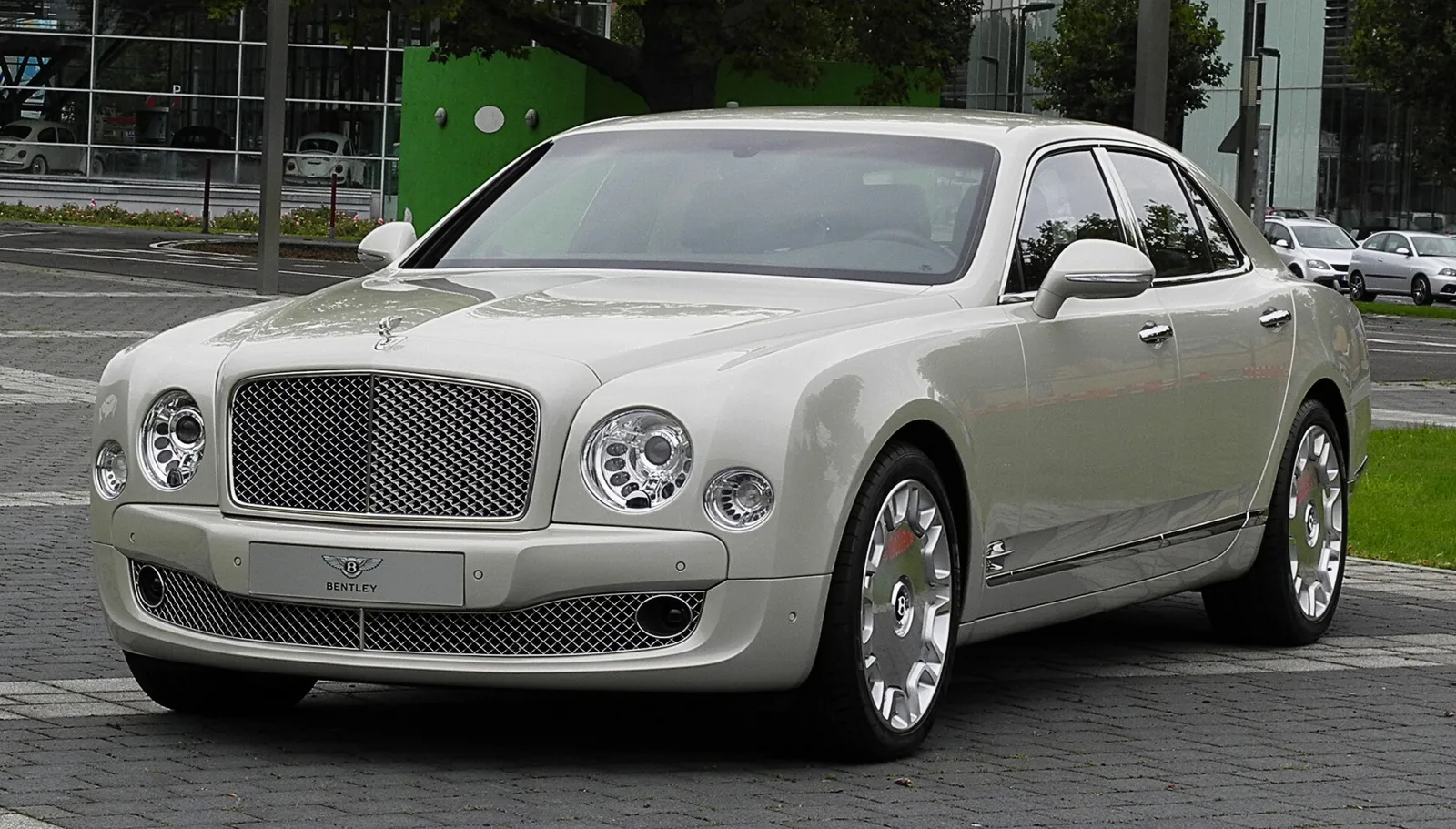
Bentley's flagship for a full decade, the Mulsanne carried a 6.75-litre twin-turbo V8 with roots in 1959 and a long run of hand-finished special editions.
The Bentley Mulsanne was a full-size luxury car built by Bentley Motors from March 2010 to June 2020, serving as the brand's flagship throughout. It used a 6.75-litre push-rod twin-turbo V8 carried over largely from the Arnage, and its Speed version produced 395 kW (530 hp; 537 PS).
Bentley's flagship saloon ran for a full decade, starting with deliveries in England in September 2010. It replaced the Rolls-Royce-based Arnage and was the first Bentley independently built since the 8 Litre conceived by W.O. Bentley in 1930.
Where did the Mulsanne come from?
Development began in June 2005 under the codename Project Kimberley, and the team called the car The Grand Bentley internally. The project name was inspired by a diamond found in South Africa.
The car debuted at the 2009 Pebble Beach Concours d'Elegance before it appeared at the 2009 Frankfurt Motor Show and the 2010 North American International Auto Show.
Chassis 00001, the first car, sold at the 2009 Gooding and Company Pebble Beach auction for US$500,000, months before deliveries began in England. It served as Bentley's flagship for its whole production run, from the first deliveries in England in September 2010 to the last cars built in 2020.
Bentley's flagship for a decade, built around a V8 that traced its roots back to 1959.
How was the Mulsanne styled?
The Mulsanne was styled by Belgian designer Dirk van Braeckel, with the interior led by British designer Robin Page. Its shallow V-shaped hood and locomotive-style shoulders were inherited from the 2008 Brooklands coupe, and the four-door body came in short and extended wheelbase versions.
The design was frozen in the winter of 2007, following board selection in September 2007. An earlier board presentation in March 2006 had led to two full-scale clay proposals, and hand clay modelling was crucial to the car's sculptural quality.
Hand clay modelling is the traditional way a designer shapes a surface at full scale before digital tools take over, and it explains much of the Mulsanne's sculpted look.
The design team comprised senior designer Crispin Marshfield, designer Gareth Thomas and junior designer Vitalis Enns. Over a year they refined the design through clay and digital iterations, and the headlamps were designed to resemble the Jaguar S-Type of the 1960s.
What was the Mulsanne's interior like?
The cabin offered four-zone climate control, 14-way heated front seats and an eight-inch touchscreen with a 14-speaker stereo. Standard equipment included 20-inch wheels, air suspension and soft-close doors.
Four-zone climate control lets each part of the cabin hold its own temperature, so front and rear occupants can choose different settings.
The Premier and Entertainment specifications show how buyers could tailor the cabin, from decorative details to rear-seat technology, while keeping the same basic car underneath.
The Premier Specification added a flying B decoration, two umbrellas and a valet key. The Entertainment Specification added 10.4-inch rear tablets and a Naim sound system.
Electric privacy curtains were standard on the Extended Wheelbase, which was unveiled in 2016 with 250 mm (10 in) more rear legroom.
What engine powered the Mulsanne?
The 6.75-litre push-rod twin-turbocharged V8 was carried over largely from the Arnage, and it was developed with Rolls-Royce. Standard output was 377 kW (505 hp; 512 PS) and 1,020 N m (752 lb ft) of torque.
A push-rod V8 operates its valves through pushrods driven by a camshaft in the engine block, an older layout than the overhead-cam designs that became common later. The Mulsanne's 6.75-litre unit was introduced in 1959 and updated in 2010.
Twin turbochargers force extra air into the engine, which is how a V8 of this size reached its torque figures. Clarkson's praise for the torque in his review shows how much that delivery mattered to the car's character.
Engine revisions cut 6 kg (13 lb) with a new crankshaft, and the pistons and gudgeon pins were coated with diamond-like carbon.Piston skirts were coated with graphite to reduce friction. The V8 could not be updated further to meet CO2 emission rules, and production ended on 25 June 2020 with no replacement planned.
How fast was the Mulsanne Speed?
The Speed version produced 395 kW (530 hp; 537 PS), with 1,100 N m (811 lb ft) available at its peak. It reached 0-97 km/h in 4.8 seconds, 0.3 seconds faster than the standard car, and its top speed rose about 3.4%, from 296 to 306 km/h (184 to 190 mph).
A redesigned combustion system delivered a 13% efficiency gain on the Speed, and the car added a Sports mode for the suspension.
The Mulliner Driving Specification added 21-inch wheels and sport-tuned suspension to the range. It gave buyers who wanted a firmer character a further option on top of the Speed.
How big was the Mulsanne?
The Mulsanne had a drag coefficient of 0.33 and a boot of 443 to 446 L (15.6 to 15.8 cu ft). The longer wheelbase version added rear space for passengers, and the boot figures stayed close across the range.
Soft-close doors use a damped mechanism to draw the door shut gently without a hard slam. Air suspension uses air springs in place of steel coils, which allows the ride to be tuned to the road.
A drag coefficient of 0.33 describes how cleanly the body moves through the air, and a low figure helps with stability at speed and with efficiency on long journeys.
Motor Trend criticised the boot as below expectations for its size.
The Grand Limousine by Mulliner arrived in 2016 and was 1,000 mm (39 in) longer than the standard car.
How was the Mulsanne built?
Each car took about 400 hours to produce, while output stayed at nine cars per week on the line, and a team of 298 Bentley employees worked on each unit. The factory produced nine cars per week, and the body in white used 5,800 welds.
Wood veneers were sliced from a steamed root burl into 0.6 mm sheets. Each wood part received five layers of lacquer and a 72-hour cure, and the hand-assembly area was staffed by 120 employees.
The inspection process is detailed by design, with a 500 to 650-point checklist working through hundreds of checks on each car before it can leave the line.
Customers could choose from over 120 exterior paint colours. The wiring loom ran to 3.2 km (2 mi) and weighed 50 kilograms (110 lb), and quality inspection was carried out against a 500 to 650-point checklist.
Around 4,000 employees contributed to the Mulsanne, and the production line was built around the hand-finished details that defined the car.
What special editions did Bentley build?
Bentley produced a long run of special editions, including the Diamond Jubilee Edition of 2012 with 60 units and the Birkin Edition of 2014 with 22 units for Europe. The Le Mans Edition of 2013 was limited to 48 units per model for North America.
The 2013 Seasons Collector's Editions had 10 units per season plus one Golden Pine. The Mulsanne 95 in 2014 had 15 units for the UK, and the W.O. Edition in 2018 had 100 units.
The Executive Interior concept was shown at the 2011 Los Angeles Auto Show, and a Shaheen edition arrived from the 2013 Dubai Motor Show.
The Speed Blue Train edition in 2015 comprised four cars built for an 85-year anniversary. The Mulsanne 6.75 Edition by Mulliner in 2020 had 30 units, and five more Grand Limousine examples were announced for sale in 2021.
Why did Bentley treat weight as a selling point?
Bentley believed that a car's weight is linked to how customers perceive it, so the company treated mass as a signal of quality rather than a cost to be minimised. That view shaped the Mulsanne from the outset.
In that view, weight is part of the luxury experience, because a solid, heavy body reads as well made to the people who sit inside it. The engineers were ordered not to exceed the kerb weight of the Arnage, which set a clear limit for the new car.
How did critics and buyers view the Mulsanne?
That stance drew comment from the motoring press, and the reviews that followed split between admiration for the refinement and doubt about the philosophy behind it.
Jeremy Clarkson said the ride was quiet and the torque great, while Evo called Bentley's heavy-car philosophy a strange thing to hear from a carmaker. Clarkson criticised the number of switches and found the interior less tasteful than a Rolls-Royce Ghost.
Reviewers judging a car this size often focus on refinement, and the Mulsanne earned its praise on that count, particularly for its quiet ride.
The Flying Spur succeeded the Mulsanne as the flagship.
Did the Mulsanne race or appear at events?
The Mulsanne competed in the 2012 Goodwood Festival of Speed hill climb and served as the official parade car for the 2012 Nurburgring 24 Hour race. Its appearances were largely ceremonial and promotional rather than competitive.
A Breitling for Bentley B04 GMT watch was launched alongside the Seasons edition of the car.
Limited editions are usually numbered and sold at a premium, which helps explain why the small runs in this list were so sought after. The number of units in each edition shows how the brand managed scarcity, with runs from four cars to 100.
The 1000th Chinese Mulsanne customer was announced at the 2013 Guangzhou show, which underlined the car's popularity in China.
Parade and demonstration roles are a common way for flagship cars to appear at events, giving a model visibility without a competitive programme behind it.
What are the Bentley Mulsanne specifications?
The Mulsanne's core figures are a 6.75-litre twin-turbo V8 with 377 kW (505 hp; 512 PS) in standard form and 395 kW (530 hp; 537 PS) in Speed guise. Its aerodynamic and luggage figures are set out in the table below.
| Specification | Detail |
|---|---|
| Production | March 2010 to June 2020 |
| Engine | 6.75-litre push-rod twin-turbo V8 |
| Standard output | 377 kW (505 hp; 512 PS), 1,020 N m (752 lb ft) |
| Speed output | 395 kW (530 hp; 537 PS), 1,100 N m (811 lb ft) |
| Speed 0-97 km/h | 4.8 seconds |
| Speed top speed | 306 km/h (190 mph), up from 296 km/h (184 mph) |
| Drag coefficient | 0.33 |
| Boot | 443 to 446 L (15.6 to 15.8 cu ft) |
| Extended Wheelbase rear legroom | 250 mm (10 in) more |
| Grand Limousine length | 1,000 mm (39 in) longer |
| Production rate | Nine cars per week |
,_30._August_2011,_D%C3%BCsseldorf.jpg)