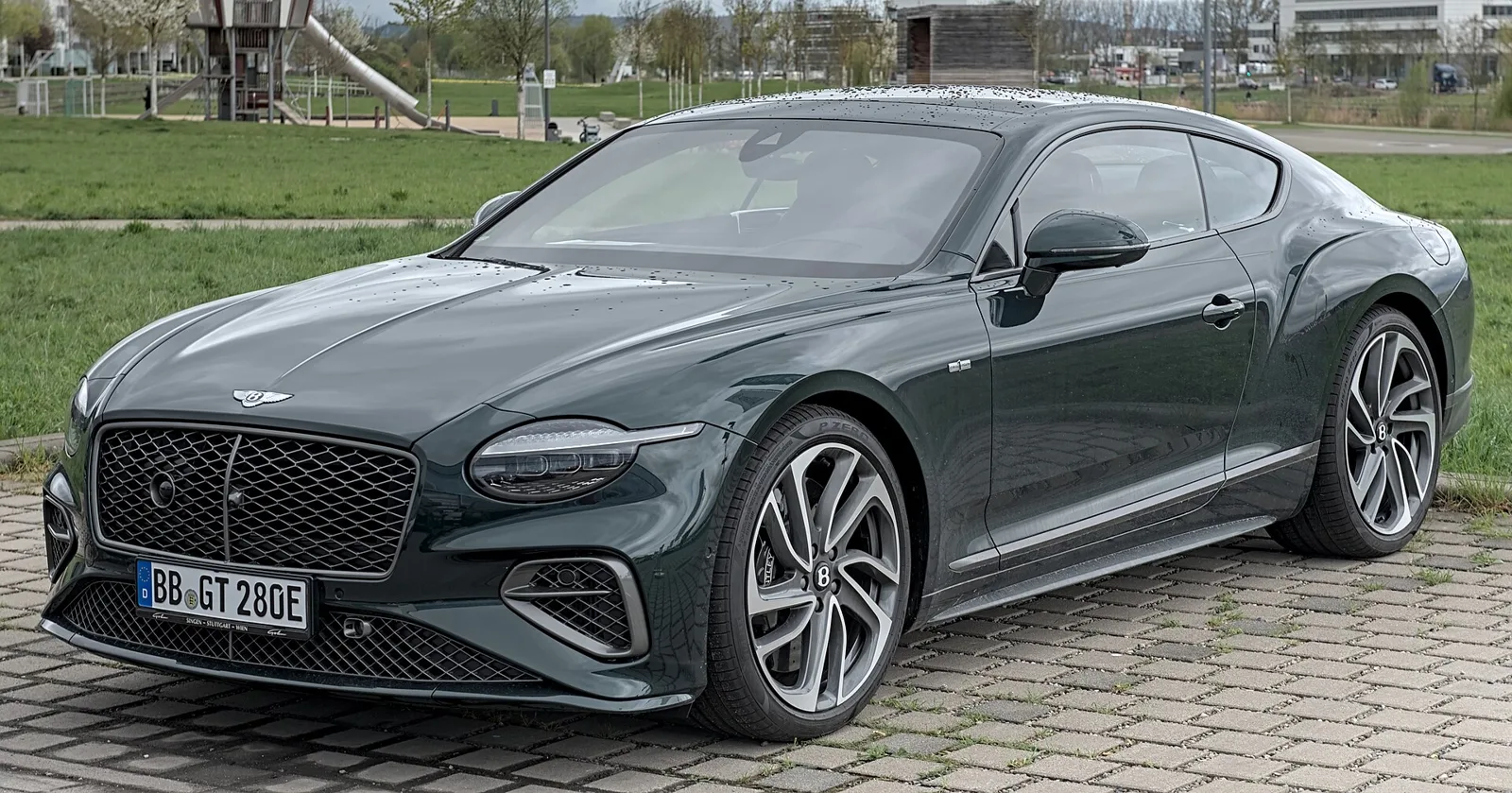
From the 2002 Paris debut to the hybrid V8 of 2024, the Continental GT has carried Bentley's coupe and convertible line through four generations.
The Bentley Continental GT is a four-seat grand tourer built by Bentley Motors since 2003, offered as a coupe or convertible. It was the first new Bentley after Volkswagen bought the company and was the marque's first mass-produced model. Four generations later it runs a hybrid V8 in its top Speed form.
Bentley's Continental GT arrived in 2003 as a grand touring car with four seats. It came as a coupe or convertible and was built in far larger numbers than the cars that came before it. Four generations on, it remains the marque's core two-door model.
Where did the Continental GT come from?
The Continental GT grew out of the Concept Java, a convertible previewed at the 1994 Geneva Motor Show by Rolls-Royce Motors, which then owned Bentley. The concept aimed at a smaller and more affordable Bentley. The production car realised that idea in far larger volumes than the exclusive Continental R.
The Concept Java never reached production in the form shown in 1994. Thirteen cars were nonetheless made for the Sultan of Brunei from that design. At the time the Continental R cost 180,000 pounds in the UK, and it sold only 200-300 units a year to a very select market.
Four generations on, the Continental GT is still Bentley's grand tourer, now with hybrid power.
Why did the first car matter to Bentley?
The first Continental GT was the first new Bentley after Volkswagen AG acquired the company in 1998. It was also the first Bentley built with mass production techniques, even though much of the car is still hand assembled. Its launch price was less than half the price of the Continental R.
Bentley aimed the car at a wider customer base than its predecessor could reach. Its design also set a lasting signature, with fixed front quarter glass and no B pillar, a feature carried through every generation. The dashboard clock came from Breitling, which Bentley commissioned in 2002.
The model also found famous owners. American musician Prince owned a 2006 Continental GT Coupe in Baby Blue, and after his death in April 2016 the car went on permanent display at his Paisley Park complex.
What did the first-generation car offer?
The first-generation car used a 6.0 litre twin-turbo W12 rated at 560 PS (412 kW; 552 bhp) at 6,100 rpm. Its 650 Nm (479 lbf ft) of torque arrived between 1,600 and 6,100 rpm, and Torsen-based four-wheel drive was standard. Bentley claimed 0-100 km/h in 4.8 seconds and a top speed of 318 km/h (197.6 mph).
Early models offered 6 body colours and 8 hide colours, which gave buyers a wide range of combinations. A 2008 model year update cut kerb weight by 35 kg (77 lb), a meaningful saving for a car of this size.
How did the Speed and Supersports differ?
The Continental GT Speed raised output to 608 PS (447 kW; 600 bhp) and 750 Nm (553 lb ft) of torque. The Supersports went further, with 630 PS (463 kW; 621 bhp), 800 Nm (590 lbf ft) and a claimed 0-100 km/h time of 3.7 seconds. Its top speed was 330 km/h (205.1 mph).
The Supersports was the first Bentley able to run on E85 ethanol. It used carbon ceramic brakes and weighed 110 kilograms (243 lb) less than the Speed, while its Quickshift automatic cut shift times by 50%.
Bentley claimed 1.29 g of lateral grip for the Supersports, against 0.98 g for the Speed. The US price of the Supersports was approximately US$270,000, which placed it far above the standard coupe.
What changed in the second generation?
The second generation arrived with the W12 Coupe, unveiled at the 2010 Paris Motor Show. A V8 joined the range later, developed jointly with Audi. The 2015 W12 was revised to 590 PS (434 kW; 582 hp) and 720 Nm (531 lb ft).
The convertible roof of the GTC was produced by Karmann in Osnabruck, Germany. The Speed Coupe produced 616 hp (459 kW; 625 PS) and reached 0-97 km/h in 4.0 seconds.
Was the V8 a fuel-saving alternative?
Yes, in economy terms. The 4.0 litre twin-turbo V8, developed jointly with Audi, produced 500 hp (373 kW) and 660 Nm (487 lb ft), and its fuel economy rose from 17.1 mpg for the W12 to 26.1 mpg. Bentley put the improvement at 40%.
The V8 was not a compromise in performance. The GT V8 S later raised power to 528 PS (388 kW; 521 hp), with 680 Nm (502 lb ft) of torque, giving the V8 a sharper edge in the range.
What was the 2017 Continental Supersports?
The 2017 Continental Supersports was a W12 version with 710 PS (522 kW; 700 hp) and 1,017 Nm (750 lb ft) of torque. Bentley built 710 Supersports in total in the second generation's final years, and the name would return later.
The Supersports badge returned in 2026 with 666 PS (657 bhp) and 800 Nm, and the car weighs 2,000 kg (4,409 lb). Only 500 units are to be made globally.
What did the third generation bring?
The third generation was unveiled at the 2017 Frankfurt Motor Show and went into production in 2018 with a base price of 156,700 pounds. It shares the MSB platform with the second-generation Porsche Panamera and is built on a longer wheelbase.
The body is over 80 kg (176.4 lb) lighter than before, and its wheelbase is 135 mm (5.3 in) longer. It is also the first production car with an entire body side made by Super Forming.
The W12 was a 6.0 litre TSI engine first launched in the Bentayga in 2016. In this form it produced 635 PS (626 hp) and 900 Nm (664 lb ft), with manufacturer figures of 3.7 seconds for 0-100 km/h, and its top speed reached 333 km/h (207 mph).
The V8 used a 4.0 litre twin-turbo layout producing 550 PS (542 hp) and 770 Nm (568 lb ft). It reached 0-60 mph in 3.9 seconds, and its top speed was 319 km/h (198 mph). The GTC has been the largest serial convertible in the world since 2023.
Which special editions were built?
Several limited runs stand out. The Diamond Series of 2007 was capped at 400 units to mark Crewe's 60th anniversary, and the 80-11 Editions of 2010 were limited to 80 units per model for North America. The Le Mans Edition of 2013 was made in 48 units per model.
The GT3-R followed in 2014 as a 300-unit run, priced at US$337,000 in the US. Each limited run came with its own design details, from badges and paint to upholstery, which kept small batches feeling distinct.
What are the Mulliner models?
Mulliner, Bentley's bespoke division, produced the Bacalar and Batur. The Bacalar was a 12-unit model with 659 PS (485 kW; 650 hp) and 22-inch wheels, while the Batur was limited to 16 convertibles and 18 coupes. Both cars were built on the Continental GT's underpinnings.
The Batur was the last new Bentley to use the W12. The coupe made 740 PS (544 kW; 730 hp) and reached 0-100 km/h in 3.3 seconds, with a top speed of 336 km/h (209 mph). Its base price was around 2.1 million USD.
How did the Continental GT perform on ice and track?
In 2007 Juha Kankkunen drove a Continental GT Speed on the Baltic Sea to an ice speed record, averaging 321.6 km/h (199.83 mph) over the flying kilometre. Bentley returned to the ice in February 2011 with a Supersports Convertible that reached 331 km/h (205.67 mph).
On the track, the Continental GT3 race car used a 4.0-litre twin-turbo V8 producing 608 PS (447 kW; 600 hp). Bentley entered the Blancpain GT Series from 2014, and the car finished fourth at the Gulf 12 Hours. The Blancpain GT Sprint title followed in 2015, while the Endurance series ended with second place, 3 points short of the title.
The Continental GT3 won the 2020 Liqui-Moly Bathurst 12 Hour, before Bentley retired the programme after the 2021 season.
What is the fourth-generation Continental GT?
The fourth generation debuted with the GT Speed at the 2024 Goodwood Festival of Speed. It replaced the W12 with a twin-turbo Ultra Performance Hybrid V8 making 782 PS (771 bhp) and 1,000 Nm (738 lb ft), which takes the car to 100 km/h in 3.2 seconds.
The hybrid car weighs 2,459 kg (5,421 lb), largely because of a 25.9 kWh battery mounted behind the rear axle. Manufacturer figures give an electric-only range of 81 km (50 mi). Its single headlight arrangement is the first on a Bentley since the 1959 Bentley S2.
The base model was unveiled on 8 April 2025 with 680 PS (671 bhp) and 930 Nm, using a derated version of the Speed's hybrid V8. It keeps the same exterior look as the rest of the range.
What are the Continental GT specifications?
The table sets out the headline figures for each generation, with metric values first and imperial in brackets. Figures are Bentley's manufacturer claims unless noted, so they are best compared as a guide rather than as independent test results for each car.
| Specification | Detail |
|---|---|
| Launch engine | 6.0 L twin-turbo W12, 560 PS (412 kW; 552 bhp) at 6,100 rpm |
| First-generation performance | 4.8 seconds 0-100 km/h; 318 km/h (197.6 mph) top speed |
| Supersports (first generation) | 630 PS (463 kW; 621 bhp), 800 Nm (590 lbf ft); 3.7 seconds 0-100 km/h; 330 km/h (205.1 mph) |
| Second-generation V8 | 4.0 L twin-turbo, 500 hp (373 kW), 660 Nm (487 lb ft); 17.1 mpg (W12) against 26.1 mpg (V8) |
| Supersports 2017 | 710 PS (522 kW; 700 hp), 1,017 Nm (750 lb ft); 710 units built |
| Third-generation W12 | 6.0 L TSI, 635 PS (626 hp), 900 Nm (664 lb ft); 3.7 seconds 0-100 km/h; 333 km/h (207 mph) |
| Third-generation V8 | 4.0 L twin-turbo, 550 PS (542 hp), 770 Nm (568 lb ft); 0-60 mph in 3.9 seconds; 319 km/h (198 mph) |
| Fourth-generation hybrid V8 | 782 PS (771 bhp), 1,000 Nm (738 lb ft); 3.2 seconds 0-100 km/h; 81 km (50 mi) electric range |
| Base model | 680 PS (671 bhp), 930 Nm; unveiled 8 April 2025 |
| Supersports 2026 | 666 PS (657 bhp), 800 Nm, 2,000 kg (4,409 lb); 500 units |
Frequently asked questions
How quick was the first Continental GT?
The first-generation car was claimed at 4.8 seconds for 0-100 km/h, and it topped out at 318 km/h (197.6 mph). The Speed version of the same period produced 608 PS (447 kW; 600 bhp), and the Supersports claimed 3.7 seconds for the same sprint.
What is the Continental GT electric range?
The fourth-generation Speed carries a 25.9 kWh battery behind the rear axle, which gives a manufacturer-claimed electric-only range of 81 km (50 mi). The hybrid V8 supplies the rest of its 782 PS (771 bhp) output.
Is there a convertible Continental GT?
Yes. Every generation has offered a convertible alongside the coupe, under the GTC name, with the same four-seat layout. Since 2023 the GTC has been regarded as the largest serial convertible on sale.
How many Continental Supersports were built?
Bentley built 710 Supersports in total during the second generation. The 2017 car produced 710 PS (522 kW; 700 hp), while the 2026 car produced 666 PS (657 bhp), and only 500 units of the newer car are to be made.
_DSC_8518.jpg)