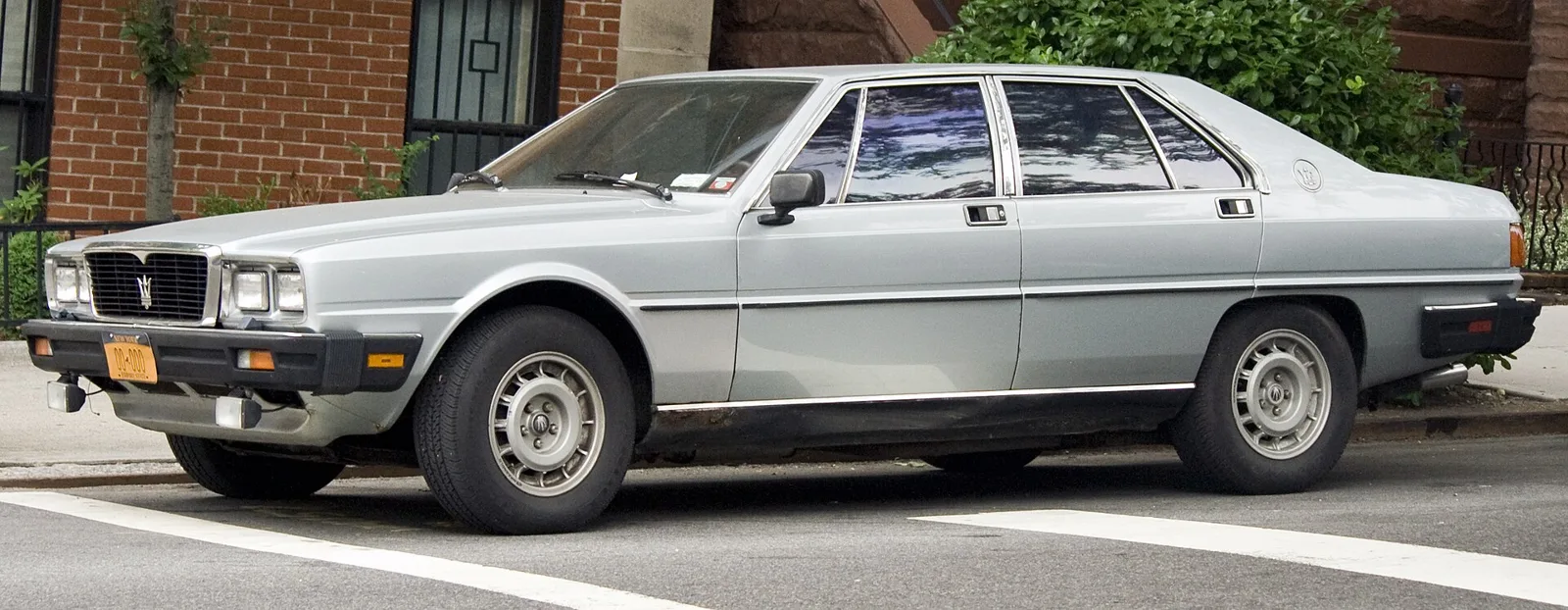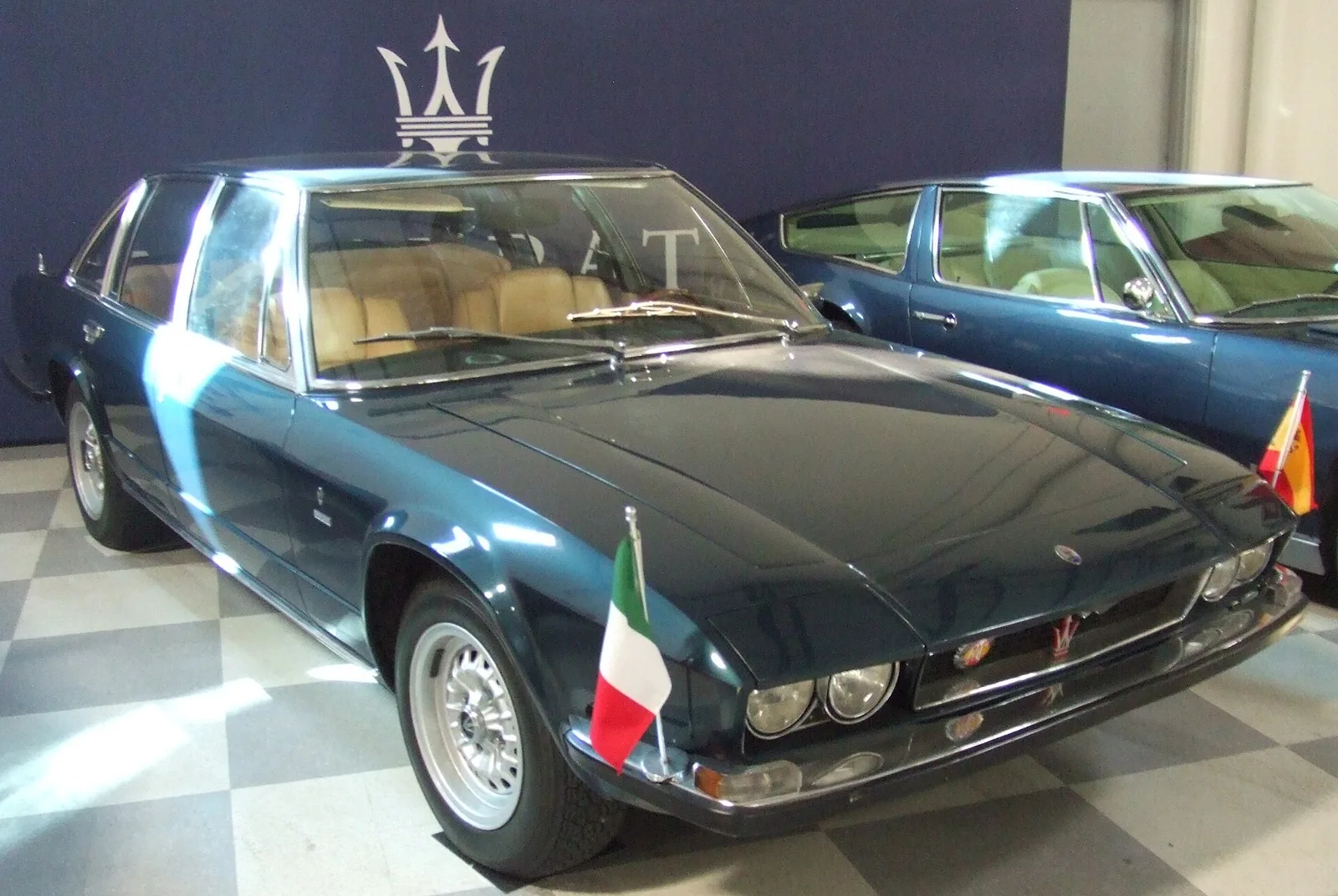
Pietro Frua's 1971 four-door concept for Maserati, which Citroen never put into series production, and the few cars built from it.
Pietro Frua styled the Maserati Quattroporte AM 121 in 1971 as a four-door concept saloon. Citroen did not put it into series production, and Frua made only two or three cars, of which two are documented in the works records.
The Maserati Quattroporte AM 121 was a large four-door sports saloon that Pietro Frua styled and first showed as a concept in 1971. Series production never came, and Frua built only two or three cars, which differ from one another in detail. Two of them are now in the hands of collectors.
Why was the Quattroporte AM 121 never put into production?
Citroen had taken over Maserati in 1968, and after the 1971 Paris show it decided against series production of Frua's design. The reasons are not clear. Some sources point to poor sales prospects for large, thirsty engines after the start of the first oil crisis in 1973.
Other sources suspect that Citroen wanted the future Quattroporte to be a four-door sister to its two-door SM, and therefore packed it with as many SM components as possible. The official successor, the Quattroporte II (Tipo AM 123), appeared in Paris in 1974 with a notchback body by Marcello Gandini for Bertone. Beneath it sat the SM's front-wheel-drive technology and its hydropneumatic suspension.
The Quattroporte II, nicknamed the big Citroen, was not put into series production either. Alejandro de Tomaso's group had taken Maserati over from Citroen in 1975, and he stopped the Quattroporte II after five, twelve or 13 cars had been built. He had a completely new Quattroporte developed, choosing a Giugiaro body and De Tomaso technology instead of Frua's design. That car, the Quattroporte III, was built from 1979 to 1990 in a four-figure total.
Pietro Frua's four-door saloon was shown in Paris in 1971, but Citroen never put it into series production.
Who initiated the project and how many cars were made?
Frua began work on a new four-door Maserati saloon in early 1971. Who started the project is unclear. Some sources assume it was Frua's own initiative, perhaps in the hope of persuading Maserati to start series production. Others name Karim Aga Khan IV as the client, and others say Maserati itself commissioned Frua to develop a successor concept.
Frua completed a prototype during 1971, and it was first shown publicly at the Paris Motor Show in October 1971. It received positive press coverage, but Citroen still declined to build it. The Quattroporte I, introduced in 1963 as the Tipo AM 107, had been sold around 770 times before its production ran down after the takeover.
Most documentation assumes that Frua built only two Quattroporte AM 121s: the 1971 prototype, AM 121.002, and a customer-commissioned car, AM 121.004, begun in 1973 and completed in 1974. One Frua biography identifies a third car, which may since have been destroyed.
What does the Quattroporte AM 121 look like?
The AM 121 is a four-door notchback saloon with five seats, a trapezoidal roof and very thin pillars. Its most unusual feature is the set of ten side windows that can each be opened separately: two in every door, front and rear, plus a large triangular pane on each side between the C and D pillars. The large glass areas led to the car being described as a light pavilion.
The front has a rectangular opening that holds four round headlights set back behind the chrome radiator mask. A flap painted in body colour covers the upper part of each light and fits into the front end when the lights are off. When they are switched on the flap rises and frees the headlights completely. The AC 429, a one-off built in 1972 on the Swiss Monteverdi High Speed 375 L, had tried a like design, and comparable ones showed up on the Iso Lele and, from 1970, the Iso Grifo.
The rear lamps came from the Alfa Romeo 1750 Berlina (second series), installed in the reverse orientation. The car was credited at its 1971 presentation with a strict elegance and at the same time sportiness. A Swiss writer saw a likeness to the Monteverdi High Speed 375/4 in 1972.
What engine and suspension did the car have?
A front-mounted, longitudinal V8 from Maserati drove the car through a manual five-speed gearbox from ZF to the rear wheels. The 1971 prototype, AM 121.002, used a 4.7-litre engine of 4,719 cc (288 cu in) rated at 290 PS (213 kW; 286 hp). The 1974 car, AM 121.004, had a 4.9-litre engine of 4,930 cc (301 cu in) producing 320 PS (316 hp).
The car's underpinnings came from the two-door Maserati Indy: its floor pan was stretched by about 22 cm (8.7 in), and the suspension was carried over as well. The front wheels had double wishbones with coil springs, telescopic dampers and an anti-roll bar. The rear was a live axle with semi-elliptic leaf springs, telescopic dampers and a further anti-roll bar.
Like the Indy, the Quattroporte used the hydraulic braking system from Citroen. The body was a self-supporting steel structure with Frua's design, built around largely unchanged technology from contemporary Maserati sports cars.
Quattroporte AM 121 dimensions and engines
| Item | Detail |
|---|---|
| Length | About 5,000 mm (196.9 in) |
| Width | 1,720 mm (67.7 in) |
| Wheelbase, AM 121.002 (Spanish papers, 1974) | 2,750 mm (108.3 in) |
| Wheelbase, AM 121.004 (French application) | 2,600 mm (102.4 in) |
| Wheelbase, prototype measured in 2003 | 2,850 mm (112.2 in) |
| Engine, AM 121.002 | 4,719 cc (288 cu in), 290 PS (213 kW; 286 hp) |
| Engine, AM 121.004 | 4,930 cc (301 cu in), 320 PS (316 hp) |
| Gearbox | Five-speed manual from ZF |
Which individual cars were built, and who owned them?
AM 121.002 was completed in October 1971 and shown in dark blue on Frua's stand at the Paris show. It had a used floor pan from an older Maserati Indy and a used engine. The Aga Khan tried to buy it from 1972, yet Maserati would not sell because the parts were second-hand. Frua therefore built a new car for the Aga Khan, which was completed in 1974 as AM 121.004.
The prototype was sold in summer 1974 to a Spanish customer, who registered it in Barcelona. Many assume the customer was the later King Juan Carlos I, though this cannot be proven. The car was repeatedly offered for sale in Barcelona until 1986, and its ownership has been documented only since 1987. In 2016 it was auctioned in the USA for 88,000 US dollars, and its whereabouts have been unknown since.
AM 121.004, the Aga Khan car, has a history documented without gaps up to 2018. Its floor pan was built at Maserati between June and November 1973, and Frua built the body in the first half of 1974. On handover the price was 30 million Italian lire (120,540 Deutsche Mark (DM) or 135,850 CHF). Frua's body accounted for 18 million of that, with the Maserati chassis taking the remaining 12 million. That made it twice as expensive as an Iso Fidia, which cost 68,000 CHF, and nearly as costly as a Mercedes-Benz 600.
Painted dark blue, the Aga Khan car was registered in France in November 1974 and was first based in Paris. In the late 1970s the Aga Khan sold or gave it to Yves St. Martin, a jockey from his stable. Several collectors and a museum in Geneva then acquired it. The most recent documented sale took place in September 2018, and the tenth owner is not publicly known.
Was there a third AM 121?
A Pietro Frua documentation records that the Frua stand at the Barcelona International Motor Show in April 1973 displayed another AM 121 beside the prototype. Because the AM 121.004 did not yet exist then, it is argued that the car shown was a third Quattroporte AM 121. It is described as silver or light blue, and is said to have been put up for sale in Spain in 1985 before burning out in a later accident.
The account is backed by a Spanish seller's statements, but it is not beyond doubt. Frua did receive further commissions in the 1970s for cars with the AM 121 body, but the works records document only 121.002 and 121.004. A blurred photo of the stand could equally show a Monteverdi High Speed 375/4.