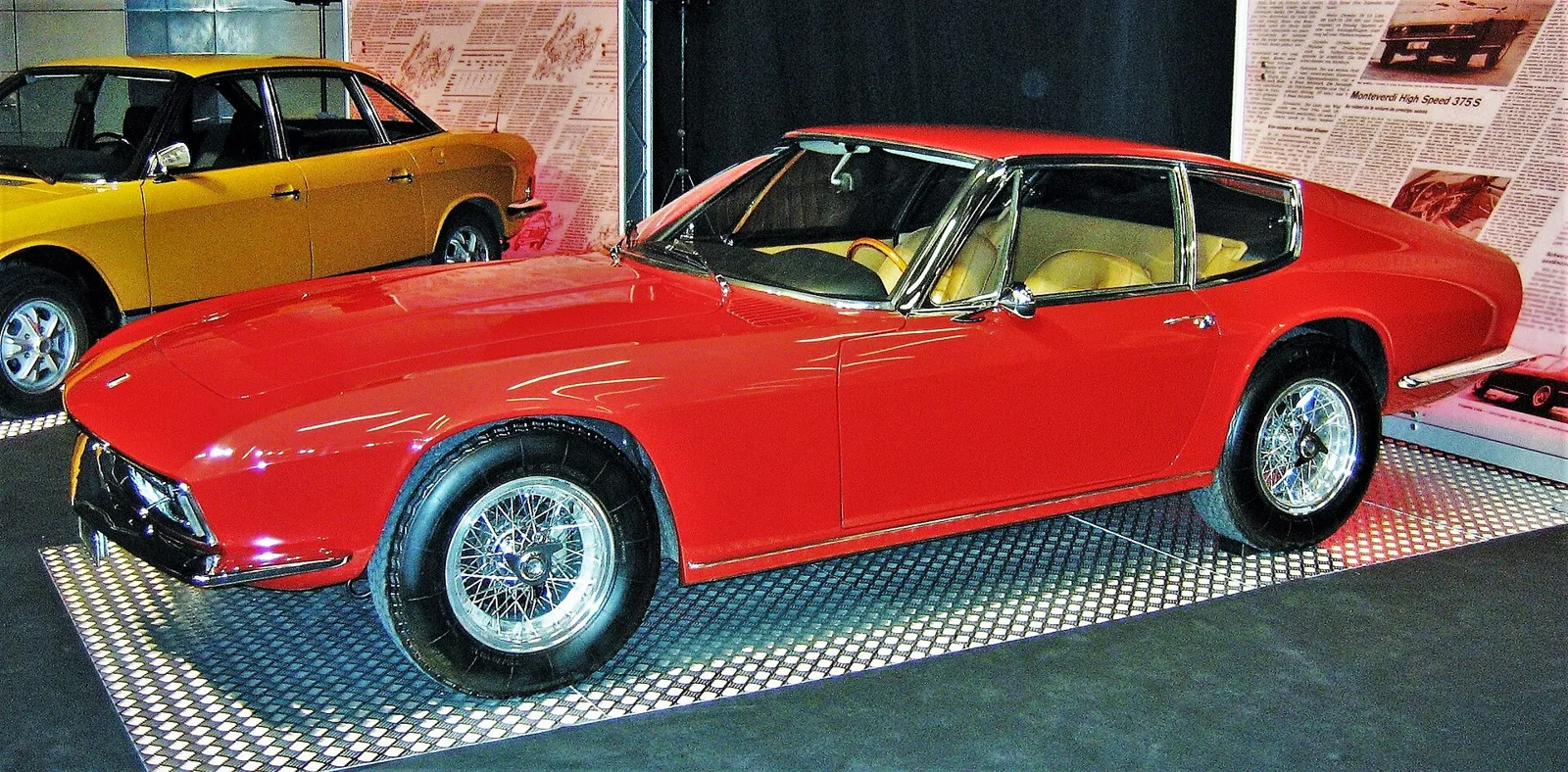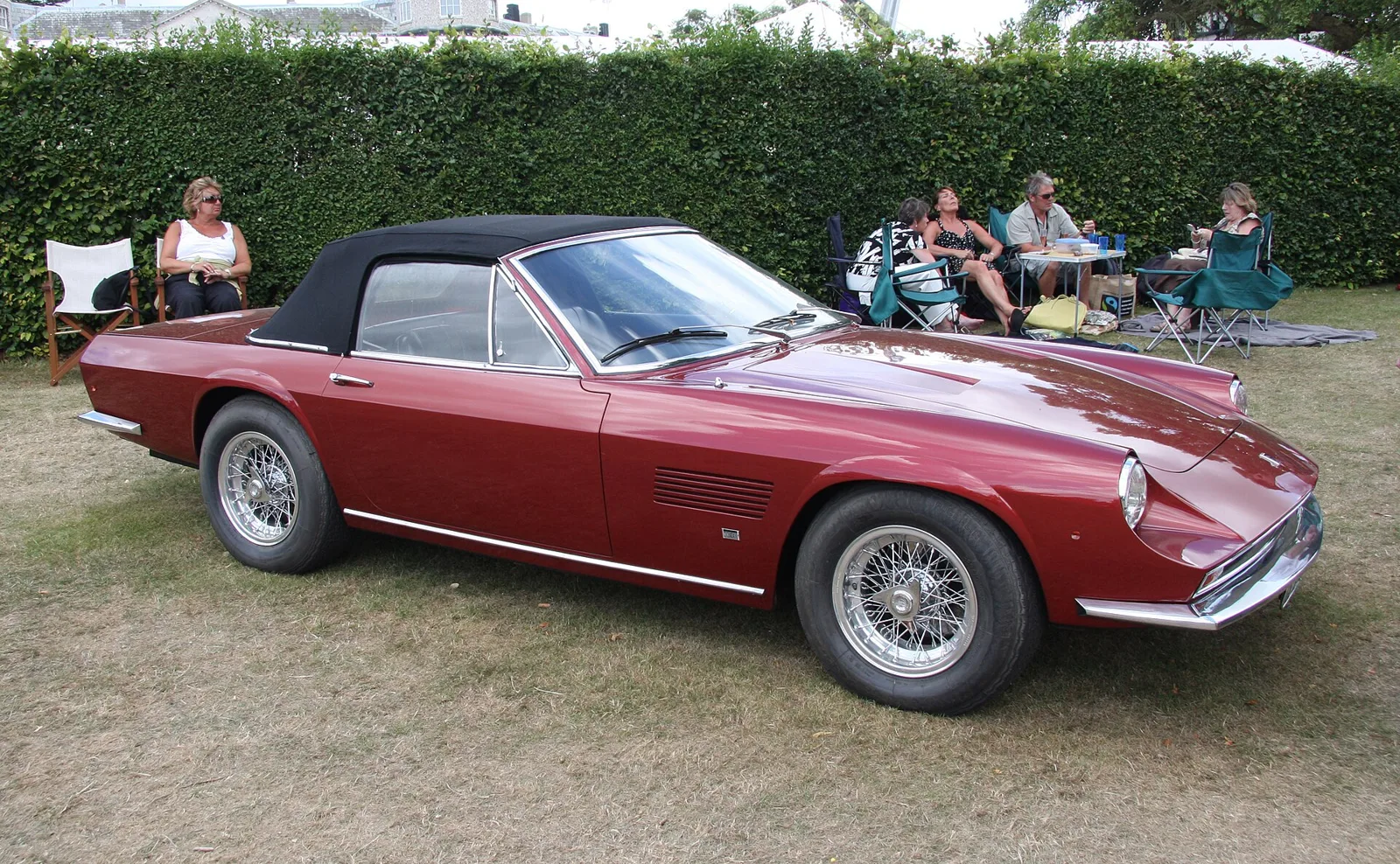
A Chrysler V8 in a Swiss-built box frame, a Frua design that ended in a court case and a Fissore body that carried the range to 1976.
The Monteverdi High Speed was a series of Swiss sports cars built from 1967 to 1976 with Chrysler V8 engines. It included coupes, a convertible and a sedan, and its bodies came first from Pietro Frua and later from Carrozzeria Fissore.
The Monteverdi High Speed was a family of sports cars built by the Swiss maker Monteverdi from 1967 to 1976. The range covered several coupes, a convertible and a sedan, and it also included the Coupe Berlinetta and the Cabriolet Palm Beach. Each car paired an American V8 with a hand-built body, which made the series expensive and rare.
What was the Monteverdi High Speed?
The High Speed was a series of sports cars built by Monteverdi between 1967 and 1976. It was a technically straightforward design that carried a Chrysler V8 in a strong frame, and it wore a succession of bodies from different coachbuilders. The model names themselves came from the power claimed for the engine.
The factory labelled every variant High Speed 375, a name drawn from the engine's power under SAE gross ratings. Suffixes identified the coupes on standard and short wheelbases, the convertibles and the sedans. Monteverdi's cars were built in Switzerland and Italy, which is why the series sits across two countries.
A Chrysler V8 in a hand-built Swiss grand tourer, moved from a Turin coachbuilder to a Savigliano workshop after a royalty dispute.
How was the High Speed built?
Monteverdi designed the frame itself, a box structure made from square steel tubes. The chassis was made by Stahlbau AG in Muttenz, in the Basel-Landschaft canton, a company that at least for a time was connected to Monteverdi. Alford and Alder in Britain supplied front suspension parts, Salisbury made the rear axles, Girling the brakes and ZF the steering.
The mechanical parts were mostly bought in from specialists, so Monteverdi's own work concentrated on the frame, the assembly and the choice of engine. Few of the cars were ever built in the same form twice, since each was finished largely by hand.
How powerful were the High Speed engines?
The engines were Chrysler V8s, and the cars were first rated at about 375 hp (280 kW; 380 PS). That figure was measured in SAE gross, and the equivalent DIN values were roughly 35 percent lower. Chrysler's big-block engines, especially those from its Mopar parts range, could produce far more power without major trouble.
Monteverdi also offered the Chrysler Hemi, which eventually became available on every High Speed. Most cars left the factory with TorqueFlite automatic transmissions, although a few were fitted with four-speed manual gearboxes.
Emissions rules tightened in the United States from the late 1960s, and the engines supplied to Monteverdi lost power as a result. In 1974 the factory's published top speed for the 375 L 2+2 was 200 km/h (124 mph), and road tests did not always reach that figure. A few years earlier the same design had managed 238 km/h (148 mph) with an engine free of those restrictions.
Monteverdi did not tune the engines for more power. Instead it fitted a bigger sump holding 7 L (1.8 US gal), together with an oil cooler and, on automatic cars, a transmission cooler.
The early cars were rated at about 375 hp, while the 1974 figure was a top speed of 200 km/h, a drop that reflected emission equipment rather than a change in the basic design.
Who designed the first High Speed cars?
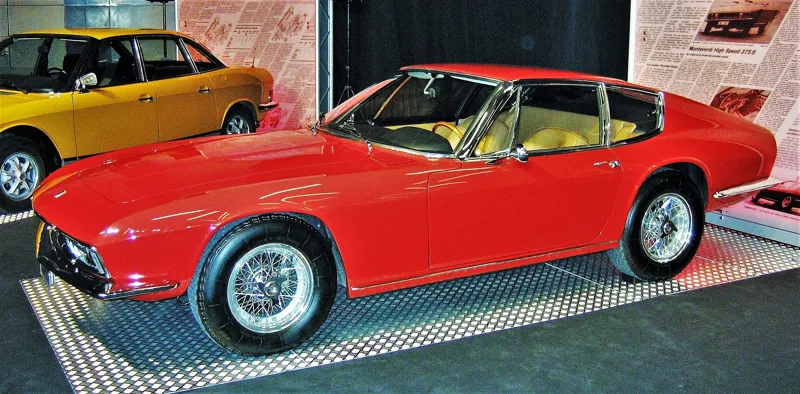
The first series, built from 1967 to 1968, used bodies designed by Pietro Frua in Turin. Frua's coupe was a two-seater that debuted at the 43rd IAA in September 1967, where it won strong reviews. The Zurich daily Blick called it the most beautiful shape between the Alps and the Channel.
Production was shared between two countries. The Binningen workshop fitted the drivetrain and suspension, the rolling chassis then went to Turin where Frua fitted the body, and the finished car returned to Switzerland for delivery. Around twelve coupes were completed early in that cooperation. Reviewers also praised its solid handling and its luxurious, well-finished interior.
Frua also drew a 2+2 version, the 375 L, which was shown in 1968 but stayed at Monteverdi's factory and was never sold. A higher-output 400 S, promised with a twin four-barrel Chrysler Magnum, was announced alongside the 375 S but never appeared with a Frua body.
Why did Monteverdi move production to Fissore?
In spring 1968 Peter Monteverdi wanted to raise output to around 100 vehicles a year. Frua's hand-built bodies could not reach that rate. A move to Carrozzeria Maggiora was rejected because of high tooling costs. Monteverdi instead chose Carrozzeria Fissore in Savigliano, a smaller studio that had worked on the De Tomaso Vallelunga.
From summer 1968 Fissore built about ten bodies in Frua's design, but Monteverdi refused to pay Frua royalties. A court order then stopped him using the design, so a new body was needed for 1969. The remaining Frua-style cars were sold off as late as 1973.
What did the 375 L volume model look like?
For 1969 the High Speed 375 L became the volume model. Buyer inquiries had shown a preference for a 2+2 coupe on the extended chassis, so the pure two-seater was no longer the main product. Its proportions matched the Frua car, but the Fissore body had angular lines at the front and rear.
The front end carried double round headlights, later replaced on some cars by rectangular units. The tail lights came from the Alfa Romeo Giulia Berlina. Peter Monteverdi said he had penned the body himself, and Fissore never disputed the claim, though the coachbuilder probably refined the details from his sketches.
A 1972 brochure promoted the car as a coupe with the technology of tomorrow. Auto Motor und Sport tested a 375 L with a 7.2-litre engine that spring. The car managed 229.3 km/h (142.5 mph) at the top end, reached 100 km/h from a standstill in 8.2 seconds and covered a standing 1 km in 28.3 seconds, which put it roughly level with the Jensen Interceptor but short of the Aston Martin V8 and the Maserati Indy.
The dashboard changed in 1972 and 1973, moving from a traditional English layout with wood and classic dials to a sportier black velour design. Because each car was built by hand, individual customer requests could still change the details.
Other coachbuilders, including Embo S.p.A., made a small number of High Speed bodies too. The 375 L stayed the core of the range until the final cars were built in 1976, and the two-seat short coupe became the rarer choice.
What were the Berlinetta and convertible versions?
The short-wheelbase 375 S returned as a two-seater with Fissore bodywork. Its headlamps were recessed and it had six round tail lights. Only six short coupes were made between 1969 and 1971, and one of them later joined the car collection of the American talk show host Jay Leno.
In the winter of 1971 and 1972 the 375 S became the Berlinetta. Its tubular frame was reinforced for better torsional rigidity, and it gained a reworked nose and a narrow grille that ran the full width of the car. Monteverdi stressed the improved passive safety of the revised structure.
The 375 C convertible followed in 1971, built from the short-wheelbase car and shown at the Geneva Motor Show. It was priced at 75,750 Swiss francs, but only two were made. One was sold to a customer, and the second was converted in 1974 into the Palm Beach convertible using Berlinetta body parts. Monteverdi later bought back the other car, which was displayed in the company's automobile museum and shown at exhibitions from time to time.
What was the 375/4 sedan?
The culmination of the series was the 375/4, a large four-door sedan that first appeared in 1971. Its wheelbase stretched to 3.15 meters, while the driveline stayed the same. The front end of the 375 L was kept up to the A-pillar, and the car used four wide-opening doors with handles borrowed from the Fiat 128.
The interior was fully trimmed in leather and came with air conditioning, electric windows and optional extras such as a television and a drinks bar. Some were delivered as chauffeured limousines with a partition between driver and passengers. Later examples received tail lights from the Triumph TR6 in place of the Alfa units, which gave a more modern look.
Which other Monteverdi designs grew from the High Speed?
Frua carried some of the 375's basic features into his later designs, in changed form. In 1971 he designed a Dodge Challenger-based fastback coupe that repeated many of the 375's features, and that car still exists and appears regularly at European exhibitions.
The 2000 GTI was a study for a cheaper alternative to the High Speed grand tourers. It used BMW components and a four-cylinder engine of 130 PS (96 kW). Peter Monteverdi decided against building it, because a smaller, lower-priced coupe would have weakened the exclusivity of the High Speed.
What are the Monteverdi High Speed specifications?
| Specification | Detail |
|---|---|
| Maker | Monteverdi, Switzerland |
| Production years | 1967 to 1976 |
| Engine | Chrysler V8, about 375 hp (280 kW; 380 PS) SAE gross |
| Frame | Box frame of square steel tubes |
| Oil system, late cars | Enlarged 7 L (1.8 US gal) sump, plus oil cooler |
| Top speed, 1974 claim | 200 km/h (124 mph), 375 L 2+2 |
| Top speed, earlier cars | 238 km/h (148 mph) |
| Test, 1972 375 L | 229.3 km/h (142.5 mph); 0-100 km/h in 8.2 seconds |
| Standing 1 km, 1972 test | 28.3 seconds |
| 375 C price | 75,750 Swiss francs |
| 375/4 wheelbase | 3.15 m |