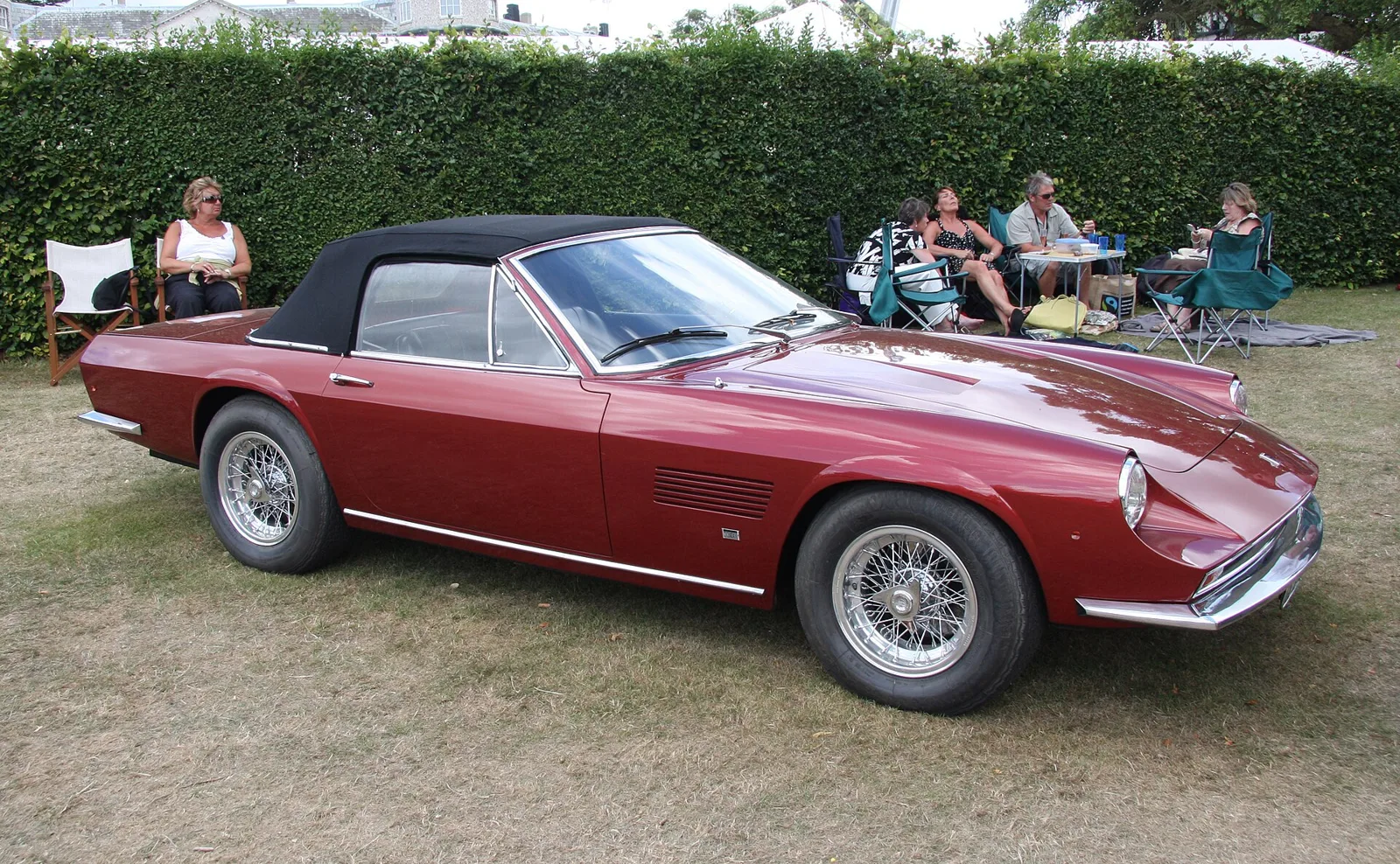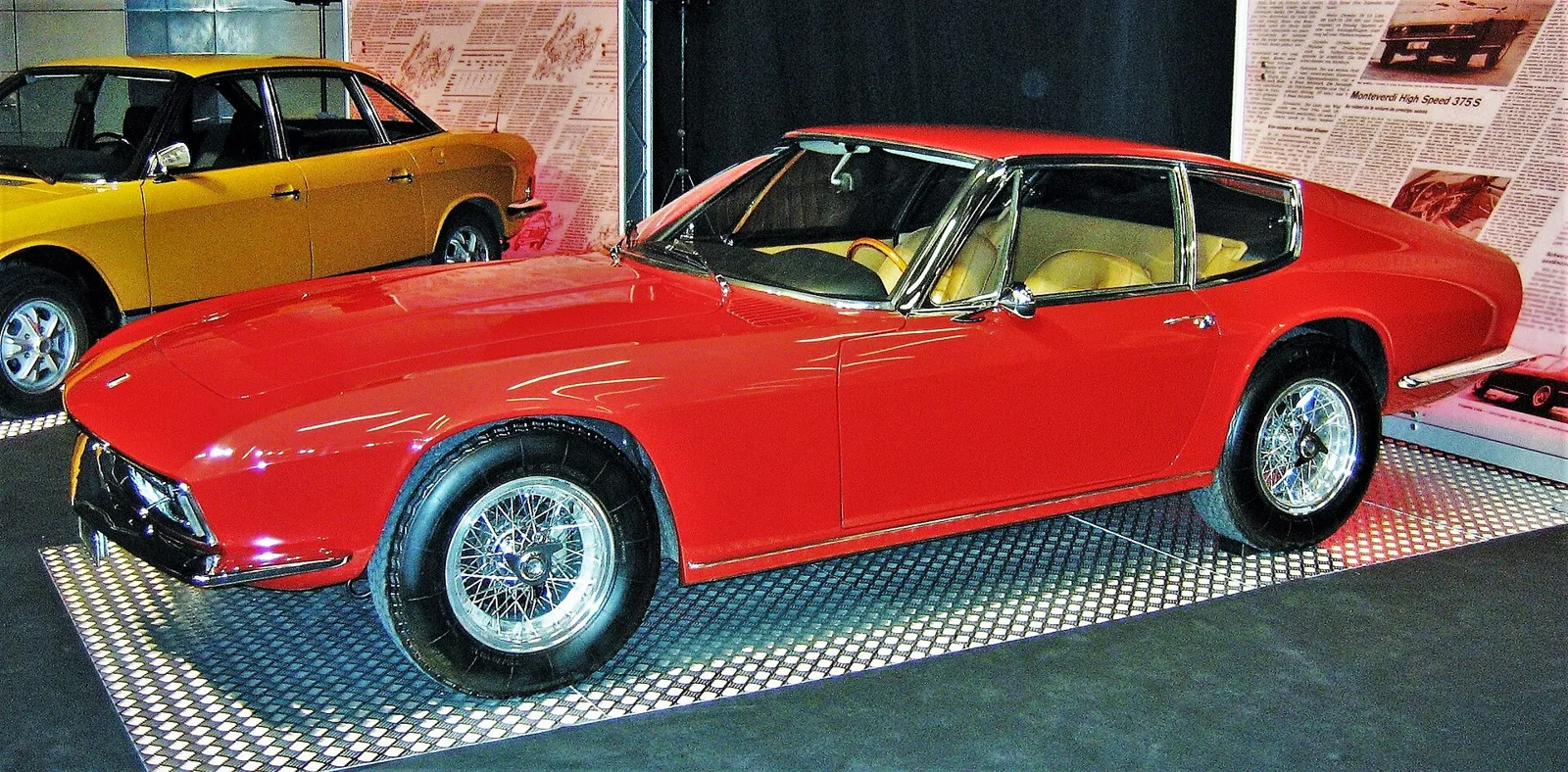
A Swiss two-seater built from bought-in parts, drawn in Turin, and then rebodied by Fissore, with a quarrel over authorship following.
Monteverdi's High Speed 375 S was a two-seat luxury coupe from Switzerland, built between 1967 and 1969 with a Chrysler eight-cylinder and a body drawn by Pietro Frua. Estimates of production run from 16 to 20 cars, and a later Fissore-bodied version followed.
Monteverdi's first car sold under its own name was a closed two-seater with an eight-cylinder Chrysler engine and a body drawn in Turin by Pietro Frua. Between 16 and 20 examples were built from 1967 to 1969. Limited capacity at Frua then moved body production to a second coachbuilder, Fissore, and a quarrel over who had designed the body ended the use of the Frua design.
Where did the High Speed 375 S come from?
The High Speed 375 S grew out of Peter Monteverdi's decision to end his links with Ferrari and Jensen and build costly luxury sports cars under his own name. Its debut came at the 1967 Frankfurt show, held in September, and series production followed.
During the 1960s Monteverdi acted as regional representative for Ferrari and Jensen, along with other marques. The Binningen workshop also turned out racing cars and small DKW-engined sports cars. Those small cars were sold under the MBM label, short for Monteverdi Basel Motors.
Sales leaflets with the MBM badge already existed for the 1967 show. Only shortly before the exhibition opened was the choice made to market it as a Monteverdi. The name explains part of the story: High Speed stands for high speed, while the 375 refers to output, measured in SAE PS and claimed by the maker.
The division of labour was clear from the start. Monteverdi designed the chassis, and Frua's Turin design studio drew the body. The model series that grew from it was built until at least 1976 and included coupes, convertibles and a saloon, but the 375 S was its first member.
A Swiss two-seater built from bought-in parts, drawn in Turin and later rebodied by Fissore.
What did the body look like?
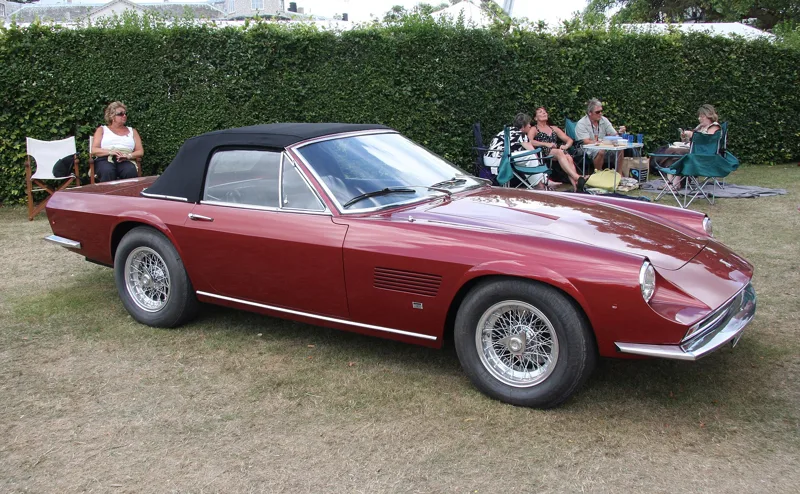
The body took its cues from the Maserati Ghibli, which Giorgio Giugiaro styled for Ghia and which reached the market in 1966. The Monteverdi has a fastback profile, but its high-mounted American engine ruled out a sloping nose, so it has fixed, upright round headlights rather than pop-up units.
Frua worked as he did for other small makers, reusing supplier parts from established models. The tail lights came from the Fiat Dino Coupe, and a chrome grille sits in front of the cooling air opening.
Some authors see a close kinship between this body and Frua's work on the Mistral and the AC 428. Certain accounts even say that glass panels and doors can be swapped between all three models.
Why did Monteverdi and Frua fall out?
Frua drew the body and Monteverdi built the chassis, but Frua could not keep up with the production volume Monteverdi wanted. At the end of 1968 Monteverdi handed body production to Fissore, and Frua then demanded licence fees. Monteverdi refused, insisting he had designed the body himself, and a lawsuit forced him to drop the Frua design.
Monteverdi's target was a yearly output of up to 100 cars. Frua's Italian workshop was built for one-off pieces and short runs, so it lacked the capacity. That capacity problem drove the move to Fissore.
The brochure makes the dispute awkward. Monteverdi's first factory brochure had named Frua as the designer, yet Monteverdi later maintained that he had drawn the body himself, and he kept to that account to the present day. Within a short time he swapped the Frua-styled car for a High Speed 375 wearing a restyled Fissore body.
What engine and gearbox did it have?
The car used an eight-cylinder petrol engine from Chrysler, the largest version of the Chrysler RB, displacing 440 cu in (7,206 cc). Monteverdi fitted it unchanged, and a four-barrel downdraught carburettor from Carter prepared the mixture. Buyers could choose a three-speed TorqueFlite Eight automatic or a four-speed manual.
The sports car's technical side was described as uncomplicated, and so was that of the younger sister models. The frame underneath was a box-section design of square tubing. Peter Monteverdi credited himself with it, and it weighed 160 kg (353 lb). The frame was made by Stahlbau AG at Muttenz, and one account suggests Monteverdi owned that firm, at least for a while.
At the front, independent suspension on double wishbones carried coil springs, an anti-roll bar, and Koni dampers that could be adjusted. The steering came from ZF as a worm-and-sector unit, with power assistance available on request. At the rear, a rigid De Dion axle ran on trailing links with a Watt linkage, and that too had adjustable dampers.
Power is quoted two ways. The factory's figure is in SAE PS, whereas the DIN value is put at roughly 285 PS (210 kW; 281 hp). The brochure also promised a faster High Speed 400 SS, but that announcement never became a car.
Key specifications
| Item | Detail |
|---|---|
| Engine | Chrysler RB, eight-cylinder petrol, 440 cu in (7,206 cc) |
| Power (factory) | 375 SAE PS (370 hp) |
| Power (DIN, probable) | About 285 PS (210 kW; 281 hp) |
| Carburettor | Four-barrel downdraught, Carter |
| Gearbox | Three-speed TorqueFlite Eight automatic, or four-speed manual |
| Frame | Box-section, square tubing, 160 kg (353 lb) |
| Front suspension | Double wishbones, coil springs, Koni telescopic dampers |
| Rear axle | Rigid De Dion, trailing links, Watt linkage |
| Steering | ZF worm-and-sector, power assistance optional |
| Seats | Two |
| List price, 1967 | 58,000 Swiss francs |
How many cars were built, and where?
Estimates of the total for this version range from 16 to 20 cars. The Frua-bodied batch numbered ten, with chassis 1001 to 1011 apart from 1004, and the Fissore-built Frua-design coupes are counted as ten or six, depending on the count.
Each Frua-bodied car followed a three-stage route. Monteverdi's Binningen workshop fitted the engine and drivetrain to a Swiss-built chassis. The rolling chassis then travelled to Turin, where Frua's craftsmen fitted a hand-built body. Finished and ready for registration, the car went back to Monteverdi.
From summer 1968 the route changed. Chassis left Binningen without engines for Fissore in Savigliano, then came back so that Monteverdi's mechanics could install the drivetrain.
Survival is patchy. Only four cars from the Frua-bodied series still existed in 2022, while five are missing and one was scrapped. Since 2006 the American entertainer Jay Leno has housed chassis 1004, one of the Fissore-built cars.
Was there a 2+2 version?
A 2+2 long version, the High Speed 375 L, was built as a prototype in 1968. Frua reworked the side line and roof section for it, and it was shown at the Geneva Motor Show that March. Monteverdi priced it at 63,000 Swiss francs, but it stayed at the factory and was never sold.
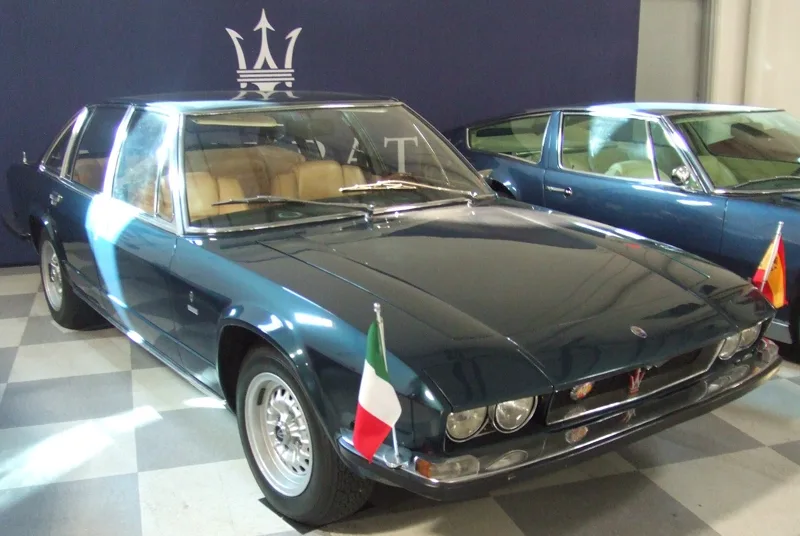
The long car returned to Monteverdi's plans in 1969, when it entered series production with a Fissore body. Frua had kept a second 2+2 body back, and a year later it went to the British sports car maker AC.
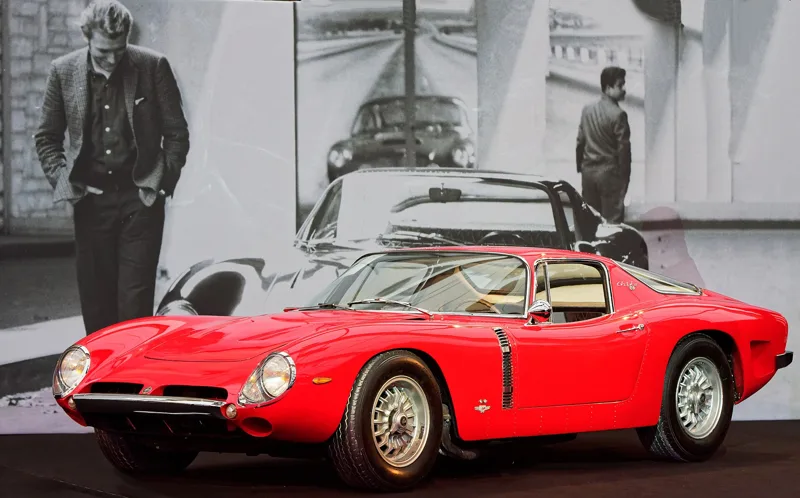
AC already had a Frua-styled coupe, the AC 428, and a spyder in its range. The leftover Monteverdi body appeared as a single example, the AC 429, with minor changes such as partly concealed headlamps like those of the Iso Lele. Alongside the long car, Monteverdi also brought out a revised short High Speed 375 S with a Fissore body, and a convertible was later derived from it.
What did it cost, and what is it worth now?
At launch in 1967 Monteverdi listed the High Speed 375 S at 58,000 Swiss francs, which put it above the Aston Martin DB6. Today it rarely appears on the classic car market, and sales about 50 years after production ended regularly reach six-figure prices.
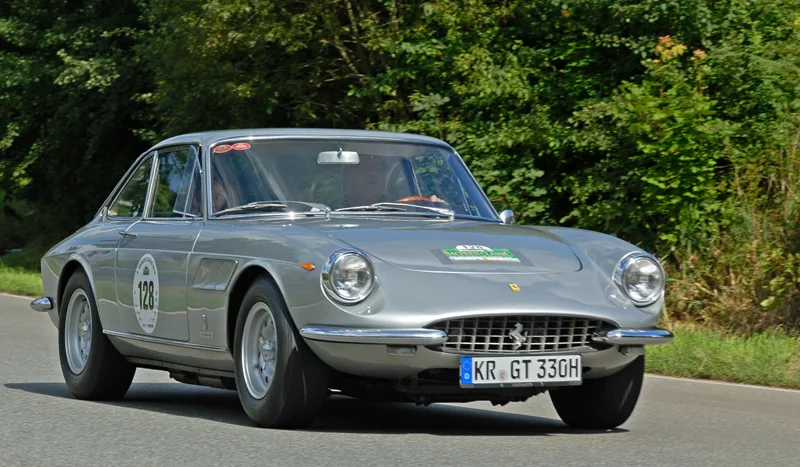
Ferrari and Maserati also had less expensive cars on offer.
In summer 2022 a Gstaad auction house sold chassis 1003, an early Frua-built car on which duty had not been paid, for 230,000 euros.
How did the press receive it?
Coverage at the time was favourable. The Zurich newspaper Blick praised the car for having the most beautiful forms ever to appear between the Alps and the English Channel. Another writer pointed out that many of its parts had been bought in from numerous sources, and called it a mixed bag of components.
The car is best understood as a hybrid. Simple mass-production drivetrain technology sat under an exclusive body designed in Europe, so the High Speed 375 S drew on several traditions at once.