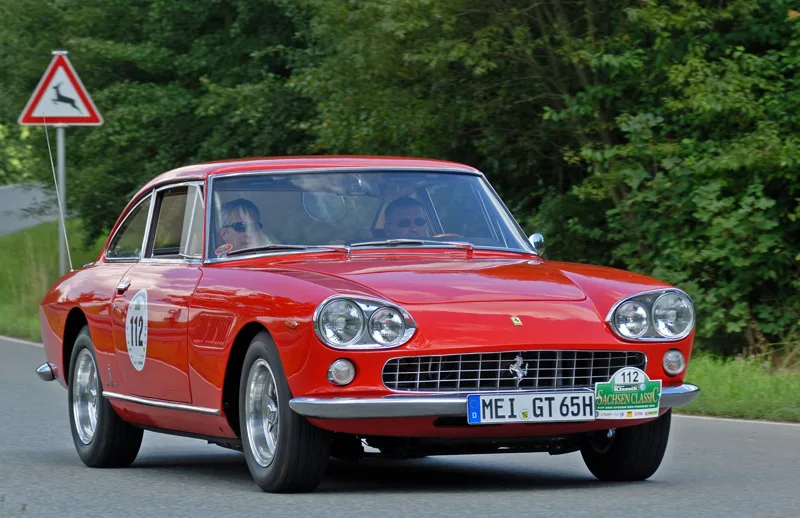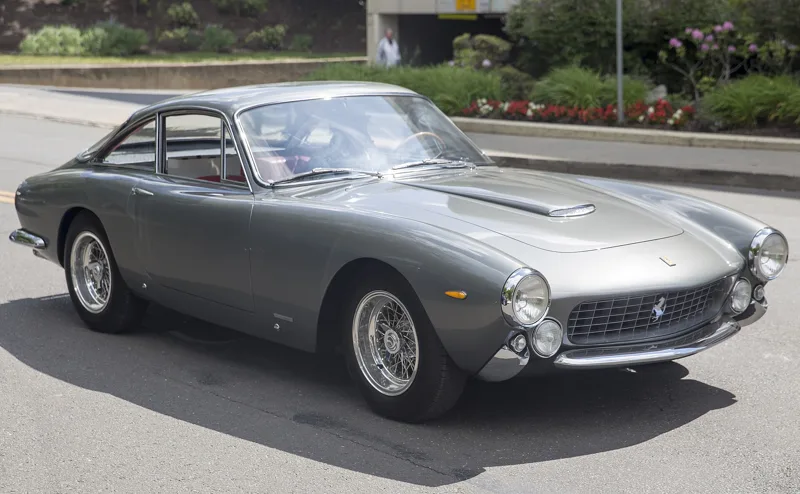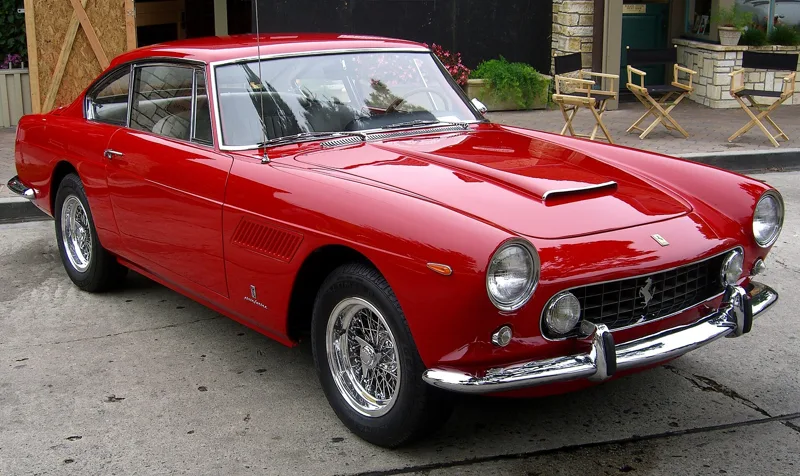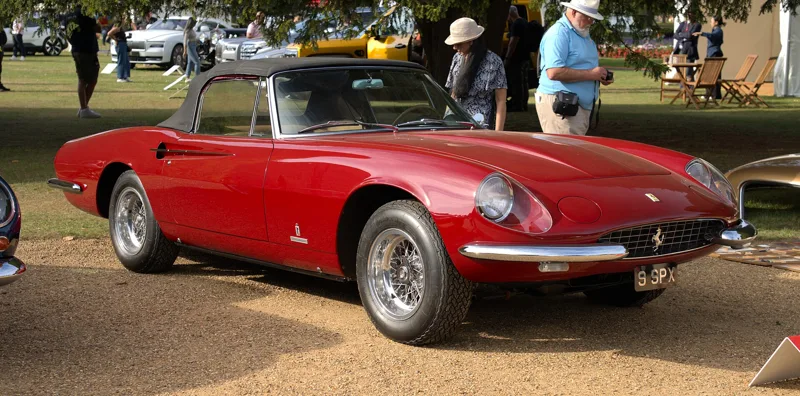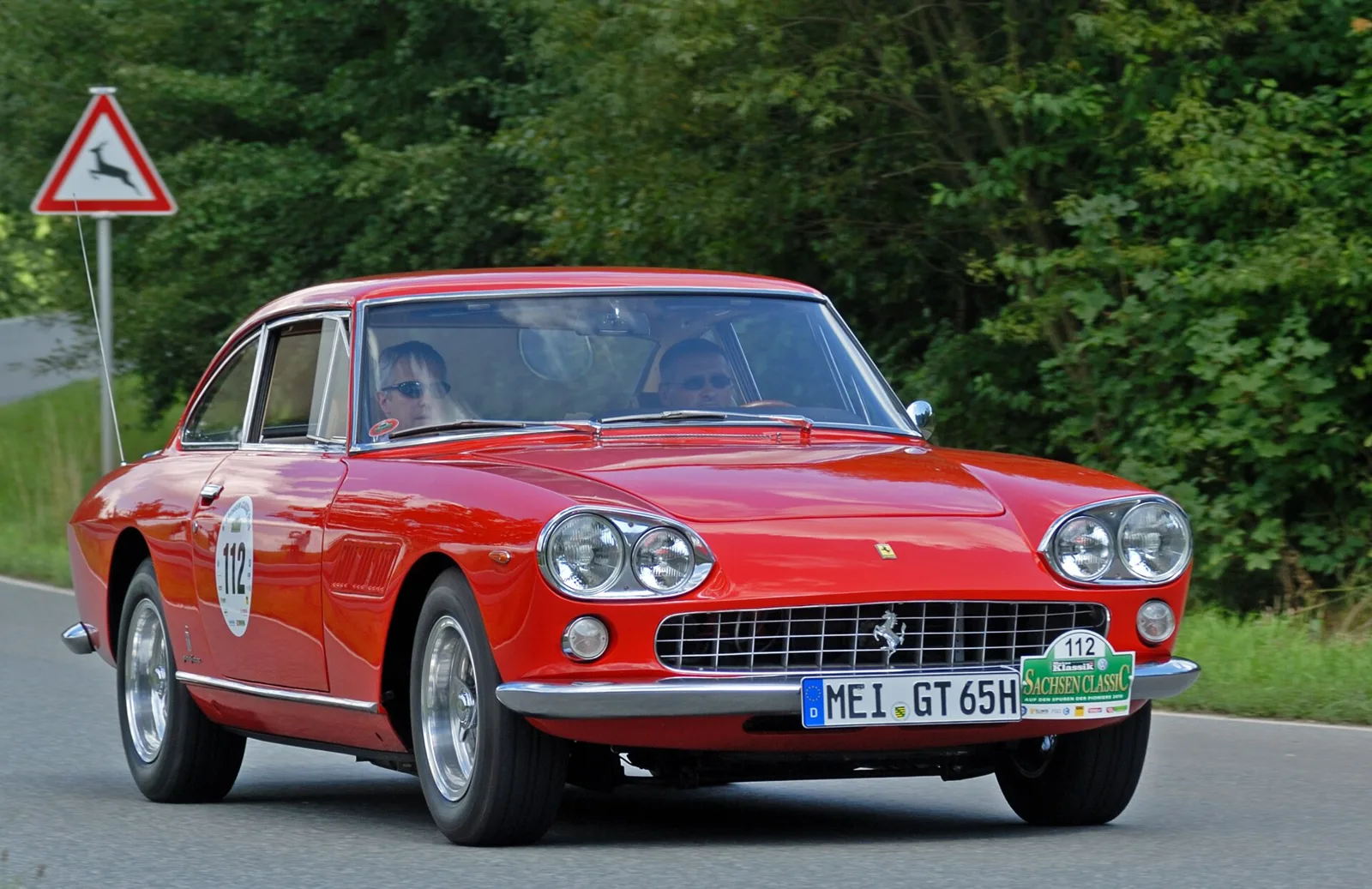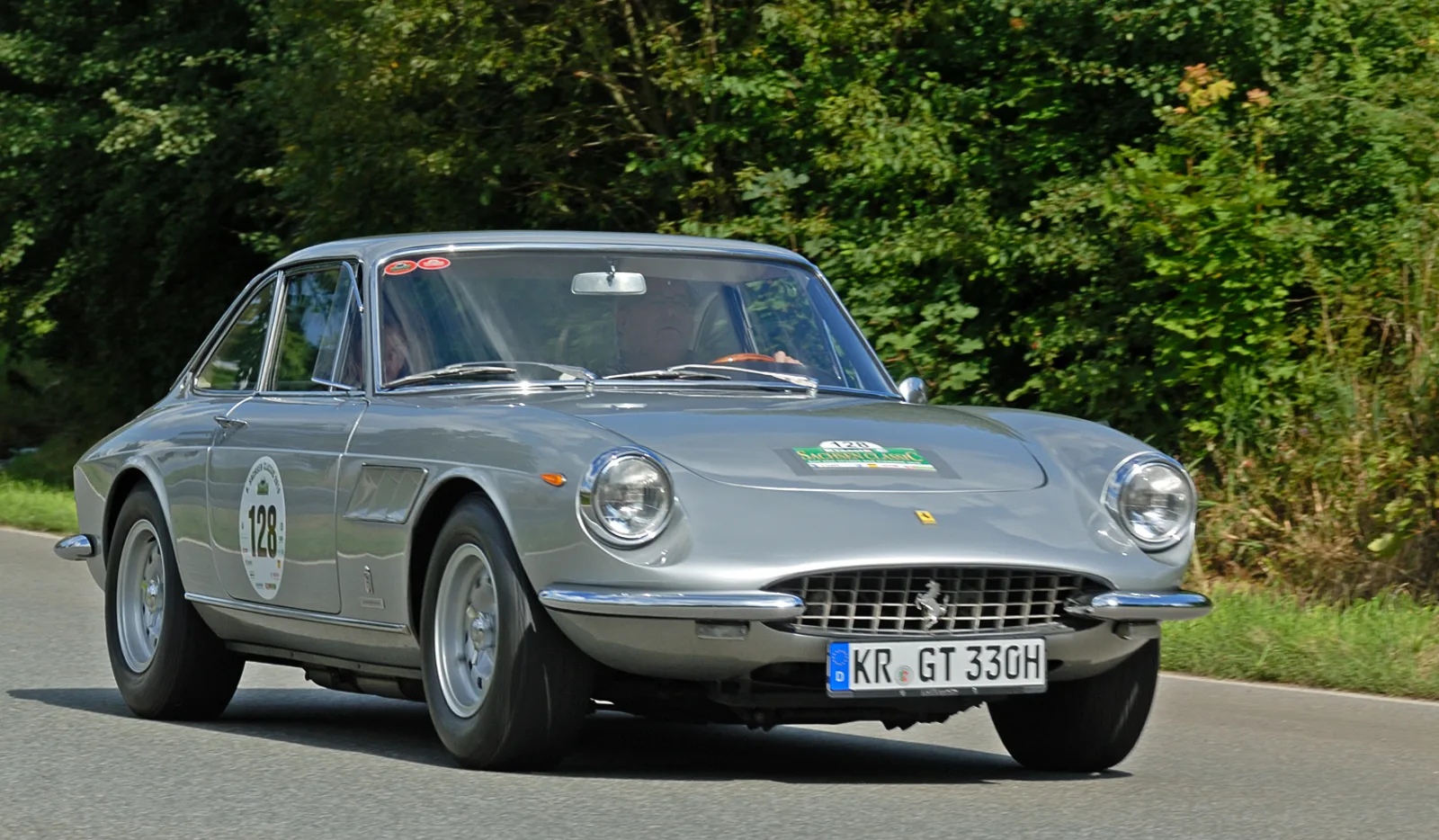
A Pininfarina-styled V12 coupe from 1966, its open GTS sibling and the one-off bodies built on the same chassis.
The Ferrari 330 GTC was a Pininfarina-styled V12 coupe introduced in 1966 to fill the market segment of the 250 GT Lusso. Its open sibling, the 330 GTS, shared the same technical details and was built alongside it until 1968.
Ferrari assembled the 330 GTC from engineering modules and body drafts already used on other models. The result was a 3,967 cc V12 coupe with three Weber carburettors, sold alongside an open GTS version until 1968.
Why did Ferrari introduce the 330 GTC?
Ferrari had left a gap in its range when the 250 GT Lusso ended during 1964, and the 330 GTC arrived in 1966 to take over that market segment. It was a newly styled coupe that combined existing technical modules, while its body combined several earlier designs.
Early in the decade Ferrari split its road sports cars into clear segments. The 275 GTB was the strongly sporting two-seater, the 250 GTE 2+2 and its successors, the 330 America and 330 GT 2+2, were four-seat grand tourers, and the two-seat 250 GT Lusso sat between them from 1962.
Ferrari did not refill the gap straight away. The 330 GTC was shown at the Geneva Motor Show in March 1966, and the Spyder GTS, which replaced the 275 GTS discontinued at the start of that year, was presented at the Paris Motor Show in October 1966. The two versions remained on sale until 1968, after which the 365 GTC and 365 GTS succeeded them, looking very alike but carrying larger and more potent engines.
Critics said the thin pillars and large glass areas gave the body a special lightness.
What engine did the 330 GTC use?
The 330 GTC used a 60-degree V12 of 3,967 cc (242.1 cu in) with a bore and stroke of 77 x 71 mm. Its Tipo 209 engine traces back to a 1947 design by Gioacchino Colombo, which Ferrari reworked in 1960 with wider spacing between the cylinders.
Three downdraught twin-barrel Weber carburettors fed the engine, with a choice of type 40 DCZ/6 or 40 DFI. Each cylinder bank had an overhead camshaft and each cylinder had two valves. Peak output reached about 220 kW (300 PS; 296 hp) at 7,500 rpm. The Tipo 209 went into every road sports car of the 330 family.
The power went through a manual five-speed gearbox. It matched the second-series 330 GT 2+2 unit, but on the 330 GTC it sat at the rear axle rather than at the front.
How was the chassis built?
The 330 GTC used a tubular steel chassis, works designation Tipo 592, which was largely identical to that of the 275 GTB. The wheelbase was 2,400 mm (94.5 in), and unlike the larger 330 GT 2+2, which kept a live rear axle, the car had individually suspended wheels at both ends.
Double wishbones with coil springs carried each wheel, with Koni hydraulic telescopic dampers and anti-roll bars. Girling disc brakes were fitted to all four wheels.
Who styled the 330 GTC body?
Pininfarina designed the body, with Aldo Brovarone as the responsible designer. He mixed design features from established Ferrari sports cars. The oval radiator opening, set between two-part bumpers, echoed the nose of the exclusive 500 Superfast.
At the back the car echoed the 275 GTS and borrowed from the Chevrolet Corvette Rondine, a 1963 study that Tom Tjaarda made for Pininfarina. Critics said the thin pillars and large glass areas gave the body a special lightness.
Most body panels were steel, with the bonnet and doors in aluminium.
What set the GTS apart from the GTC?
Technically the open 330 GTS matched the closed GTC in every detail, but it was slightly heavier. Its fabric roof folded almost completely into the body, so the continuous belt line stayed uninterrupted, and a vinyl protective cover could be fitted over the folded roof.
Only odd chassis numbers were allocated to the 330 GTS.
What do the model names mean?
The name followed Ferrari's usual practice of the period, taking its figure from the displacement of a single cylinder, which in this engine was about 300 cc. GTB stands for Gran Turismo Berlinetta, and GTS for Gran Turismo Spyder, the open version.
Ferrari used this naming practice widely in the 1950s and 1960s.
How many were built and where?
The cars were built at Pininfarina's Turin works, and Ferrari then installed the mechanical components at Maranello. In two years 598 coupes and 100 Spyders were built, with almost no technical or stylistic changes along the way.
Specifications at a glance
| Item | Detail |
|---|---|
| Engine | 3,967 cc (242.1 cu in) V12, 60-degree bank |
| Bore x stroke | 77 x 71 mm |
| Output | About 220 kW (300 PS; 296 hp) at 7,500 rpm |
| Carburettors | Three Weber twin-barrel downdraught |
| Gearbox | Manual five-speed, rear-mounted |
| Wheelbase | 2,400 mm (94.5 in) |
| Brakes | Girling discs on all four wheels |
Which one-off bodies were built on the chassis?
Several chassis received bodies of their own, and their owners included a royal family member, a US car collector and a country singer. Four cars were built as the Speciale P.F. "Rethy" on the short 330 GTC chassis, Pininfarina made a targa-style one-off in 1968, and Zagato and Felber later used other chassis for their own designs.
330 GTC Speciale P.F. "Rethy"
The Rethy cars combined the short 330 GTC chassis with a body whose profile followed the much longer 365 GT 2+2 "Queen Mary". Pininfarina drew the design. The rear window stood upright, recalling the lines of the Dino 246, and concealed auxiliary headlamps sat at the front, as on the 365 California Spyder.
Belgian King Leopold III commissioned the first car, chassis number 9439, which went to his second wife, who held the title Princess of Rethy. That title gave the model its unofficial name. A second, almost identical car with chassis number 9653 was shown at Geneva in March 1967 and went to a friend of the royal family. Both were built in early 1967, and Pininfarina made two more later that year, one with a differently styled rear end. The last two went to Italian customers.
The 330 GTS Harrah Targa
Pininfarina built this one-off in 1968 on a 330 GTS, chassis number 10913. Its targa body had a broad chrome roll bar at the B-pillar, a large inclined plastic panoramic rear window and a removable roof section between the windscreen and the roll bar.
The client was the American businessman and car collector William F. Harrah, who passed the car to the country singer Bobbie Gentry, his wife at the time. Harrah sold the car after their divorce in 1970.
330 Convertible Zagato
Five years after the 330 GTC left production, in 1973, the US importer Luigi Chinetti asked the Milan studio Zagato for a fresh body on a secondhand chassis. The base car had been built in 1967 (chassis number 10659) and delivered to the USA. Accounts differ on the designer, with Elio Zagato and Giuseppe Mittino both named.
Zagato had built a very similar design in 1970 on a 250 GT Berlinetta SWB chassis, but the 1974 car was a two-door safety convertible with a broad roll bar behind the seats and a removable plastic roof section over them. Its headlamps sat behind a wide Perspex cover, a reinterpretation of the front of the first series of the 365 GTB/4 "Daytona". It was shown at Geneva in March 1974 and remained a one-off.
Felber-Ferrari FF
The Swiss carmaker Felber used the 330 GTC chassis as the base for a retro roadster, which took only loose cues from the Ferrari 166. The doorless two-seater was shown at Geneva in 1974, and a small series of six followed, each built on a used 330 GTC chassis. Panther Westwinds in Britain made the bodies, and Enzo Ferrari allowed Felber to use the Ferrari name.
What are the 330 GTC and GTS worth today?
Both are high-priced classics. In 2017 a 330 GTC in exhibition condition was priced at 800,000 euros and a middling example at 600,000 euros, while a 330 GTS in top condition was quoted at 1.8 million euros. Worse examples were only slightly cheaper.
Classic prices had almost quadrupled in the five years before that.