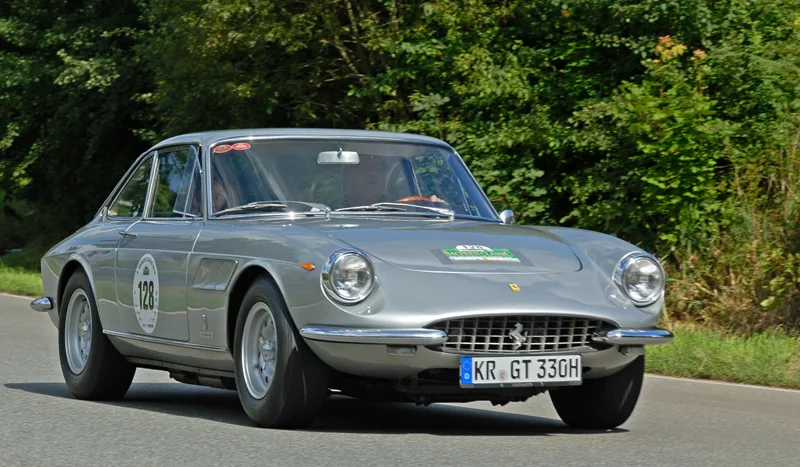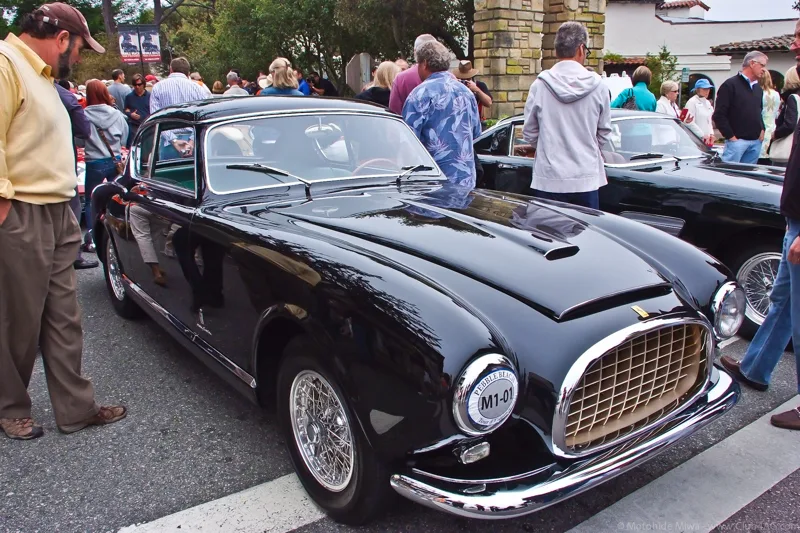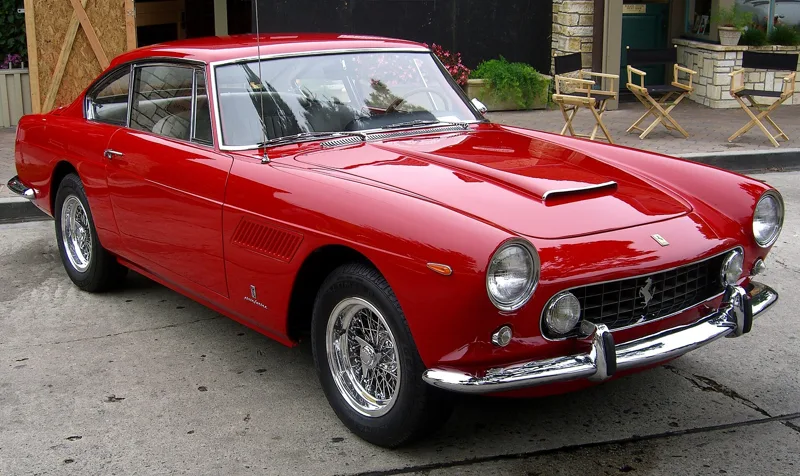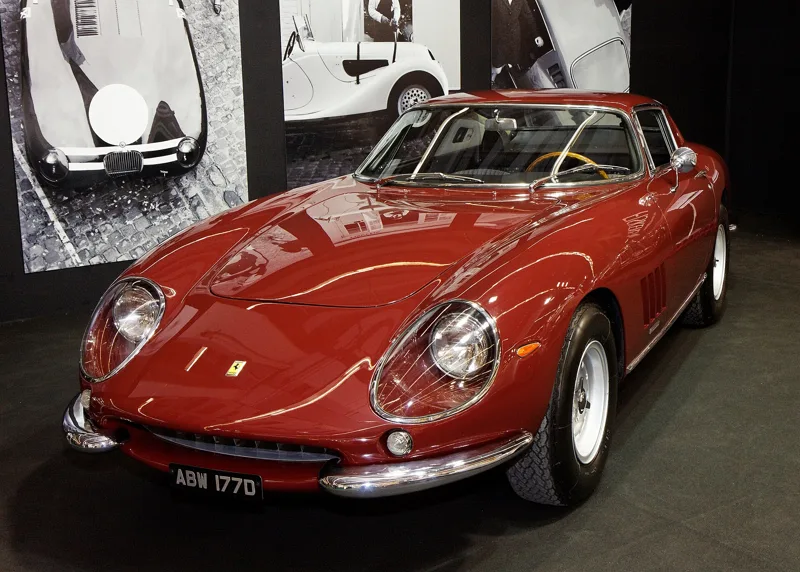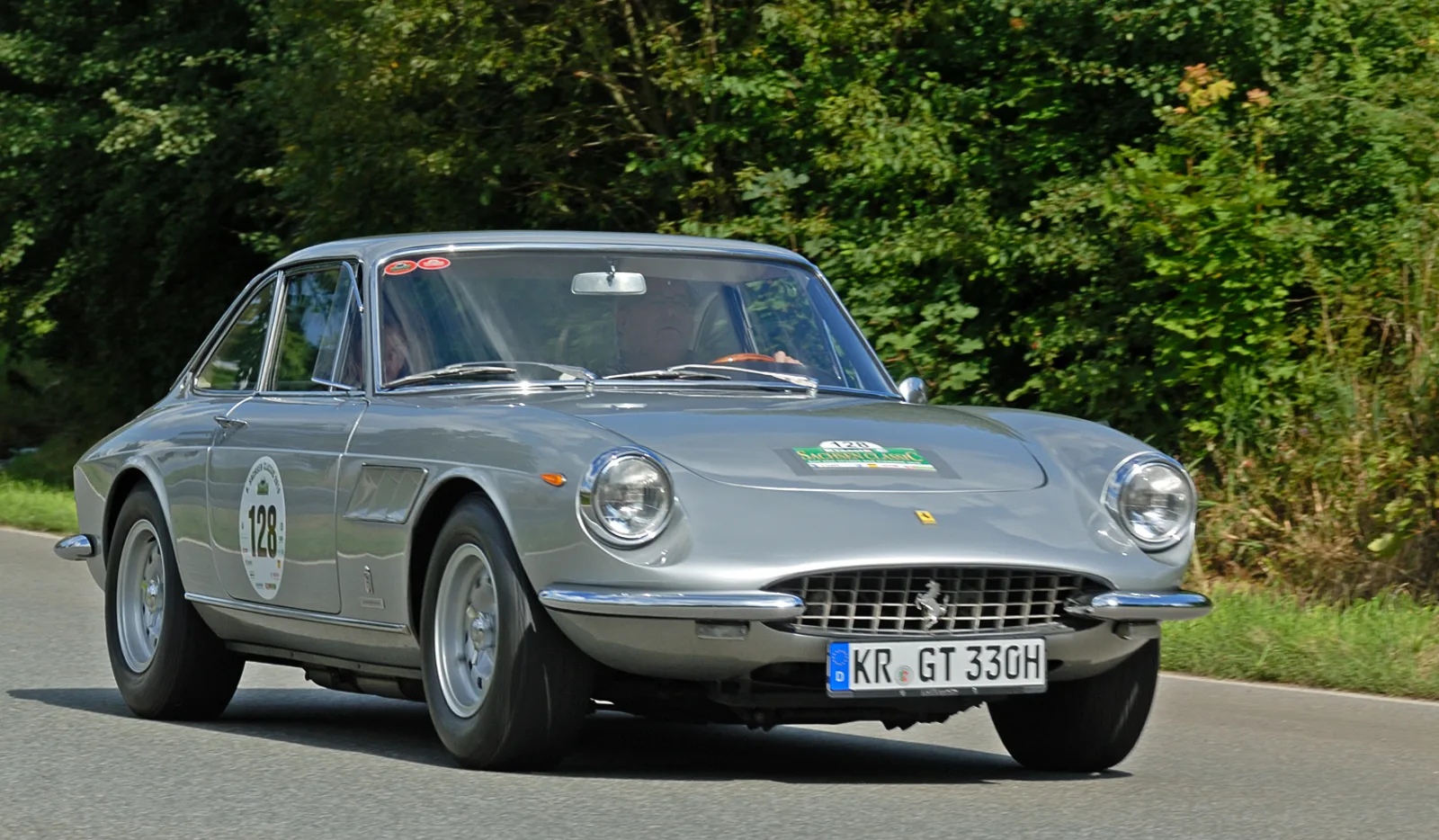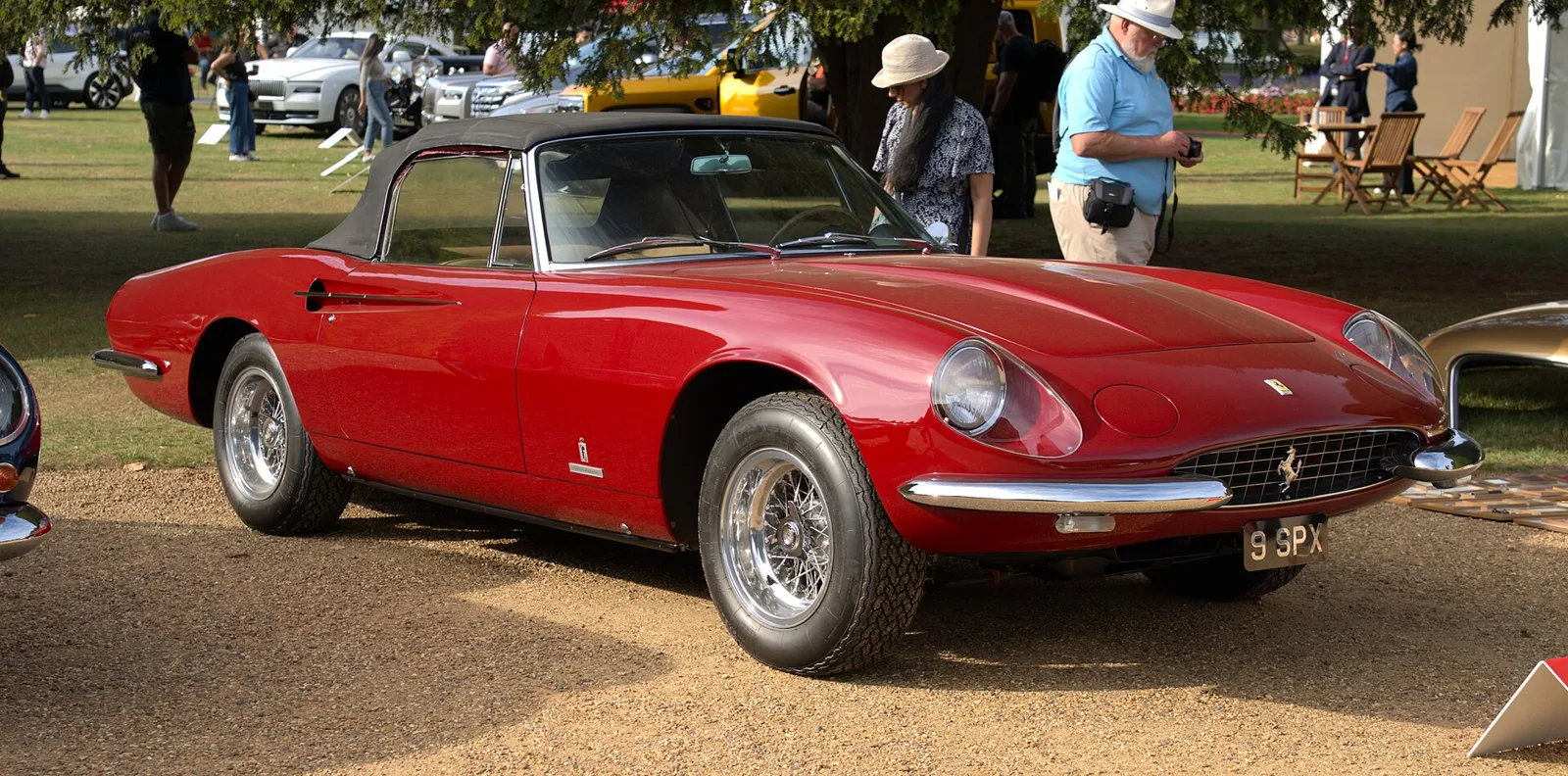
Pininfarina's open V12 from 1966 and 1967, built in just fourteen examples and finished largely by hand.
The 365 California Spyder was an open Ferrari with its V12 at the front, built by Pininfarina in 1966 and 1967 as the heir to the 500 Superfast. Only 14 were made, and their 4.4-litre engines were rated at 320 PS (316 hp).
Built in 1966 and 1967, the 365 California Spyder was an open car with its engine at the front, and it headed the 365 family as its most exclusive model. Pininfarina styled the body, and the car is counted as the last small-batch Ferrari with its engine up front. Only fourteen were made, each with a large share of hand work.
Where did the 365 California come from?
Since the 1950s Ferrari had sold a handful of costly, luxurious grand tourers to wealthy clients, many in North America, rather than racing machinery. That series began in 1952 with the 342 America, and from 1964 the Pininfarina-bodied 500 Superfast filled the slot. Superfast production stopped in 1966 after 37 cars, and the 365 California followed it.
Its name honoured the 250 GT Spyder California, made from 1957 to 1963 and placed similarly in the lineup. Beyond the name and the place in the range, the two cars had little in common. The 365 debuted at the Geneva show in March 1966.
Fourteen cars, finished largely by hand at Pininfarina, and a front-engined V12 built at the tail end of a line.
What was under the bodywork?
The chassis was carried over unchanged from the 500 Superfast, a type 598 that itself descended from the 330 GT 2+2. Each front wheel had its own suspension arms and a coil spring, while the rear used a solid axle with semi-elliptic leaf springs and extra trailing arms. Hydraulic telescopic dampers were fitted front and rear.
The solid rear axle was criticised as outdated as soon as the car was presented.
A 4.4-litre V12 with an old pedigree
The V12, labelled type 217B, was based on a 1947 design by Gioacchino Colombo. The 330 family of 1961 had received a thorough rework of that engine, including a new block while keeping the 60-degree bank angle. The 4.0-litre type 209 grew to 4.4 litres by boring the cylinders from 77 to 81 mm, leaving the 71 mm stroke alone. Each bank had one overhead camshaft and two valves per cylinder, and three Weber 40DF double-barrel carburettors supplied the mixture. Ferrari put the output at 320 PS (316 hp).
How was the body styled?
Pininfarina's design team handled the bodywork, with Tom Tjaarda leading the work. The nose came from the 500 Superfast, with extra pop-up headlamps added. Opinions split: some judged the shape well formed, while others found it unbalanced, a strange mixture of curves and lines.
Unusual details included side vents that did nothing but ran across the doors and rear wings, with the door handles set into them. Retractable fog lamps were fitted too. The tail lamps mixed angular and round shapes, a link to Tjaarda's earlier Chevrolet Corvette Rondine and a 1963 Lancia Flaminia coupe proposal. The flat body carried long overhangs front and rear, and at 4,900 mm (193 in) it ranked among the longest production Ferraris.
How many were built and where did they go?
Only 14 were completed: a prototype in January 1966, then eleven left-hand-drive cars and two right-hand-drive cars between August 1966 and October 1967. Pininfarina built them largely by hand. American demand for the open car led to the eleven-car order, and two British orders in 1967 produced the right-hand-drive pair.
The prototype
Chassis 8347 was finished at the end of January 1966 as a driveable, fully equipped prototype, and it was the only car on the type 571 chassis, the family used in the 330 GT 2+2. Ferrari showed it at Geneva in a darker night blue, trimmed in beige cord rather than the fashionable black and white fabric.
Series cars and the Superfast link
Production cars were planned on the Superfast's newer type 598 chassis, which brought small differences from the prototype. Pininfarina cleared earlier Superfast orders first: the last five of the 37 Superfast coupes built since 1964. Then the remaining cars were built one by one.
Eleven more left-hand-drive cars
Two were finished in 1966, one at the end of August and one in mid-October. The 1967 output was one car in February, one in March, three in April, and single cars in May, June, July and October. Cars bound for continental Europe differed from those bound for the United States in lighting, dashboard instruments and some ancillary engine units.
Which cars were right-hand drive?
Right-hand-drive cars were not planned at first, because nobody knew whether the open model would sell in Britain. Two British orders arrived anyway in 1967. The tenth car, chassis 9985, went to the British importer Maranello Concessionaires and became the first right-hand-drive example. The fourteenth and last, chassis 10369, was the second.
What happened to the individual cars?
Records from 2017 list just one of the fourteen as lost or destroyed. The other thirteen have largely been restored, some to concours condition, and several have been sold at major auctions. Some stayed with collectors for decades, while others were treated as high-priced investments.
Chassis 9127 went to the importer Luigi Chinetti, found its first buyer in 1967 and stayed with one family from 1968 to 2005. During the 1990s it was offered repeatedly, with asking figures starting at US$595,000. In 2005 it went to the Indian entrepreneur Vijay Mallya, later better known as a Formula One team owner, for 736,000 euros. The prototype, chassis 8347, went in July 1966 to a well-known Italian publisher and has stayed in private hands since.
What did the cars sell for?
Chassis 10327 shows the spread best. An offer of US$1.5 million was recorded for 1990, but the car changed hands for US$346,000 in 1993. Bidding topped out at US$500,000 and US$550,000 in the 1999 and 2005 auctions, both short of the reserve, and sales reached US$1.375 million in 2007 and US$2.97 million in 2013. Chassis 9631 made US$880,000 at auction in 2010.
Other chassis histories
Chassis 9849 also had US equipment and went through Chinetti to New York City. After several American owners, a Briton acquired it for 728,000 euros. Between 2010 and 2016 the Munich entrepreneur Alexander Rittweger, a developer of a loyalty card scheme, owned it, and in part exchange he gave it up for a Maserati 3500 GT Vignale Spyder. The car started out white with a black interior, wore many colours over the years, and returned to white in 2016.
Chassis 9889 had European equipment and went to an Italian fashion designer's family, where it spent 34 years. Since 2001 it has changed hands several times in the United States, with a documented sale at US$410,000 that year and an offer at US$650,000 in 2003. It is still finished in light blue metallic with black upholstery.
Chassis 9935 had US equipment and was sold on again through Chinetti. After a year with a leasing company it passed through several American hands, and since the mid-00s it has been in Montreal, Canada. Its red paint, white interior and white hood set it apart.
The Spanish car and a fatal collision
The only example sent to Spain, chassis 9615, was completed in October 1967 in silver with black trim. Its buyer, Rafael Leonidas Trujillo Martinez, lived in exile in Spain as the son of the Dominican Republic's dictator, who had been assassinated in 1961. In December 1969 his Ferrari hit a Jaguar head-on near Madrid. The Duchess of Alburquerque, whose Jaguar it was, died at the scene, and Trujillo died ten days later of pneumonia after serious facial injuries.
Two Britons bought the wreck, which was rebuilt. After another change of hands and a rebuild by the British specialist Terry Hoyle, a British collector has owned it since 1987. It now carries silver-grey metallic paint with black upholstery.
Where are the museum and collection cars?
Chassis 9447 has been part of the Thomas C. Crawford Auto Aviation Museums in Cleveland, Ohio, after a restoration in California in 1980. Chassis 10077 belongs to the Nethercutt Collection at San Sylmar, California, a collection built by the American entrepreneur Jack Boison Nethercutt, who lived from 1913 to 2004. The car has appeared at leading concours events several times.
Which famous owners kept a 365 California?
Chassis 10327 was owned for several years from 1999 by the actor Charles Bronson. Chassis 10155 went from the factory to Hans Riegel junior, a Bonn businessman who owned the German confectionery company Haribo, in June 1967 through the Duesseldorf dealer Auto Becker. Several other owners were collectors and businessmen.
The car that vanished
Chassis 10155, the only car delivered from the factory to West Germany, was displayed at the Frankfurt motor show in October 1967 and for a time at the Nurburgring automobile museum. Designer Manfred Lampe bought it in the 1970s; when he joined Ford's styling studio he took the car to Dearborn, near Detroit. It was last spotted at a New York scrapyard in 1991 and has been considered lost since.
Individual histories, continued
Chassis 9447, the third car, was finished in light red with a light brown interior. An Italian buyer took it late in 1966. The following year it was a Ferrari exhibition car at the Turin Motor Show, and it later moved to the United States.
Chassis 9631 was completed in February 1967 and was on show at Geneva in March and then at New York the following month. After years with a US leasing company it was in poor condition. The first complete rebuild, in 1976, did not last, because a serious accident followed soon after. A Ferrari collector had it rebuilt by Ferrari and Pininfarina in Italy the following year. Since its owner's death in 2005 it has been auctioned several times, and its original finish, beige metallic with light brown trim, has been restored.
Chassis 9801 was the sixth car and had US equipment. It was also an exhibition car at the New York show. Finished in light red like the third car, it had a black interior instead. Through Chinetti it passed to American private owners. In 1985 a Swiss dealer offered it for 200,000 Swiss francs, and its later American owner had Allegretti in Modena, an Italian specialist, carry out a full restoration.
Chassis 9985 was the first right-hand-drive car, delivered to Maranello Concessionaires under Colonel Ronnie Hoare. Its fourth owner, a British estate agent, used it from 1969, and from 1977 in the Bahamas. He had it restored in Florida from 1983 to 1985, when its night blue body was changed to red and parts of the interior went from beige to black. Since 1986 a Briton has owned it.
Chassis 10327 was delivered to its first owner overseas in early October 1967, probably through Chinetti. For roughly eleven years it was owned by two executives of an American electronics group. From 1968 to 94 it lacked its typical folding auxiliary headlamps, because of an accident and a repair by Chinetti.
Chassis 10369, the last car, was metallic blue with a beige interior. It was the second right-hand-drive car with British equipment. The London property speculator Harry Hyams bought it. Following a bad 1969 crash involving a military truck, Hyams commissioned a Pininfarina rebuild the next year and added an electric hood mechanism. The family kept it until 1999; that summer it was at the Carrozzeria Zanasi in Italy. Nothing reliable is known about its later whereabouts.
Specifications at a glance
| Item | Detail |
|---|---|
| Chassis | Type 598, carried over from the 500 Superfast |
| Engine | 4,390 cc (268 cu in) V12, type 217B |
| Bore and stroke | 81 mm bore (was 77 mm), 71 mm stroke |
| Valve gear | Single overhead camshaft per bank, two valves per cylinder |
| Carburation | Three Weber 40DF double-barrel carburettors |
| Output | 320 PS (316 hp) |
| Overall length | 4,900 mm (193 in) |
| Designer | Tom Tjaarda, Pininfarina |
| Production | 14 cars in total |
| Built | January 1966 to October 1967 |