A two-seat Grifo built by Bizzarrini in Livorno with a Chevrolet V8, class results at Le Mans and an auction price above 1.8 million euros.
Built in very small numbers between 1963 and 1965, the Grifo A3/C paired a Chevrolet V8 with a Drogo aluminium body. Giotto Bizzarrini's Livorno works produced it, and it won its class at Le Mans in 1964 and 1965. Auction prices now run into seven figures.
The Iso Grifo A3/C was a two-seat competition coupe that the engineer Giotto Bizzarrini designed, built from 1963 to 1965 in very small numbers. Its Chevrolet V8 and its Drogo aluminium body set it apart from the comfortable road Grifo that shared its name. The car is credited with class wins at Le Mans in 1964 and 1965, and today it sits among the costliest classics in the world.
Where did the Grifo come from?
Bizzarrini was a Tuscan engineer who had worked for Ferrari for many years. After leaving that firm in 1963 he took on design work for various clients as an independent. For Renzo Rivolta he developed the four-seat Iso Rivolta IR 300 in 1962, a sporty yet luxurious grand tourer.
Rivolta had earlier enjoyed great success with the Isetta in the early post-war years.
The IR 300 is regarded as an early example of a hybrid concept, combining American drivetrain technology with a body and chassis of European and, in this case, Italian design. Its bodies were built by the Turin coachbuilder Bertone.
After the IR 300 had proved itself, Bizzarrini and Bertone talked the reluctant Rivolta into a shorter sporty two-seater derived from it. That became the Grifo. Bizzarrini produced two largely independent versions: a comfortable Iso Grifo A3/L, also called the Grifo GL, with a Bertone body designed by Giorgio Giugiaro, and a competition car with a Drogo body, designated Grifo A3/C.
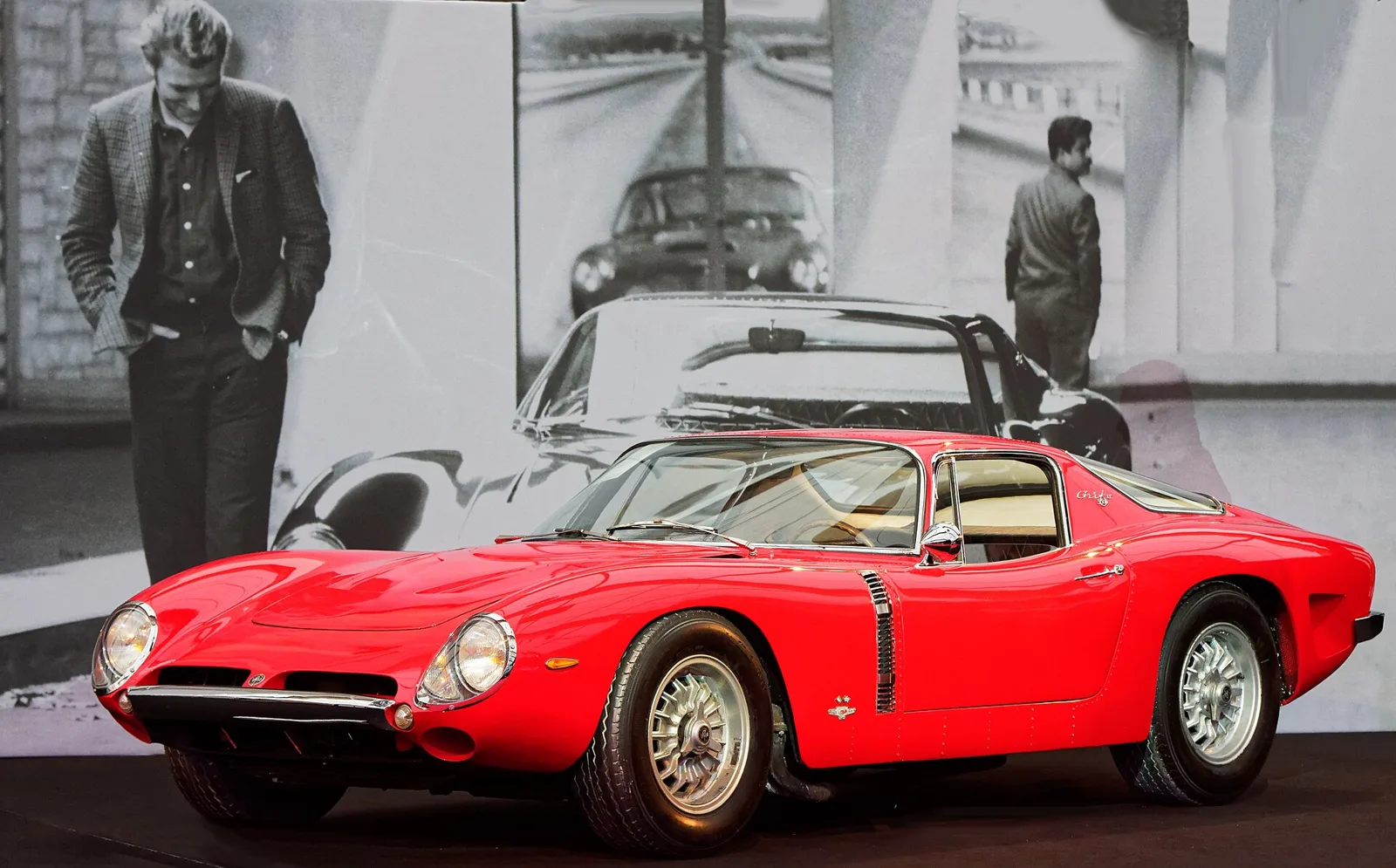
Built in tiny numbers, the Grifo A3/C paired a Chevrolet V8 with a low aluminium body built for competition.
How did the A3/C differ from the Grifo GL?
The two cars were largely independent of each other. Both debuted at the Turin motor show in November 1963, with the GL on the Bertone stand and the sporty A3/C at the Iso stand. Production of the A3/C began as early as 1963.
The first production GL cars were not available until the second half of 1965, possibly so as not to endanger sales of the IR 300.
The A3/C also had a different birthplace. Unlike the IR 300 and the GL, it was not built at Iso in Bresso or at Bertone in Turin, but in Bizzarrini's own workshop in Livorno. Its chassis was a shortened version of the IR 300's, and its front suspension and steering departed from the more comfortable sister model.
Why did Iso and Bizzarrini fall out?
In spring 1965, while Bizzarrini was working on another racing model, the Iso Rivolta Daytona, a rift opened between Renzo Rivolta and Giotto Bizzarrini. Bizzarrini had fitted some A3/C cars with his own emblem rather than the Iso Rivolta badge, or with a mixture of the two. More important was the fact that he had protected the model name Grifo.
The dispute was settled by dividing the market. Iso Rivolta kept the Grifo name for exclusive use and limited itself to the road car A3/L, sold as the Iso Grifo GL. From late summer 1965 Bizzarrini built the sports version under his own name, as the Bizzarrini GT 5300. He also received chassis and drivetrain parts from Iso, enough for about 50 more vehicles.
The GT 5300 succeeded the Iso Grifo A3/C and remained in production until 1968. That period was marked by lasting money problems at Bizzarrini's company and by a good deal of improvisation.
What were the chassis and layout like?
The Grifo A3/C used a semi-monocoque made of aluminium sheet, designed by Bizzarrini and largely identical to that of the IR 300. The A3/C's wheelbase was cut by 250 mm, to 2450 mm (96.5 in). The rear suspension used a rigid De Dion axle on four trailing links with a Watt linkage, the same as the GL.
Its front, with recirculating-ball steering and separately suspended wheels on double wishbones, departed from the more comfortable sister model.
The frame was designed to take the engine as a front-mid unit, placed as centrally as possible to give a nearly balanced centre of gravity. One consequence was that some parts, including the ignition distributor, could be reached only through the passenger compartment, through a flap in the dashboard. The 140 litres of fuel were spread across three tanks, one in each side sill and a larger one behind the seats, which gave a weight distribution of 52 to 48, front to rear.
How was the body designed and built?
The A3/C had its own body, with no stylistic links to the GL that Giugiaro drew for Bertone. The two cars shared no identical exterior parts. The A3/C body is generally credited to Bizzarrini and Piero Vanni. It was a two-door fastback coupe with two seats, and it sat extremely low.
The Strada stands 1110 mm (43.7 in) tall, the Corsa 1106 mm (43.5 in).
Round single headlamps sat in the front edges of the wings, covered by Plexiglas, where the GL had twin headlamps and a vertical radiator surround. Bumpers were absent, although some Strada models wore thin imitation bumpers for appearance. Early cars had a flat rear window and a side-trimmed B-pillar with several air outlets. From summer 1964 a rear panoramic window reaching into the flanks replaced that arrangement, and the same window later appeared on the GT 5300.
Nearly all the bodies were made by Piero Drogo's firm, Sports Cars di Benedetti and Co., formerly Carrozzeria Sports Cars, in Modena. Drogo's bodies were aluminium, often in the Avional alloy, and were mostly riveted. The one exception was chassis B-0222: in 1965 it received a plastic Corsa-style body from Vincenzo Catarsi Mare, a boatbuilder in Livorno. That car was rebuilt in 1966 as a Strada with the chassis number IA3-0222.
The link with Drogo ended in the summer of 1965, when Bizzarrini began building the car on his own account. The GT 5300 kept the same styling but took its bodies from BBM, Grosso e Vece and Subalpina.
What engine did the Grifo A3/C use?
The Grifo A3/C was powered by a 5,359 cc (327 cu in) V8 petrol engine, with a bore by stroke of 101.6 mm x 82.5 mm. Chevrolet built the engine in large series in the USA, and its small-block design was intended primarily for the Chevrolet Corvette.
Its core dated from a design introduced for the 1955 model year, and the 5.3-litre version used in the Iso had reached the American market in 1962.
Key specifications
| Specification | Iso Grifo A3/C |
|---|---|
| Engine | 5,359 cc (327 cu in) V8, Chevrolet small-block |
| Bore and stroke | 101.6 mm x 82.5 mm |
| Power, basic version | 370 bhp (276 kW), Carter four-barrel carburettor |
| Power, Corsa | 405 bhp, four Weber twin-barrel carburettors |
| Gearbox | Manual, fully synchronised four-speed |
| Wheelbase | 2450 mm (96.5 in) |
| Height, Strada and Corsa | 1110 mm (43.7 in) and 1106 mm (43.5 in) |
| Top speed, Strada | 260 km/h (162 mph) |
| Top speed, Corsa | 299 km/h (186 mph) |
| Weight distribution | 52 to 48, front to rear |
Bizzarrini changed the engines only slightly, and output depended on how the mixture was prepared. The basic version used a four-barrel Carter carburettor and reached 370 bhp (276 kW). The Corsa had four twin-barrel Weber carburettors and produced 405 bhp, or 420 SAE PS according to another account. Drive went through a manually operated, fully synchronised four-speed gearbox in every variant.
What separated the Strada from the Corsa?
The Grifo A3/C came in a road version, the Strada or Stradale, and a version built around competition, the Corsa or Competizione. The Corsa had the most powerful form of the Chevrolet engine. To keep the mass as low as possible it did without interior trim and several comfort features.
The Strada had better temperature and noise insulation, among other things.
How fast was the Grifo A3/C?
Performance depended on engine output and on the rear-axle ratio. Bizzarrini provided a standard ratio of 2.88 to 1 for both the Strada and the Corsa, and other ratios, for quicker acceleration or a higher top speed, were available on request.
On that gearing the Strada tops out at 260 km/h (162 mph), with 6.0 seconds from rest to 100 km/h. The Corsa, lighter and with more power, manages 299 km/h (186 mph) and needs 5.1 seconds for the same run.
How many were built and how were they numbered?
Work took place in Bizzarrini's Livorno works. He built the frame in-house, Iso contributed a few technical parts and Drogo produced the bodies. Carbondio may already have helped finish the cars in those years. The total number of A3/C built, and the split between Strada and Corsa, has not been conclusively established.
Giotto Bizzarrini never released official information about the scope of his car production.
The numbering system separates the cars built for Iso, which carry the prefix B-, from Bizzarrini's own GT 5300, whose chassis numbers begin with IA3-. Bizzarrini's numbers were probably not sequential, and some cars later received new numbers. Years after the 1968 collapse of Automobili Bizzarrini he rebuilt some vehicles and said they used chassis made before 1968 that had never been used. Because of these uncertainties, reconstructing output from chassis numbers, as is possible for many other makers, is not promising for the Grifo A3/C.
The main references for the output figures come from people close to Bizzarrini. Among the names are Jack Koobs de Hartog, a Dutch car historian, and Salvatore Diomante, an Italian who runs a Turin restoration firm devoted to Bizzarrini cars. Both are disputed within the classic car scene. Based on Koobs de Hartog's publications, most of the production is assigned to the Strada version.
How did the Grifo race?
Both the Strada and the Corsa were often entered in competitions. Sometimes Giotto Bizzarrini organised a quasi-works entry, but most of the cars were run by private customers. Some 28 race entries by various Grifo A3/C are documented. Works entries, by contrast, were organised from Livorno.
Works entries
Until summer 1965 the works cars were regularly entered under the Iso name. Renzo Rivolta was fundamentally opposed to racing, however, so the entries were never handled by Iso Rivolta and were run exclusively by Bizzarrini in Livorno. The team entries were therefore made out to Giotto Bizzarrini, Prototipi Bizzarrini or similar combinations.
Reims hosted the first works outing for an Iso Grifo A3/C, a 12-hour race on 5 July 1964. Bizzarrini's team entered chassis B-0207 for Pierre Noblet and Edgar Berney. They started from 12th on the grid and retired after an engine failure. The works team skipped the 1964 Le Mans 24-hour race, leaving the field to the French customer team run by Auguste Veuillet.
In October 1964 the works team, entered as Giotto Bizzarrini, ran two cars in the 1000-kilometre race at Montlhery near Paris. Noblet and Berney took the freshly rebuilt B-0208, and Mario Casoni and Odoardo Govoni the elder B-0207. The Casoni and Govoni pairing took eleventh place, and Noblet and Berney came home twenty-first.
In March 1965 Prototipi Bizzarrini fielded two cars at the 12-hour race at Sebring. Both retired after accidents before the end. Four weeks later the team entered B-0207 for Noblet and Casoni, plus a further car, probably B-0201, for Antonio Finiguerra and Regis Fraissinet, at the 1000-km race at Monza. Noblet and Casoni finished eighth, eight laps behind the winner, and Finiguerra and Fraissinet came 13th.
In June 1965 the Iso Prototipi Bizzarrini team lined up chassis B-0222, entered as an Iso Grifo A3/C, for the 24-hour race at Le Mans. It was the one-off with Catarsi's plastic body. Lacking money for a race transporter, Giotto Bizzarrini drove the car himself from Livorno to the circuit. In the classification it sat among prototypes above 5.0 litres. Regis Fraissinet and Jean de Mortemart were its drivers, and the Grifo started from 24th place on the grid. In all it completed 303 laps, which earned the class victory and ninth place overall.
Customer entries
The first successful entry by a customer team came at Le Mans in 1964, when the French team of Auguste Veuillet ran the early Corsa, chassis B-0207, with Noblet and Berney. The pair took fourteenth overall and claimed the class among prototypes above 5001 cc. Several other customer teams used various A3/C chassis in sports car and hill climb events until 1965.
Who owned the Grifo A3/C?
A number of well-known people owned an Iso Grifo A3/C at various times. The list includes the journalist and racing driver Paul Frere, whose car was B-0213, the racers Ed Hugus and George Abecassis, and the French singer Johnny Hallyday, owner of B-0209.
How did critics judge the Grifo A3/C?
Its everyday usability was often praised in print. In 1965 the British motoring journalist John Bolster noted that he had managed Paris city traffic in a Grifo A3/C without difficulty. Practical faults in detail were occasionally criticised too.
A remark quoted in the literature observes that a driver with legs long enough for the pedals would probably have shoes too wide to work them one at a time.
What is an Iso Grifo A3/C worth today?
Since the 21st century began, the Iso Grifo A3/C has ranked among the priciest cars in the world. Depending on condition and previous ownership, prices now run into seven-figure sums in euros.
Hallyday's first car, B-0209, was put up at a classic car auction in 2018, a year after his death, with heavy promotion and an estimate of 2,500,000 to 3,000,000 euros. No buyer came forward. In 2021 it was auctioned for 1,805,000 euros.