Corvette, Ford, Buick and Plymouth engines under Italian coachwork: the Grifo, the 5300 and the Indra, and the supply deals that undid them.
Iso, Bizzarrini and Intermeccanica were small Italian makers that fitted American V8s from Chevrolet, Ford, Buick and Plymouth into bodies drawn in Italy. Iso built the Rivolta GT and Grifo, Bizzarrini the 5300 GT Strada, and Intermeccanica the Apollo, Italia and Indra, before engine supply, rivals and finances ended or reshaped each firm.
General Motors made these Italian cars fast, and General Motors hurt them. Iso found that its Chevrolet engines came with a demand for payment in advance. Intermeccanica saw its Chevrolet and Opel supply switched off after the Indra had collected orders at the 1973 New York show. Bizzarrini built his best-known road car around the same Corvette V8, and his firm was gone by 1969.
The recipe never changed: an Italian chassis and body, a big American V8 bought in. Ford, Chevrolet, Buick and Plymouth all supplied engines. Two of the three firms shared an engineer, a body-builder and a racing programme, and all three ended up fighting the same problem, which was that someone else owned the heart of the car.
Where did Iso come from before the Rivolta GT?
Iso began as Isothermos, a Bolzaneto maker of electric heaters and chillers that the engineer Renzo Rivolta bought in 1939 and relocated to Bresso in 1942, once bombing had wrecked its Genoa offices. After the war he turned the business to motorbikes and, in 1953, to the Isetta.
The Isetta came from an idea Rivolta had held since the early 1950s: a vehicle halfway between a motorbike and the cheapest Italian car of the day, the FIAT 500 Topolino. Think of a motorbike with a roof. The result was an egg-shaped cabin scooter with four wheels, a 236 cm3 engine from the ISOmoto 200 and a single door that formed the whole nose of the car, windscreen and steering wheel included.
It sold poorly at home. Rivolta licensed it abroad instead, to VELAM in France, to ROMI in Brazil and to BMW, whose version was far more successful and helped push the car's eventual total to 160,000. Iso's own Isetta production stopped at the end of 1956. Early in 1957 the company dropped microcars and motorbikes altogether, and Rivolta started again as a maker of high-end Gran Turismos, aimed at the gap between the German or American idea of a GT and the Italian one.
GM changed course, cut off the Chevrolet engines as well as the Opel parts, and told its German dealers to stop selling the Indra.
How did the Iso Rivolta put a Corvette V8 into an Italian grand tourer?
The Iso Rivolta IR 300 was a luxury coupe styled by Bertone from Giorgetto Giugiaro's sketches, with a chassis by Giulio Alfieri and a Chevrolet Corvette V8 under the bonnet. The 300 in its name stood for the engine's power in horsepower. From that car on, Iso's course was set: fast, finely finished grand tourers.
Pairing Italian lines with a Corvette engine had a British precedent. Iso's first prototype, the Iso Gordon GT, grew out of the Gordon-Keeble, a car Giugiaro had drawn in 1960. Giotto Bizzarrini, whom Rivolta hired as a consultant on the project, drove the Gordon-Keeble and came away impressed by two things: the power of the Corvette V8 and the De Dion layout at the rear. A De Dion axle ties the rear wheels together with a tube while the differential stays bolted to the chassis, so the wheels stay upright without the weight of the final drive hanging from them.
The production Iso Rivolta GT was a four-seater drawn by Giugiaro, with a 327 cu in (5.36 L) Corvette V8, the De Dion rear end, and pressed steel monocoque bodywork over a pressed steel frame. It was unveiled to the press in 1963 and stayed in production until 1970, finding 799 buyers. The IR 300 had been presented publicly in 1962, with the production GT following to the press in 1963.
What made the Iso Grifo so fast?
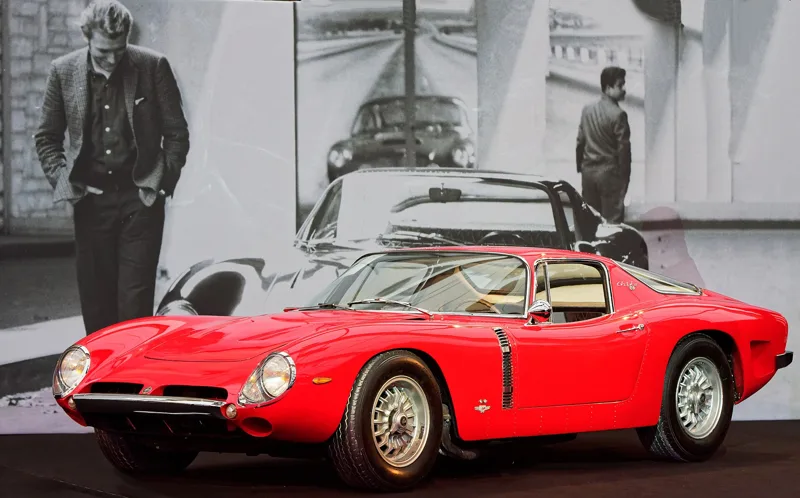
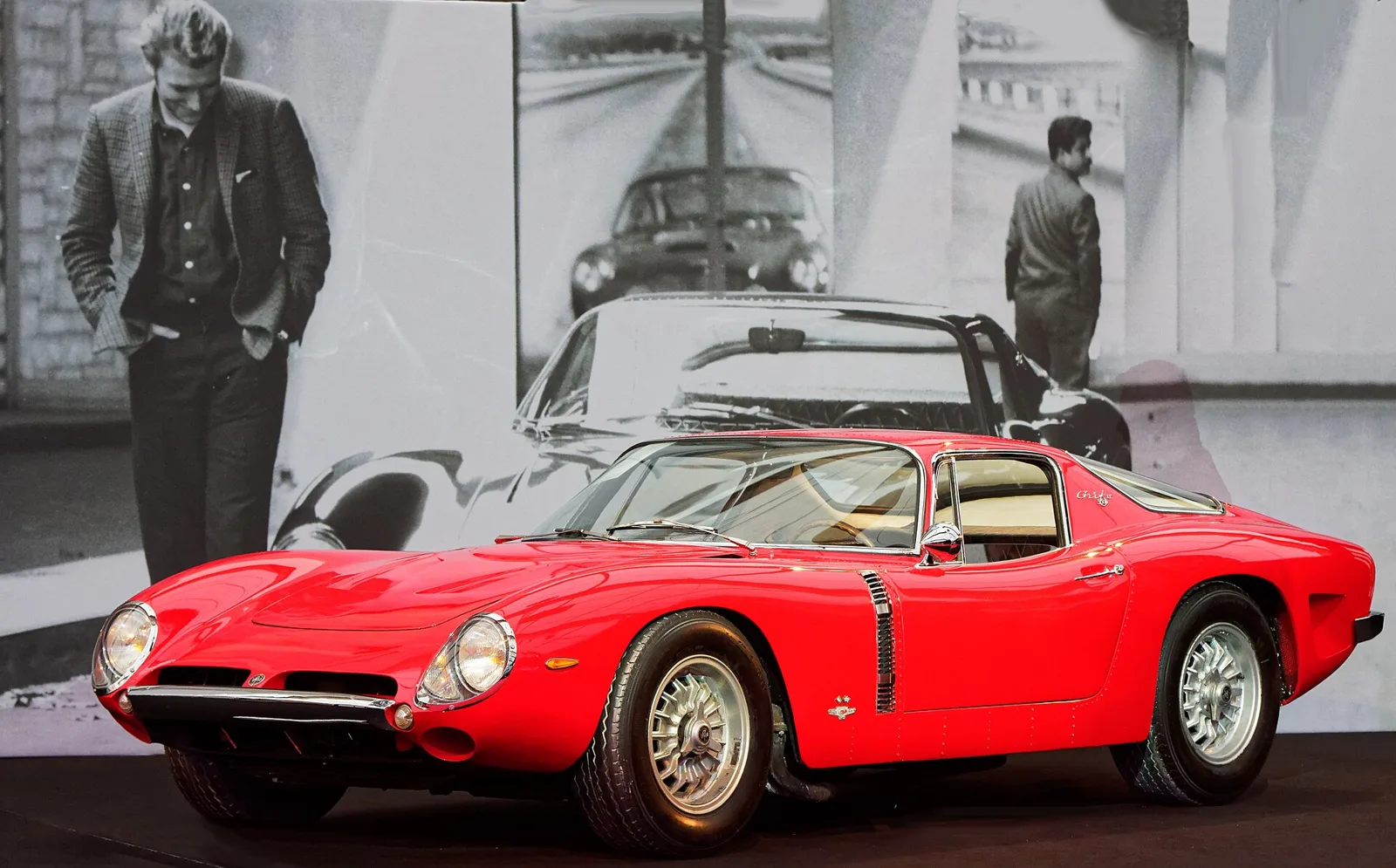
The Grifo A3L was a two-door V8 coupe built on a shortened Rivolta GT chassis, with the L standing for Lusso, or luxury. Giugiaro and Bizzarrini worked on it together. Autocar tested it in 1966 and found it the fastest production car it had tried, with a top speed of 260 km/h (160 mph).
The Grifo was shown at the 1963 Turin show, and the production Grifo coupe is dated to 1965, after sales began in the United States and Iso signed a stable engine contract with General Motors. Engines ran from 5.4 to 7 litres.
The biggest was in the Grifo 7 Litri, which took a big-block Corvette V8 rated at 441 PS (324 kW; 435 bhp). Only 90 of these handbuilt cars were made, and a raised, pagoda-style scoop on the bonnet gives them away. Some were rebuilt later with even larger engines. The same chassis, standard, shortened or stretched, underpinned the Fidia luxury saloon of 1968 and the Lele 2+2 grand tourer of 1969, which Marcello Gandini drew at Bertone.
How did Giotto Bizzarrini turn the Grifo into a racer?
Bizzarrini wanted the Grifo on the track, so he developed the A3C, with C for Competizione or Corsa. Piero Drogo, in Modena, built a lightweight riveted aluminium body for it. The engine moved back in the frame until it poked into the cabin, and with hot camshafts and four big Weber carburettors it made more than 406 PS (298 kW; 400 bhp).
Bizzarrini had the pedigree for it. Born in Livorno in 1926, he graduated in engineering at the University of Pisa in 1953, spent 1954 to 1957 at Alfa Romeo and then moved to Ferrari. Over five years there he worked as developer, designer, test driver and chief engineer, and his projects included the 250 TR, the 250 GT SWB and the 1962 250 GTO. He was fired in the "palace revolt" of 1961 and joined ATS, a company started by other ex-Ferrari engineers.
At Iso the Drogo bodies used so many rivets, 1,700 by one count, that the A3C picked up the nickname millechiodi. Around 29 carried Iso badges, and five of those wore fibreglass bodies from Drogo. They ran at Le Mans in 1964 and 1965, at the 1965 Nurburgring 1000 and at Sebring. With no factory support, they took a class win at Le Mans both years and ninth overall in 1965, and they were among the quickest cars on the Mulsanne Straight. In 1965 the actor and singer Johnny Hallyday bought the berlinetta version.
The partnership did not last. Bizzarrini wanted to build race cars, while Rivolta wanted high-quality GTs, and the two parted in 1964 after what is described as a complicated deal.
What was the Bizzarrini 5300 GT Strada?
The 5300 GT Strada was the road-legal version of the Grifo A3C, released in 1966 by Bizzarrini S.p.A. It was sold as the 5300 GT America in some markets. With body shape and mechanical parts much like the Iso racer's, the coupe stood only 1.09 m (43 in) high.
Bizzarrini had founded Prototipi Bizzarrini in 1964 and renamed it Bizzarrini S.p.A. in 1966. At Livorno it built some 140 cars before failing in 1969. The 5300 GT Spyder S.I. was built just three times, from 1966, by Stile Italia and Sibona e Basano, and appeared at the 1966 Geneva show as a spyder and targa. All three survive.
Bizzarrini also tried a smaller idea. He proposed a scaled-down 5300 GT to GM-Opel, built on the Opel 1900 platform. The company chose its own stylists' less aggressive design, which became the Opel GT, so he built his version himself as the 1900 GT Europa. Around 17 prototypes were finished, with 1.3 L and 1.6 L four-cylinder engines from GM, Alfa Romeo and Fiat, plus a racer with SPICA fuel injection.
The P538S carried the Corvette-engine idea furthest. The name is a code: P for posteriore, 53 for the 5300 cc engine, 8 for the V8 and S for Sports car. At Le Mans in 1966 it spun at the start and retired in under half an hour with a cracked oil line, yet it was clocked among the fastest cars on the Mulsanne Straight. A 1967 entry did not qualify. Three or four chassis were built in period, and a dozen or more exist now, some of them replicas claiming to be the Le Mans cars. At least two of the replicas use Lamborghini V12 engines.
Sebring in 1965 was the low point. On 27 March both Iso/Bizzarrini race cars crashed beyond repair. One lost its brakes and hit a Volkswagen bus; the other aquaplaned in heavy rain, struck a pedestrian bridge and split in two behind the driver. Nobody was injured in either crash. The California builder Max Balchowsky took the wreckage home to make one car from two, and that car has never been seen again. Later the same year came the high point, at Le Mans in June, with the class win and ninth place.
What was the Intermeccanica Italia?
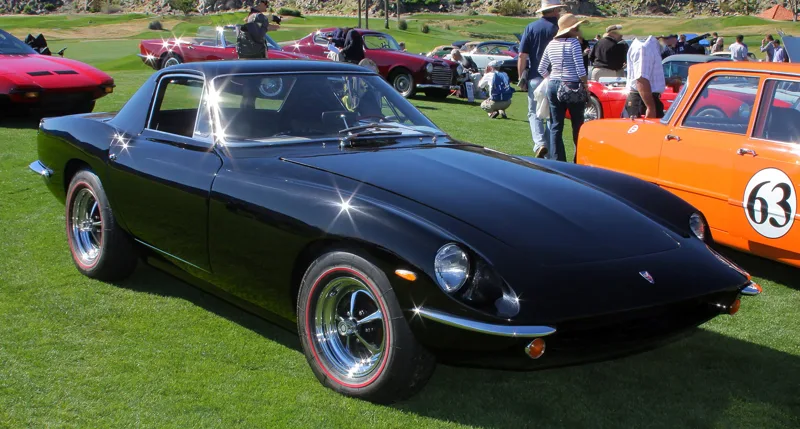
The Italia was a Ford-powered grand tourer from Intermeccanica, a Turin firm founded in 1959 by Frank and Paula Reisner. It began as the Torino until Ford's hold on that name forced a change, and was built as a coupe and as a convertible that sold especially well, with about 500 produced.
About 500 Italias were built, with the run dated between 1966 and 1972. Output reached 100 to 120 cars per year, but only after it became clear that cars had to leave Italy fully assembled and running. With financing from Credito Italiano and a New Jersey distributor, Genser Forman, they did, all with Ford V8s and Ford running gear.
Before that, Intermeccanica sold tuning kits for Renault, Simca, Peugeot and DKW, and free-flow exhausts for 50 or more European cars. It built a rear-engined Formula Junior in 1960 and 21 small aluminium coupes on the Puch 500, one of which won its class at the Nurburgring.
American money arrived next. International Motor Cars of Oakland, California, commissioned the Apollo GT, a body first drawn by Ron Plescia and then tweaked by Franco Scaglione. Intermeccanica supplied steel body and chassis units; IMC finished them in Oakland with Buick's new aluminium V8 and Buick running gear, leather trim and Borrani wire wheels. Between 1961 and 1965 the total was 88 cars: 77 coupes, counting an alloy prototype and a 2+2 prototype, and 11 convertibles.
In 1966 Jack Griffith, who had already tried a transatlantic venture with the TVR Griffith 200, backed a bigger production car. The Griffith GT was shaped by Robert Cumberford and given a chassis by John Crosthwaite, and it appeared in New York with a Plymouth 4.5 L V8. Around fourteen cars shipped before Griffith's company closed. Steve Wilder took over, renamed the car the Omega and had Holman and Moody assemble 33 in North Carolina for the United States.
The Indra was the biggest success. Opel, a GM subsidiary, approached Intermeccanica, and with Erich Bitter as distributor they built a car around a Chevrolet 350 V8, Hydramatic transmission, De Dion rear end, disc brakes and parts from the Opel Diplomat. Scaglione styled it, and it was shown at Geneva. Between 1971 and 1974 125 were built as a convertible, a notchback coupe and a fastback coupe.
Then the supply line broke. GM changed course, cut off the Chevrolet engines as well as the Opel parts, and told its German dealers to stop selling the Indra. The results for Intermeccanica were disastrous. Bitter's answer was a near-identical car, the CD, with Baur doing the building.
Italian American hybrid cars side by side
| Maker | Car production began | American engines | Best-known cars | Numbers built | What happened |
|---|---|---|---|---|---|
| Iso | 1962 (IR 300) | Chevrolet Corvette V8; Ford Cleveland from the end of 1971 | Rivolta GT, Grifo A3L, Grifo A3C | 799 Rivolta GT; 90 Grifo 7 Litri; around 29 A3C | Car production ended 31 December 1974 |
| Bizzarrini | 1964 | Chevrolet Corvette 5300 cc V8 | 5300 GT Strada, P538S | Some 140 cars through 1969 | Failed in 1969; name acquired in 2020 |
| Intermeccanica | 1959 (firm); Apollo GT from 1961 | Buick aluminium V8; Plymouth V8; Ford V8; Chevrolet 350 V8 | Apollo GT, Italia, Indra | 88 Apollo; about 500 Italia; 125 Indra | Moved to California in 1975, to Vancouver by 1982 |
What brought each maker down?
Each firm failed for its own reasons, but one supplier ran through two of them. Iso met GM's demand for advance payment on engines, switched to Ford Cleveland units by the end of 1971, and was then squeezed by rivals and the 1973 oil crisis. Intermeccanica lost its Chevrolet and Opel supply in a single policy change.
Iso's last years were crowded. The Rivolta family floated the company in New York in early 1973, and a deal with Philip Morris and a young team manager, Frank Williams, created the Iso-Marlboro Formula 1 team. The company was renamed ISO Motors & Co., made 10,000 snowmobiles, and the family gave up ownership. Costs, falling sales and a late start in gaining the United States' Small Manufacturer status, which brought lighter penalties, all counted against it. Car production ended on 31 December 1974.
Bizzarrini S.p.A. lasted five years. Intermeccanica kept going by changing its product. Reisner moved to Santa Ana, California, in 1975, where a prototype Indra project funded by San Bernardino was cancelled about a month after the family arrived. A Porsche Speedster replica followed in 1976 and about 600 were built. A neo-classic on a Checker chassis, code-named Lexington, died when financing could not be found. In 1981 Reisner developed the Roadster RS from the 1959 Porsche 356 convertible, and with local investors moved production to Vancouver. A tubular chassis arrived in 1985, a Kubelwagen replica in the mid-1990s.
Which of the three marques have been revived?
Bizzarrini's revival has been the longest wait. Concept cars appeared in the 2000s, among them the 2005 GT Strada 4.1, a two-door GT with a 4.1-litre engine of 558 PS (410 kW; 550 bhp), a quoted top speed of 360 km/h (220 mph) and a 3.8-second sprint from 0-100 km/h, and production pencilled in for 2007. In 2020 Pegasus Brands acquired the name and announced plans to restart production with new models that draw on Giotto Bizzarrini's racing and design past.
ISO Rivolta came back in 2017 under Atelier Zagato, first as the Vision concept built to race virtually in PlayStation's Gran Turismo, which over 120,000 gamers adopted. That led to the family's decision to build the GTZ, designed and produced by Zagato in a partnership with Chevrolet Corvette, with only 19 to be produced. A museum project for the old Bresso warehouses has been in development for years.
Intermeccanica, now Intermeccanica International Inc., builds the Roadster, modelled on the 1959 Porsche 356 convertible, plus a Kubelwagen replica, a 1958 Speedster and turbo-look versions. Henry Reisner, who took over after his father's death in October 2001, co-founded ElectraMeccanica in 2015 to make electric commuter cars. Intermeccanica has been its subsidiary since 2017, and the team has worked on the SOLO and the TOFINO.
How rare are these cars, and who supports their owners?
Rarity sets the terms. Beyond Iso's 799 Rivolta GTs and about 500 Intermeccanica Italias, the numbers are tiny: some 140 Bizzarrinis in total, 125 Indras, 90 Grifo 7 Litris and just three Spyder S.I. cars. Under the skin, nearly all of them are Detroit hardware in Italian clothes.
Anyone eyeing a P538S has to reckon with replicas, because some claim to be the cars raced at Le Mans. Support exists, though. The Iso and Bizzarrini Owner's Club publishes a magazine, there is an interest circle in Switzerland, and the IsoRegistry covers the Grifo, Rivolta and Lele. A Bizzarrini BZ-2001, a one-off on a Ferrari Testarossa chassis with a carbon body, sold to a Swiss collector in 2021.