Intermeccanica bodies, Griffith Motors engines and a 1966 American launch: a sports car that never got past its first batch of cars.
The Griffith 600 was an Italian-American sports car built by Intermeccanica in Turin and fitted with engines by Griffith Motors in New York. It was marketed in the USA in 1966, and the project collapsed soon after the first cars were finished.
The Griffith 600 was a transatlantic project. Italian bodywork from Turin, American engines fitted in New York and a sales plan for the USA all came together in 1966. The project fell apart soon after the first cars were finished, and its further developments were the Omega GT of 1967 and the Intermeccanica Torino and Italia.
How did Intermeccanica come to build the Griffith?
Frank Reisner founded Intermeccanica in Turin in 1959. By 1962 the firm had a two-seat sports car ready, and small-scale production began the following year. Intermeccanica sent complete cars without drivetrains to businesses in California and Texas, which installed General Motors power and sold the results as the Apollo GT and Vetta Ventura. Those businesses struggled, and output halted in autumn 1965 after 88 or 89 cars.
On Long Island, Griffith Motors had been bringing in TVR Grantura sports cars since 1962. Following the recipe of the AC Cobra, it dropped Ford V8s into them and marketed the results as the Griffith 200 and 400. TVR's collapse brought that tie to an end at about the time the Apollo venture also faded.
The two sides found each other at the 1965 New York Auto Show. Under their deal, Intermeccanica would supply engine-free bodies from 1966 for Griffith to sell in America, taking over the role TVR had played. For Reisner the arrangement promised lasting stability, since Griffith wanted 1,000 cars, a quantity well beyond anything Intermeccanica had produced so far.
A Turin body and a New York sales deal, undone in part by a heavier Plymouth engine.
Why did the Griffith 600 end up with Plymouth engines?
Jack Griffith had assumed American Ford engines, as in his earlier sports cars, and the chassis and suspension were laid out around that plan. He never secured a supply of Ford units. One version of events blames unpaid bills from the TVR era. The first car received a Ford unit, probably left over from his stock, and series cars moved to Plymouth V8s from the family of Chrysler, a Ford rival. The advertising ran with the slogan Plymouth powered.
The Plymouth unit was physically bigger than the Ford and heavier too, and fitting it meant reworking the front end. Chrysler supplied a batch of ten engines and gearboxes to Griffith in 1966, but it appears that only one car at the Griffith works received a Plymouth engine. The added weight pushed the handling in the wrong direction.
How was the Griffith 600 developed?
Griffith's first idea was to bring in the 2+2 model of the Apollo GT. Intermeccanica had built one prototype of it in autumn 1964, and that car stayed unique. Copyright ruled the plan out, because the design was owned by Vanguard Motors Corporation, a company that had once worked with Intermeccanica. A fresh car, technically and visually distinct from the Apollos, left the drawing board in winter 1965/66.
Griffith recruited Robert Cumberford, who had once worked at General Motors, and John Crosthwaite, a British racing car designer whose earlier work included BRM, Cooper and Lotus. Crosthwaite was seen as a specialist in chassis work. The racer Mark Donohue joined for test runs, and Griffith's advertisements went so far as to name him chief engineer.
On the Plymouth-engined car, Donohue reported heavy understeer, and he called the braking of the front-heavy car a nightmare. Griffith failed to solve these problems by the summer of 1966.
How was the Griffith 600 engineered?
The frame was a ladder structure built from welded steel tubing with square sections. Suspension at the front was independent, using components from the Fiat 2300, while the rear had a live axle located by a Panhard rod. Discs were fitted at every corner. Ford had originally been expected to supply the suspension parts for production. Intermeccanica had developed the chassis and suspension on that Ford basis.
Accounts of the chassis differ. One credits Frank Reisner, with John Crosthwaite offering only minor detail suggestions that Reisner accepted. Another names Crosthwaite as the sole designer. The disc brakes came from the British company Girling.
What did the Griffith 600 look like?
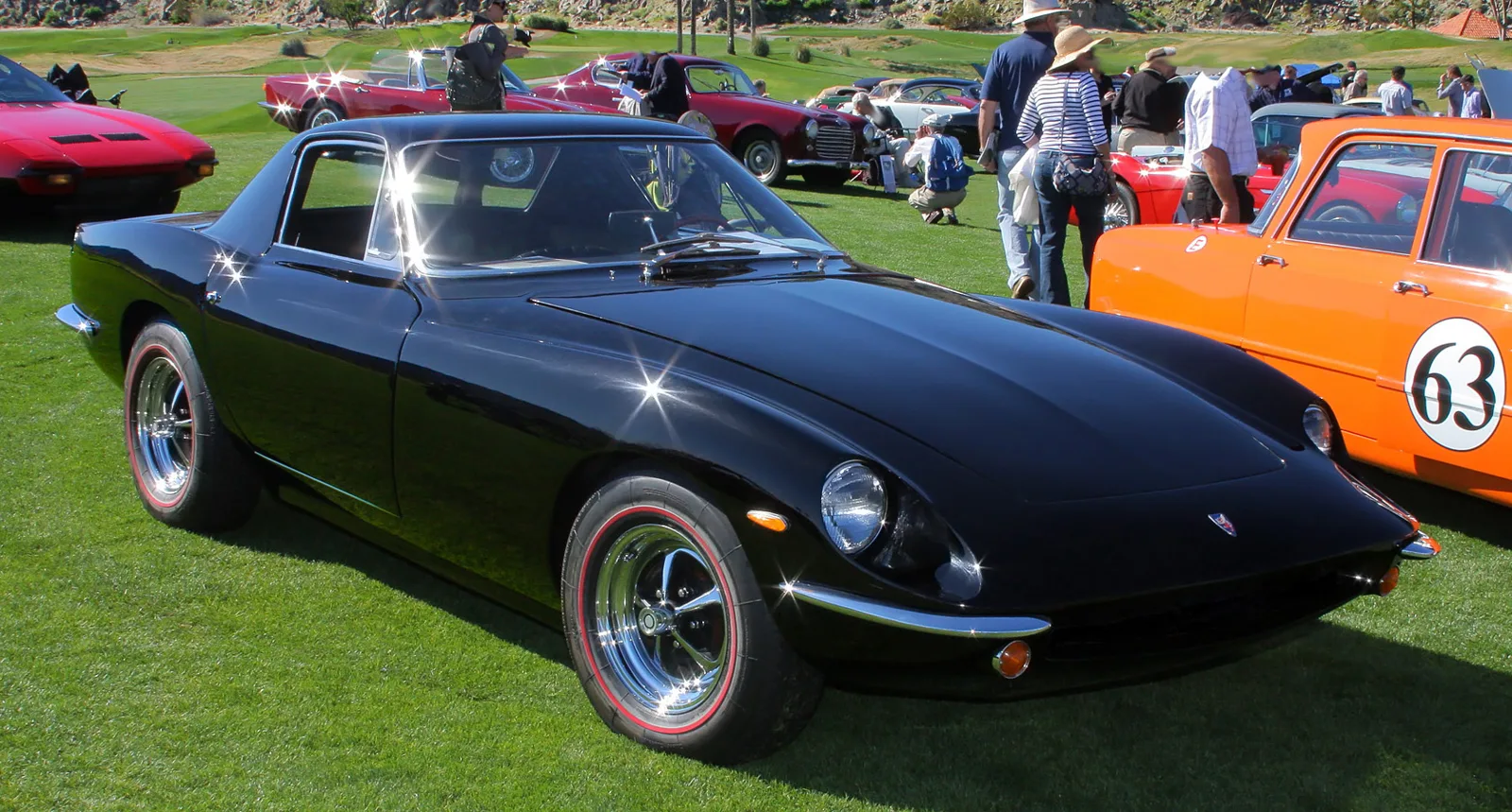
Earlier Griffith sports cars had glass-fibre bodies, but this one was steel sheet, shaped by hand over a wooden model. The shape started as a sketch by Robert Cumberford, and the former Bertone designer Franco Scaglione refined it for Intermeccanica.
Designers planned a two-door fastback coupe and a two-door convertible, with matching styling apart from the roof. The proportions borrowed from the Ferrari 275 GTB, which had appeared in 1964. The nose is long, while the passenger area sits well back and is compact.
Round headlamps sit slightly set back in the front wing ends. The air intake gets a two-piece bumper, as on the Ferrari, though a single car wore a continuous bumper over the radiator opening. At the back, horizontal lamps came from the Renault 8, and the coupe's roof has a trapezoidal outline with the B-pillar fully trimmed.
Which engines did the Griffith 600 use?
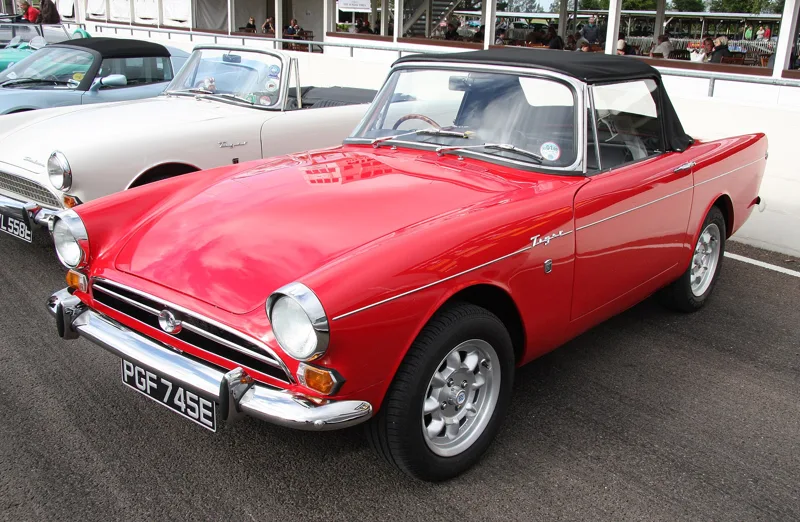
The first car ran a 4,727 cc (289 cui) Ford Windsor V8, the same unit Griffith had put in its 200 and 400, and rivals such as the AC Cobra and Sunbeam Tiger could be had with it too. It produced 200 PS (147 kW) and weighed 230 kg (506 lb).
Production cars were to get the Plymouth Commander, a Chrysler LA-series small-block of 4,473 cc (273 cui) with a 92.1 mm bore and 84.1 mm stroke. Griffith specified the high-performance tune, giving 238 PS (175 kW). Weighing 245 kg (525 lb), it was the top engine option in the Plymouth Barracuda that year.
Chrysler was to supply a four-speed manual gearbox, with a three-speed automatic available at extra cost.
Engines compared
| Engine | Displacement | Output | Weight |
|---|---|---|---|
| Ford Windsor V8 (first car) | 4,727 cc (289 cui) | 200 PS (147 kW) | 230 kg (506 lb) |
| Plymouth Commander V8 (series) | 4,473 cc (273 cui) | 238 PS (175 kW) | 245 kg (525 lb) |
Where were the cars built?
Intermeccanica relied on a web of Turin subcontractors. Balla produced the chassis, Cellino assembled the body, Fillippone sprayed the paint and Carbondio fitted the glass and interior. Intermeccanica sent the finished cars abroad ready to go, while engines and gearboxes were meant to be installed by Griffith in the USA.
How many Griffith 600s were built?
Nobody knows for certain. Most accounts settle on six cars delivered to Griffith, while others claim 10 or 14 without explaining why. Only six coupes are documented.
Convertibles appear in Griffith's plans, but no open 600 is confirmed. Probably just two cars received engines at Griffith's own works, one a Ford and one a Plymouth. The rest left without drive units, and their buyers installed their own.
What happened after the Griffith 600?
Griffith Motors was already in serious economic difficulty when the agreement was signed, and the Intermeccanica deal was its last attempt to find new income. The car's problems came from several directions at once: the Plymouth installation never fully worked out, Griffith could not meet its purchase commitments, and the company went bust once the first shipment landed in New York.
By then, Intermeccanica's subcontractors had completed more than 170 bodyshells that were still waiting in Italy. Journalist Steve Wilder and Suspensions International took the project on in late 1966. In 1967 they sold about 33 Omega GT cars using the Ford engine Griffith had planned, and that partnership also collapsed in under a year.
From 1968 Intermeccanica sold the largely unchanged cars under the Torino and Italia names. This is when the company finally found steady success, with more than 500 built in that form. Erich Bitter sold the Italia in Germany for a time, and the Italia came before the Bitter CD sports car.