Iso's 1953 microcar, its licensed builds across Europe and South America, and the BMW version that sold 161,728 units.
The Isetta is a microcar that Iso SpA of Italy launched in 1953 with a 236 cc two-stroke engine and an egg-shaped body. It was later built under licence in several countries, and BMW's version sold 161,728 units before production ended in 1962.
Born in Italy in 1953, the Isetta was a microcar from Iso SpA that later spawned licensed versions in several countries. Its rounded body and bubble windows earned it the nickname bubble car. BMW's version became the best-known Isetta, and the family's 161,728 units made it the best-selling single-cylinder car worldwide.
Where did the Isetta come from?
Iso was an Italian company that made fridges, scooters and light three-wheel trucks. Its owner, Renzo Rivolta, decided that a small car for mass distribution could open a new market, and he pushed the project forward. Its engineering background in machinery shaped the simple design that followed.
Engineers Ermenegildo Preti and Pierluigi Raggi had a design ready by 1952. It took its power from the Iso Moto 200 motorcycle engine, and the name is an Italian diminutive that roughly means little Iso. The press first saw the car in Turin in November 1953.
An egg-shaped microcar with a nose that opened like a door, and a licence that carried it across the world.
Why was the Isetta called a bubble car?
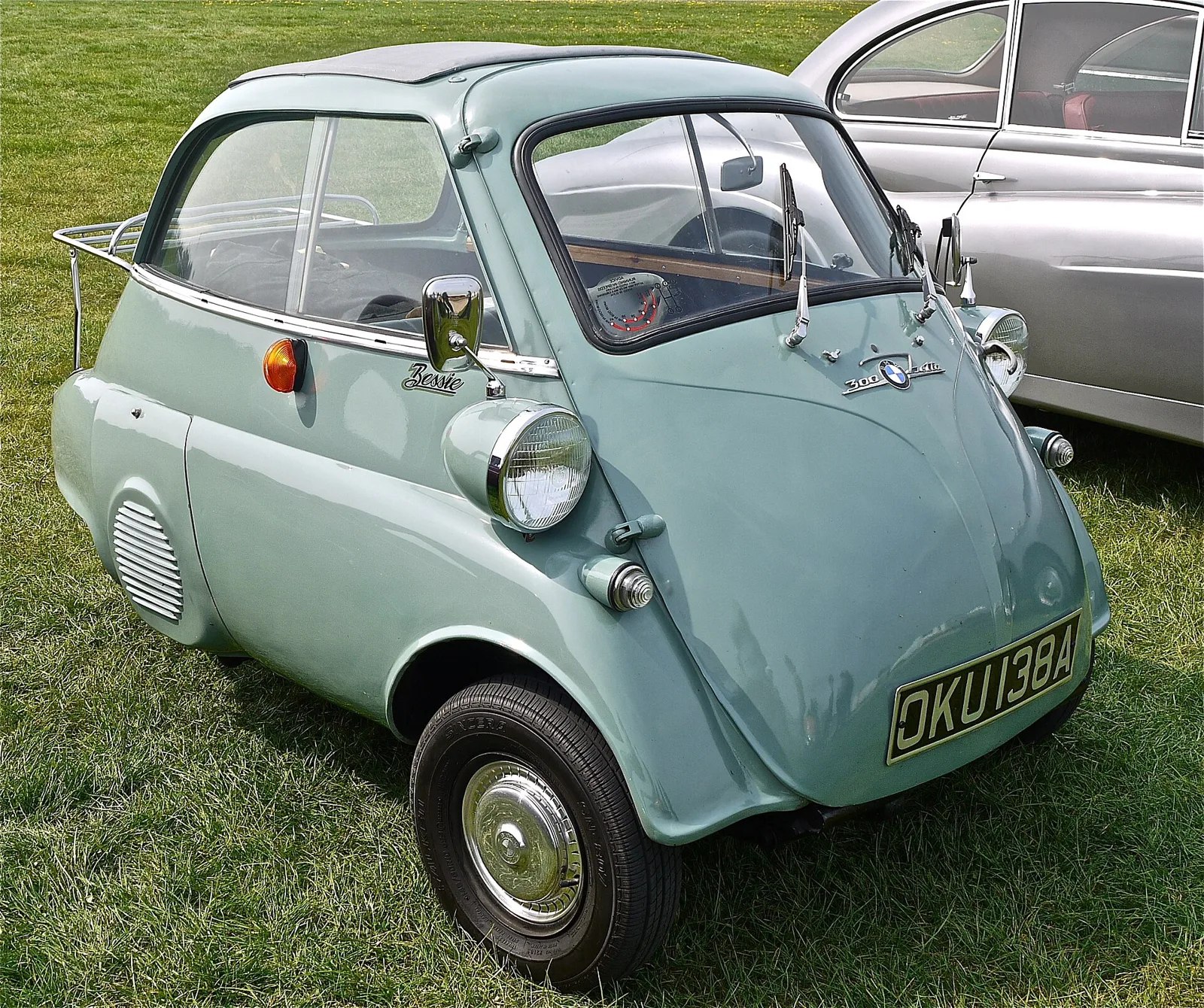
The body was egg-shaped, and its windows were round and bulbous, which gave the car its nickname. The look was unlike anything on the road at the time, and the bubble car label was later attached to other vehicles with a similar outline.
At 2.29 m (7.5 ft) long and 1.37 m (4.5 ft) wide, the car was small enough to fit into tight urban spaces. The rounded silhouette kept the footprint compact while still leaving room for two people to sit side by side.
How did the Isetta open and seat its occupants?
The whole nose of the car swung open on hinges, turning the front into the entry point. The steering wheel and dashboard moved outward with the door, which cleared a path to the bench seat behind them. That single opening was the signature feature that made the car easy to enter.
That bench was wide enough for two adults and perhaps a small child. A large parcel shelf sat behind the seat, with the spare wheel tucked beneath it. Air came in through the front triangular windows and the fabric sunroof, which also served as an emergency exit in an accident.
What powered the original Isetta?
The first cars used a 236 cc two-stroke, split-single engine rated at 7.0 kW (9.5 hp). A combined generator and starter called the Dynastart brought the engine to life, and a manual gearbox offered four forward gears and reverse. Power output was modest even for the period, which kept the car's pace in line with its city role.
Power reached the rear wheels through a chain and a solid axle. Early prototypes carried one rear wheel, but that layout tipped over too easily, so the design moved to a pair of wheels 480 mm (18.9 in) apart. The narrow track meant no differential was needed.
How fast was the original Isetta?
Getting to 50 km/h (31 mph) from a standstill took the original car more than 30 seconds. Its maximum was roughly 75 km/h (47 mph), which suited the short city runs the design had in mind. Those figures place it firmly in the slow lane, even among microcars.
The fuel tank held 13 litres (2.9 imp gal; 3.4 US gal), and consumption ranged between 5.6 L/100 km and 4.0 L/100 km depending on conditions. Those numbers mattered to owners who drove a great deal around town.
Who built the Isetta under licence?
Firms in Spain, Belgium, France, Argentina, Brazil, Germany and Britain built the car under licence. Each arrangement gave a local firm the right to make the car, and many of those firms adapted the design to suit their own parts and markets.
BMW opened talks with Rivolta in mid-1954 and acquired the licence along with the full body tooling. That tooling was the key asset, because it let BMW produce the body with its own equipment rather than building new dies.
How did BMW change the Isetta?
BMW rebuilt much of the car, so that no part of a BMW Isetta Moto Coupe could be swapped with one from an Iso Isetta. Its single-cylinder four-stroke was a motorcycle-derived unit of BMW's own making, producing 8.8 kW (12 PS).
The first BMW Isetta rolled out in April 1955, and about 10,000 were produced in the following eight months. The 250 kept the bubble look but moved its headlamps to the sides of the body, and the BMW roundel sat beneath the windscreen.
What did the 300 cc Isetta change?
BMW introduced a 300 cc version in February 1956, when its enlarged engine displaced approximately 297 cc. Output rose to 9.6 kW (13 PS) at 5200 rpm, which strengthened the car's performance over the earlier 250 engine, whose 8.8 kW (12 PS) was modest.
In October 1956 BMW introduced the Isetta Moto Coupe DeLuxe, which replaced the bubble windows with longer sliding side windows. That change altered the car's appearance while retaining its basic layout.
Was the BMW 600 a bigger Isetta?
The BMW 600 aimed to build on the Isetta idea with extra power and a conventional four-wheel layout. Its wheelbase was stretched to seat four, and a standard rear axle replaced the earlier arrangement. The result was a far more conventional car than the Isetta, with a cabin for four passengers.
The 600 also brought a semi-trailing arm rear suspension, which was new to the car. The 600 used the 582 cc boxer from the R67 motorcycle and reached 103 km/h (64 mph). BMW built 34,000 of them in two years.
How did the Isetta sell in Britain?
Production in the United Kingdom started in 1957 under the Isetta of Great Britain company. British cars were right-hand drive, so a counterweight of 27 kg (60 lb) was fitted to the left side to balance the engine on the right.
The British car was not popular until a three-wheeled version arrived, because three-wheelers were taxed as motorcycles. The company also built four-wheel cars shipped overseas to Canada, New Zealand and Australia before ending car production in 1962.
What were the Isetta's sales figures?
The BMW family's total of 161,728 units is the figure most often cited. That total is the basis of the car's reputation as a commercial success. Iso built only about 1,000 cars in Italy before that production ended in 1955, and it kept building the car in Spain until 1958.
Licence builders added their own totals. Romi-Isetta in Brazil made about 3,000 cars from 1956 to 1961, while Argentina's Metalmecanica built 798 examples before moving to the BMW 600.
What was the Iso Autocarro?
The Autocarro was a commercial relative of the Isetta, built on a four-wheel layout with a full-width rear axle and conventional leaf springs. Its body styles included a flatbed pickup, an enclosed truck and a fire engine, although some variants may never have been sold.
Iso built more than 4,000 Autocarros between 1954 and 1958, and the type was also built in Spain. Its frame was a large tubular ladder design that could carry a 500 kg load, which made the vehicle far more practical for working use than the passenger car.
How did the French VELAM version differ?
VELAM acquired a licence from Iso in 1954 and began production in June 1955. Because Iso had already sold its body-making equipment to BMW, VELAM developed a body of its own while keeping the original Iso engine. The French version was therefore a separate body design on Iso mechanics.
French production ended in January 1958, after competition from the Citroen 2CV and then the Renault Dauphine reduced demand for the small car.
How did Brazil and Argentina build the Isetta?
Brazil and Argentina both built versions of the Isetta under licence, and their output differed sharply. Argentina's Metalmecanica built 798 Isettas before moving to the BMW 600, which it produced in 1,413 examples from 1959 to 1962. Its record is one of the clearer comparisons between licence builds.
Romi-Isetta kept the Iso engines until 1958, so the Brazilian car stayed closest to the original Italian design for its first two years. That early loyalty to the Iso engine set it apart from later builds that moved to BMW power units.
Did the Isetta live on in later cars?
The Isetta shape returned several times. Each later car revived the bubble look in a new form. The firm Tri-Tech sold a Zetta replica in the UK, and it could be bought as a kit or as a finished car, using modern motorcycle engines.
The Microlino was revealed at the 2016 Geneva Motor Show as a microcar inspired by the Isetta, and it drew pre-orders for more than 8,000 vehicles. Rumours of a BMW iSetta followed an Auto Express report on the company's small-car work with the University of Bath, but no such car was built.
Did the Isetta race or set records?
In the 1954 Mille Miglia, several Isettas entered by Iso finished first, second and third in the economy category. Across 1,600 km (1,000 mi), the crews kept an average above 70 km/h (43 mph). Those results were a strong showing for a microcar in a long-distance event.
In 1957 a streamlined VELAM roadster captured seven world records for cars under 250 cc at the Linas-Montlhery autodrome. VELAM was the French licence builder, and its record run showed the car could do more than city work. Those results gave the Isetta a competitive reputation beyond its size.
Isetta specifications at a glance
| Item | Detail |
|---|---|
| Length | 2.29 m (7.5 ft) |
| Width | 1.37 m (4.5 ft) |
| Original engine | 236 cc two-stroke, 7.0 kW (9.5 hp) |
| Original fuel tank | 13 litres (2.9 imp gal; 3.4 US gal) |
| Original top speed | About 75 km/h (47 mph) |
| BMW 250 engine | 250 cc four-stroke, 8.8 kW (12 PS) at 5800 rpm |
| BMW 300 engine | Approximately 297 cc, 9.6 kW (13 PS) at 5200 rpm |
| BMW 600 top speed | 103 km/h (64 mph) |
| BMW total units | 161,728 |
| Romi-Isetta output | About 3,000 cars, 1956 to 1961 |