A pontoon-bodied four-door from 1939-1940 that never reached series production, was built only as three test cars and left its styling in later BMW models.
Designed in 1939 and 1940 to succeed the BMW 326 as a four-door upper-class saloon, the 332 never reached series production. The Second World War ended that plan, leaving three pre-series test cars, and none of them still exists today.
The BMW 332 was a four-door upper-class saloon with a streamlined pontoon body, developed by BMW in 1939 and 1940 but never put into series production. The Second World War stopped the plan, and only three pre-series cars were built for testing. None of them survives, although the car's shape and some of its details reappeared in BMW models after the war.
Why did BMW design the 332?
The 332 was meant to replace the BMW 326 from 1940. BMW had built the 326 at the former Dixi works in Eisenach since 1936, and almost 16,000 were built, making it the most successful pre-war model alongside the small BMW 3/15 PS. By 1939 the 326's saloon bodies, with a tall, narrow bonnet, curved front and rear wings and running boards, looked conservative beside the newest models from Adler and Opel.
The rapid expansion of the autobahns also created a need for a body that could reach higher speeds. A more aerodynamic body was the answer, and the 332's pontoon shape was BMW's response. It was intended as the starting point for a whole family of models, just as the 326's underpinnings had carried the 327, 327/28 and 328 from 1936 onwards.
Three pre-series cars, a war that ended the plan, and a pontoon shape that later BMW models quietly borrowed.
How did the 332 grow out of earlier test cars?
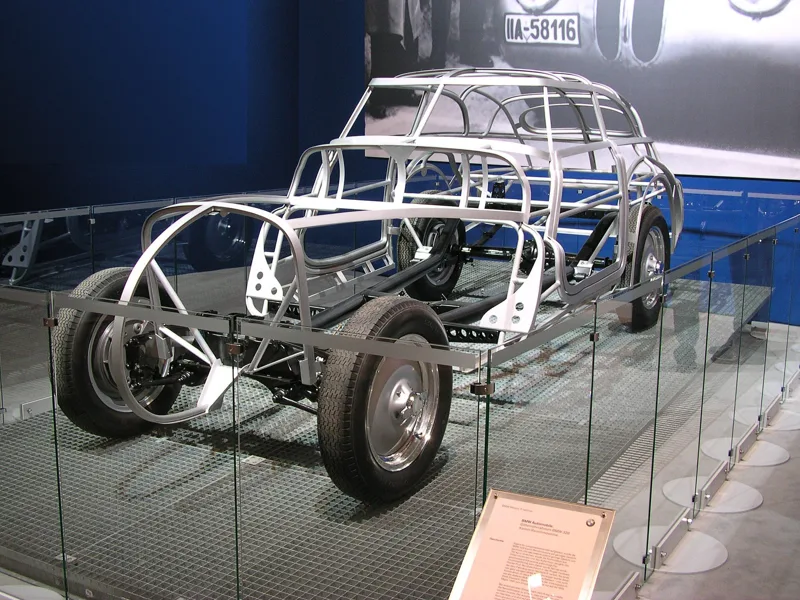
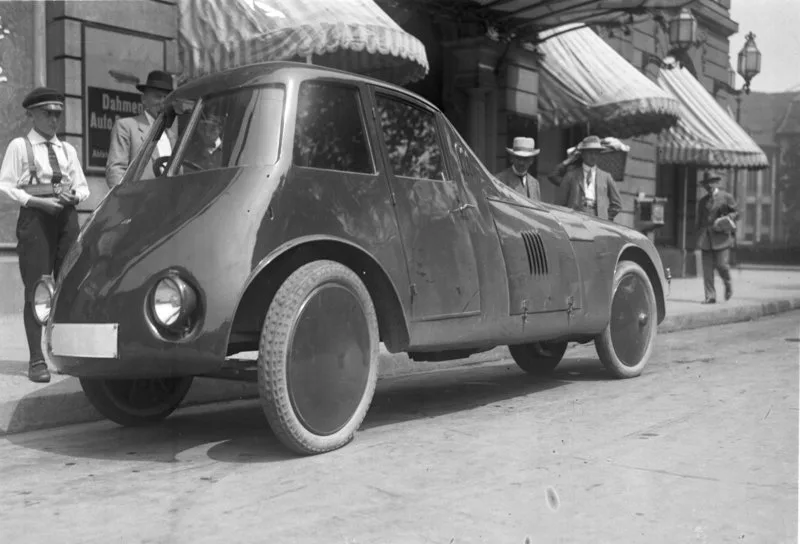
BMW had already tested aerodynamic cars with pontoon bodies and fastback tails. The K1 (1938/39) and K4 (1939/40) were both based on the larger BMW 335 presented in 1939. A racing saloon built on the sporty BMW 328 was prepared for the Mille Miglia of 1940. The streamlined outline with a shortened tail, the so-called Kamm tail, followed the work of Professor Wunibald Kamm of the FKFS in Stuttgart.
Those cars were not to everyone's taste. Their bulbous shapes, covered wheel arches and, at times, large fins on the roof did not suit popular expectations. The form was therefore reworked for series production, and the result became the 332. Much of the 326's engine, drivetrain, chassis and suspension was still considered current in 1939, and some parts were even regarded as exemplary, so BMW planned to carry them over with only minor changes.
What engine and running gear did the 332 use?
The 332 was to get a modified version of the 326's water-cooled six-cylinder four-stroke in-line engine. It displaced 1,971 cc (120.3 cu in) and had a long-stroke design with a 66 mm bore and a 96 mm stroke. Internally BMW called it engine type 326/4. The crankshaft ran in just four bearings, and a side camshaft driven by a duplex chain operated overhead valves through pushrods and rocker arms.
A dedicated oil cooler set the 332 apart. It gave the engine extra thermal reserves for sustained higher engine speeds and road speeds, which mattered on long autobahn runs. Power reached the rear wheels via a single-plate dry clutch and a four-speed manual.
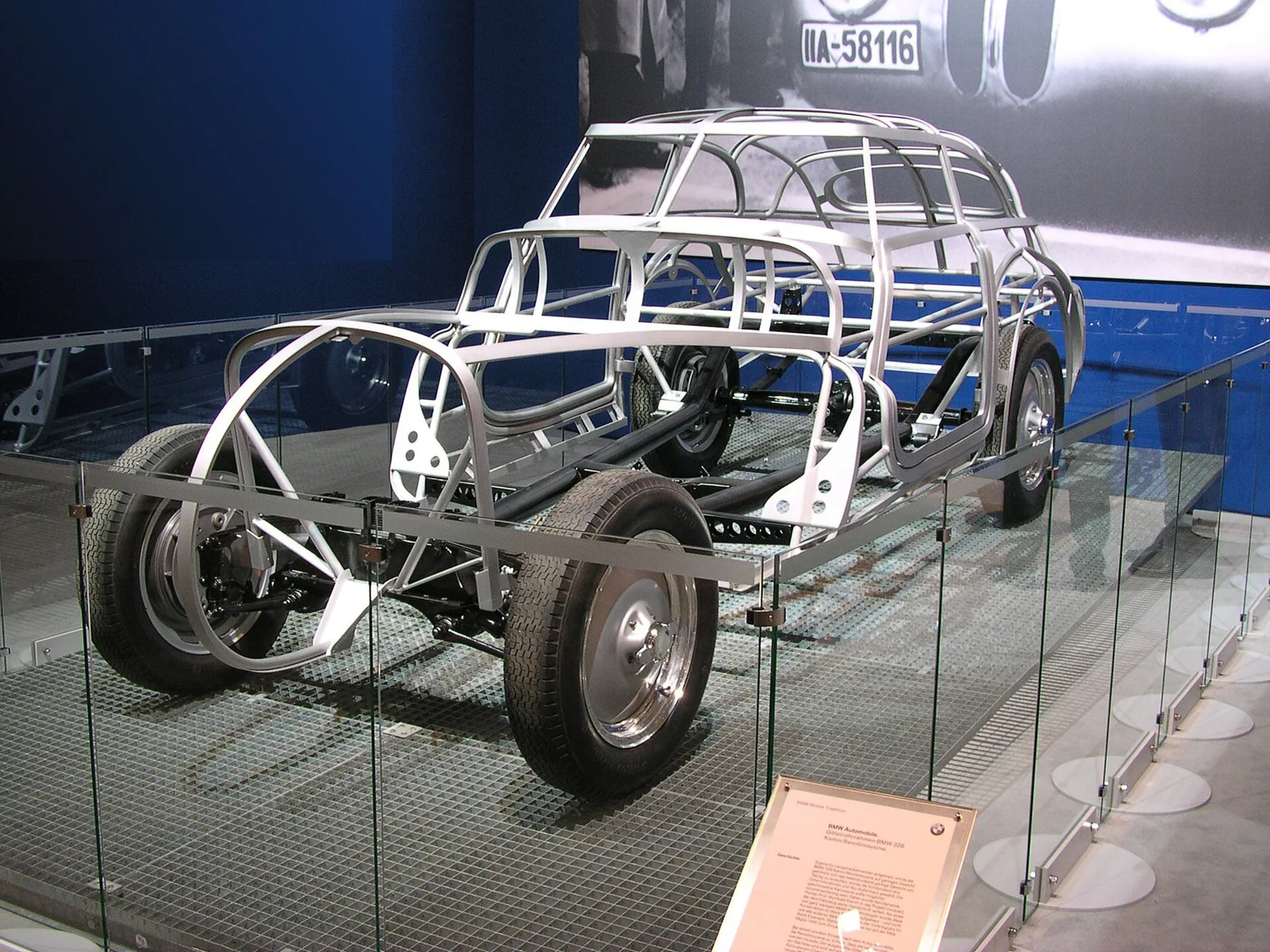
The front suspension used upper wishbones with a transverse leaf spring below, on a low-slung box-section frame. Track width was 1,300 mm (51.2 in) at the front and 1,400 mm (55.1 in) at the rear. The rear had a rigid axle with two longitudinal torsion bars, which was more comfortable than the leaf-sprung axles of the sportier 327, 328 and models 320 and 321. Steering was by rack and pinion, and all four wheels had hydraulically operated drum brakes.
What was new about the 332's controls?
The 332 was the first BMW to use a steering-column gear change in place of the usual floor-mounted lever. It was a detail that BMW later fitted as standard on its post-war 501 and 502, and until 1957 on the type 503 as well. The handbrake was cable-operated and acted on the rear wheels.
How did the three test cars differ?
All three pre-series cars shared the pontoon shape, but they were not identical. One had front and rear doors hinged at the rear, so-called suicide doors, with handles sitting just below the side windows above the shoulder line. The other version hinged only the front doors at the rear and used the usual B-pillar hinges for the rear doors, as the 326 and 335 had done. Its handles sat much lower on the rounded door skin.
The 332 body had large headlights fitted almost flush into the front, a split windscreen, fully covered rear wheels and a chrome trim strip along the lower edge. At the rear sat a split rear window and a boot lid with a cut-out for the spare wheel, which was mounted almost upright inside the boot.
What happened to the test cars?
Two of the three test cars were lost during or at the end of the Second World War and are considered missing. The third was recovered from the ruins of the BMW works in Munich's Milbertshofen district in 1945, badly damaged. It was rebuilt with a pre-war 2.0-litre six, rated 37 kW (50 PS; 49 hp), the type fitted to the 326. Until 1949 it served as a management car at BMW's Munich headquarters.
Its next owner was the racing driver Georg "Schorsch" Meier. According to one account, Willi Huber, once a BMW racing technician, broke up the final BMW 332 in his workshop on Frauenchiemsee island and used its chassis parts, engine and drivetrain components for one of his HH racers, built for Hermann Holbein. No BMW 332 survives. As of February 2010, no BMW project to build a replica had become known, unlike some prestigious 328 racing versions.
Why did the 332 matter to BMW after the war?
The war hit BMW hard. The Eisenach works, which had housed pre-war car production, lay in the Soviet occupation zone. The two Munich works, which had mainly built motorcycles before the war, were largely destroyed by bombs, requisitioned for a time and partly dismantled. To meet everyday needs, BMW first made cooking pots, building fittings and bakery machines.
Passenger cars were on the agenda as well, with pre-war designs of the sort rival makers were building. The modern 332 would have suited that role. In the first post-war years, however, BMW could not raise the production halls or buy the machinery it needed.
Did the 332 influence later BMW designs?
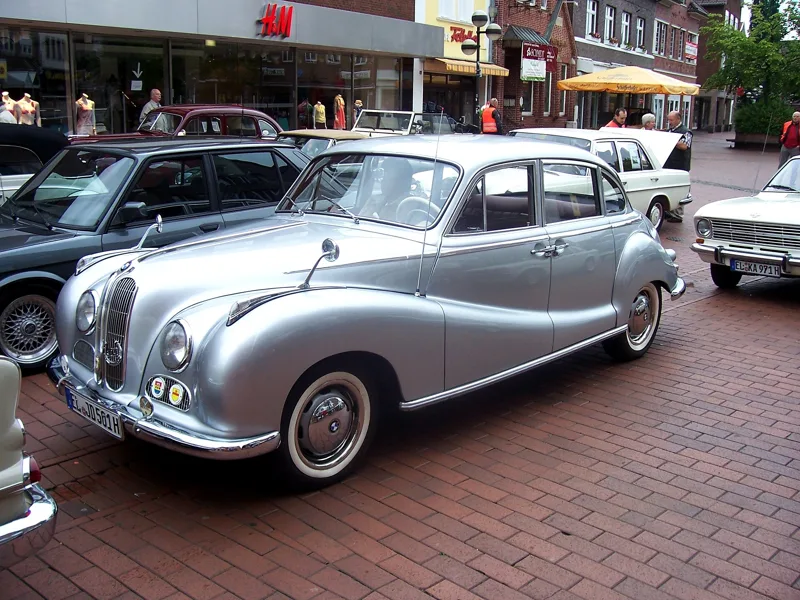
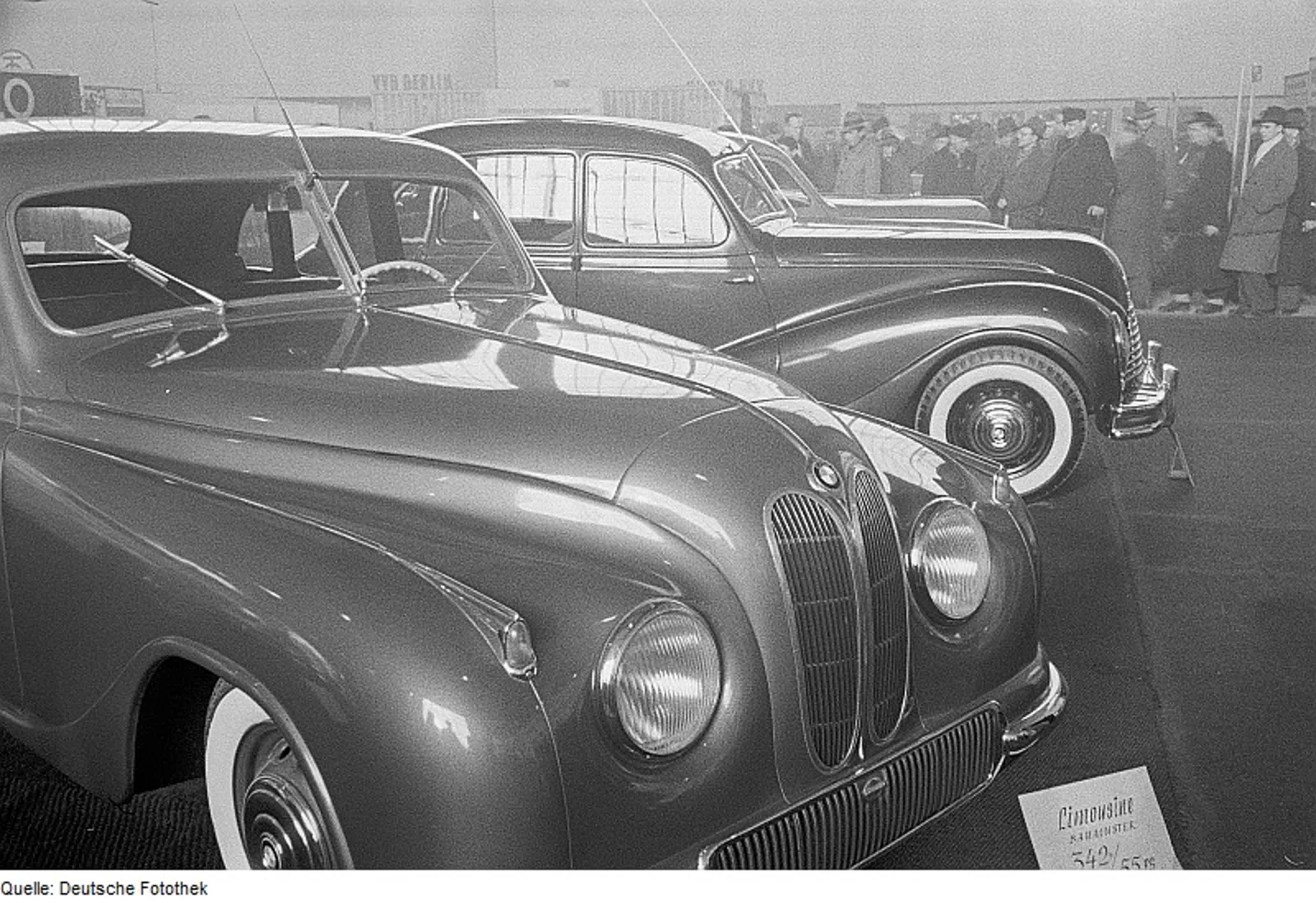
Yes, in a few details. The striking front styling around the headlights, the kidney grille and the transition into the bonnet reappeared on the 1950s model 501/502. That car looked more classic, with moulded wings in the style of contemporary Austin models, and it earned the nickname "Baroque angel".
The design also travelled east. In 1951 the Soviet joint-stock company Avtovelo unveiled its prototype 342, which rested on the pre-war BMW 326 and the BMW 340. The front end was largely the 332's, though Avtovelo added an extra lower cooling air intake and chrome indicators on the front wings.
Borgward's Hansa 2400 in its version up to 1955, and the Standard Vanguard in Phase I, also bore a very similar design.
Was the BMW 332 name used again?
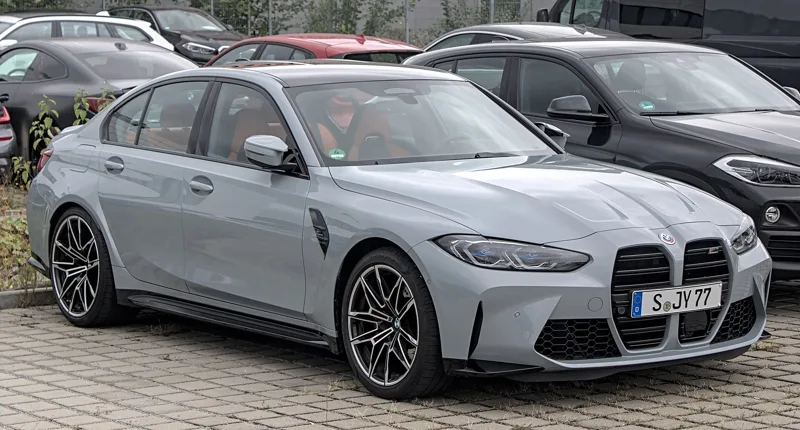
Only unofficially. From 1995 to 1999 the designation appeared on a special export version of the BMW M3 (E36) for North America. That car had a 3.2-litre six-cylinder in-line engine (type S52USB32) producing 243 PS (179 kW; 240 hp) and 320 Nm (236 lb ft) of torque, with a five-speed manual gearbox. The regular M3 engine produced 321 PS (236 kW; 317 hp) and 350 Nm (258 lb ft).
What were the BMW 332's specifications?
| Specification | Detail |
|---|---|
| Body | Four-door upper-class saloon, pontoon body, fastback tail |
| Engine | Six-cylinder water-cooled in-line, type 326/4 |
| Displacement | 1,971 cc (120.3 cu in) |
| Bore and stroke | 66 mm and 96 mm |
| Valve gear | Overhead valves, pushrods and rocker arms |
| Transmission | Four-speed manual, single-plate dry clutch |
| Track, front | 1,300 mm (51.2 in) |
| Track, rear | 1,400 mm (55.1 in) |
| Rear axle | Rigid, two longitudinal torsion bars |
| Brakes | Hydraulic drum brakes, all four wheels |
| Pre-series cars | Three built; none survives |