A four-door experimental saloon on the BMW 335 chassis, shaped in Stuttgart to a cw value of 0.23 and never built for sale.
The BMW K1 was an experimental four-door saloon built in 1938/39 on the BMW 335 chassis. Professor Wunibald Kamm's team at the Stuttgart research institute FKFS developed it, and its body reached a cw value of 0.23. It had a 3,485 cc six-cylinder and was never put into series production.
The BMW K1 was a four-door experimental saloon that BMW and the Stuttgart research institute FKFS built in 1938/39 on the BMW 335 chassis. Its body was shaped to a cw value of 0.23, very low for the period, when most saloons sat between 0.5 and 0.6. It was never intended as a production car, yet the lessons from it fed into planned BMW models for 1940 and 1941.
Why did BMW build a streamlined experimental saloon?
Cars that passed 100 km/h had to overcome growing air resistance, and Germany's autobahns were expanding fast. A slipperier body promised both higher top speeds and lower fuel use, so by the end of the 1930s Germany needed more aerodynamic bodies.
Aerodynamics had counted for little in road car design before the 1930s, and only a handful of record and racing machines had taken it seriously. Stronger, more durable engines and better chassis changed the picture, because ordinary passenger cars could now reach speeds at which drag became the main obstacle.
Several engineers had first learned their trade on gliders, sailplanes, powered aircraft and airships. Edmund Rumpler and Paul Jaray applied those lessons to cars from about 1921, and the Romanian Aurel Persu from 1922. Gottlob Espenlaub's early automobiles from 1928 are now largely forgotten. The better-known names of the 1930s included Ferdinand Porsche, Hans Ledwinka at Tatra and Gabriel Voisin in France, alongside Kamm, Reinhard von Koenig-Fachsenfeld and Karl Schlor.
Built to test an idea rather than to sell, the K1 showed how far a saloon body could cut drag.
How did the K1 get its shape?
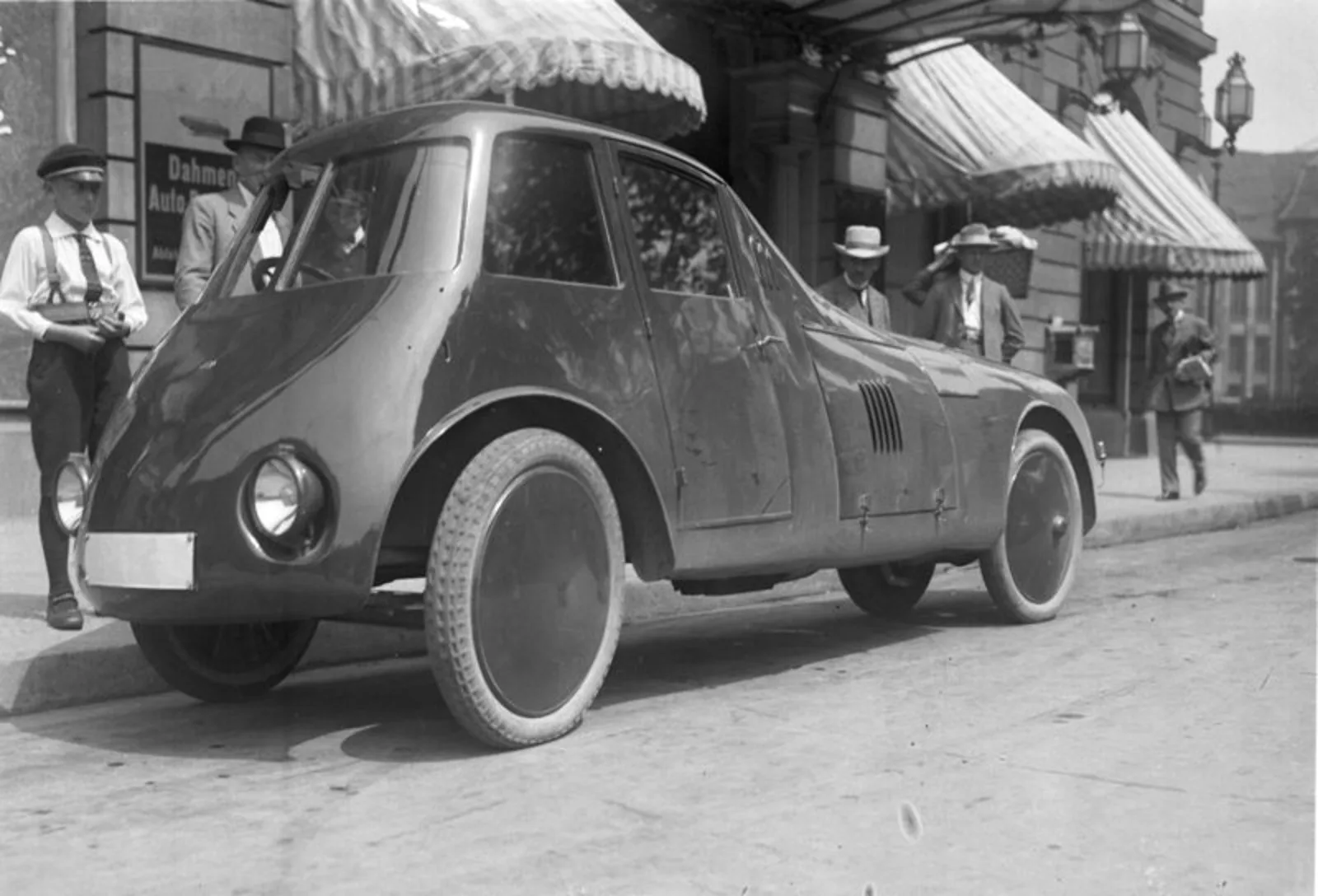
The K1 combined a full pontoon body with a wing-section profile, a rounded and deeply drawn front, and a long fastback that ended in a nearly straight cut-off tail. Smooth underbody panels and fully faired wheel openings completed the package. Together these details produced a cw value of 0.23.
The cut-off tail did not start with Kamm alone. Rumpler and Jaray had first chosen tall, narrow bodies that channelled the air mainly along the sides, and that proved less than ideal. Jaray's drawings already hinted at the wing profile, and from that idea came the cut-off form. Kamm had set out the principle in lectures in 1933, yet he held no patent on it and had not yet built a car around it. Koenig-Fachsenfeld also asserted that the form was his discovery, or at least his joint work.
The first vehicle using this principle was the E-Wagen, finished in 1938 by Emil Everling, who taught at the Berlin-Charlottenburg technical college. Voll and Ruhrbeck of Berlin built it. It reached a cw value of 0.31. The K1 followed in the same year with 0.23, a figure that is still outstanding by modern standards.
The front windscreen was made of four segments with rounded sides, because curved glass was still unusual. The body panels were smooth, the windows sat flush, and the rear doors had no outside handles. An oval, upright cooling opening replaced the BMW kidney grille that the marque had used since 1933.
The doors opened in opposite directions. Front doors hung from the back, the so-called suicide doors, while the rear doors hung from the front. Both sets of hinges sat on the B-pillar. Two tall vertical fins were fitted to the roof for a while to guide the airflow, but in practice they worsened stability in crosswinds and made the car less steady on a straight road.
The shape was pursued without regard to contemporary taste. The K1 therefore had no chrome trim, no ornament and no bumpers, even though bumpers could have prevented everyday damage to the body.
Where was the K1 developed and who built the body?
The car was developed not at BMW's main works in Munich or at the Eisenach plant, the former Dixi works that handled car production at the time, but by Professor Wunibald Kamm, whose FKFS group worked in Stuttgart. Walter Vetter in Fellbach built the body to Kamm's plans. Vetter was known at the time for bodies on Mercedes-Benz chassis.
On 1 April 1930 Kamm took up a professorship in automotive engineering and vehicle engines at Stuttgart. The same year he founded the FKFS as a research institute that was not aimed at making a profit. Through it he could run projects with industry outside the rigid structures of the university, especially with Daimler-Benz and BMW, both based in southern Germany.
State-backed research into streamlined cars began in 1935. From 1937 the funds that flowed to the FKFS under Kamm came from the Reich Research Council, which was founded in part for this purpose.
The K1 was the first drivable product of the FKFS and Kamm's work. Its chassis was a pre-series 335 unit that BMW handed over in 1938, and the car carried several engine and running-gear innovations. Three more saloons followed between 1939 and 1940: the K2 and K3, built on the Mercedes-Benz 170 V, and the K4, which like the K1 used the BMW 335 platform.
What engine and performance did the K1 have?
Under the bonnet sat the freshly designed six-cylinder from the BMW 335. Its 3,485 cc (212.7 cu in) came from an 82 mm bore and a 110 mm stroke. Output was 66 kW (90 PS; 89 hp) at 3,500 rpm, and the car reached 183 km/h (114 mph).
| Specification | BMW K1 |
|---|---|
| Engine | 3,485 cc (212.7 cu in) six-cylinder in-line, overhead valves |
| Bore and stroke | 82 mm x 110 mm |
| Compression ratio | 1:5.8 |
| Power | 66 kW (90 PS; 89 hp) at 3,500 rpm |
| Gearbox | Manual four-speed, rear-wheel drive |
| Wheelbase | 2,984 mm (117.5 in) |
| Track, front and rear | 1,306 mm and 1,404 mm |
| Weight | About 1,500 kg (3,307 lb) |
| Top speed | 183 km/h (114 mph) |
| Fuel use at 100 km/h | 7.6 L/100 km (37.2 mpg-imp; 30.9 mpg-US) |
Only four main bearings supported the crankshaft. A side camshaft operated the overhead valves through pushrods and rockers. Novotex helical gears drove that camshaft rather than a duplex chain, and two twin-barrel carburettors supplied the mixture.
The FKFS and BMW also built in a lean-mixture setting for constant engine speeds, and a special overdrive let the engine turn more slowly at higher speeds. Test runs produced consumption figures that were excellent for the era. The car used 7.6 L/100 km (37.2 mpg-imp; 30.9 mpg-US) at a constant 100 km/h. Averaging 120 km/h, it needed 10 L/100 km (28.2 mpg-imp; 23.5 mpg-US), and at 140 km/h it burned 12 L/100 km (23.5 mpg-imp; 19.6 mpg-US).
Producing the same 66 kW (90 PS), the K1 reached 183 km/h (114 mph), while the production BMW 335 managed 145 km/h (90 mph). Tyre pressure could also be raised from the dashboard while driving, which lowered rolling resistance and so cut fuel use on the new autobahns, especially at high speed.
Chassis, weight and interior
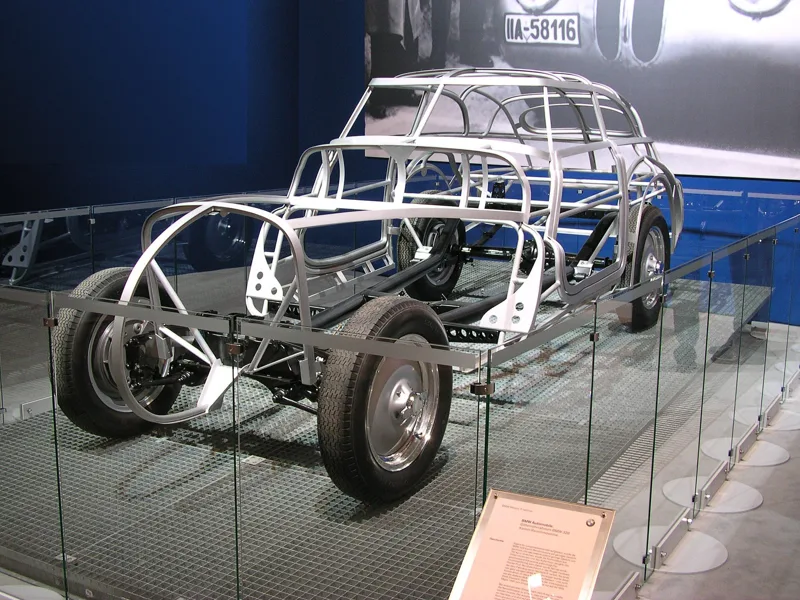
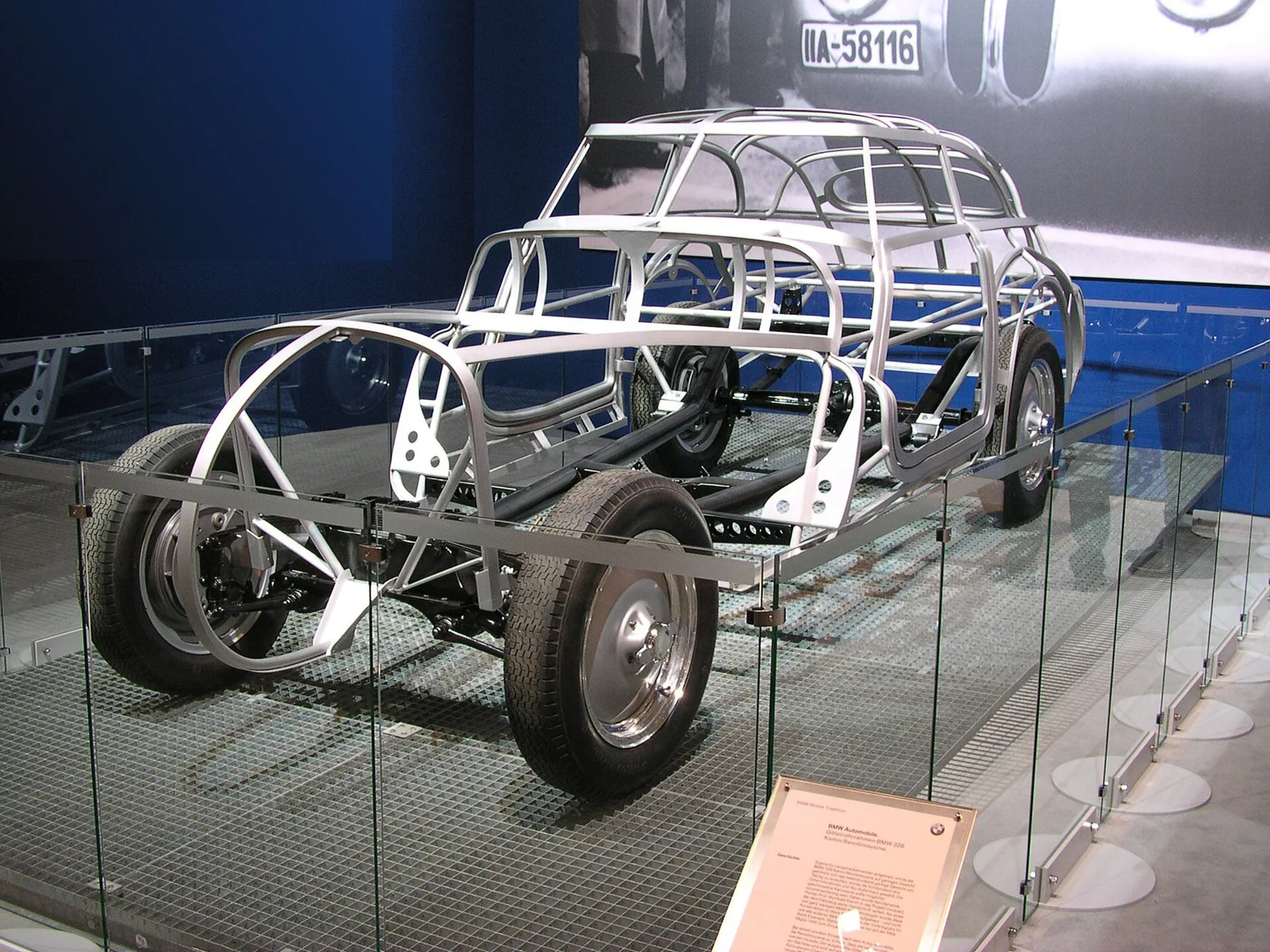
BMW had derived the K1's chassis from the 326 and then reinforced it and stretched it by 234 mm, to a wheelbase of 2,984 mm (117.5 in). The frame was a deep-bed box, with upper wishbones and a transverse spring below at the front. The track measured 1,306 mm at the front and 1,404 mm at the rear.
The rear axle was rigid, held by two longitudinal torsion-bar springs. This was considered more comfortable, though less sporty, than the half-elliptic leaf springs of the 327 and 328, but it suited the K1's role as a comfortable touring saloon better. Steering was rack and pinion. Hydraulic drum brakes served all four corners, and a cable ran the handbrake to the rear wheels.
Interior room was generous, thanks to the broad full pontoon body without flared wings or running boards, and to the fastback. A large boot could be reached from outside. The equipment was lavish and comfortable, meant for a long-distance touring saloon. The result weighed about 1,500 kg (3,307 lb), heavier than the standard 335 because of its wider body and richer fittings.
Why did the K1 remain a one-off?
The K1 was an experimental car from the start and was never designed for series production. Test drives in 1939 and 1940 confirmed that the body and technical ideas worked well, but the car's appearance drew harsh criticism from the public, so it stayed a single example.
Extended test runs took place in 1939 and 1940, and for a time two large vertical fins sat on the roof. The full pontoon body, the unusual tail, the fully covered wheels and the roof fins set the car apart from the production models of its day, and public reaction was often harsh.
Today the K1 is considered lost. Its trail ends in the war years or as the war closed. Some accounts say it was the only Kamm-Wagen to outlast the war and is held by the Automobilmuseum Schloss Langenburg. That is not correct. The vehicle in that museum is the smaller, lighter K3, built on the Mercedes-Benz 170 V.
Did the K1 influence later BMW models?
In part. BMW's experience with the K1 and K4 fed the planned BMW 332, the intended successor to the 326 for 1940, and the BMW 337, a luxury model planned for 1941 above the 335. Kamm's own K2, K3 and K4 carried the same lessons forward, and BMW kept a fairly conservative design until the mid-1990s.
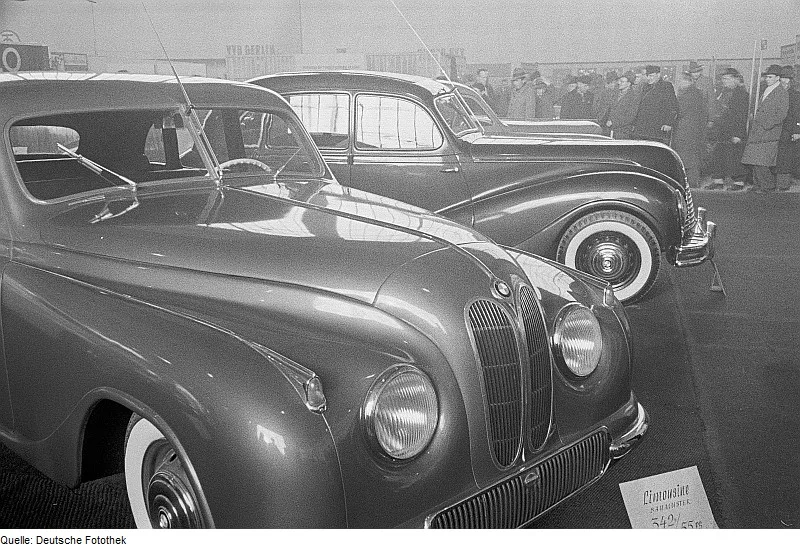
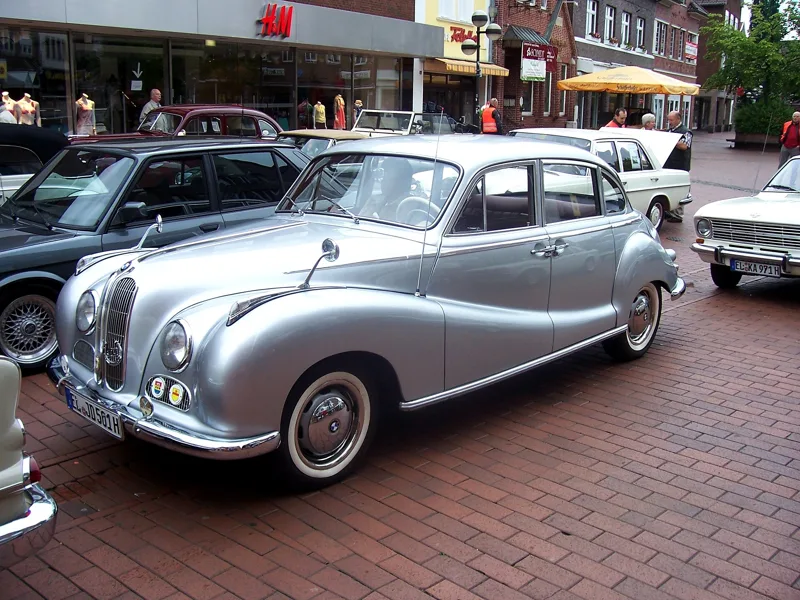
Some design traits did resurface. The pontoon idea and streamlined lines appeared again in the BMW 501 and 502 of the 1950s, although those cars carried sculpted wings in the manner of the period's Austin and already looked classic, earning the nickname Baroque angel. The Borgward Hansa 2400, produced between 1952 and 1955, had a fastback body that looked quite similar to the K1.
BMW returned to the big fastback idea only in 2007, with the BMW Concept CS. It reached production with the X6 and the 5 Series Gran Turismo, launched in 2008 and 2009 respectively. The Vision Efficient Dynamics concept of 2009 explored an energy-efficient, large, multi-seat model along similar lines.
How was the K1 received by the public?
Public reaction to the car's appearance was in places very harsh, and the design never led to production, which is why the K1 stayed unique. The advanced body and the technical innovations, however, proved functional and highly efficient in the 1939 and 1940 test runs.
Covered wheels, an unusual tail and roof fins fitted at times gave the K1 an outline that few contemporary cars shared, and the criticism of that outline was sometimes sharp.
Kamm also provided the template for the BMW 328 racing saloon, a car that later had success in motor racing, particularly at the Mille Miglia. Replicas have been built of some prestigious 328 racing versions. As of March 2010, however, no BMW effort to build a replica of the K1 had become known, and BMW had not shown anything as radical and aerodynamically efficient since.
The name also appears on a motorcycle. The 1988 BMW K1 was an innovative sport tourer, with a shrouded front wheel, full fairing and, for an extra charge, one of the first anti-lock brake systems on two-wheelers. Its name came from the BMW K series of motorcycles, which used in-line engines instead of the traditional boxers. Whether the motorcycle name was chosen with the car in mind is not recorded.