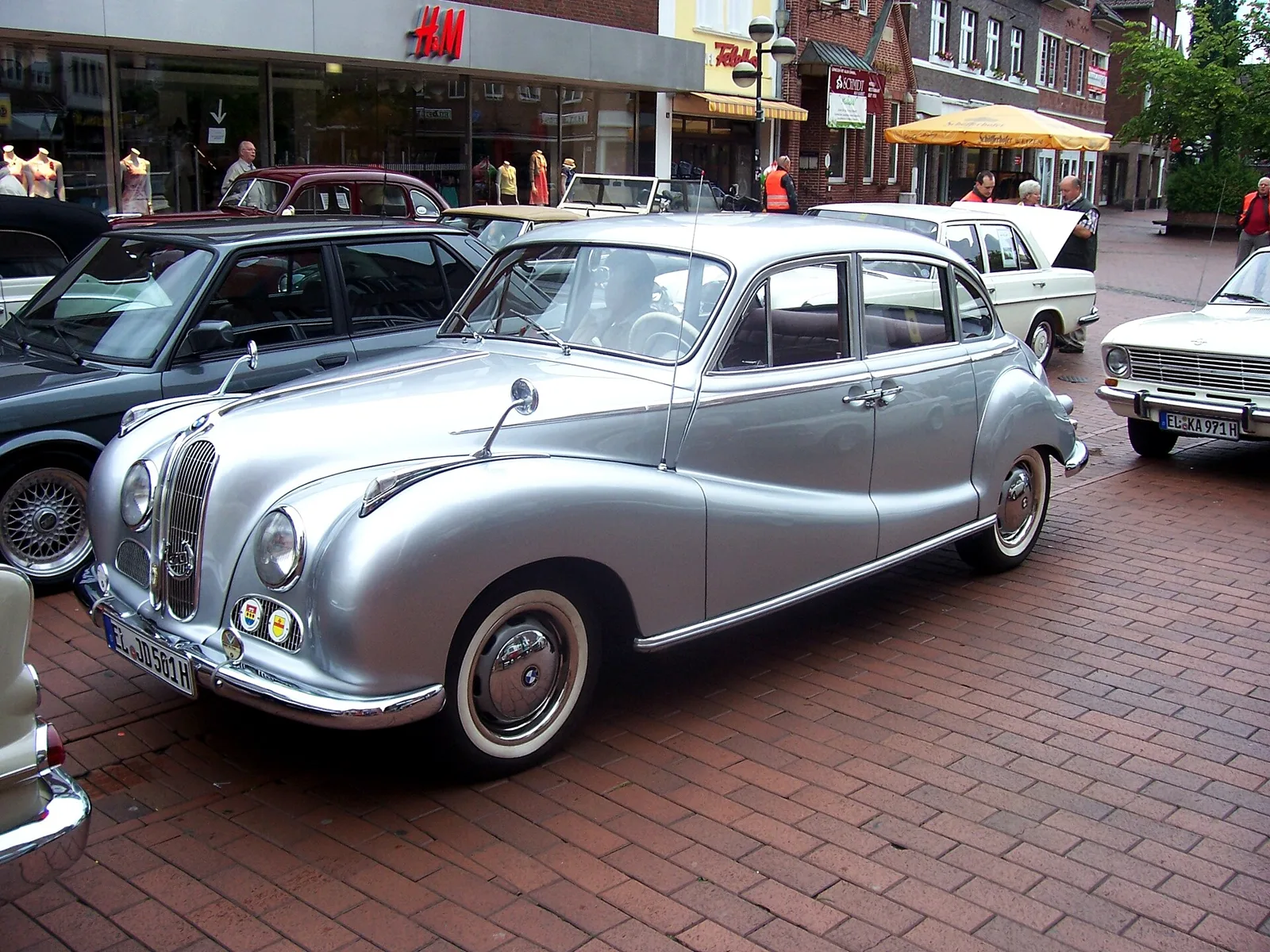
BMW's first postwar car, a luxury saloon with a six-cylinder engine and a V8 sister that made Germany's first postwar V8 road car.
The BMW 501 was a luxury saloon built from 1952 to 1958 and the first BMW car made after the Second World War. Its V8 derivative, the 502, followed in 1954 and sold in small numbers.
The BMW 501 was a luxury saloon that BMW built from 1952 to 1958. It was the first BMW model made and sold after the Second World War, and the first BMW car actually built in Bavaria. Its V8 derivative, the 502, was Germany's first postwar car with that engine layout.
What was the BMW 501?
The 501 was a four-door luxury car that was first shown at the first Frankfurt Motor Show in 1951. It went on sale in limited numbers from late 1952. The 501 and its derivatives were nicknamed Baroque Angels by the German public for their graceful but dated styling.
While the 501 and 502 model numbers ended in 1958, the same platform and body continued in variations until 1963.
BMW's first postwar car was an expensive luxury saloon whose V8 sister took the engineering lead, even though sales never followed.
How did BMW restart after the war?
BMW's satellite factory at Eisenach fell into the Soviet zone, which became the Communist GDR. Manufacture of pre-war BMW models restarted there in late 1945 under a Soviet-created entity called Awtowelo, which sold its cars with BMW badges even though BMW AG had nothing to do with them.
In Bavaria, BMW AG restarted on a much smaller scale, making pots and pans before moving to household hardware and bicycles. With American permission and bank funding, it began building motorcycles in 1948.
To stop Awtowelo's trademark infringement, the Eisenach branch was legally dissolved in September 1949. The Soviet-created firm renamed itself EMW in 1952, kept the tooling and equipment, and changed the blue in the BMW logo to red.
Why did BMW consider building other makers' cars?
Kurt Donath, the technical director and general manager of the Milbertshofen factory, approached manufacturers including Ford and Simca about building their vehicles under licence. He hoped to buy old products along with the tooling and licence.
While Donath searched, chief engineer Alfred Boning developed a small economy car, the BMW 331, powered by a 600 cc motorcycle engine with a four-speed gearbox and a live rear axle. Its body by Peter Szymanowski looked like a miniature BMW 327.
Why was the 331 rejected for production?
Sales director Hanns Grewenig vetoed the 331. A banker and former Opel plant manager, he believed that BMW's small production capacity suited luxury cars with high profit margins, like the cars the company had built before the war.
Grewenig therefore asked Boning and his team to create the car that became the 501.
How was the 501 engineered?
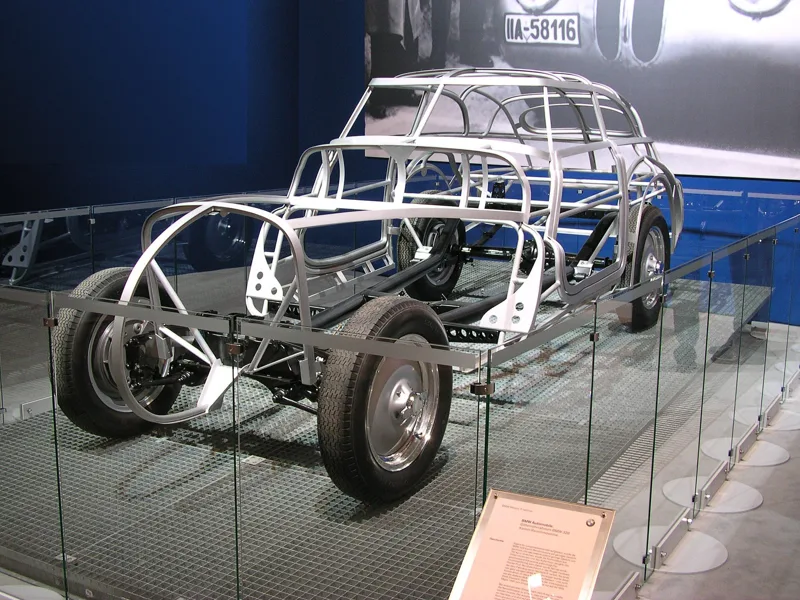
The 501 was an all-new platform with a perimeter frame. It used double A-arm front suspension with torsion bar springs, and a live rear axle that was also sprung by torsion bars. The steering resembled a rack and pinion system, except that the rack was semi-circular rather than straight.
The engine was the 2-litre straight-six OHV M337, derived from the BMW M78 that powered the pre-war 326. The four-speed gearbox was a separate shaft-driven unit mounted between the crossmembers, rather than bolted to the engine.
The remote gearbox made the shifter action vague because of its complicated linkage to the column-mounted lever, but it gave front passengers more legroom.
How did the 501 body come about?
Szymanowski's in-house team drew the body. Once the prototype had been seen, the management asked Pininfarina for a competing design. The Pininfarina design was thought to be too close to its own Alfa Romeo 1900 saloon, so BMW kept Szymanowski's shape.
The steel body turned out far heavier than Szymanowski had calculated. The finished car had a dry weight of 1,430 kilograms (3,150 lb), which hurt performance. Its top speed was 135 km/h (84 mph), and it took 27 seconds to reach 100 km/h (62 mph), an unfavourable comparison with the six-cylinder Mercedes-Benz 220.
Passive safety was a clear priority. The chassis gave above-average side-impact protection, the steering column was unusually short with the steering gear set well back, and the fuel tank sat above the rear axle in a protected place to reduce fire risk in a crash.
How did the public react to the 501?
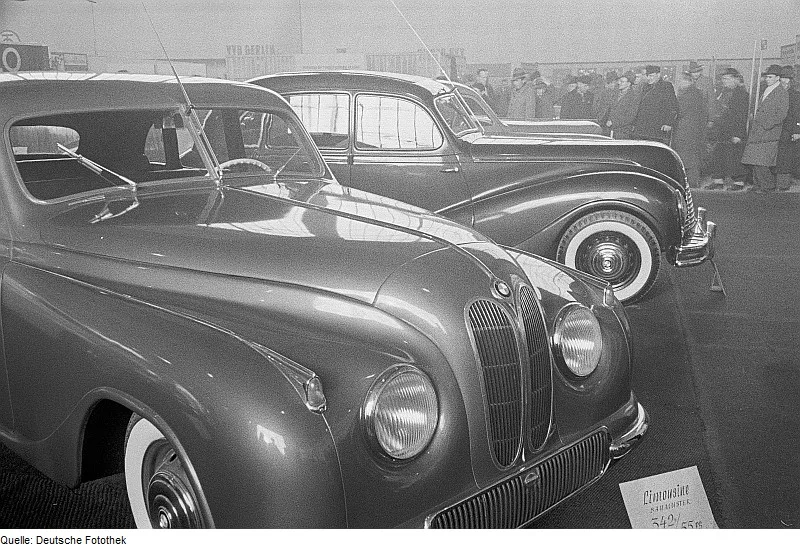
The 501 was shown to the public in April 1951 at Frankfurt, alongside the cheaper and production-ready Mercedes-Benz 220. The 501 made an impression with its solid engineering and its extravagance, and its curved, flowing style was reminiscent of the Baroque era.
Its list price passed fifteen thousand Deutsche Mark, about four times the typical annual income in Germany at the time.
When did production start?
Development problems delayed production until late 1952, and BMW still lacked the equipment to press body panels in-house. The first 2,045 four-door saloon bodies were built by Karosserie Baur in Stuttgart and shipped to BMW's factory in Munich for assembly.
The thousandth 501 was completed on 1 September 1953. Derivatives built at BMW were four-door saloons, while coupe and convertible versions were offered as custom orders from Baur or Autenrieth.
How did the 501 perform on the road?
A road test of the 501 in March 1953 by the magazine Auto- und Motorrad-Welt reported better than average wind resistance, good ride quality and an effective heating system. Fuel consumption was given as 10.3 L/100 km (27 mpg-imp; 23 mpg-US).
How did the 501 change in its first years?
The 501A arrived in 1954 as a replacement with similar trim and equipment, priced at DM14,180, more than 800 Deutsche Mark below the original. The 501B was a decontented version that cost DM500 less than the 501A, and both used a revised M337 engine.
In spring 1955 the 501A and 501B gave way to the 501/3, which had an updated M337 engine. The 501/3 appeared alongside a 501 V8 that used a detuned version of the 2.6-litre V8 introduced in the 502 the year before.
Why was the V8 developed?
Before building the first prototype of the 501, chief engineer Alfred Boning had calculated the car's mass and realised that the six-cylinder would be barely adequate. He proposed a larger engine for later versions, and management accepted the idea.
Boning began a V8 with a general layout similar to the 303-cubic-inch overhead-valve Oldsmobile Rocket V8 of the period. The BMW unit used an aluminium block with cast-iron cylinder liners, and it was much smaller, starting with a 74 mm bore and 75 mm stroke for 2,580 cc (157 cu in). Fritz Fiedler completed the development after replacing Boning as chief engineer in 1952.
What was the BMW 502?
The 502 was the V8-engined saloon introduced at the 1954 Geneva Motor Show. It shared the 501's chassis and much of its body, but its light V8 produced 100 hp (75 kW) through a single two-barrel Solex carburettor, which made it considerably faster.
The published top speed of 160 km/h (99 mph) was well above that of the first six-cylinder Ponton Mercedes launched that year. At its introduction the 502 was reportedly Germany's fastest production passenger sedan.
Why did the 502 sell so few cars?
The 502 was acclaimed as Germany's first postwar V8 car, but at DM17,800 it was expensive. Only 190 were sold in its first year, and the high price limited its appeal.
The 502 was distinguished from the 501 by extra chrome trim and more lavish interior fittings. Fog lights and individual front seats became standard, and a wraparound rear window arrived with a mild restyle in 1955.
What came after the 2.6 models?
In 1958 the 501 V8 was renamed the BMW 2.6, and the 502 became the 2.6 Luxus. Power steering became an option in 1959, and front disc brakes were added in 1960, before the model designations changed again.
In 1961 the range became the 2600 and 2600L. The 2600L was tuned to 110 hp (82 kW), and production ended in 1963.
How did the 3.2 models develop?
A further development of the V8 appeared at the 1955 Frankfurt Motor Show with an 82 mm bore and a capacity of 3,168 cc (193.3 cu in). It debuted in four cars: the 507 two-seat gran turismo, the 503 2+2 gran turismo, the 505 limousine prototype and the 3.2, a development of the 502 identified only by its displacement.
The 3.2 engine had a 7.2:1 compression ratio, up from 7.0:1, and produced 120 hp (89 kW). The final drive was raised from 4.225:1 to 3.89:1 to limit the fuel consumption of the larger engine. The 3.2 Super followed in 1957 with 140 hp (100 kW).
What were the 3200L and 3200S?
In 1961 the 3.2 and 3.2 Super were replaced by the 3200L and 3200S. The 3200L had a single carburettor engine producing 140 hp (100 kW), while the 3200S had two carburettors and produced 160 hp (120 kW) at 5600 rpm.
A report on a 3.2-litre BMW saloon estimated the consumption of the 502 at 15 L/100 km (19 mpg-imp; 16 mpg-US). Production of the family ended in 1963.
What were the 503 and 507?
The 503 and 507 were grand touring cars. The 503 was a four-seat coupe or convertible, and the 507 a two-seat convertible. They were conceived by US importer Max Hoffman, styled by German-American designer Albrecht von Goertz and engineered by Fritz Fiedler.
Hoffman expected to sell them for about five thousand dollars in the United States, and to move thousands of them. Instead they were priced at about ten thousand dollars, and only 412 of the 503 and 252 of the 507 were sold.
Why did the 505 never reach production?
The 505 limousine was styled by Giovanni Michelotti and shown at Frankfurt in 1955. It was 5.1 metres long, with a wheelbase of about 3.1 metres. Chancellor Konrad Adenauer tried it, and reportedly knocked his hat off on entering. He kept using a Mercedes-Benz 300, which earned the nickname Adenauer Mercedes.
The 505 never went into series production, and only two prototypes were built. It was briefly used at a wedding on 20 May 2023.
What was the 3200 CS?
The 3200 CS was a coupe built from 1961 to 1965. Its body was designed and built by Bertone and shipped to Munich, where it was fitted to a 3200S chassis. It was the last variant of the 501 family that BMW manufactured.
Why were the 501 patrol cars popular with police?
During the 1950s and 1960s the 501 radio patrol cars were widely used by police in Bavaria, including the Bavarian State Police and Munich City Police. With a top speed of 145 km/h (90 mph) by the standards of the time, the car gave police an advantage over most criminals, who did not have easy access to faster machines.
The Munich force used seventeen 501 patrol cars for about 10 years and about 130,000 service kilometers. The last two police cars were delivered to Amberg in 1965, after production had ended, and were retired by 1971 because of rust. A 501 patrol car also featured in the early 1960s police drama Funkstreife Isar 12.
How did the 501 affect BMW's finances?
The 501 and 502 were commercially unsuccessful, and their high development and production costs added to BMW's financial difficulties. By 1959 the company faced a takeover by Daimler-Benz, which was prevented by its shareholders and by the investment of Herbert Quandt.
The 501 and 502 lost money, but their V8 engineering outlived the commercial failure. The V8 went on to power the 3.2 family and the 3200 range that followed.